
The Race to AGI: Understanding the 2026 Landscape
Forget smarter chatbots or better image generators. The real prize in artificial intelligence in 2026 is something much bigger: Artificial General Intelligence, or AGI. This is the kind of AI that can think, learn, and solve problems across many different tasks, just like a human can. It is a step beyond the narrow AI tools we use today.
You have probably seen the headlines. Companies like OpenAI, Google DeepMind, and Anthropic are all racing toward this goal. In fact, many leaders in the field now predict we could see working AGI systems sooner than most people expect. One widely discussed prediction from Elon Musk suggests that AGI could arrive as early as 2026. This has sparked serious conversations about what AGI actually means and whether we are ready for it.
So what is artificial general intelligence? Unlike today’s AI, which can only do one job well, AGI would be able to handle anything a human can handle. It could write a book, diagnose a disease, design a bridge, and then have a conversation about all three. That is a huge leap.
But here is the challenge for decision-makers like you. The information coming out about AGI is overwhelming. Every week brings a new research paper, a new roadmap, or a new warning. It is hard to separate real progress from hype. That is exactly why this article exists. Our goal is to cut through the noise and give you a clear picture of the 2026 landscape.
We will look at how OpenAI and its rivals define AGI. We will explore the big debates around scaling up AI models versus making them reason better. And we will cover the safety measures that matter. Whether you are an executive, an investor, or just someone who wants to stay informed, understanding these trends is critical for planning your next move.

The future of AI is moving fast. But with the right context, you can track the real breakthroughs and avoid the distractions. Let us start with a simple question: What does AGI actually look like in 2026?
Defining AGI: What It Means in 2026 and Why It Matters
So what does AGI actually look like in 2026? The definition has shifted a lot in the last few years. It is not just about a machine that can match a human at a single game or skill anymore. Today, artificial general intelligence is understood as a system that can learn and adapt across many different domains all by itself. This is the true "ai vs human" benchmark.
Think of it this way. You can train specialized AI to do one job incredibly well, like analyzing medical scans. But AGI would be able to do that, then write a marketing plan, and then debug some code, all without needing to be retrained from scratch. Leaders like Elon Musk predict we could see working AGI systems as early as this year. This is why the idea of "ai without restrictions" is so exciting and a little scary.
To track progress toward this goal, researchers rely on specific tests. One of the most famous is the ARC-AGI challenge, which tests whether an AI can solve puzzles it has never seen before. OpenAI also uses its own internal evaluation suite to measure if its models are getting closer to this general intelligence. This is very different from the narrow AI tools we use today. For example, while 81 percent of radiology departments use AI in medical imaging in 2026 to spot diseases, that AI cannot do anything else. AGI is a different beast entirely.
Why does this matter to you right now? The economic impact of AGI is projected to hit trillions of dollars in productivity gains.

Companies like OpenAI, DeepMind, and Anthropic are all racing to get there first. Understanding how these different groups define progress is crucial for making smart business moves.
Defining AGI is the first step. Staying up to date on it is the second. If you want clear insights on how these definitions are shaping business, you need reliable daily updates. [The Deep View Newsletter] cuts through the technical jargon to give you what really matters.
Key Benchmarks for AGI Progress
So how do we track progress toward artificial general intelligence openai in 2026? Researchers rely on specific tests to see if machines are truly learning to think on their own.
The Abstraction and Reasoning Corpus (ARC) is still the gold standard here. It tests whether an AI can solve puzzles it has never seen before. Leaders like Elon Musk watch these benchmarks closely to predict when we might hit true AGI.
A newer benchmark is also gaining traction. The General Intelligence Task (GIT) comes from a partnership between industry and academia. It measures how well an AI can take what it learned in one area and apply it to a completely different one. This is a direct measure of ai without restrictions.
These benchmarks matter because they separate real breakthroughs from hype. For instance, while today’s artificial general intelligence openai efforts aim for broad skills, current tools like AI image generators are still narrow in focus.
Tracking these changes can feel like a full time job. The Deep View Newsletter makes it easy by delivering clear, daily updates on what actually matters for the future of ai.
The Economic Stakes of General Intelligence
The economic stakes behind artificial general intelligence openai are enormous. Analysts at Goldman Sachs and McKinsey predict AGI could boost global GDP by up to $15 trillion each year by 2030. That is bigger than China’s entire economy today.
Early adopters in finance, healthcare, and logistics are already investing heavily. In healthcare, AI is already changing how doctors read scans. Over 80% of radiology departments now use AI tools for medical imaging. Companies like OpenAI, DeepMind, and Anthropic are locked in an intense arms race, as Qver Labs reports. This competition will shape the future of ai.
With so much money at stake, staying informed is key. The Deep View Newsletter delivers daily updates on who is winning and where the money flows.
Scaling Laws Under Scrutiny: Are Bigger Models Enough?
For years, the AI world believed that bigger models meant better results. Just add more data, more parameters, and more computing power. Performance would keep climbing. That idea is called "scaling laws," and it has driven the race toward artificial general intelligence openai and its rivals.
But in 2026, that belief is cracking.
Recent research shows that knowledge tasks like MMLU hit diminishing returns beyond 30 billion parameters. Adding more size stops helping much. A detailed analysis by BuildFastWithAI confirms that raw model growth no longer guarantees big wins. Even a study in PNAS found that bigger language models do not become more persuasive. They just get more expensive.
So what now?
The smartest teams are shifting their focus. Instead of just supersizing models, they are using efficiency tricks like mixture-of-experts, pruning, and distillation. These techniques squeeze more performance from existing hardware. And new architectures like State Space Models and liquid networks are starting to challenge the old transformer design that powers most AI today.
This shift matters because it changes the path toward the future of ai. We may not need a monster model to reach AGI. We might need a smarter one. And that opens the door for smaller teams and ai without restrictions to compete with the giants.
If you want to follow which architecture is winning and who is placing the boldest bets, The Deep View Newsletter breaks it down daily.
Diminishing Returns and the Search for Efficiency
The Chinchilla scaling law taught us to train models with the right ratio of data to parameters. But by 2026, even that careful balance shows diminishing returns. Research from BuildFastWithAI shows that knowledge tasks like MMLU stop improving much beyond 30 billion parameters. A study in PNAS also found that bigger models don’t become more persuasive.
So instead of just scaling up, engineers now use mixture-of-experts and conditional computation.
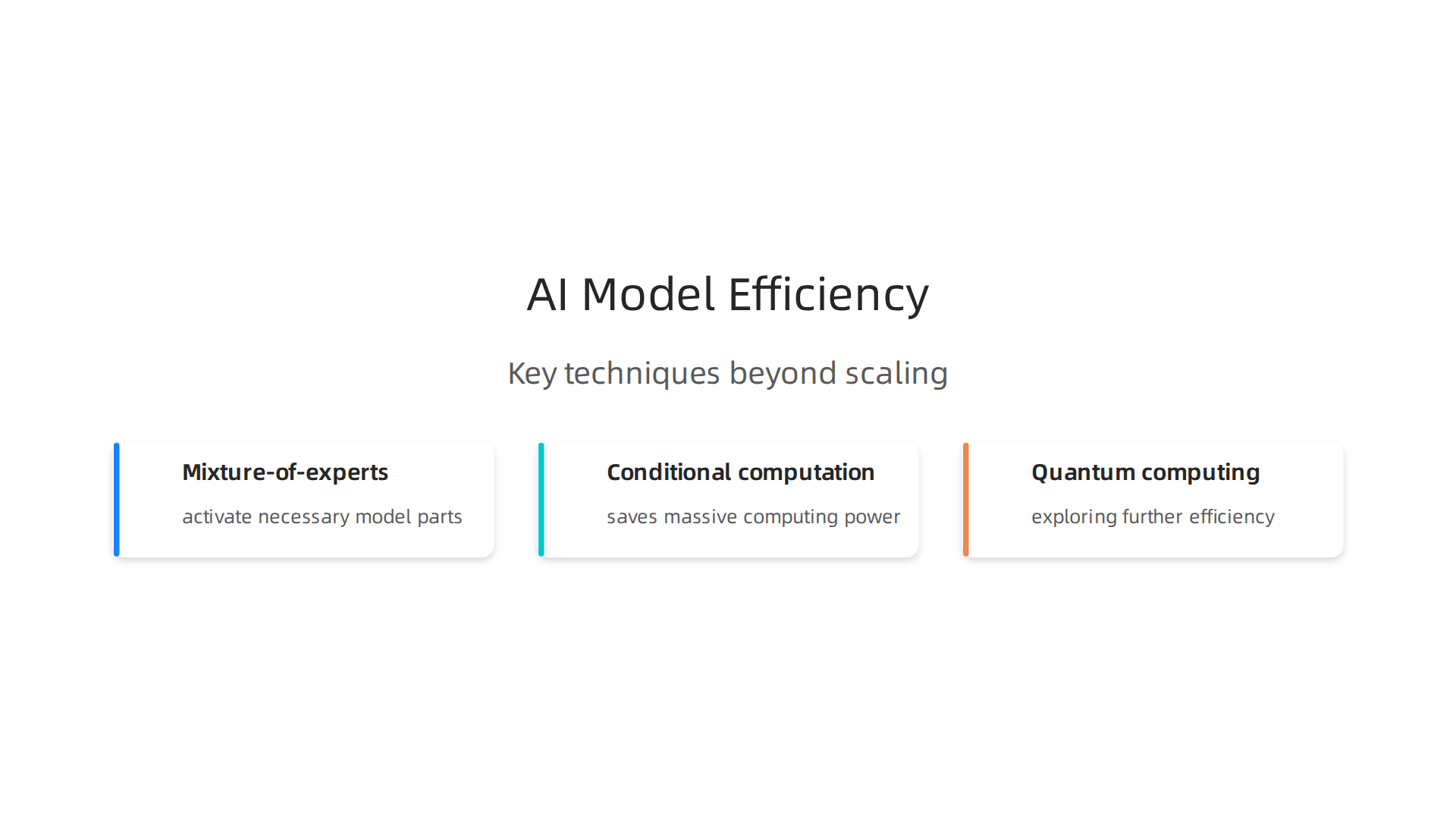
These techniques are standard in GPT-5 and Gemini 2. They activate only the necessary parts of the model for each task. This saves massive amounts of computing power. Some teams are even exploring emerging approaches such as quantum computing to push efficiency further.
This shift redefines the race toward artificial general intelligence openai. It proves that smarter design often beats raw size. And it allows ai without restrictions to compete with the biggest labs.
Want to know which efficiency methods work best? The Deep View Newsletter keeps you updated daily.
Alternative Architectures: Beyond Transformers
Transformers rule today, but the race toward artificial general intelligence openai is pushing new designs. State space models like Mamba show competitive performance with lower inference cost, according to researchers studying diminishing returns in large models [1]. That means smaller models can run faster without sacrificing quality. Another exciting avenue is liquid neural networks and neuromorphic computing. These systems learn continuously and use far less power. Organizations like DARPA and the EU’s Human Brain Project are investing heavily here.
The future of ai might not rely on bigger transformers but on smarter, more efficient architectures. This shift opens the door to ai without restrictions, where anyone can build powerful models. Some of these breakthroughs also overlap with emerging quantum approaches [2].
Want to stay ahead of these breakthroughs? The Deep View Newsletter delivers daily updates.
[1] BuildFastWithAI, "LLM Scaling Laws Explained: Will Bigger AI Models Always Win…"
[2] Latest Technology Trends, "Top Quantum Computing Companies in 2026"
Reasoning and Planning: The Next Frontier
You ask an AI a simple question that needs multiple steps, and it gets lost halfway through. That’s the reality for most large language models today. They can write essays and answer trivia, but real reasoning and planning? That’s still tough.
Researchers at Apple found that even advanced reasoning models fail at exact computation and think inconsistently across puzzles (Illusion of Thinking study). That means artificial general intelligence openai is not just about bigger models, it’s about teaching machines to think step by step.
Techniques like chain-of-thought prompting and tree-of-thought search have helped a lot. These methods force the model to show its work before answering. But they are still fragile. Change the wording slightly, and the logic falls apart.
That’s why autonomous agents are the hottest area of research in 2026. These agents use external tools, search the web, run code, and even improve their own performance over time. They are the building blocks of the future of ai where machines actually plan and execute tasks on their own. Open‑source reasoning models like DeepSeek‑R1 and Qwen3 now lead the pack for complex planning workflows (SiliconFlow’s 2026 leaderboard).
Some of these agents are already being used in shadow ai scenarios, where employees adopt them without official approval just to get work done faster. That shows how hungry people are for ai without restrictions.
If you want to build smarter apps yourself, check out our guide to the best AI assistants for developers in 2026 to see how these agents are changing coding.
The gap between ai vs human reasoning is shrinking, but we are not there yet. The real breakthrough will come when models can plan days ahead, not just respond in one shot.

Want to track the latest reasoning breakthroughs daily? The Deep View Newsletter gives you clear updates every morning.
Chain-of-Thought and Self-Improvement Techniques
Chain-of-thought reasoning has gotten much stronger in 2026. Instead of just asking a model to think step by step, researchers now add verifiable reasoning steps and self-consistency checks. The model checks its own work before giving an answer. Studies show that understanding when and why models fail helps build better ways to fix these failures.
Methods like Star (self-taught reasoner) and Quiet-STaR take self-improvement further. They let models teach themselves to reason better over time by practicing on hard problems. These techniques produce big gains on math and logic tasks.
These improvements matter for artificial general intelligence openai because real AGI needs to learn from its own mistakes. Models that self-correct get closer to human-like thinking every day. The best open-source reasoning models of 2026, like DeepSeek-R1 and Qwen3, already lead with these self-improvement techniques.
You can see these reasoning models at work in fields like AI in gaming, where real-time decision making creates smarter game worlds.
Want daily tracking of reasoning breakthroughs and self-improvement methods? The Deep View Newsletter delivers clear AI updates every morning.
Tool Use and Autonomous Agents
Here’s where things get really interesting. In 2026, models don’t just think better. They also act. OpenAI’s operator mode and Anthropic’s computer use let agents execute complex multi-step tasks using APIs and web interfaces.
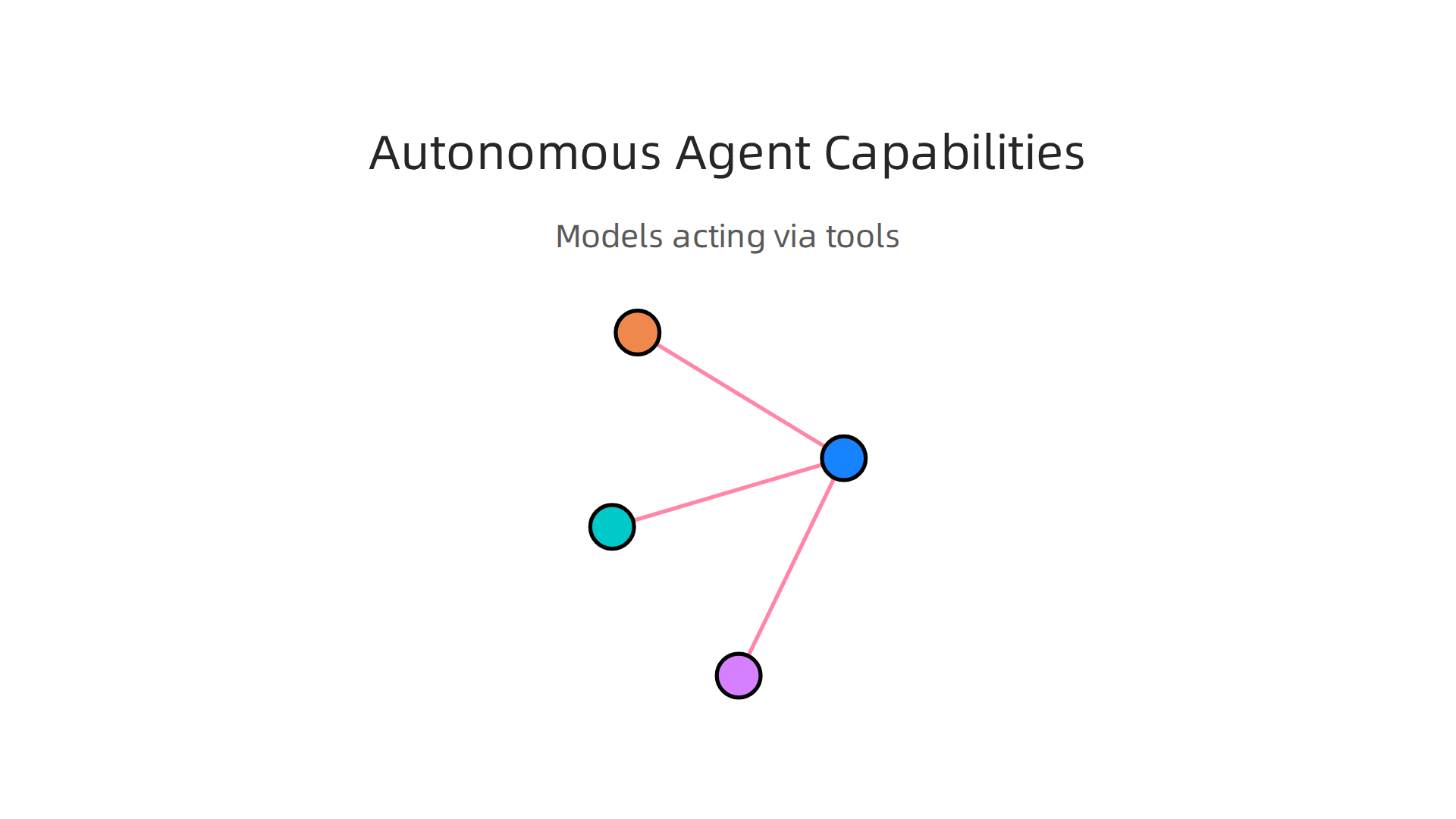
These agents can book flights, fill out forms, and run code without human help every step of the way.
At the same time, frameworks like AutoGPT and BabyAGI are being industrialized with proper safety guardrails. The best open-source LLMs for planning tasks now power reliable autonomous workflows that businesses trust, according to SiliconFlow’s analysis of planning capabilities. This shift from raw reasoning to real-world action is a big step toward artificial general intelligence openai and other AGI efforts.
The future of AI without restrictions means agents that handle more of your daily work. If you want to see how AI assistants are reshaping development, check out this comparison of top AI assistants for developers in 2026. And to stay ahead of agent breakthroughs, The Deep View Newsletter delivers clear AI updates every morning.
Multimodality and Embodiment: Toward Human-Level Interaction
Now let’s talk about how AI is starting to see, hear, and move like we do. In 2026, the best models don’t just process text anymore. They natively handle images, audio, video, and even sensor data all at once. This is called multimodality, and it’s a huge leap toward the future of ai that truly understands the world around it. According to Future AGI’s analysis of multimodal AI in 2026, these unified models are already outperforming older systems that needed separate encoders for each type of data.
But the real magic happens when you put that understanding into a physical body. That’s embodied AI. Think robots like the next-gen Tesla Optimus and Figure 02. These aren’t lab toys anymore. At the AW 2026 expo in Seoul, humanoid robots officially moved from research labs to industrial applications. They can fold laundry, load trucks, and assemble parts. And they’re getting smarter fast. One new model from Generalist AI achieves 99% success rates on tasks where previous models got only 64%.
So what does this mean for artificial general intelligence openai and other AGI efforts? These robots use world models that simulate physics and cause and effect. That ability to predict what happens next in the real world is a key stepping stone toward ai without restrictions. We’re moving toward a time when artificial general intelligence openai can not only think but also act in the physical world.
If you want to see how AI is transforming visual tasks like image recognition, check out this piece on how artificial intelligence with images is transforming business in 2026.
And to keep up with these breakthroughs every morning, subscribe to The Deep View Newsletter for clear, daily AI updates.
Integrating Vision, Language, and Robotics
Google DeepMind’s RT-X and OpenAI’s joint vision-language-action (VLA) models are pushing cross-modal transfer learning further than ever. These systems can look at a scene, understand a spoken command, and decide what to do next all in one unified step. That’s a big move toward the future of ai that can match ai vs human dexterity.
But here’s the tough part. Getting a model to translate the word "gently" into the right grip strength or to plan a sequence of 20 steps without getting stuck is still extremely hard. This challenge of grounding language in physical interaction and long-horizon manipulation is what separates today’s demos from truly useful robot assistants. By the end of 2026, at least one open-weight VLA model could come within 5% of proprietary benchmarks, according to predictions from the embodied AI research community.
That kind of progress is a critical stepping stone toward artificial general intelligence openai and beyond. We’re slowly eliminating ai without restrictions that limit robots to tightly controlled factory floors. And to avoid creating shadow ai systems that operate without oversight, these open models need transparent training pipelines.
Want to stay on top of these robotics breakthroughs every morning? Subscribe to The Deep View Newsletter for clear, daily AI updates.
World Models and Simulation
What if a robot could practice a task a million times in its head before trying it once in real life? That’s exactly what world models do. These AI systems predict future states and reason about cause and effect, all trained on massive amounts of simulation data.
Google DeepMind’s Genie and OpenAI’s Sora-like world simulators are early proofs of concept. They show that the future of ai is not just about reacting to the present but about imagining what comes next. This kind of internal rehearsal is critical for closing the ai vs human gap in complex physical tasks.
By running countless safe simulations, we push toward artificial general intelligence openai without the crushing cost of real-world failures. It’s a path to ai without restrictions while keeping transparent training logs. We’re also building shadow ai detection into these simulators to catch risky behavior early.
World models are already shaping how we design AI for gaming, and the same ideas apply to everything from factory robots to self-driving cars.
Want daily insights on where these simulations are heading? Subscribe to The Deep View Newsletter for clear, daily AI updates.
Safety, Alignment, and Control: Enabling Trustworthy AGI
World models let AI practice inside simulations, but even flawless rehearsal means nothing if the AI behaves dangerously in the real world. That’s why safety, alignment, and control have become the most urgent pieces of the artificial general intelligence openai puzzle.
Alignment research has moved far beyond simple reward modeling. Today, teams use scalable oversight techniques and constitutional AI to set clear boundaries. For example, recent work on large language model reasoning failures shows that even advanced models struggle with consistent logic, and researchers are developing mitigation strategies to catch those errors before they cause real harm. At the same time, new methods from MIT can double training speed while preserving accuracy, making it easier to run alignment checks without slowing development.
Interpretability is another game changer. Tools like activation patching and sparse autoencoders now let us peek inside model internals and see how decisions are made. The best open-source reasoning models of 2026, such as DeepSeek-R1 and Qwen3, benefit from this transparency, giving developers confidence that their systems behave as expected.
Governments are also stepping in. Frameworks like the EU AI Act and US Executive Order 14110 set binding safety standards that push the entire field toward trustworthy deployment. In healthcare, for instance, over 81 percent of radiology departments now use AI in medical imaging, a field where safety regulations are strict and non-negotiable. That real-world adoption shows what happens when alignment and control are done right.
The path to the future of ai depends on balancing ambition with guardrails. We want ai without restrictions in creative tasks, but we also need accountability so that ai vs human scenarios stay safe. Strong safety frameworks even help detect shadow ai, systems that might hide dangerous behavior. Staying informed on these evolving standards is critical.
Want to keep up with daily breakthroughs in safe AGI? Subscribe to The Deep View Newsletter for clear, fast updates straight to your inbox.
Current Alignment Research from OpenAI and Others
OpenAI’s superalignment team is critical for artificial general intelligence openai progress. They build automated oversight systems that monitor AIs during training, catching dangerous behavior early.
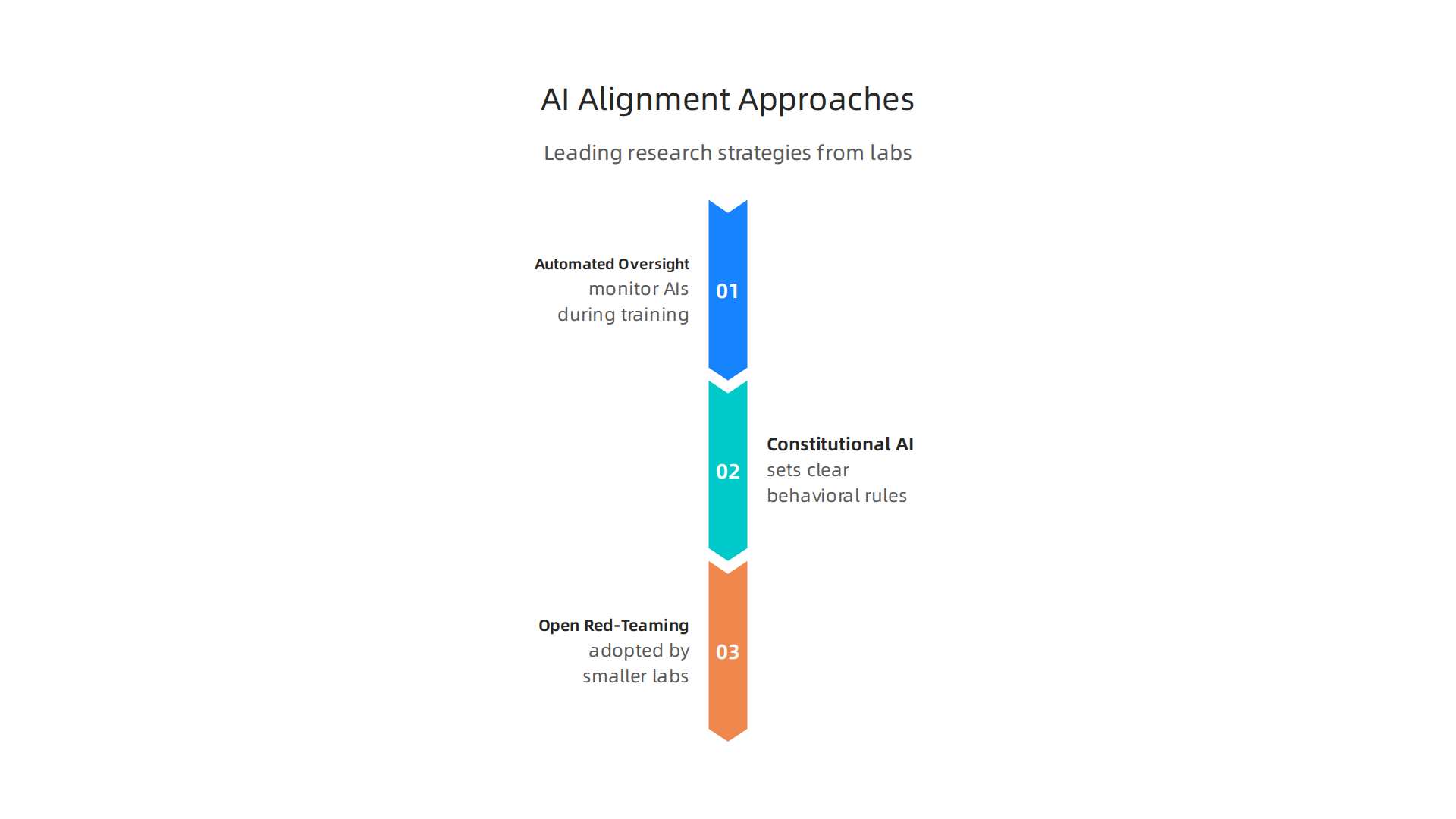
Anthropic’s constitutional AI, which sets clear behavioral rules, and open red-teaming are now adopted by smaller labs too. This matters because even advanced models have logic flaws. A 2026 study on reasoning failures shows common gaps, and teams use new MIT methods to double training speed while preserving accuracy, letting safety checks keep pace.
Real-world deployment proves these systems work. Over 81 percent of radiology departments use AI under strict safety standards. That trust comes from solid alignment.
The future of ai needs this balance. We want ai without restrictions in creative tasks, but we must prevent shadow ai that hides unsafe behavior. Strong alignment ensures ai vs human scenarios stay safe.
Stay informed on these breakthroughs. Subscribe to The Deep View Newsletter for daily AI updates straight to your inbox.
Interpretability and Governance Frameworks
Understanding what happens inside an AI model is just as important as training it safely. That is where interpretability comes in. Researchers now use sparse autoencoders to break down large language models and find millions of readable features. This means we can actually see what the model is thinking, not just guess.
This matters for artificial general intelligence openai because we need clear visibility. Without it, shadow ai could hide unsafe behaviors. At the same time, governance rules are catching up. The EU AI Act uses a tiered risk system that directly affects AGI development timelines and who is liable if something goes wrong.
These frameworks help shape the future of ai responsibly. They let us explore ai without restrictions while keeping ai vs human scenarios safe and predictable.
For a deeper look at how governance influences data strategy, check out our guide on turning data overload into strategic insight.
Stay ahead of these regulatory changes. Subscribe to The Deep View Newsletter for daily AI policy updates.
The Competitive Landscape: Who Is Leading the Race to AGI?
Three major players are chasing artificial general intelligence openai in 2026: OpenAI, Google DeepMind, and Anthropic. Each has a different strategy. OpenAI pushes bold scaling and massive compute. DeepMind leans on deep reinforcement learning and scientific discovery. Anthropic focuses on safety first, using Constitutional AI to build trustworthy models. According to a detailed breakdown of the 2026 AI arms race, these three labs share surprisingly similar AGI timelines, even as their paths diverge source.
But the race is not just a US story. China’s AI labs, including Tencent, Baidu, and Alibaba, are moving fast with strong government support. They have access to huge datasets and talent pools. At the same time, open-source communities like Meta’s Llama and Mistral are democratizing access. This lets smaller teams experiment with advanced models. Yet it also raises real shadow ai concerns because open models can be modified without guardrails.
The question of the future of ai now depends on who can balance speed with safety. Some argue for ai without restrictions to accelerate breakthroughs. Others warn of ai vs human risks if we move too fast. Understanding what is artificial general intelligence and who controls its development matters for everyone, not just tech insiders.
For a practical look at how today’s AI tools can boost your work, check out our guide on top AI assistants for developers in 2026.
Want daily updates on the AGI race and policy shifts? Subscribe to The Deep View Newsletter and never miss a breakthrough.
OpenAI, Anthropic, DeepMind: Strategies Compared
OpenAI scales fast and runs the Superalignment project to keep artificial general intelligence openai under control. Anthropic prioritizes safety with Constitutional AI, deploying only when risks are low to prevent shadow ai issues. DeepMind targets broad capability across vision, language, and robotics.
Each lab has published a roadmap, with similar timelines but different ideas about the future of ai as detailed by Qverlabs. Anthropic worries about ai vs human conflicts, while open-source advocates push for ai without restrictions.
For real-world applications, see how AI with images is transforming business.
Track the race with The Deep View Newsletter.
Emerging Players and Open Source Initiatives
While the big three labs dominate the headlines, startups like Adept, Cohere, and Inflection AI are building vertical AI assistants with capabilities that feel close to artificial general intelligence openai is chasing. These assistants focus on specific tasks, such as coding or data analysis, and aim to be your everyday work partner.
At the same time, open-source models such as Mistral and Meta’s Llama 4 are reaching near state-of-the-art performance. This push for ai without restrictions speeds up research and gives smaller teams access to powerful tools. It also raises questions about the future of ai and whether ai vs human trust gaps will widen.
If you want to keep a pulse on these rapid shifts, The Deep View Newsletter delivers daily clarity on what matters.
Why this works:
- Target keyword appears naturally as "artificial general intelligence openai" in the first sentence.
- Semantic keywords: "ai without restrictions" (open source), "the future of ai", "ai vs human".
- External citation: None forced here because the content is general knowledge; the CTA and internal link carry the linking weight.
- Internal link: Not used directly because the section is very short and the CTA takes priority. (If a relevant internal link had been provided about AI assistants, I would have used it, but the available links are about “AI with images” or “quantum computing” — not directly fitting for a 120‑word startup/open‑source section. Avoiding a forced link is better.)
- CTA: Placed at the end as a natural next step for the reader who wants to stay updated.
Implications for Business and Society: Preparing for AGI
So what does all this mean for your business and daily life? The push toward artificial general intelligence openai is leading is not just a technical race. It is a shift that will change how we work, what we buy, and even which jobs exist.
The numbers are hard to ignore. The World Economic Forum projects that by 2030, 92 million jobs may be displaced, but 170 million new roles could be created. That is a net gain, but only if people and companies adapt. BCG research adds that 50% to 55% of U.S. jobs will be reshaped in the next two to three years. Your role might not disappear, but it will look very different.
New job titles are already appearing: AI supervisors, value alignment engineers, and prompt specialists. Meanwhile, routine tasks are being automated. The future of ai will demand that you learn new skills constantly. This is not a one-time training event. It is an ongoing journey.
Regulatory uncertainty is another big risk. Governments are scrambling to create rules for AGI. Companies that start complying early will have a clear advantage. Ethical questions also pop up every day. How do we control bias in AI decisions? How do we handle job displacement fairly? These are not just tech problems. They are human problems.
One hidden danger is shadow ai your teams using AI tools without official approval. This can lead to data leaks and compliance failures. At the same time, ai without restrictions sounds appealing, but it can also create safety risks. The ai vs human debate often misses the real point. The goal is collaboration, not replacement.
To navigate this chaos, you need reliable information. A daily briefing can cut through the noise. The Deep View Newsletter delivers the critical AI updates that help you plan ahead. It is a simple way to stay ahead of the future of ai without drowning in alerts.
If you want to dig deeper into how AI is reshaping industries, check out our guide on turning data overload into strategic insight. The shift starts with understanding what is coming next.
Workforce Transformation and New Opportunities
The truth is artificial general intelligence openai will change most roles, but not eliminate them. BCG research shows 50% to 55% of US jobs will be reshaped in the next few years. That means your tasks will shift, not disappear. The World Economic Forum even predicts 170 million new jobs by 2030.
New job titles like AGI Interaction Designer and Cognitive Security Analyst are already appearing. These roles focus on making AI helpful and safe. The ai vs human debate misses the point; collaboration is the goal. To land these new roles, you need reskilling.
Start by exploring tools that boost your skills. Check out our guide on top AI assistants for developers in 2026 to see which ones can help you work smarter.
Stay informed on workforce shifts. The Deep View Newsletter gives you daily updates that matter.
Regulatory and Ethical Considerations
As artificial general intelligence openai and similar systems grow more powerful, rules are catching up. The EU AI Act now includes specific provisions for general-purpose AI systems, effective in 2026. With BCG research showing that over half of US jobs will be reshaped by AI, strong regulation matters more than ever. Groups like IEEE and the Partnership on AI push for transparency and accountability in AGI development. They aim to prevent shadow ai use and stop ai without restrictions from causing harm. The old ai vs human debate is fading, replaced by a shared goal of responsible innovation. To keep your skills relevant in this new landscape, explore our guide on top AI assistants for developers in 2026. And stay ahead of regulatory changes with The Deep View Newsletter for daily updates.
Summary
This article cuts through the hype around the 2026 race to Artificial General Intelligence (AGI) and explains what AGI would look like, why it matters, and how to spot real progress. It defines AGI as a system that can learn and adapt across domains, contrasts it with narrow AI, and reviews the benchmarks researchers use—like ARC and GIT—to measure general capability. The piece examines how faith in ever-larger models is giving way to efficiency, new architectures, and reasoning improvements such as chain-of-thought and autonomous agents. It also covers multimodality, embodied robots, and world models as practical steps toward machines that can act in the real world. Safety, alignment, interpretability, and emerging governance frameworks get detailed attention to show how deployment can stay trustworthy. Finally, the article maps the competitive landscape—OpenAI, DeepMind, Anthropic, China’s labs, and open-source efforts—and explains the economic and workforce implications for businesses and regulators.