

Introduction
Imagine watching a movie that changes its plot based on your mood, or playing a game where every character reacts to you like a real person. This is not science fiction anymore. In 2026, artificial intelligence gaming is turning those ideas into everyday experiences. The entertainment world is shifting faster than most of us can keep up with. An ai engine now powers everything from the monsters you fight to the stories you love.
But here is the challenge. For technology professionals like you, the flood of news about AI can feel overwhelming. Every day brings a new headline about what AI can do. How do you separate real breakthroughs from empty hype? How do you know which trends actually matter for your work or your investments?
That is where this article comes in. We are cutting through the noise to give you a clear, evidence-based look at what is really happening. The numbers tell a powerful story.
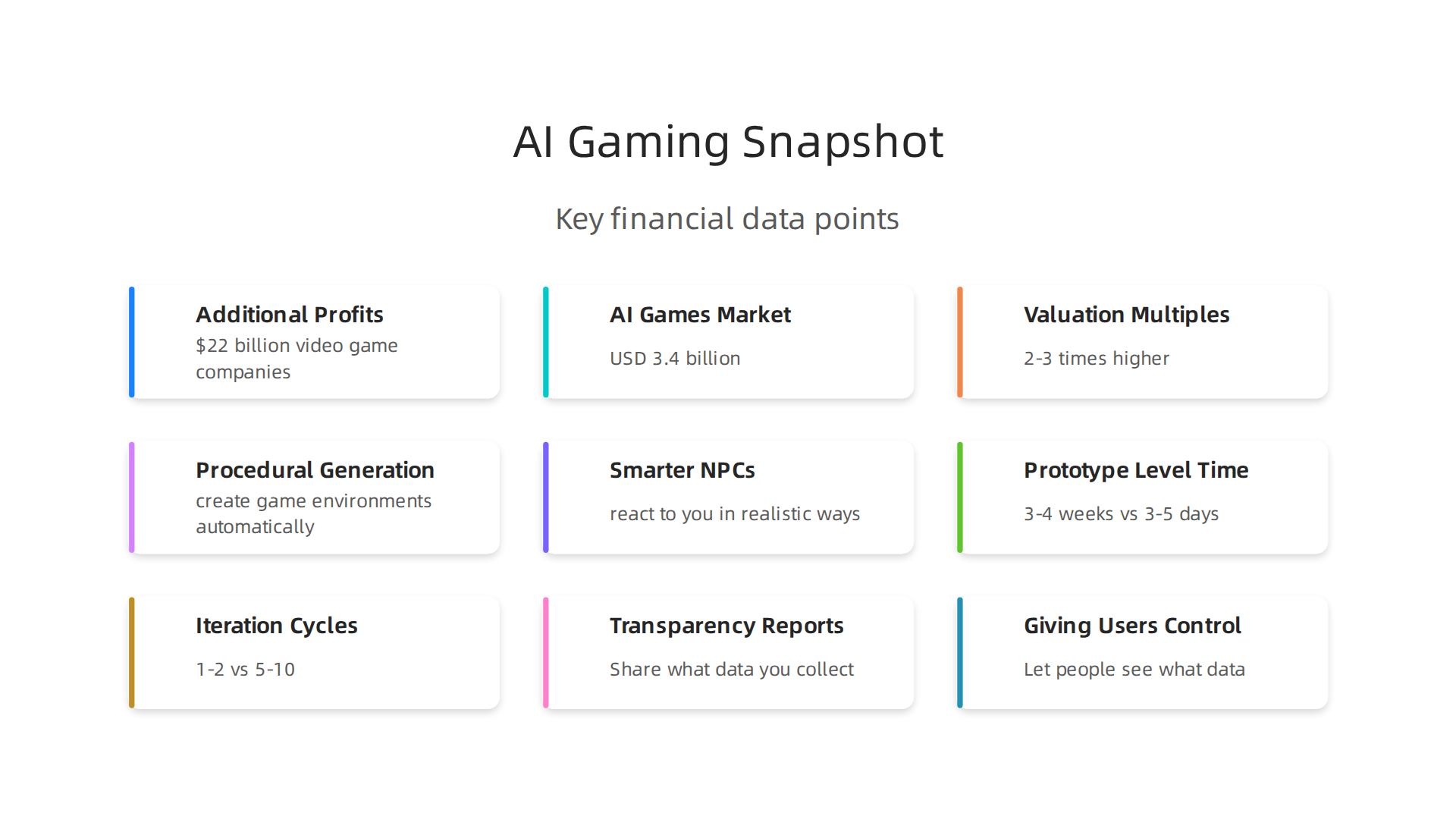
According to a Morgan Stanley analysis, AI could unlock $22 billion in additional profits for video game companies through lower costs and faster production. The AI in Games Market is valued at USD 3.4 billion in 2026 and is expected to nearly double by 2030. Companies that integrate AI into strong intellectual property are seeing valuation multiples 2-3 times higher than those that lag behind.
This massive shift touches not just gaming, but streaming, virtual reality, augmented reality, and content creation. We will explore each area and the ethical questions that come with them. The goal is simple: help you spot the trends that will define the next few years.
If you are tired of trying to turn data overload into strategic insight, you are in the right place.

Let us break down what artificial intelligence gaming really means in 2026 and beyond. The future of entertainment is already here. Let us make sense of it together.
How AI is Revolutionizing Game Development: Procedural Generation and Smarter NPCs
Remember those old video games where every villager said the same three lines? Or where the world outside the main path felt empty and lifeless? Those days are ending fast. In 2026, artificial intelligence gaming is changing how developers build entire worlds and how characters inside them behave. Two big changes are leading the way: procedural generation and smarter non-player characters (NPCs).
Infinite Worlds Without Endless Manual Work
Procedural content generation (PCG) uses an ai engine to create game environments automatically. Instead of hundreds of artists spending months designing every tree, rock, and building, AI can generate unique landscapes, levels, and even entire planets on the fly. This saves time and money while making each playthrough feel fresh.
A research paper on enhancing NPC behavior explains how PCG and AI together let developers build infinite worlds without manually creating every piece of content. The result is games that feel alive and unpredictable.
Today, 90% of developers use AI in some part of their workflow according to an AI Buzz studio guide. That includes PCG tools that generate everything from forests to dungeons. The market for AI-powered game development is already worth billions and growing fast.
NPCs That Actually Feel Human
The bigger leap might be in how NPCs behave. Old NPCs followed simple scripts. Walk here, say this line, repeat. Now, NPCs use reinforcement learning and natural language processing to react to you in realistic ways.
Imagine a shopkeeper who remembers you stole from them last time. Or an enemy that learns your attack patterns and changes its strategy. A study from SSRN on AI and PCG in games shows how these techniques create characters that feel more alive.
AAA studios report that AI-driven NPCs increase player engagement and replayability by 30 to 50%. When every character can remember, learn, and adapt, you have a reason to come back and try different choices.
What This Means for Developers
If you work in tech, these changes affect you whether you build games or not.

The same AI techniques are used in training simulations, virtual reality, and even business applications. Learning how an ai engine handles real-time decision making can give you insights into broader automation trends.
Want to dive deeper into how developers are using AI tools? Check out our comparison of the top AI assistants for developers in 2026 to see which ones can speed up your own workflow.
The bottom line is simple. Procedural generation and smarter NPCs are not just cool features. They are reshaping how games are built and how players experience them. And the technology behind them is spreading into every corner of entertainment and beyond.
AI-Powered Personalization: Tailoring Every User’s Experience
You know that feeling when you open Netflix and spend twenty minutes scrolling, only to land on something you have already seen? That frustration is exactly what AI powered personalization aims to kill.

In 2026, the same artificial intelligence gaming techniques that create adaptive NPCs are now shaping how every user experiences streaming platforms, music apps, and even news feeds.
How Streaming Platforms Read Your Mind
Behind the scenes, deep learning models track your viewing habits, pause points, and even the time of day you watch certain genres. An ai engine then compares your behavior with millions of other users to predict what you will enjoy next. According to a 2026 guide on AI driven personalization, these systems adjust recommendations in real time, so the more you watch, the smarter they get.
But this is not just about suggesting movies. Platforms like Netflix and Spotify tailor the entire interface. Some users see darker themes for horror fans, while others get bright, comedy focused layouts. The goal is to make every visit feel personal without you having to lift a finger.
Interactive Stories That Change With You
The next big leap is adaptive storytelling. Remember Netflix’s Bandersnatch? That was just the beginning. In 2026, successors to that interactive format use AI to branch narratives based on every choice you make. The story does not just fork at key moments. It learns your preferences and reshapes future scenes accordingly.
This keeps you glued to the screen. Studies show that interactive content increases dwell time by more than 40%. When you feel like the story is written just for you, you are far less likely to click away.
The Privacy Trade Off
Now the honest part. All this personalization comes at a cost. To know you that well, platforms need tons of data. That raises real questions about privacy and fairness. An ethical AI guide highlights the importance of transparent algorithms and clear opt in models. Without those, you risk creepy over personalization or even biased recommendations that lock you into a narrow filter bubble.
So does will ai take over the world of entertainment? Not really. But it will keep getting better at guessing what you want. The key is building trust through lucid ai systems that explain their logic and let you control your data. Companies that get this balance right will earn your loyalty. Those that don’t will lose you to competitors who respect your privacy.
For a deeper look at how to turn user data into smart strategies without crossing ethical lines, read our guide on turning data overload into strategic insight.
Generative AI and the Future of Content Creation
So we have seen how AI personalizes what you watch. But what about how the content itself gets made? That is where generative AI is shaking things up hard. In 2026, both indie studios and AAA giants are using artificial intelligence gaming tools to build worlds faster than ever before.
From Blank Canvas to Playable World in Days
Imagine needing a forest background for your game. Instead of hiring a concept artist and waiting a week, you type a prompt into an ai engine that spits out four variations in seconds. That is not the future. That is today.
Generative AI models now handle everything from texture creation to full 3D model generation. According to a 2026 comparison of AI asset generators, tools can automatically create sprites, animations, and even entire level layouts based on your art style. The best part? You can train these models on your own existing assets, so every new piece matches your game’s unique look perfectly.
Soundtracks are getting the same treatment. AI music generators compose background scores that adapt to gameplay intensity. A quiet exploration scene gets soft strings. A boss fight gets pounding drums. All generated on the fly.
The Legal Gray Area Nobody Talks About
Here is where things get tricky. If an AI generates a character that looks suspiciously like a famous movie villain, who is responsible for the copyright violation?
The truth is that current laws are playing catch up. The U.S. Copyright Office has started denying protection for works where AI did most of the heavy lifting. The EU is also drafting guidelines to determine where human creativity ends and machine generation begins.
This is a big deal for studios. If you cannot copyright the assets an AI made for you, your entire game could be vulnerable to clones and knockoffs. A 2026 guide to AI native game development warns developers about this exact problem, calling it the "gameslop" risk where low quality AI content floods the market and devalues original work.
The Cost Numbers That Turn Heads
Despite the legal headaches, the financial case for generative AI is loud and clear.
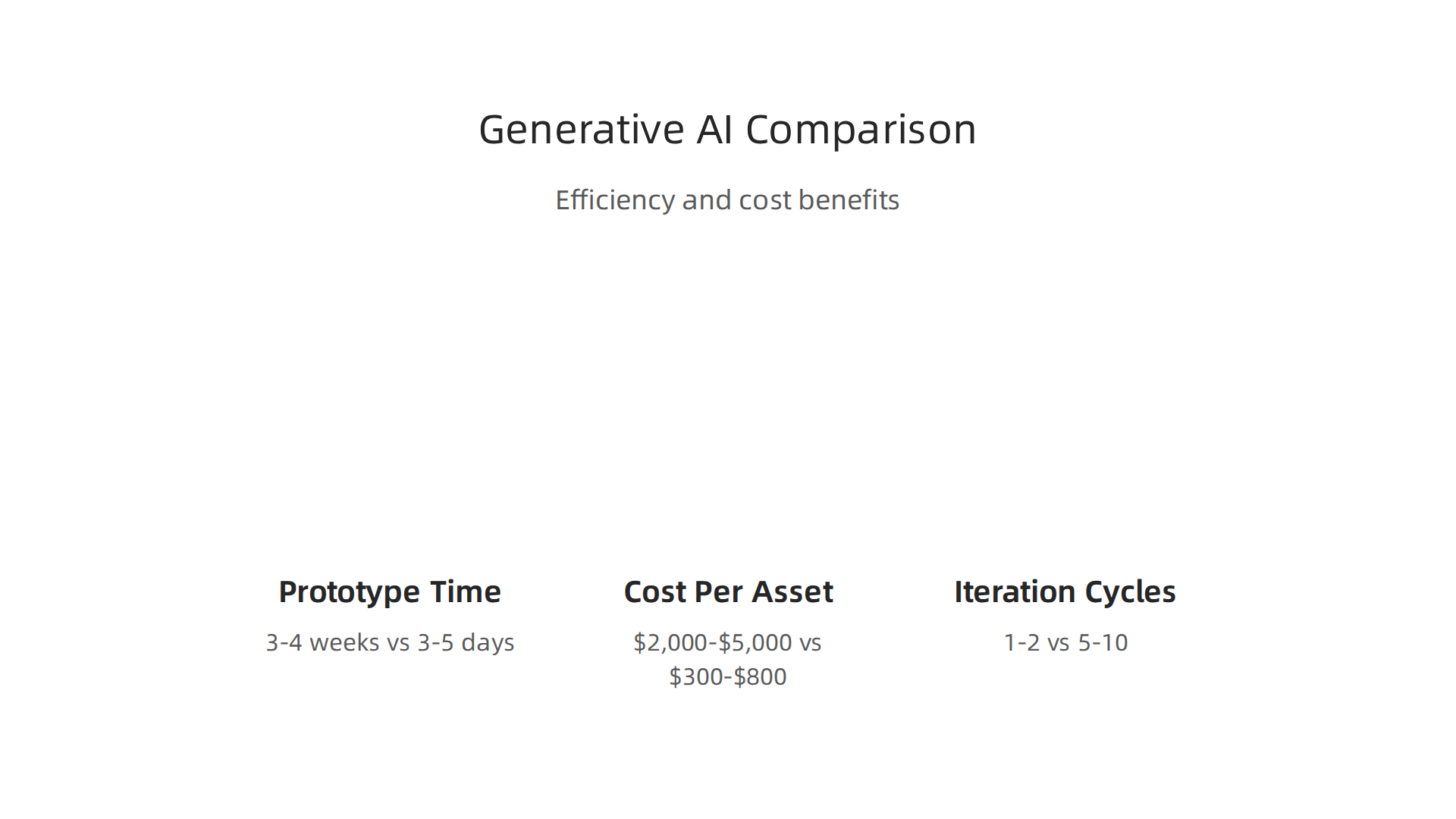
| Metric | Traditional Workflow | With Generative AI |
|---|---|---|
| Time to prototype a level | 3 4 weeks | 3 5 days |
| Cost per asset batch | $2,000 $5,000 | $300 $800 |
| Iteration cycles per week | 1 2 | 5 10 |
Studies show that generative AI can cut content production costs by up to 40% while speeding up iteration cycles dramatically. For a small studio, that is the difference between shipping a game and running out of money halfway through.
Does this mean will ai take over the world of creative jobs? Not completely. Artists and writers are still needed for vision, direction, and quality control. But the grunt work of generating hundreds of background assets or drafting dialogue options? That is now the AI’s job.
The smartest studios are the ones using lucid ai systems that clearly mark which assets are AI generated. This transparency helps with legal protection and builds trust with players who want to know how their games were made.
For a deeper look at how AI is reshaping visual content across industries, check out our guide on AI image generation market trends and business applications. It covers how the same technology behind game assets is transforming marketing, film, and design.
AI in Virtual and Augmented Reality: Creating Immersive Worlds
Imagine putting on a VR headset and seeing your real hands inside the game. You reach out to pick up a glowing object. The ai engine tracks every finger movement instantly. The object glows brighter as you touch it. This is not a dream. In 2026, artificial intelligence gaming in virtual and augmented reality makes experiences feel this real.
How AI Makes VR and AR Feel Alive
The secret is real time object recognition and natural hand tracking. Old VR systems had big delays. You moved your hand, and the screen took a second to catch up. That broke the magic. Now, machine learning models process your gaze, gestures, and movement in milliseconds. They remove that lag and make the world react like the real one.
A research paper on enhancing NPC behavior shows that combining AI with procedural content generation creates characters and environments that respond to you naturally. When you walk through a virtual forest, the deer there notice you. They react differently based on how fast you move or where you look. That level of detail comes from AI models trained on thousands of human interactions.
The environment itself adapts to you. If you keep staring at a distant mountain, the ai engine automatically sharpens the view and adds wind sounds from that direction. If you turn around, the world shifts to match your new focus. This creates a personalized journey every time you play.
Beyond Gaming: Real World Uses
These same AI tools are moving far beyond entertainment. Hospitals now use VR training simulations where AI tracks a surgeon’s hand movements and gives instant feedback. A 2026 study on AI integration in gaming reports that about half of game studios already use AI in production, and many of those same tools are being adapted for healthcare and live events.
Think about virtual concerts. You put on a headset, and AI generates dazzling visuals that sync with the music in real time. The light show changes based on where you look. The sound adapts to your position in the crowd. It feels like you are really there.
The Growth Is Fast
The numbers back up this shift. According to a 2026 AI in games market report, the market reached $3.4 billion in 2026 and is expected to grow at an 18.6% compound rate. A separate guide on AI in game development confirms that 90% of developers now use AI tools. That includes VR and AR teams.
So will ai take over the world of immersive experiences? Not completely. Human creativity still drives the vision and story. But AI handles the repetitive work of tracking objects, generating environments, and adjusting the world to fit each user. That frees up developers to focus on what makes a game or training module truly special.
For a closer look at how AI is transforming visual content across industries, check out our guide on how artificial intelligence with images is transforming business in 2026. It covers the same technology powering VR and AR experiences today.
The Business of AI Entertainment: Market Trends and Investment
So how big is this artificial intelligence gaming boom?

In 2026, the numbers are staggering. The global AI in games market hit $3.4 billion this year, and experts expect it to reach $6.73 billion by 2030, growing at an 18.6% rate. But that is just one slice. Other reports put the entire AI in gaming market at $4.2 billion in 2025, with a projected climb to $66.84 billion by 2035 at a 32% compound annual growth rate.
The real story is what these numbers mean for game companies and investors. A report from Morgan Stanley says AI could unlock $22 billion in extra profits for video game companies. How? By cutting development costs, speeding up production, and making games more personalized. In 2026, studios that use AI well are already seeing the difference.
Why Money Is Pouring In
Venture capital funding for AI-first entertainment startups hit record levels in 2025. Investors are betting big on generative AI and personalization tools. The idea is simple: an ai engine that creates characters, environments, and storylines on the fly saves months of manual work. That efficiency translates directly to higher profit margins.
Strategic partnerships between AI companies and legacy studios are reshaping how content gets made. Instead of building everything from scratch, studios team up with AI specialists to speed up their pipelines. According to a report by AlixPartners, gaming companies that successfully integrate AI into strong intellectual property will command valuation multiples two to three times higher than those that lag behind. That is a massive competitive advantage.
What This Means for You
If you are a game developer, a studio owner, or an investor, the message is clear: the business of artificial intelligence gaming is not slowing down. Companies that ignore this trend risk falling behind. The will ai take over the world question gets asked a lot. In the business context, AI is not taking over. It is becoming a core tool that separates market leaders from everyone else.
To make smart investment or career decisions, you need reliable data. The same tools that power immersive VR worlds are now driving market growth. If you want to turn this data overload into real strategic insight, check out our guide on how to turn data overload into strategic insight in the information society 2026. It covers exactly how to make sense of fast-changing trends like this one.
The bottom line: the business of AI entertainment is growing fast, and the opportunities are huge for those who act now.
Challenges and Trust: Bias, Privacy, and Responsible AI
But here is the thing. All that exciting growth in artificial intelligence gaming comes with some serious baggage. The same ai engine that can create amazing personalized experiences can also cause real harm if we are not careful. In 2026, the conversation has shifted from "can we build this?" to "should we build this, and how do we do it the right way?" Trust is becoming the most valuable currency in tech.
Let us break down the biggest challenges.
The Bias Problem Nobody Talks About Enough
AI recommendation systems learn from data. And the data we feed them often reflects the biases we carry as humans. Gender stereotypes, racial assumptions, and other harmful patterns can quietly slip into an AI model without anyone noticing. This is not just a theoretical problem. Some platforms already face regulatory scrutiny because their AI pushed unfair or discriminatory content. According to a guide on ethical AI for personalized experiences, companies that ignore bias testing risk damaging their reputation and facing legal trouble. The same source warns that ethical AI requires constant auditing. It is not a set-it-and-forget-it tool.
A report on AI driven personalization lists bias as one of the main pitfalls companies must address. If you are building an ai engine for games or entertainment, your team needs to check for bias at every stage of development.
Privacy: The Data You Collect Comes With Strings Attached
Here is the uncomfortable truth. To deliver those magical personalized experiences, AI needs data. A lot of it. Behavioral data, play patterns, even voice and facial expressions in some VR worlds. That level of collection raises serious privacy flags. Laws like GDPR in Europe and CCPA in California set strict rules, but compliance alone is not enough anymore.
Research from AI and the ethics of personalization highlights how privacy concerns can break user trust fast. When players feel watched, they stop engaging. A key strategy from protecting privacy while powering AI is data minimization. Only collect what you truly need. That simple rule can prevent a lot of headaches.
Best Practices for Responsible AI in 2026
The good news? The industry is learning. Companies that take responsibility seriously are building stronger, longer-lasting relationships with their users. Here is what the leaders are doing right now:
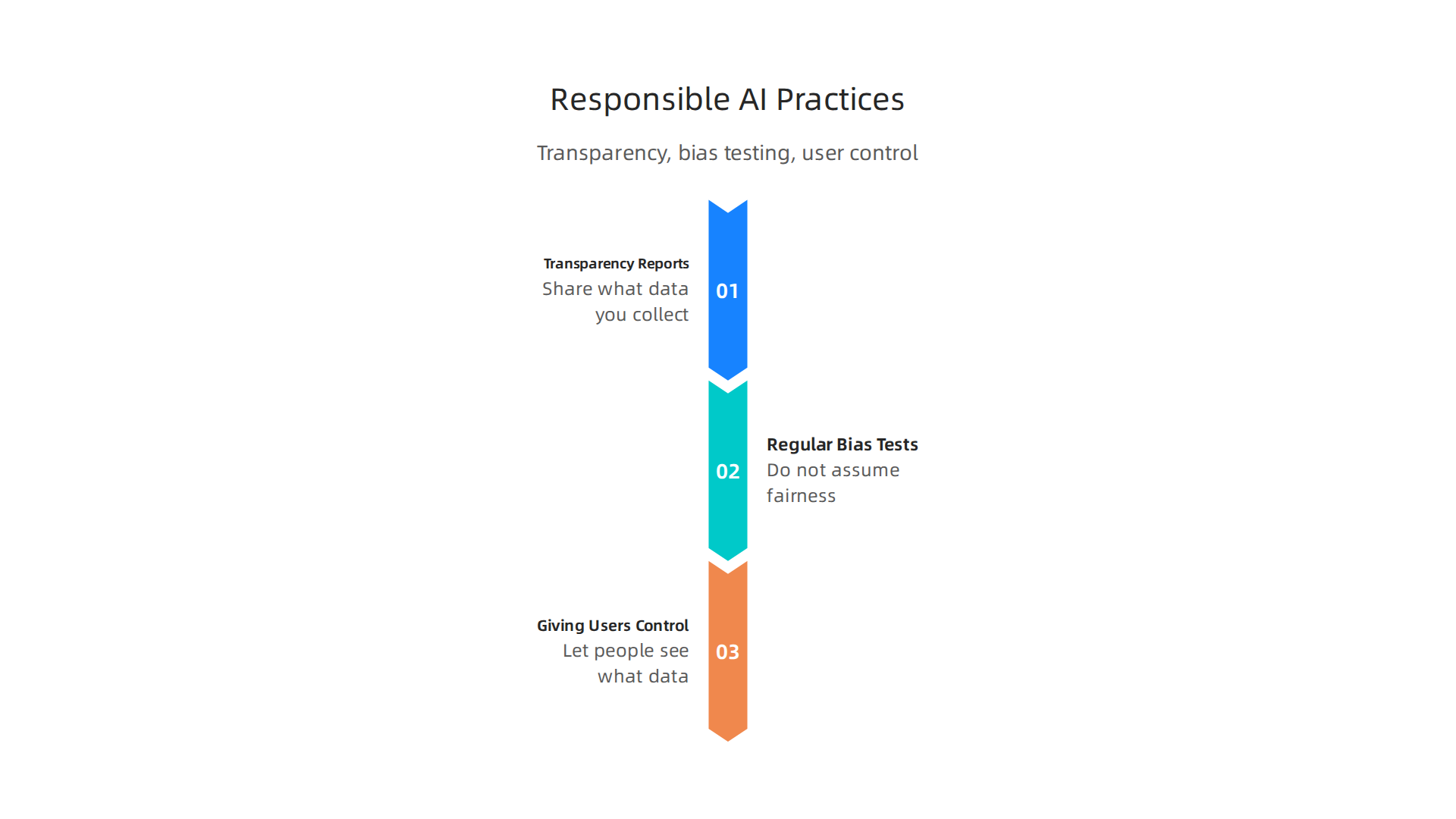
- Publishing transparency reports. Share what data you collect, how you use it, and how your AI makes decisions. According to AI for content personalization, documenting ethical guidelines builds trust with both internal teams and the public.
- Running regular bias tests. Do not assume your model is fair. Test it. Fix it. Test it again. Salesforce’s complete guide emphasizes feeding clean data to AI models to prevent discrimination.
- Giving users control. Let people see what data you have on them. Let them adjust their preferences. Let them opt out. Control builds trust.
The question will ai take over the world often pops up in these conversations. But the real concern is not AI taking over. It is AI running on bad data with no oversight. When done right, responsible AI can create amazing experiences without crossing ethical lines.
If you want to make sense of these complex challenges and build strategies that actually work, check out our guide on how to turn data overload into strategic insight in the information society 2026. It helps you filter the noise and focus on what matters for your business.
The bottom line? Trust is not a nice-to-have. In 2026, it is a competitive advantage.
Summary
This article maps how artificial intelligence is reshaping gaming and entertainment in 2026, showing the practical changes and business stakes behind the headlines. It explains how AI engines power procedural generation and smarter NPCs to speed development and increase player engagement, how personalization adapts streaming and interactive stories to individual tastes, and how generative models produce art, music, and levels far faster and cheaper than traditional workflows. The piece also covers AI-driven advances in VR/AR that make virtual worlds feel responsive, and it summarizes market numbers—like a $3.4 billion AI in games market in 2026 and strong projected growth—that explain why investors and studios are pivoting fast. At the same time, it flags legal, privacy, and bias risks and outlines responsible practices studios should follow. Readers will finish able to identify which AI trends matter for product decisions, how to capture cost and time savings, and what governance steps reduce ethical and legal exposure.