
Introduction: From Information Overload to Strategic Insight
You wake up to 50 emails, three news alerts, a podcast recommendation from a coworker, and two LinkedIn posts about the next big thing in tech. By lunch, you’ve skimmed headlines about artificial intelligence, cybersecurity threats, and a new cloud service. But when someone asks you what actually matters for your business this year, your mind goes blank.
That feeling is not your fault. We live in an information society where the creation and sharing of data have become one of the most powerful forces shaping our world. According to the classic definition, an information society is one where the use, creation, and integration of information is a central activity (Wikipedia). But here’s the thing: for decades, the challenge was simply getting enough information. In 2026, the challenge is the opposite. We have more data than we can ever use. The real problem is curation, trust, and turning noise into knowledge.
Technology trends in 2026 are accelerating at a breathtaking speed. Gartner forecasts that worldwide information security spending will reach $244 billion this year, up 13.3 percent from 2025 (Software Strategies Blog). That’s just one example of how fast the landscape is shifting. Emerging technologies examples like generative AI, advanced robotics, and quantum computing are no longer science fiction. They are real tools that businesses are adopting right now. But without a clear framework, chasing every new trend can lead to confusion and wasted investment.
This article provides a structured, evidence-based roadmap for understanding the most important trends in our information society today. You will learn how to separate hype from real innovation, where science advances are creating new opportunities, and how to apply these insights directly to your business strategy. We will start with a quick artificial intelligence review to see where AI stands in 2026, then move into other critical technologies.
If you are ready to move from information overload to strategic insight, keep reading.

For a deeper look at specific trends, check out our analysis of how 81 percent of radiology departments now use AI in medical imaging or see which tools top our list of AI assistants for developers in 2026. These are just two examples of how the information society is transforming real-world work.
Let’s get started.
1. Defining the Information Society: From Data to Wisdom
The term information society started showing up in the 1970s and 1980s. Back then, researchers used it to describe a new kind of economy where more people worked with information than with factory machines. The OECD even created a Guide to Measuring the Information Society to help countries track this shift. The core idea was simple: information became the most valuable resource, just like land or oil once were.
By 2026, that definition feels almost too simple. We now live in an information society where the creation, sharing, and use of data touches every part of our lives. According to the classic explanation, an information society is one where the use and integration of information is a central activity (Wikipedia). But here is what has changed. In the past, the big problem was not having enough data. Today, the problem is having too much, and not knowing what to trust.
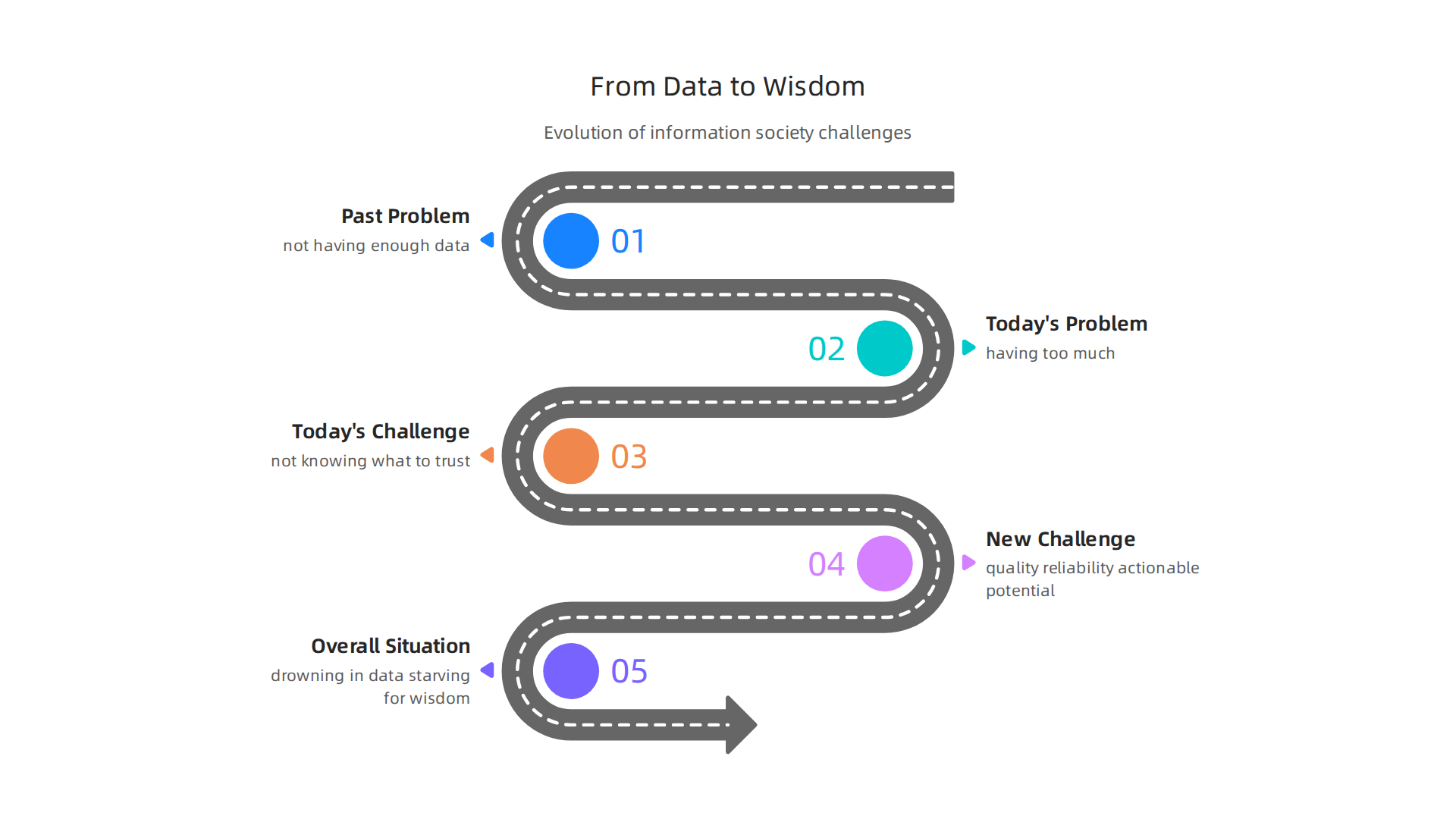
The real challenge in 2026 is not the quantity of information. It is the quality, reliability, and actionable potential of that information.

As the OECD noted in its landmark recommendation on information integrity, addressing disinformation and governance is now a global priority (GFMD). We are drowning in data, but starving for wisdom.
This evolution explains why some emerging technologies examples dominate the conversation. Artificial intelligence helps us sort the noise. Cybersecurity protects the data we trust. Cloud computing gives us the power to process it all. Without these tools, the information society would be chaos. For instance, the i-Society 2026 conference brings together global experts to discuss these exact challenges (i-Society 2026). And when we look at science advances in machine learning, it becomes clear that AI is the key to turning raw data into decisions.
So how do you personally move from data to wisdom? Start by recognizing that not all information is equal. You need filters. You need trusted sources. And you need to understand the context behind the numbers. That is where innovation in AI and analytics comes in. For a deeper look at how these tools work in practice, check out how 81 percent of radiology departments now use AI in medical imaging or see which tools top our list of AI assistants for developers in 2026.
Understanding this foundation helps you see why the next sections matter. You will learn exactly where artificial intelligence review stands today and how other technologies fit into the bigger picture. But first, remember this: an information society without wisdom is just noise. Your job is to find the signal.
2. The Acceleration of AI and Its Impact on Information Access
So how do you cut through all that noise? In 2026, the answer for most professionals is artificial intelligence. Generative AI and large language models have completely changed the way we find, summarize, and trust information. Instead of digging through pages of search results, you can now ask a tool to synthesize key points in seconds. That sounds great. But it also creates a brand new set of problems.
Here is the reality check. AI adoption has exploded. According to the McKinsey Global AI Survey, 72% of enterprises now have at least one AI workload in production as of Q1 2026. That is up dramatically from just a few years ago. Generative AI spending is projected to hit $2.5 billion in 2026, a fourfold increase over 2025 (Gartner via Larridin). And two-thirds of organizations report that AI has already improved their productivity and efficiency, according to Deloitte.
But speed without trust is dangerous. That is where the challenges come in.
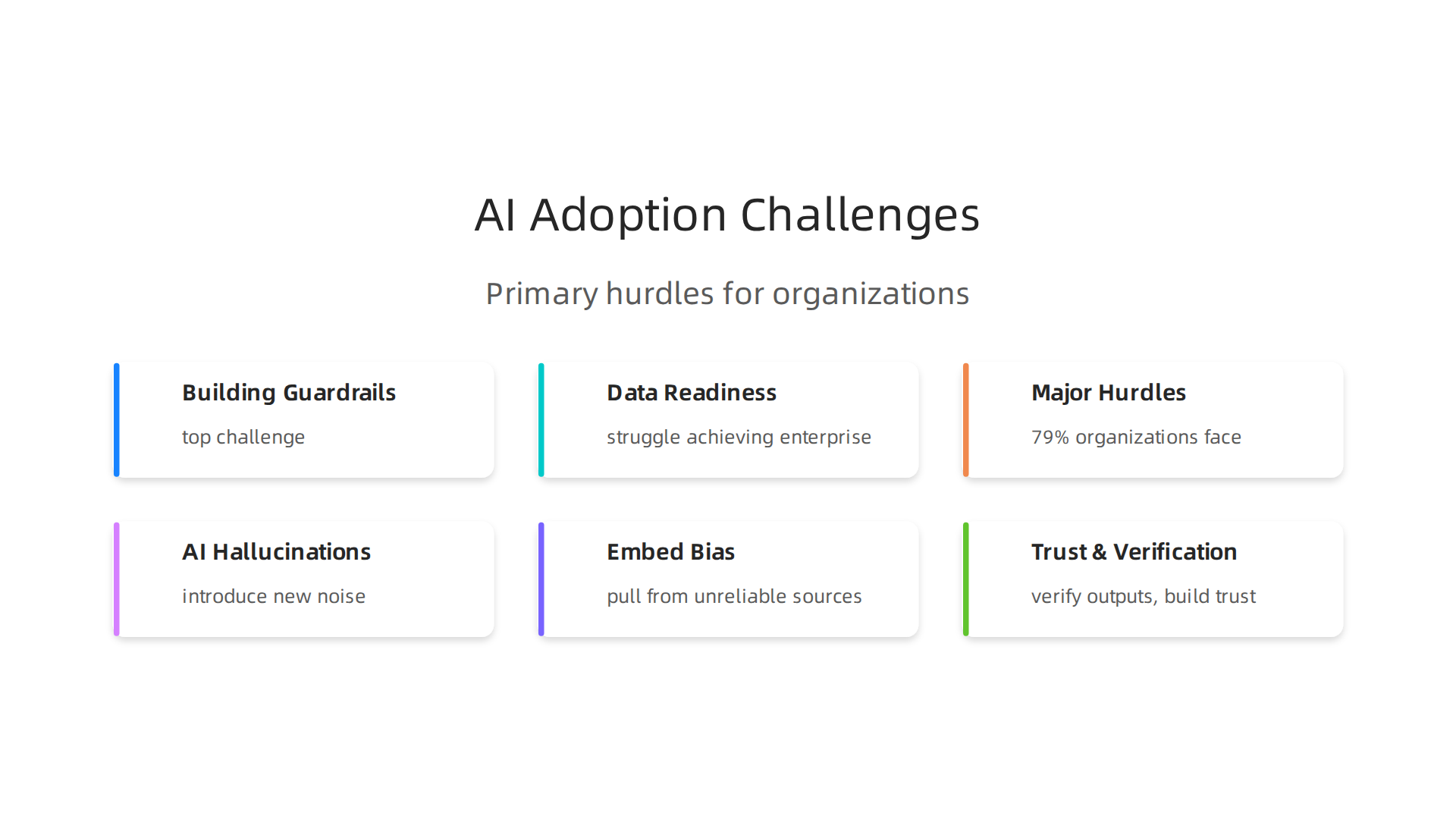
A 2026 survey by K2view found that 76% of companies say building effective guardrails for responsible AI use is a top challenge. And 62% struggle with achieving enterprise data readiness. Another report from Writer shows that 79% of organizations face major adoption hurdles, a double-digit jump from 2025. The tools are powerful, but they can also produce hallucinations, embed bias, or pull from unreliable sources.
This creates a tricky situation. On one hand, AI helps you overcome information overload. On the other hand, it can introduce new kinds of noise if you do not use it carefully. That is why innovation in science advances around AI governance matters so much. Companies that develop stronger governance frameworks actually adopt AI faster. Grant Thornton found that among organizations still just piloting AI, only 7% are very confident they could pass an independent audit of their AI systems. That is a huge gap.
So what does this mean for you as a professional? You need to use AI as a tool, not a crutch. Always verify its outputs. And understand which emerging technologies examples are worth your attention. For a closer look at how these tools are being applied, read about how 81 percent of radiology departments now use AI in medical imaging or see which tools made our list of top AI assistants for developers in 2026. You can also explore how AI with images is transforming business this year.
The bottom line is this: AI has accelerated information access, but it has also raised the stakes. You need to be informed, careful, and strategic. That is the only way to turn AI’s speed into real wisdom instead of just faster noise.
3. Cybersecurity and Digital Trust in the Modern Era
Think about how much of your daily life now happens online. You work remotely, shop, bank, communicate, and even get medical advice through digital channels. That is what being part of the information society really means. But here is the problem: every new connection, every AI tool, and every piece of shared data also creates a new door for attackers.
As our dependence on digital information grows, so does the attack surface. Cybercriminals are smarter than ever. They use AI too, automating phishing attacks, generating convincing deepfakes, and exploiting weak spots faster than humans can react. That is why trust has become the most valuable currency in the digital world. If people or companies lose that trust, they lose everything.
Organizations are spending record amounts to protect themselves. Gartner forecasts that information security spending will reach $244.2 billion in 2026, up 13.3% from the year before (Software Strategies Blog). Other estimates put the number as high as $260 billion (Cybersecurity Dive). That is a massive amount of money, and it shows how serious this issue has become.
So what are companies actually doing with all that spending? Two big trends stand out.
First, zero-trust architecture is now standard. The old model of a strong perimeter and a trusted internal network is gone. Zero-trust means you verify every user, every device, and every request, even inside the building. It is a core part of modern innovation in cybersecurity.
Second, AI-driven security tools are helping teams spot threats in real time. These tools analyze huge amounts of data to find patterns humans would miss. But even the best AI cannot fix the weakest link: people. A single employee clicking a malicious link or reusing a weak password can bring down an entire network. That is why ongoing science advances in user behavior analytics are so important.
Regulation is also shaping how organizations handle data security. The GDPR set the standard in Europe, and in 2026 new laws are emerging around AI accountability and breach reporting. Companies must prove they are protecting customer information. If they fail, the fines and reputation damage can be devastating.
For a closer look at how emerging technologies examples like AI are being applied in specific fields, you can read about how 81% of radiology departments now use AI in medical imaging or see which tools made our list of top AI assistants for developers in 2026. Another useful resource is this artificial intelligence review of how AI with images is changing business.
The bottom line is simple. In the modern information society, cybersecurity is not just an IT problem. It is a business problem, a trust problem, and a personal responsibility. The more you rely on digital tools, the more you need to protect yourself. Stay informed, stay cautious, and never assume you are safe.
4. The Role of Cloud Computing and Edge Technologies
If cybersecurity is about protecting your digital life, cloud computing is what makes that digital life possible in the first place. Think of the information society as a giant machine. The cloud is the engine that powers it. Without cloud services, most of the apps, websites, and tools you use every day would simply stop working.
Here is how big cloud computing has become. As of Q1 2026, AWS, Microsoft Azure, and Google Cloud together control about 66% to 68% of all enterprise cloud spending (Channel Insider, Quantumrun). AWS alone holds roughly 31% of the global market, with Azure around 21% and Google Cloud at about 14% (KodeKloud, Statista). And the growth is not slowing down. A whopping 94% of enterprises now run at least some of their workloads in the cloud (Quantumrun). The public cloud segment is expected to lead, making up 55.88% of the total market in 2026 (Fortune Business Insights).
But here is the thing. Cloud alone is not enough anymore. The information society demands instant responses. Think about an autonomous car that needs to make a split-second decision or a factory robot that must react to a sensor reading in milliseconds. Sending that data to a distant cloud server and waiting for a reply takes too long. That is where edge computing comes in.
Edge computing moves processing power closer to where data is created. Instead of sending everything to a central cloud, devices handle some work locally. This cuts down on lag, saves bandwidth, and keeps sensitive data closer to home. It is a perfect example of innovation in action.
So what does this mean for businesses in 2026? Most companies now use a mix of both. They run a multi-cloud strategy, meaning they use two or more cloud providers at the same time. They also combine public and private clouds into a hybrid cloud setup. This gives them flexibility and prevents them from being locked into one vendor. But it also creates new headaches. Keeping all those different systems working together (interoperability) is tough. And tracking costs across multiple cloud bills can be a nightmare.
The really exciting science advances are happening at the intersection of AI and edge computing, often called AI at the edge. Instead of sending raw data to the cloud for analysis, smart devices run AI models right on the hardware. This is opening up all kinds of emerging technologies examples in the Internet of Things (IoT) and autonomous systems. For instance, smart security cameras can now identify threats in real time without needing a constant cloud connection. And in healthcare, edge AI can process patient data instantly at the bedside.
For a deeper look at how AI is being applied at the edge and in the cloud, you can explore our artificial intelligence review of how AI with images is transforming business in 2026. You might also find it useful to see how 81% of radiology departments now use AI in medical imaging or check out our list of top AI assistants for developers in 2026.
The bottom line is pretty simple. Cloud computing gives the information society its scale and reach. Edge computing gives it speed and responsiveness.

Together, they make modern life possible. And the smartest organizations are learning to use both.
5. The Human Element: Digital Literacy and The Skills Gap
All the cloud servers, edge devices, and AI models in the world will not help if people do not know how to use them. The information society is built on human skills. We need people who can think critically, ask the right questions, and make sense of data. Without those abilities, even the best technology falls flat.
Here is the problem. Many workers are not ready for this reality. A 2026 report from EDUCAUSE found that nearly one third of the U.S. workforce has little to no digital literacy skills (Human-I-T). That is a huge gap. And it is not just about knowing how to use a spreadsheet or send an email. Digital literacy today means understanding how AI works, spotting misinformation, and protecting your data. It is a core skill for every role, not just IT.
The World Economic Forum’s Future of Jobs Report 2025 adds more context.
Employers expect that about 170 million new jobs will be created this decade, but many of those jobs will require skills that most people do not have yet (World Economic Forum). The report highlights a growing need for AI proficiency, data analysis, and cybersecurity know-how. These are not just nice to have. They are survival skills in the information society.
The WEF also points to a new skills triad: carbon intelligence, virtual intelligence, and AI proficiency (World Economic Forum). This mix of environmental awareness, digital collaboration, and machine learning know how will define the next generation of successful workers. In other words, the old way of learning a single trade and sticking with it for life is gone. Innovation in education and training is now a must.
So what can you do about it? Upskilling and reskilling are the answer. Online learning platforms are becoming a vital part of closing the skills gap

(Coursera Blog). And the good news is that science advances are making education more accessible than ever. You do not need a four year degree to pick up a new skill. You just need the willingness to learn.
Take healthcare as one example of emerging technologies examples in action. More and more radiologists are using AI to read scans faster and more accurately. But that only works if the doctors and technicians understand how the AI works and when to trust it. We have covered this trend in depth in our article on how 81% of radiology departments now use AI in medical imaging in 2026. It is a perfect case study of why digital literacy matters at every level.
The bottom line is simple. The information society will only succeed if we invest in people. Technology is powerful. But it is people who make it useful. Whether you are an executive, a marketer, or a factory worker, building your digital literacy is the smartest move you can make in 2026.
6. Strategic Foresight: Turning Trends into Business Decisions
Knowing about the information society is one thing. Doing something with that knowledge is another. The real challenge for B2B professionals is moving from awareness to action. You can read every report about AI adoption, cloud market shifts, and emerging technologies examples. But if you don’t turn that insight into a strategy, it won’t help your business.
Here is the hard truth. Most organizations struggle to turn trends into results. The 2026 survey from Writer.com found that 79% of organizations face challenges in adopting AI, a sharp increase from the year before (Writer.com). Meanwhile, 72% of enterprises have at least one AI workload in production according to McKinsey (MedhaCloud). So most companies are using AI, but most are also hitting roadblocks. The difference between success and failure often comes down to one thing: strategic foresight.
Strategic foresight is not about predicting the future. It is about preparing for multiple possible futures. Two frameworks help with this.
Scenario planning helps you imagine different outcomes. What if cloud costs rise sharply? What if a new AI regulation passes? By thinking through these possibilities now, you can build flexible plans instead of reacting in panic later.
Technology roadmapping helps you plot a realistic path forward. Instead of chasing every shiny new tool, you map out which innovations matter most for your business and when to adopt them. This is where an artificial intelligence review of your current stack becomes valuable. You check what is working, what is not, and what should come next.
Success in the information society requires three things.
Continuous learning. The pace of change is too fast for a single course or book. You need ongoing education. This is where science advances in online learning make a real difference. Platforms now offer bite sized lessons on AI, data analytics, and cloud computing that fit into a busy schedule.
Cross functional collaboration. The best technology strategies don’t come from IT alone. They come from teams that include marketing, operations, finance, and HR. Each group brings a different perspective on what the business actually needs.
External partnerships. You cannot build everything in house. Smart leaders look for partners who have already solved the hard problems. The Grant Thornton 2026 AI Impact Survey shows that organizations with stronger governance structures adopt AI faster (Grant Thornton). That governance often comes from working with external experts who understand compliance, data quality, and risk.
A good place to start is with a focused technology roadmap. Look at one area where innovation can make an immediate difference. For example, many development teams are exploring new tools to boost productivity. You can read our comparison of the top AI assistants for developers in 2026 to see how these tools fit into a roadmap.
The bottom line is simple. The information society rewards those who plan, not just those who react. Take the time to build strategic foresight into your business. Your future self will thank you.
Summary
This article offers a practical roadmap for turning 2026’s overwhelming data landscape into actionable strategic insight. It explains what an information society means today, why the problem is quality and trust rather than quantity, and how accelerating technologies—especially generative AI, cloud/edge computing, and cybersecurity innovations—shape access to and protection of information. You’ll learn the limits and benefits of AI, the rise of zero-trust and AI-driven security, how to choose cloud or edge architectures, and why digital literacy and reskilling are business priorities. The piece also shows how to convert trends into plans via scenario planning, roadmaps, and external partnerships, and it emphasizes simple governance and verification steps so you can adopt technology faster and safer. After reading, you’ll be able to prioritize which innovations matter for your organization, build basic guardrails for AI, and start a focused upskilling and technology roadmap.