
Why Defense Tech Startups Matter Now
The world of defense is changing very fast in 2026. Old ways of doing things are making room for new, smart technologies. Think about things like Artificial Intelligence (AI), self-driving robots, strong cybersecurity to protect online information, and new ways to use space. These advanced tools are becoming super important in the defense world. This big shift means there are huge chances for new defense tech startups to bring their fresh ideas to the table.
Actually, a lot of money is being invested in these companies right now. Reports show that a massive $35.6 billion was put into defense and related startups in just the first half of 2026 alone, showing how fast this sector is growing Defense Tech Funding is Breaking Records, with $35.6B …. This shows just how much these defense tech startups matter today. Businesses and leaders around the world are watching these changes closely as part of the bigger Global Tech Landscape 2026 Strategic Trends for Business.
But here’s a common problem: if you are a leader or someone who makes big choices, it can feel like too much to handle.

There are so many new companies and so many smart ideas. How can you tell which of these defense tech startups are truly important? How do you find the best AI startups or the top SaaS companies that will really make a difference for defense needs? It’s hard to sort through all the information and find the innovations that really count.
This guide is made to help you with that. We will clear up what’s happening in this exciting field. We’ll look at the big trends, how the defense sector buys new technologies, the very newest tech ideas, smart ways for companies to sell their products, and important things to think about regarding risks. By the time you finish this guide, you will have a much clearer picture of the world of defense tech startups in 2026.
Ready to dive deeper into the world of AI and technology trends? Get clear daily AI updates from The Deep View Newsletter.
1) The 2026 defense tech startup ecosystem: size, segments, and where momentum is strongest
Now that you know why these new companies are so important, let’s look closer at the world of defense tech startups in 2026. This world is like a big, busy city with many different parts, all working together to create new defense technologies.

Understanding this "ecosystem" means knowing who the main players are, what types of technology they focus on, and where the most excitement and money are.
First, let’s talk about the main kinds of technology that defense tech startups are building. These are the core "segments":
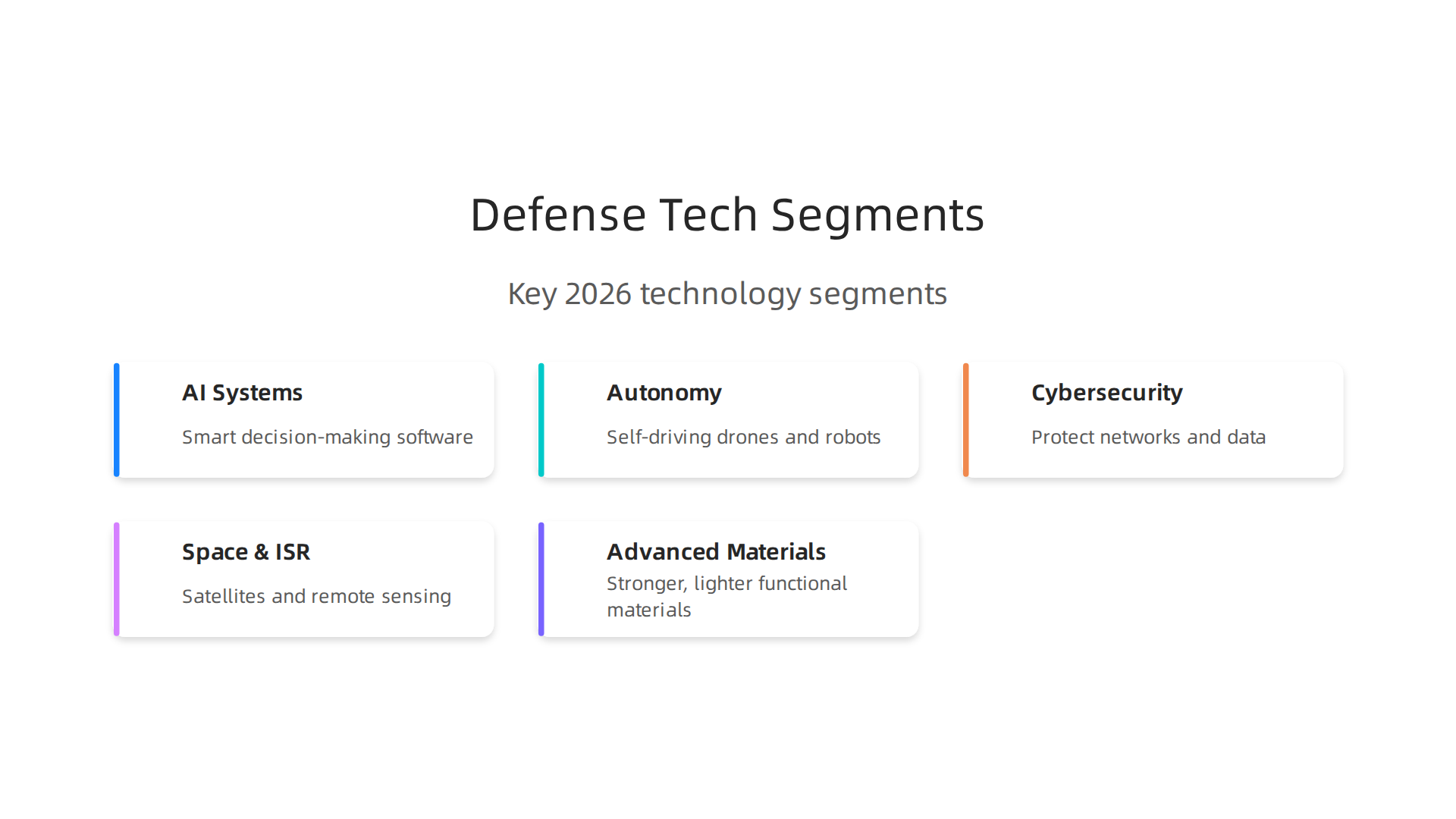
- AI-Enabled Systems: These are smart computer programs that help with everything from making fast decisions to guiding smart weapons. The US government wants to spend a lot of money, about $13.4 billion, on AI and related self-driving tech in 2026 to make these systems better Pentagon Seeks $13.4 bn for AI and Autonomy FY 2026 Budget Request. Buyers are mainly military groups and intelligence agencies looking for the best AI startups.
- Autonomy: Think of self-driving drones, robot soldiers, or uncrewed ships. These systems can work on their own or with very little help from people. This area is seeing a lot of new money and growth Defense Tech 2026: Autonomy, Capital, and Venture Growth. The military is a big buyer here.
- Cybersecurity: This is about protecting important computer networks and data from attacks. With more technology in defense, keeping information safe is super important. Government agencies and military branches are always looking for strong cybersecurity solutions. Some of the top SaaS companies in this space offer special software services for defense.
- Space and ISR (Intelligence, Surveillance, and Reconnaissance): This segment deals with satellites and other tools that watch and gather information from far away. The White House has made outer space a top priority for military tech New White House strategy clarifies military tech priorities. The Space Force and intelligence groups are the main customers.
- Advanced Materials: These are new kinds of materials that are stronger, lighter, or have special features. They are used for better armor, faster planes, or more efficient gear. Defense manufacturers and military research teams buy these.
Now, who are the players in this ecosystem?
- Startups: These are the small, new companies with fresh, bold ideas. They are often quick to try new things and push the limits of technology.
- Prime Contractors: These are the very big, established defense companies. They often work with startups to add new ideas to their larger projects.
- Defense-Focused VCs (Venture Capitalists): These are special investors who put money into defense tech startups. They look for companies with great potential to grow.
- Government R&D Programs: These are special groups within the government that fund research and development for new military technologies.
- Incubators and Accelerators: These are places that help new defense tech startups grow quickly by giving them advice, office space, and connections.
Right now, the biggest attention and money are going to AI-enabled systems and autonomy. These areas are changing fast and promise big advantages. Also, many of these exciting new defense tech startups are popping up in places like Silicon Valley, Boston, and even cities like Albany, New York, where new ideas are always brewing. If you want to dive deeper into how technology research is changing, take a look at the R&D Technology Trends 2026 to see what’s coming next.
Getting money for defense tech startups works a bit differently than for other new companies. While regular startups might chase quick money from many investors, defense tech startups often look to special groups that understand the unique needs of national security.
Let’s look at the main ways these companies get funding:
Government Grants and Contracts
A big way defense tech startups get money is from the government itself. This isn’t just a handout; it’s often smart investments by agencies that need new technology.
- Defense Grants: These are like special gifts of money for specific research and development projects. They don’t make the startup give away a part of their company (called "non-dilutive" funding).
- Small Business Innovation Research (SBIR) awards: These are special programs designed to help small businesses develop new technologies that the government needs. They help turn good ideas into real products.
- Other Transaction Authority (OTA) Prototype Agreements: The government uses these fast-track ways to test out new tech quickly, often with a goal of turning successful trials into bigger contracts. For example, the Defense Innovation Unit (DIU) often uses OTAs for quick prototype contracts with companies that have both military and civilian uses for their products DoD Contracting for Startups 101.
These government paths are very important because they help defense tech startups build and test their ideas without giving up too much control of their company early on.
Specialized Investors and Partnerships
Beyond direct government funding, defense tech startups also get money from investors who truly understand this special market.
- Defense-Focused Venture Capitalists (VCs): These are investors who specifically look for startups creating technology for defense. They know the market well and can provide not just money but also helpful advice and connections. These VCs have been very active; in the first half of 2026 alone, a huge $35.6 billion was invested in defense and related startups Defense Tech Funding is Breaking Records, with $35.6B ….
- Corporate VCs: Sometimes, very large, established defense companies (called "prime contractors") have their own investment arms. They might invest in smaller defense tech startups to bring new ideas into their bigger projects and services. These partnerships can also lead to trial projects that might become large contracts later on NIF Insights: Working with defence primes – key lessons for startups ….
- Strategic Partnerships: Instead of just money, some startups partner with big defense companies like Lockheed Martin or Boeing. These partnerships can give startups the resources and expertise to grow and take on larger projects DoW Contracting for Startups 101.
Different Expectations for Defense Tech
Funding for defense tech startups works differently than for, say, a new social media app.
- Longer Timelines: Defense products often take a long time to develop and test properly. Investors in this space know this and are usually more patient.
- Specific Milestones: Instead of just getting a lot of users, defense tech startups must often show their technology actually works in real-world military settings. They need to pass tough tests and show clear results.
- Investor Expectations: Defense investors care deeply about how well the technology meets a specific government need. They also care about safety, security, and how the technology can be scaled up for widespread use.
- Dilution Trade-offs: Startups always have to decide how much of their company they’re willing to give away (dilution) for funding. In defense tech, sometimes taking less money but keeping more control, especially when working with government grants, can be a better long-term strategy. This helps them stay true to their core mission.
For anyone trying to keep up with the fast pace of technology and its implications for business, understanding these unique funding models is key. The right information can help you make smarter decisions.
To stay on top of the latest advancements and funding trends in technology, consider checking out The AI Newsletter Worth Reading from The Deep View Newsletter. It offers daily insights that can help you understand the broader tech world, including where innovations like those in defense tech are heading.
For anyone trying to keep up with the fast pace of technology and its implications for business, understanding these unique funding models is key. The right information can help you make smarter decisions. But what about the technologies themselves? Where are the biggest changes happening in 2026 for defense tech startups?
3) Technical frontiers: AI, autonomy, cyber resilience, and space-enabled capabilities
In 2026, the world of defense technology is rapidly changing, driven by new ideas in areas like Artificial Intelligence (AI), systems that can act on their own (autonomy), strong cyber defenses, and advanced tools in space. These technical frontiers are where many defense tech startups are making a real difference.
AI and Autonomy Lead the Way
Artificial intelligence is at the very top of military tech priorities for 2026, as outlined by the White House New White House strategy clarifies military tech priorities. The Pentagon is investing a lot, with billions of dollars set aside for AI and autonomy. This money helps bring cutting-edge AI solutions into real-world use for defense Pentagon Elevates AI as Cornerstone of FY2026 Defense Tech.
AI isn’t just a buzzword here; it’s being used to make things like drones, submarines, and decision-making systems much smarter. Think of it as making these systems able to learn and adapt, which is super important for national security. For example, AI is helping to detect and stop threats, even those from smaller, uncrewed aircraft What Are the Top Defense Technology Priorities for 2026?. Startups are particularly good at creating these advanced AI tools. If you’re looking to understand more about these complex systems, check out our guide on Computer Vision AI Roadmap for 2026 Business Decisions.
Autonomy is closely linked to AI. It’s about systems that can work without constant human input. The Department of Defense is even updating its rules to make sure these self-acting weapon systems are used safely and ethically National Security Presidential Memorandum/NSPM-11. This includes everything from autonomous cyber tools that can improve their own defenses, showing how fast AI cyber capability is advancing How fast is autonomous AI cyber capability advancing?, to systems that help soldiers make better decisions faster.
Strong Cyber Resilience and Space Tech
Keeping defense systems safe from hackers and enemies is called cyber resilience. This is another major focus, especially with AI being used to boost cybersecurity. The Cyber Command itself is launching new AI programs in 2026 to develop better cyber tools Cyber Command creates new AI program in fiscal 2026 budget. Defense tech startups are often at the forefront of creating these advanced protections.
Beyond Earth, space is becoming a vital area for defense. In 2026, "Space Control" is a key idea, focusing on using space-based tools to counter threats and ensure freedom of action in space Countering threats and enhancing operations: Our 2026 technology. This involves advanced space sensors and secure communication systems that work reliably, even under attack.
Bringing it All Together
One big challenge for defense tech startups is making sure all these different technologies work well together. This means solving problems with:
- Interoperability: Can a new AI system from one company talk to a drone system from another?
- Latency: Do messages and commands get through fast enough for real-time action?
- Security: Are all parts of the system safe from being hacked or jammed?
Startups are really good at finding new ways to solve these tricky problems. They can move faster than big companies and often come up with clever solutions that have both military and civilian uses. For example, many of the best AI startups and top SaaS companies are building software platforms that can be adapted for defense, offering quick, innovative solutions. They provide asymmetric value, meaning a small, smart solution can have a very large impact. You can learn more about general innovation in our overview of R&D Technology Trends 2026.
Dealing with these cool new technologies is one thing, but getting them into the hands of the military means understanding how the government buys things. This process has its own special rules, called procurement, along with strict controls on who can get the technology and where it can go.

For defense tech startups, knowing these steps is super important in 2026.
How Government Buys Tech from Startups
The government has a few main ways to work with defense tech startups:
- Small Business Programs: Two of the most common ways are the Small Business Innovation Research (SBIR) and Small Business Technology Transfer (STTR) programs. These are designed to help small businesses like yours develop new technologies for the government. They were made stable again through 2031 with a new law in 2026, offering clearer paths for funding Second Quarter 2026 Government Contracts Policy and Regulatory Review. There’s even a new way for companies to get more money and faster contracts if their tech is really useful to soldiers FY2026 NDAA: The Most Important Provisions for Defense Tech. You typically submit proposals through the Department of Defense SBIR/STTR Innovation Portal.
- Faster Contracting with OTAs: Sometimes, the government wants new technology very quickly. This is where "Other Transaction Authorities" (OTAs) come in. Groups like the Defense Innovation Unit (DIU) and AFWERX use OTAs through programs called Commercial Solutions Openings (CSOs) to bring in new tech faster than old ways of buying things Defense procurement in 2026: DIU, AFWERX, OTA. These paths help defense tech startups get their innovations to the military without as much paperwork.
Strict Rules: Export Controls, Classification, and Supply Chains
Working with defense technology also means following very strict rules about what you can make and who you can share it with.
- Export Controls: These rules stop sensitive technology from falling into the wrong hands. The main ones are the International Traffic in Arms Regulations (ITAR) and the Export Administration Regulations (EAR). If your technology is under these rules, you might need special licenses to send it outside the U.S. DEPARTMENT OF DEFENSE – DoD. Not getting the right license on time can cause big problems https://www.dodsbirsttr.mil/submissions/api/public….
- Security Clearances: When a company deals with secret government information, it needs a special approval called a facility security clearance. This means some of your team members might need personal security clearances, which is a thorough background check Scaling US Defense Tech in 2026 and Beyond. If your company has owners or important leaders from other countries, this can also bring up issues about "Foreign Ownership, Control, or Influence" (FOCI), which the government looks at very closely FOCI and the SF-328: What Foreign Ownership Does to ….
- Supply Chain Security: The government wants to know exactly where all parts of your technology come from. This is to make sure no enemy can sneak bad parts or software into defense systems. In 2026, companies need to show a full list of all parts and how they trace back to their origins, along with clear steps to keep the supply chain safe Securing America’s Defense Supply Chains and Ensuring Domestic …. This also means making sure your cloud systems are secure with certifications like FedRAMP and your overall cybersecurity is strong with CMMC (Cybersecurity Maturity Model Certification) DoW Contracting for Startups 101.
Practical Checklist for Founders
Before your defense tech startup dives into government contracts, here’s a quick checklist to help:
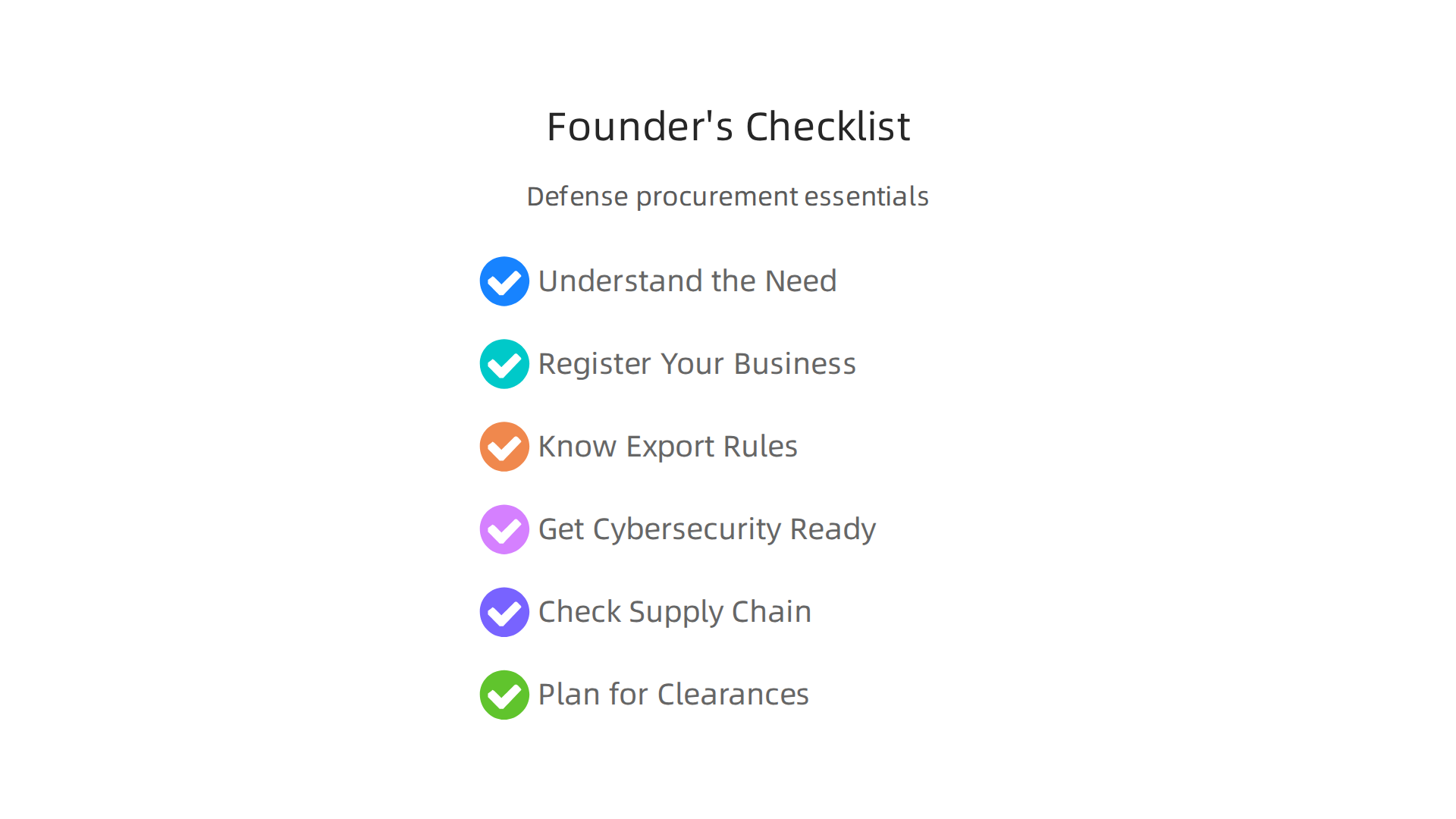
- Understand the Need: Make sure your solution truly solves a specific military problem DIU CSO Guide for Startups: How to Get DIU Funding (2026).
- Register Your Business: Get your small business registered in the right systems.
- Know Export Rules: Find out early if your tech needs export licenses and apply for them.
- Get Cybersecurity Ready: Work towards FedRAMP certification for cloud products and meet CMMC standards for cybersecurity.
- Check Your Supply Chain: Be ready to show where all your components come from and how you keep them safe.
- Plan for Clearances: Understand that some roles will need security clearances, which can take time.
Navigating these rules can be complex, but for defense tech startups, it’s a necessary step to bring their important innovations to national security. To stay informed about broader trends that affect the industry, consider exploring the Global Tech Landscape 2026 Strategic Trends for Business.
For those who want to keep up with the fast-moving world of AI and other tech trends, staying informed daily is a huge advantage. Get clear daily AI updates from The AI Newsletter Worth Reading.
Knowing the rules is a great first step. Now, let’s talk about how defense tech startups actually sell their cool inventions to the government and work with bigger companies. This is called your "go-to-market" plan, and it’s key for growing your business in 2026.
Go-to-Market Strategies and Partnerships for Scaling in Defense Markets
When you’re a defense tech startup, you usually have two main ways to sell your products: directly to the government or by partnering with bigger defense companies, known as "primes."
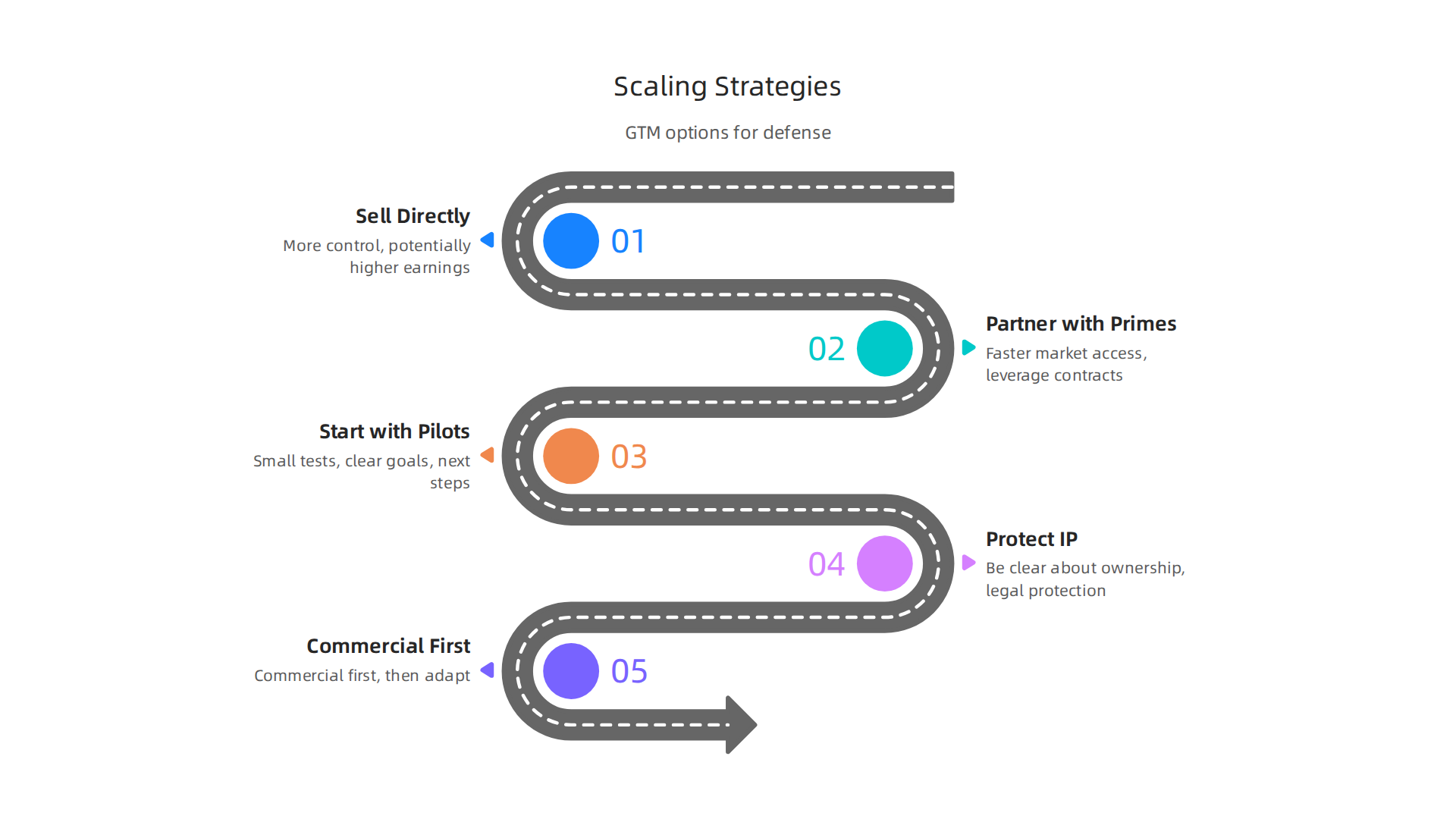
Each path has its own good and bad points.
Selling Directly to the Government
Selling directly means your defense tech startup works right with government agencies.
- Good things: You have more control over your product and how it’s used. You can also potentially earn more money since you don’t share profits.
- Challenges: It can be harder and slower because you have to learn all the government’s buying rules. You also need to build trust from scratch. Many direct sales start with small projects or "pilots" to show your tech works. The Department of Defense (DoD) often begins working with small companies through these pilot projects Pilot to Production, Leaping the Valley of Death in Defense Contracting.
Working with Prime Contractors
Prime contractors are large companies like Lockheed Martin or Boeing that already have big contracts with the government. Your startup becomes their partner or a subcontractor.
- Good things: This can be a much faster way to get your technology to the military. Primes already know the government’s needs and how to handle paperwork. They can help your defense tech startup scale up quickly DoD Contracting for Startups 101.
- Challenges: You give up some control and have to share profits. You also need to make sure your important ideas (intellectual property or IP) are protected in any agreements.
How to Build Strong Partnerships
No matter which path you choose, good partnerships are vital. Here’s what to think about:
- Start with Pilots: Many government groups start with small tests or "pilots" of your technology. It’s important to set clear goals for these tests and talk about what will happen if your tech performs well. Your pilot agreement should define what success looks like and what the next steps are if it works Defense startup go-to-market. Sometimes, these can even be no-cost pilots to get your foot in the door quickly How to land and convert your first defense pilots.
- Data and IP: Be very clear about who owns the data and intellectual property (IP) created during a project. This protects your startup’s core technology.
- Money Matters: Understand how you’ll get paid. Will it be a fixed amount, or based on your costs plus a fee?
Dual-Use Products: Commercial First
Many defense tech startups create "dual-use" products. This means their technology works for both military and everyday commercial customers. Think about AI software that helps analyze videos for security, which could also help businesses understand customer behavior.
For these startups, a "commercial-first" strategy often makes sense. You build your product for the commercial market first. This lets you get feedback, improve your tech faster, and grow your sales outside of government contracts. Then, you adapt and sell the same core technology to defense customers. This way, you keep your commercial business strong while also helping national security.
Keeping up with how technology changes can really help you figure out your best strategy. To see how things like artificial intelligence are changing many different industries, you might want to explore articles on Mastering computing innovation for business success in 2026 or Unlocking tech driven business potential in 2026.
To succeed, your defense tech startup also needs to think carefully about its people, keeping secrets safe, and doing the right thing. These are big parts of being a strong business in 2026.
Talent, Security, and Operational Risks: Building a Resilient Defense Tech Startup
Growing a defense tech startup means you must pay close attention to who you hire, how you protect your valuable information, and the bigger picture of what your technology can do.
Finding the Right People: Talent Challenges
One of the biggest hurdles for defense tech startups is finding people with the right skills and clearances.
- Security Clearances are Key: Many jobs in defense require a special security clearance. This means employees have been checked by the government and are allowed to see secret information. Finding people who already have these clearances can be tough, and getting new ones takes a lot of time and money Defense Industry Recruiting Guide: Finding Cleared Talent 2026. In 2026, a top-secret clearance can cost over $6,000 Is The Nispom Still A Manual…. This makes it hard to hire quickly. Often, companies need to look for candidates who already hold the necessary clearance Security Clearance Staffing DMV: Why It Matters in 2026. Also, if your company has foreign ownership, it can make it harder to get access to classified information FOCI and the SF-328: What Foreign Ownership Does to ….
- Cross-Domain Engineers: Your team needs people who understand both advanced technology and the specific needs of the military. These "cross-domain" engineers can bridge the gap between complex tech ideas and practical defense uses.
- Other Ways to Build Your Team: Sometimes, working with contractors or academic groups can help fill talent gaps. They can provide skilled help for specific projects without the full hiring process. When thinking about your team’s skills, it’s good to keep up with how to find and interview for cutting-edge roles, especially in AI. You might find resources like The tech interview handbook 2026 master AI and emerging tech roles helpful.
Keeping Your Secrets Safe: Operational Security
Defense tech startups deal with sensitive information. Protecting your unique ideas (intellectual property) and systems from harm is super important.
- Intellectual Property (IP) Protection: Make sure your patents, software code, and special designs are legally protected. This stops others from stealing or copying your innovations.
- Cybersecurity Practices: You must have strong digital defenses to keep your data and systems safe from hackers. This means using good passwords, secure networks, and always checking for weaknesses.
- Supply Chain Risks: Even if your company is secure, the companies you buy parts or services from can be weak links. "Supply chain risk" means a bad actor could mess with the design or function of your product through one of your suppliers MEMORANDUM FOR. The government requires companies to have plans to make sure all parts of their supply chain are secure, including checking on the people who work for suppliers Securing America’s Defense Supply Chains and Ensuring Domestic …. This includes careful checks on outside companies you work with to make sure their cybersecurity is strong Cybersecurity Supply Chain Risk Management Practices ….
Doing the Right Thing: Governance and Ethical Choices
Many defense tech startups create powerful new tools. This brings up important questions about how these tools are used.
- Dual-Use Systems: As discussed, many technologies have both military and non-military uses. Think about AI that can improve targeting systems, but also help doctors find diseases. Startups need to think about the possible negative uses of their technology.
- Lethal-Capable Systems: If your technology could be part of weapons or systems that cause harm, ethical questions become even more serious. You need clear rules and oversight to ensure your technology is used responsibly and within legal and moral bounds. This often means having strong internal policies and understanding broader guidelines, such as those related to AI policy the 2026 roadmap for business compliance and trust.
Staying on top of these complex issues is key for any growing defense tech startup. It helps build trust and makes sure your company is seen as a responsible partner. If you want to keep up with the latest in AI and other tech developments that could impact your strategic decisions, consider subscribing to The AI Newsletter Worth Reading from The Deep View Newsletter for clear daily AI updates.
Growing a defense tech startup means you must pay close attention to who you hire, how you protect your valuable information, and the bigger picture of what your technology can do.
Emerging Companies and Illustrative Case Examples (What Worked, What Didn’t)
It’s exciting to see how many new defense tech startups are finding ways to grow and make a real impact. Many have different starting points and face unique challenges. In fact, funding for defense tech startups is reaching new highs. For instance, in the first half of 2026, over $35.6 billion was invested in defense and related startups, which is a big jump from the year before Defense Tech Funding is Breaking Records, with $35.6B ….
Let’s look at a few made-up examples to see different paths these companies take.
Different Paths to Success
-
From Grants to Contracts: "Innovate Solutions"
- "Innovate Solutions" started small, focusing on research and development (R&D) helped by government grants like Small Business Innovation Research (SBIR) awards. These grants allowed them to build a special drone for monitoring large areas. The trick for them was to turn successful small tests (pilots) into bigger, long-term contracts. They learned that showing their technology worked in real-world situations, not just labs, was key. Many startups use these grants to get started, then aim to move from a pilot project to an official program Defense startup procurement cycle: from pilot to program of record.
-
Teaming Up with Big Players: "Apex Systems"
- "Apex Systems" had a smart AI-powered software but was a small team. They decided to partner with a much larger, established defense contractor (often called a "prime" contractor). This partnership helped "Apex Systems" get their software into bigger military systems and access larger contracts they couldn’t get alone. The challenge was making sure their fast startup pace matched the bigger company’s slower ways. Working with these prime partners can open many doors for defense tech startups Working with defence primes: key lessons for startups.
-
Commercial First, Then Defense: "Dual-Use Tech Co."
- "Dual-Use Tech Co." first made amazing battery technology for electric cars and drones in the commercial world. Their tech was super efficient. Then, they saw a chance to adapt their batteries for military vehicles and equipment. They had to change their designs to meet strict military rules for toughness and security. This path let them build a strong business first, then add defense as a new market, using their technology in two ways.
Big Choices for Founders
Defense tech founders often face tough decisions. Should they accept classified work that brings more money but means more rules and slower progress? How do they make sure their product truly fits the specific needs of the military? Or how do they pay for making their products in large numbers? These choices can make or break a company. Learning about the global tech landscape in 2026 can help founders make better decisions.
What Investors Look For
For investors and venture capitalists (VCs) looking at defense tech startups, there are key things to check:
- Strong Team: Does the team have the right technical skills and necessary security clearances?
- Unique Ideas (IP): Are their special designs and technologies well-protected?
- Clear Path to Customers: Can the startup clearly show how they will move from small tests to big government contracts? They need a plan to get beyond just pilot programs How to land and convert your first defense pilots.
- Market Understanding: Do they really understand what the military needs and how to sell to them?
- Growth Potential: Can their technology be made in large numbers to meet big demands?
- Funding Trends: Investors closely watch overall funding for defense tech, which continues to grow. For example, in 2025, venture capital deals in defense technology reached a record $49.1 billion Defense tech startups had their best funding year ever in 2025.
Understanding these paths, choices, and investor interests can help defense tech startups grow stronger and safer in 2026.
Summary
This article explains why defense-focused tech startups are central to national security and commercial opportunity in 2026, and walks readers through the full ecosystem: the technology segments gaining momentum (AI, autonomy, cybersecurity, space, materials), who the main players are, and how money flows from grants to specialized VCs and strategic partnerships. It explains the technical frontiers shaping product design and integration challenges—interoperability, latency, and supply-chain security—and lays out how governments buy technology, the export and clearance rules founders must plan for, plus practical go-to-market routes (direct sales, pilots, and teaming with prime contractors). The guide also covers talent and operational risks, IP and ethical considerations for dual-use or lethal-capable systems, and offers concrete founder checklists and illustrative company examples to show what works and what doesn’t. Readers will finish with a clearer roadmap for funding, compliance, partnerships, and scaling defense tech in 2026.