

Why computer vision ai matters in 2026 — a concise roadmap for decision-makers
In 2026, understanding computer vision ai is no longer just for tech experts. It’s a must-have for everyone who makes important business decisions.

Think about how you build new products, how your company runs day-to-day, and where you choose to invest your resources. Computer vision AI is deeply changing all these areas. It is quickly becoming one of the smartest ai tools available to us, giving machines new "eyes."
This advanced kind of AI allows computers to "see" and understand the real world through pictures and videos, much like people do. This means machines can now handle tasks that once strictly required human observation. For your products, computer vision can add smart features, like helping cars spot dangers on the road or making sure items are perfect before they leave the factory. In daily operations, it can boost efficiency by watching security feeds, managing inventory, or even helping in farming to check crop health. For smart investment decisions, truly grasping computer vision ai helps you spot the next big opportunities and avoid pitfalls. This technology is also a key part of multimodal ai systems, which combine different types of data, leading to more complete and contextual ai solutions. This powerful intelligence fusion allows for deeper understanding and faster responses in complex situations.
This article is here to give you a clear, honest guide. We promise a balanced, evidence-first look at computer vision AI. We will start by explaining its core technical building blocks in simple terms. Then, we will show you real-world examples of how businesses are adopting and benefiting from this technology right now. Crucially, we will also cover the important governance considerations, which are the rules and guidelines for using this powerful AI responsibly and ethically. For instance, many global bodies are creating frameworks to ensure AI is developed and deployed safely, as highlighted by resources like the International AI Safety Report 2026. Our goal is to help you cut through the noise and focus on what truly matters for your strategic product choices, operational improvements, and investment plans. To better understand how these kinds of advanced systems fit into the broader tech world, you might want to read about mastering computing innovation for business success in 2026.
For even more daily insights into how AI is shaping the world, you might like to get The AI Newsletter Worth Reading.
Fundamentals: What ‘computer vision ai’ actually means today
So, what exactly is computer vision AI? At its heart, it is about teaching computers to "see" and make sense of visual information. Think of it like giving a machine eyes and a brain to understand what those eyes are looking at. This includes everything from single pictures to live video streams. In 2026, this technology is like one of the smartest ai tools we have for understanding the world visually.
When we talk about computer vision, we are really talking about two big ideas working together:
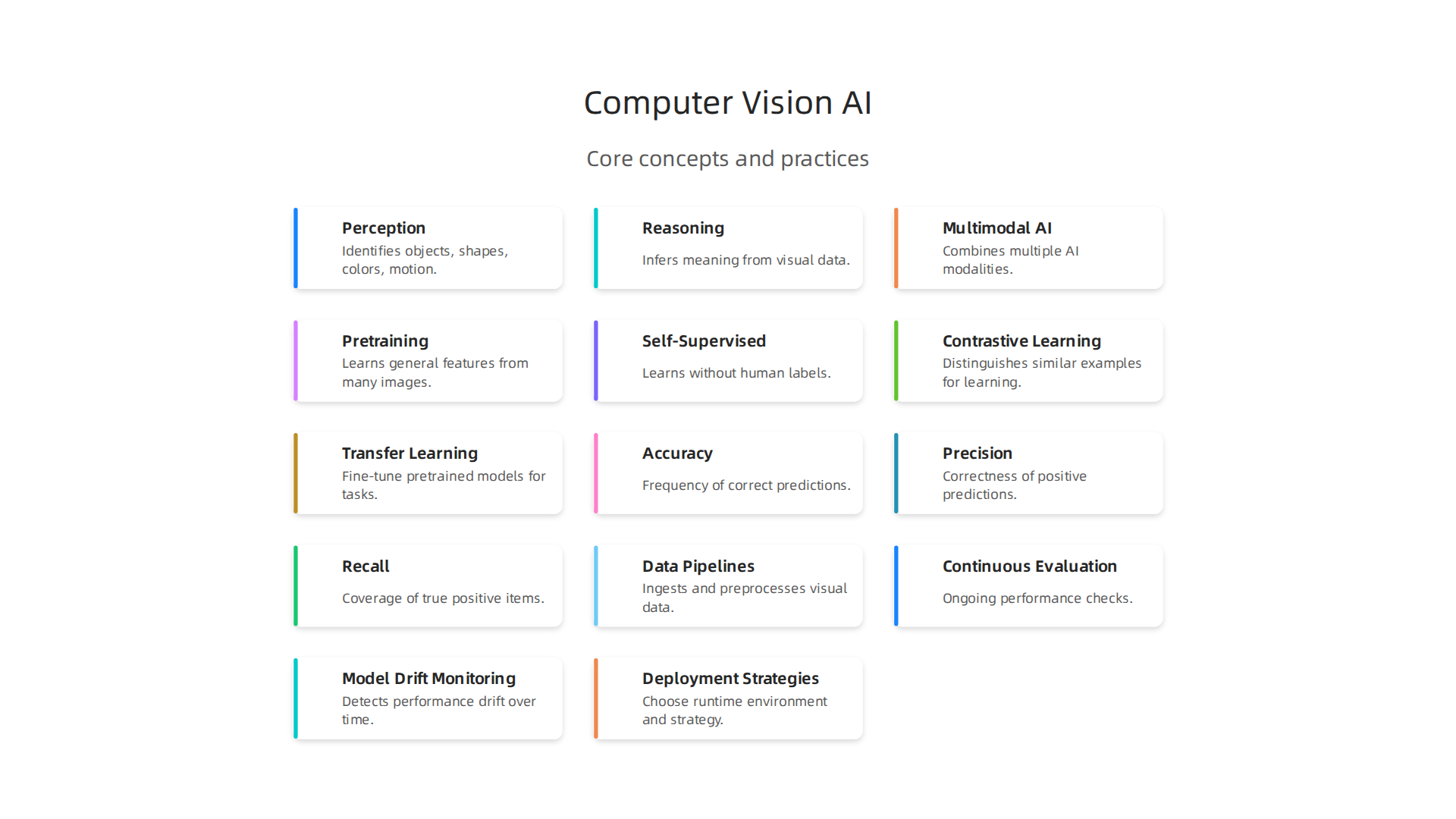
- Perception: This is the "seeing" part. It is when the computer identifies objects, shapes, colors, and movements. For example, a computer vision system can tell if there is a cat in a picture, or if a person is walking or running in a video. It is about what the eyes pick up.
- Reasoning: This is the "understanding" part. After seeing, the computer tries to figure out what it all means. Why is the cat there? What is the person doing? Is the person running away from something or towards something? It is about thinking about the visual information to make smarter decisions.
These two parts work together. For instance, in 2026, many systems use advanced methods called "Vision Transformers" to process images and videos. These are like highly skilled detectives for visual data, helping AI systems to perceive and reason more accurately than ever before. Research shows how these transformer models are becoming very important in computer vision, often doing better than older methods in many tasks related to images and video, as explained in A Comprehensive Survey of Recent Transformers in Image Processing.
Computer vision ai does not work alone. It often joins forces with other types of AI. For example, when computer vision identifies a person’s emotions from their face, it might then send that information to Natural Language Processing (NLP) to help a chatbot understand how to talk to that person. This mix of different AI types is called multimodal ai. It allows for a richer, more contextual ai understanding of situations, leading to powerful intelligence fusion. Instead of just seeing, it is seeing and hearing, and even understanding language, all at once.
A common misunderstanding is thinking computer vision is just about taking pictures. Actually, it is about interpreting them. It is not just a camera; it is a camera with a super smart brain attached. It is also important to remember that while computer vision is very good at tasks like finding things in photos or tracking movement, it still needs clear instructions and a lot of training data to work well. It does not "know" things on its own, but learns from what it is shown, getting smarter over time.
To really grasp how AI works across different fields, including vision, it helps to understand the core ideas. You can learn more by reading our guide on Artificial Intelligence Explained: A Clear Guide for Thinking Humans.
Core techniques and building blocks: models, pretraining, and transfer learning
To make computer vision AI truly "see" and "understand," it needs special tools. These tools are often called models or architectures. Think of them as different kinds of brains that help the computer make sense of pictures and videos.
One older, but still important, type of brain is called a Convolutional Neural Network, or CNN. These models are very good at finding patterns in images, like edges, shapes, and textures. They work a bit like shining a spotlight over small parts of an image to find clues. Many older computer vision systems still use CNNs for tasks like finding objects in pictures, as discussed in research on Semi-Supervised Object Detection: A Survey on Progress from CNN to Transformer.
But in 2026, a newer, more powerful type of model is taking over: the Vision Transformer, or ViT. You heard about Vision Transformers in the last section. These are like super detectives for visual data. Instead of just looking at small parts, they can look at how all the different parts of an image relate to each other at the same time. This makes them very good at complex tasks. Many studies show how important Vision Transformers are becoming in computer vision, often doing better than older methods in many tasks involving images and video. Experts continue to track their development, as noted in surveys on Vision Transformers and their CNN-Transformer based Variants and Decoding vision transformer variations for image classification.
Now, here’s a smart trick these models use:
-
Pretraining: Imagine you want to teach a child to read. You wouldn’t start by giving them a brand new, hard book. You’d teach them letters and simple words first. Pretraining is similar. We first teach a computer vision model by showing it millions and millions of pictures and videos. The model learns general things about the world, like what a cat or a car looks like, even without being told specific names for everything. This general learning makes the model a lot smarter from the start.
-
Self-Supervised Learning: This is a very clever way to pretrain. Instead of needing a human to label every single picture (like saying "this is a cat," "this is a dog"), the model learns on its own. It might be shown a picture with a missing piece and tries to guess what’s gone. Or it might compare two slightly different versions of the same picture to find similarities. This kind of "learning by itself" is called self-supervised learning, and it helps a lot because humans don’t have to do all the labeling. It is like teaching itself by playing visual puzzles. Research explores different ways this works, including A Survey of the Self Supervised Learning Mechanisms for Vision Transformers.
-
Contrastive Learning: This is a type of self-supervised learning. Here, the model learns by telling similar things apart from different things. For example, it learns that two different pictures of the same cat are more alike than a picture of a cat and a picture of a tree. This helps the model build a strong internal understanding of different objects. Methods like masked autoencoders (MAE) and contrastive learning are important for self-supervised pre-training.
-
Transfer Learning: After a model has been pre-trained on a huge amount of general data, it’s already quite smart. Now, if you want it to do a very specific job, like finding a rare type of defect on a factory line, you don’t need to start from scratch. You take the already pre-trained model and give it a smaller set of specific pictures related to that defect. This is called transfer learning. You are simply "transferring" the general knowledge it already has and fine-tuning it for a new task.
These methods are like magic for computer vision ai. By using pretraining and transfer learning, companies can build powerful and useful computer vision systems much faster and with less cost. They don’t need to gather as much special data for every new project. This makes computer vision AI more accessible and helps create more of the smartest AI solutions we see today, driving faster product timelines and making smarter tech investments possible. If you are looking to understand more about investing in smart technology, a guide like Science Machine: Your Blueprint for Smarter Tech Investment could be helpful.
Datasets & benchmarks: what to trust and how to evaluate data readiness
Even with the smartest models and clever learning tricks like pretraining, computer vision AI is only as good as the information it learns from. Imagine trying to teach a child to recognize animals, but showing them blurry pictures or calling a cat a dog sometimes. The child would get confused. The same is true for computer vision AI. The data we use to train these systems is super important.
The Power of Data: Labeled and Synthetic
To make computer vision AI truly smart, it needs a lot of examples. These examples come in the form of datasets. A dataset is like a giant photo album filled with pictures or videos. For the AI to learn, these pictures often need "labels." This means a human has looked at each image and drawn boxes around objects, identifying them as "car," "person," or "traffic light." These are called large labeled datasets. They are the foundation for training many computer vision models, helping the AI understand what it’s looking at. Experts often review many such datasets to track progress in the field, as shown in a review of object recognition datasets. For example, a specialized collection called VISION Datasets for industrial inspection helps AI find tiny flaws in factory products.
But sometimes, getting real-world labeled data is hard. It can be costly, take a long time, or involve private information. This is where synthetic data comes in. Synthetic data is fake data, created by computers. Think of it like a video game world where you can make endless scenes and label everything perfectly, without needing real cameras or human help. This fake data can be just as good, or even better, for training AI, especially for rare events or things that are hard to photograph.
The most important part of any dataset, real or synthetic, is annotation quality. This means how well and how accurately the pictures are labeled. If the labels are messy or wrong, the computer vision AI will learn bad habits. High-quality labels mean the AI can learn faster and be more accurate, leading to a truly intelligent AI solution.
Benchmarks: How We Measure AI Performance
Once you’ve trained a computer vision AI model, how do you know if it’s actually good? You test it! That’s where benchmarks come in. Benchmarks are like standardized tests for AI models. They are specific collections of data with known answers that everyone uses to see how different AI models perform. By using benchmarks, we can compare one AI model against another fairly, seeing which one is the "smartest AI" for a particular job. These benchmarks help us understand the strengths and weaknesses of different computer vision AI systems. You can find up-to-date lists of leading models and their scores on various Computer Vision SOTA Benchmarks.
When looking at these tests, we use evaluation metrics. These are numbers that tell us how well the AI did. Common metrics include:
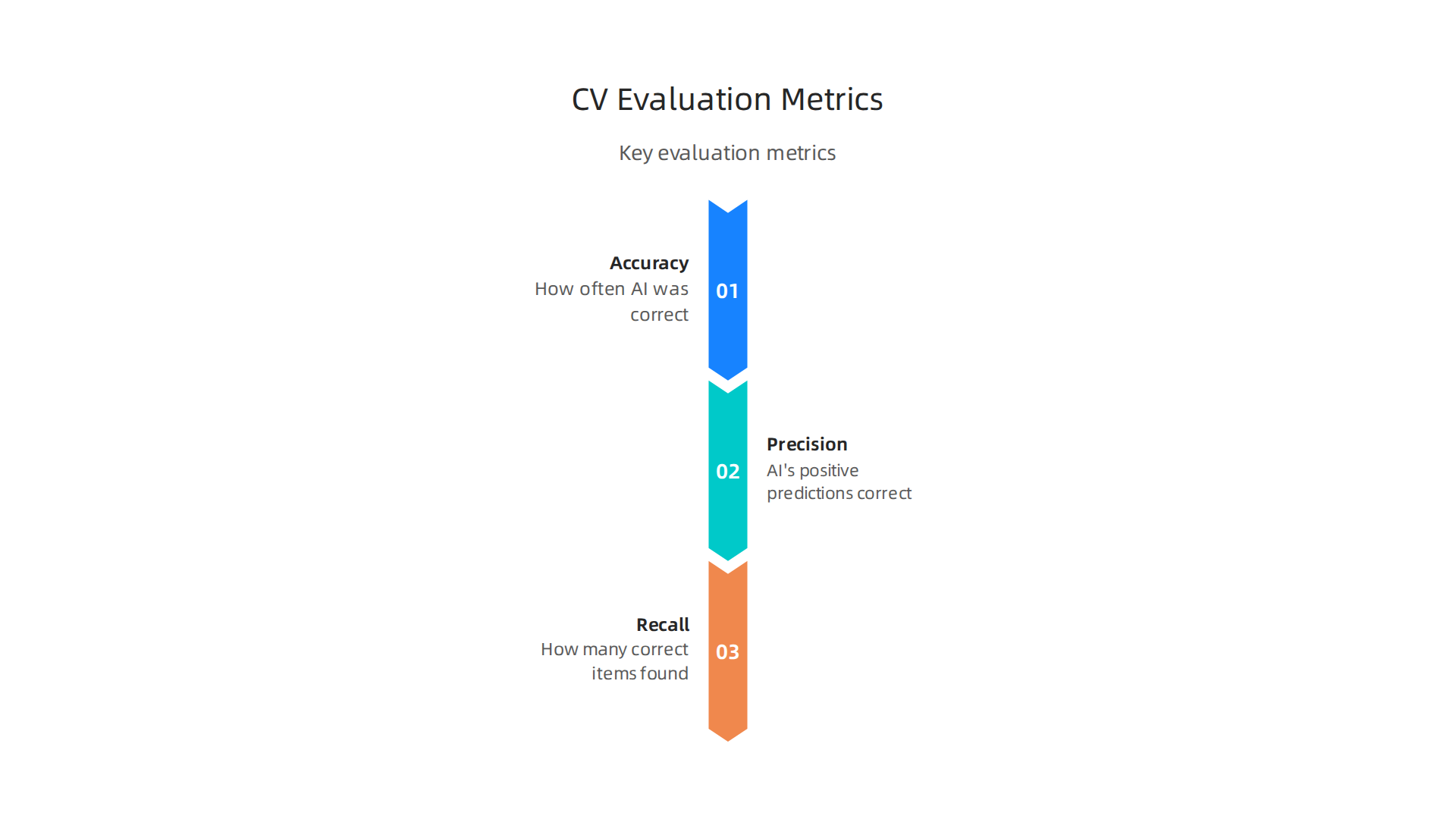
- Accuracy: How often the AI got the right answer.
- Precision: How many of the AI’s positive predictions were actually correct.
- Recall: How many of the actual correct items the AI found.
For businesses, understanding these metrics is key. A model might have high overall accuracy, but poor recall for a very important item, like a safety hazard. Or a model might be great at spotting objects but slow to make decisions, which isn’t good for real-time needs. Different tasks need different focuses. For example, a summary of evaluation datasets might show various metrics for different object detection and counting tasks. Newer benchmarks, like OmniDocBench for document analysis, are even created to provide high-quality tests for more complex, diverse types of visual information.
Choosing the right benchmarks and understanding what the metrics mean for your specific business goal is vital. It helps you pick the right computer vision AI solution and know what to trust. This careful evaluation is part of mastering computing innovation for business success in 2026. It helps you make sure the AI isn’t just "smart" in a lab, but also effective in the real world, aligning with the ways how artificial intelligence with images is transforming business in 2026. You need to evaluate incredible technologies for business growth carefully to ensure you invest in the right systems.
After understanding what makes good data and how to test AI models, the next step is to look at how these smart brains, the computer vision AI models themselves, are built. Think of it like a car engine. You can have the best fuel (data) and run it on a great test track (benchmarks), but the engine’s design still matters a lot for how well it performs.
The Evolution of AI Vision: From Specialized to Smartest AI
For a long time, a type of AI called Convolutional Neural Networks, or CNNs, were the stars of computer vision AI. These models are really good at picking out patterns in pictures, like finding edges, shapes, and textures. They were designed to work much like how we thought our own brains see things, looking for small details and building them up. CNNs have been very successful in tasks like finding objects in images or sorting pictures into categories. Surveys from 2026 show how important foundational architectures like CNNs were for early vision tasks Deep learning approaches in computer vision.
However, in recent years, a new type of architecture called Transformers has become very popular. Transformers first made a big splash in understanding language, but they turned out to be really good at vision tasks too. What makes them special is their ability to look at a whole image at once and understand how different parts relate to each other. This gives them a deeper understanding of the "context" of an image. This shift from CNNs to Transformers is a big topic, with many papers discussing the evolution of object detection and other tasks The evolution of object detection from CNNs to transformers and beyond. They help create a more contextual AI.
Today in 2026, you’ll often see a mix. Many advanced computer vision AI systems use hybrid models, which combine the best features of CNNs and Transformers. This means they can be great at spotting fine details while also understanding the bigger picture. Surveys highlight the development of these hybrid CNN-Vision Transformer models Decoding vision transformer variations for image classification.
For a deeper dive into how these and other amazing technologies are shaping the business world in 2026, explore all our in-depth articles on Artificial Intelligence.
What This Means for Your Business: Trade-offs
This move to newer, more complex models brings both good things and some challenges:
- Accuracy: Generally, newer Transformer-based models can be more accurate, especially for difficult tasks or when the AI needs to understand complex relationships in an image. They help build truly smartest AI systems. For example, some models can reach very high accuracy on standard tests Foundations and Models in Modern Computer Vision.
- Compute (Power Needed): The downside is that these fancy new models often need a lot more computing power to run. This can make them more expensive to use, especially for big projects.
- Latency (Speed): Because they are more complex, some Transformer models can also be slower to give an answer. For things that need quick decisions, like self-driving cars, speed is super important.
- Intelligence Fusion and Multimodal AI: The new architectures also make it easier for AI to combine different types of information. This is called multimodal AI. Imagine an AI that not only sees a picture but also understands the text next to it. This kind of intelligence fusion allows for even smarter and more helpful applications.
Recent Innovations Making AI Even Better
Researchers are always working to make these powerful models better and more practical. One big area of focus is making Transformers more efficient.

This means finding ways for them to achieve high accuracy without needing as much computing power or being as slow.
Another important trend is "self-supervised pre-training." This is like letting the AI learn a lot about pictures on its own before we teach it specific tasks. It helps the AI build a strong foundation of knowledge, much like a child learning about the world before starting school. Methods like masked autoencoders help Vision Transformers learn from lots of unlabeled data Published as a conference paper at ICLR 2025. This helps create truly intelligent AI solutions that can adapt to many situations.
Understanding these different ways that computer vision AI models are built helps businesses choose the right tools for their needs. It’s about finding the balance between how smart an AI is, how much it costs to run, and how fast it can work.
To make sure you’re always one step ahead, get your daily dose of AI and tech insights with The Deep View Newsletter.
Now that we’ve seen how different smart computer vision AI models are built, let’s talk about what they can actually do for businesses. It’s not just about cool technology; it’s about making money and saving costs. Many companies in 2026 are already using these smart systems to get real results.
Practical Applications & Industry Use Cases That Drive ROI
Computer vision AI helps businesses in many ways by letting machines "see" and understand the world around them. This leads to clear benefits like making things better, faster, and cheaper. Think of it as giving your business a new pair of super-powered eyes.
In the Factory: Making Things Perfectly
Manufacturing is one of the biggest areas where computer vision AI shines. Imagine a factory making car parts or phones. With old ways, people had to check each item by hand.

This was slow and sometimes mistakes were missed. Now, computer vision AI systems can do this job much faster and with incredible accuracy.
For example, these systems can spot tiny defects on products that a human eye might miss. One report from 2026 showed that AI-powered quality checks could reduce defect escape rates from 32% to just 0.2%, saving companies millions of dollars in scrap and rework costs AI-Powered Computer Vision for Quality Inspection in Small …. This kind of inspection can cut down on costs for bad products by 30-60% and reduce warranty claims by a lot Smart Manufacturing 2026: AI Use Cases for Predictive ….
Companies are seeing big returns on their money. In manufacturing, it’s common to get back 300-400% of what they spent on these systems over three years, with the original cost paid back in just 7 to 9 months Enterprise Computer Vision in 2026: Defect Detection ROI. This means money saved on things like wasted materials, fewer errors, and faster production. Some even report annual savings of $2 million from just one vision inspection system AI Visual Inspection Quality Control for Automated Defect Detection.
In Stores: Better Shopping for Everyone
Retail is another big winner. Computer vision AI helps stores manage shelves, prevent theft, and understand how people shop. Imagine a camera that can tell if a shelf is empty and alert staff to restock. This means customers always find what they need, and stores don’t lose sales. These systems can pay for themselves in 9 to 18 months, leading to much bigger profits Computer Vision in Retail: 10 Use Cases Driving ROI in 2026.
In Healthcare, Logistics, and Automotive
- Healthcare: Computer vision AI helps doctors look at X-rays or scans to find problems faster and more accurately. This leads to better care for patients.
- Logistics: In warehouses, AI can watch packages, make sure they go to the right places, and even spot damaged goods. This makes shipping faster and more reliable.
- Automotive: For cars, this technology is key for self-driving features, helping cars "see" other vehicles, pedestrians, and traffic signs safely. This is where
contextual AIis super important for understanding complex driving scenes.
From Small Tests to Big Changes
When businesses first try out computer vision AI, they often start with small "pilot experiments." This is like testing the waters. For example, a factory might try using AI to check just one part of their production line. If it works well, they then scale it up to cover more machines or even entire factories.
The key is to move from these small tests to "scalable deployments." This means setting up the AI to work seamlessly across many parts of the business, bringing bigger and longer-lasting benefits. Companies that do this well are seeing huge gains, like a 20% increase in how much a factory line can produce AI to ROI Case Study: PepsiCo’s AI-Powered Digital Twin. This shows how making small, smart moves with AI can grow into massive success.
For businesses looking to use AI to improve their operations and see real returns, it’s about choosing the right tools for the right job and then growing those solutions wisely. If you want to dive deeper into how AI can transform your business, you can find more information on using AI to drive business growth with practical applications in 2026.
To stay on top of how these technologies are changing the world daily, make sure you’re getting the best insights.
The AI Newsletter Worth Reading provides clear daily AI updates from The Deep View Newsletter. The AI Newsletter Worth Reading
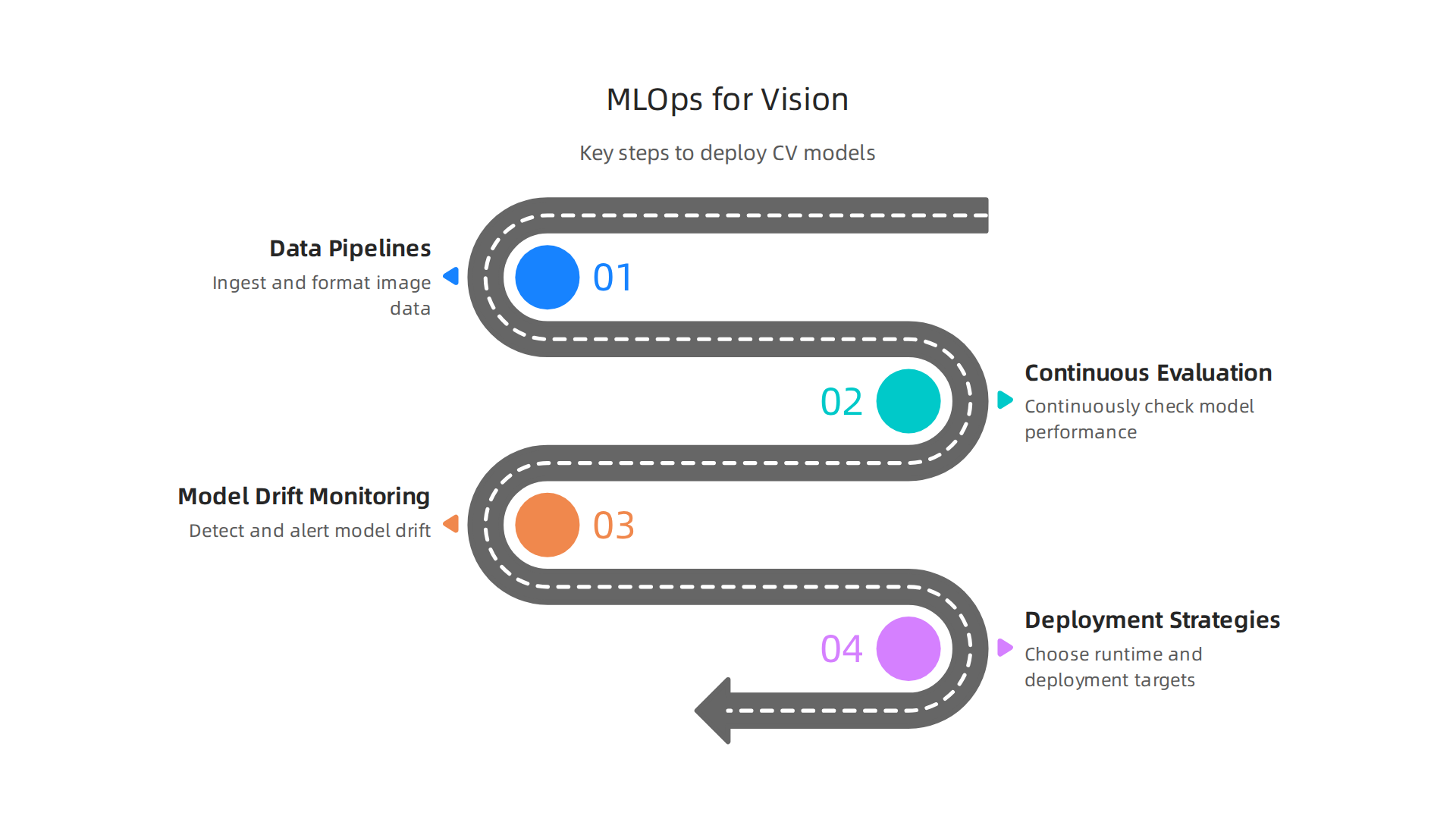
Bringing computer vision AI solutions from a small test to full-scale use in a business involves several important steps. It’s like building a good house, where you need a strong plan and careful work to make sure it stands tall and works well. This whole process is called MLOps, which simply means making sure AI models are built, run, and kept up-to-date in a smart way.
Implementation, MLOps & deployment: bringing models into production
For computer vision AI to deliver on its promise, businesses need to make sure the AI models work correctly all the time. This means setting up good systems to handle data, check how well the AI is doing, and quickly fix any problems that come up.
Data Pipelines: Feeding the AI
First, imagine a pipeline that brings clean water to your house. AI models need a similar pipeline for data. This "data pipeline" makes sure the AI gets all the images and videos it needs in the right format. Clean, well-organized data is like good food for the AI; it helps the model learn better and make more accurate decisions. If the data is messy, the smartest AI won’t be as helpful.
MLOps and Continuous Checks
After an AI model is built, the work doesn’t stop. Teams use MLOps (Machine Learning Operations) to manage the AI model’s life, from training to being used every day. A big part of this is something called "continuous evaluation." This means constantly checking the AI to see if it’s still doing its job well. Think of it like a regular health check-up for your AI system. Best practices for making AI work smoothly in a company include keeping data, code, and models organized, and automating how models are updated MLOps in 2026: Best Practices for Scalable ML Deployment.
Monitoring for Drift: When AI Forgets
One tricky thing with AI, especially computer vision AI, is "model drift." This happens when the real world changes over time, and the AI model, which learned from older data, starts making mistakes. For example, a computer vision AI system trained to spot defects on a product might struggle if the product design slightly changes, or if the lighting in the factory shifts. It’s like the AI slowly "forgets" what it learned.
To fight this, teams use special tools that constantly watch the AI’s performance. They look for signs that the model is drifting, like its accuracy going down or its confidence in its answers changing. When drift is found, the system can alert people, or even automatically trigger the AI to learn again from new, updated data. This makes sure the multimodal AI and contextual AI models stay sharp and continue to be useful. Some systems can even detect drift at the edge and automatically trigger retraining actions Drift Detection & Auto-Retraining for Greengrass Vision.
Where AI Lives: Edge vs. Cloud
When it’s time to use the AI model, businesses have to decide where it will run.
- Cloud Deployment: This means the AI model lives on big computers in data centers far away. It’s powerful and flexible, good for tasks that need a lot of computing power or when data comes from many places.
- Edge Deployment: This means the AI model runs on smaller devices right where the action is, like on a camera in a factory or a sensor in a store. This is faster because data doesn’t have to travel far, and it can work even without an internet connection. It’s great for real-time decisions, such as a self-driving car quickly seeing a stop sign.
Choosing between edge and cloud depends on what the business needs in terms of speed, security, and cost. Oftentimes, a mix of both, called intelligence fusion, works best, using the strengths of each.
Tools and Planning for Success
Businesses also need the right tools to manage their computer vision AI systems. These "toolchains" help with everything from collecting data to monitoring performance. And just like any other business investment, teams must plan for the costs of running these systems, making sure the benefits outweigh the expenses. This careful planning helps businesses truly maximize business impact with enterprise AI platforms.
Bringing computer vision AI into daily business operations is exciting, but it also comes with important questions about how these smart systems affect people and society. It’s not just about making the AI work; it’s also about making sure it works fairly, safely, and in a way that respects everyone’s rights. This means looking at risks, understanding new rules, and keeping an eye on what’s coming next.
Risks, ethics, regulation & future trends to track
When using computer vision AI, businesses must think about more than just the technical parts. They also need to consider the ethical side, meaning what’s right and fair.

Ethical Challenges for Computer Vision AI
- Bias: Sometimes, AI models can learn unfair ideas from the data they were trained on. For example, a computer vision AI system used to identify people might work better for some groups than others if it didn’t see enough diverse examples during training. This can lead to unfair decisions or outcomes. Researchers are actively studying these ethical challenges in computer vision applications Key studies addressing ethical aspects of computer vision applications.
- Surveillance: Computer vision AI can be used to watch people or places. While this can be helpful for security, it also raises big questions about privacy. People worry about being watched all the time and what happens to all that visual data.
- Safety: If computer vision AI is used in things like self-driving cars or medical tools, its mistakes could cause real harm. Ensuring these systems are super safe and reliable is a huge task.
These kinds of ethical concerns are important, and many groups worldwide are creating rules and guidelines for AI use Worldwide AI ethics: A review of 200 guidelines and recommendations for AI governance.
Growing AI Regulations
Because of these risks, governments are stepping in to create rules for AI. In 2026, we are seeing more laws and guidelines appearing. For example, Europe has its EU AI Act, which is the first big rulebook for AI. It focuses on making sure AI is safe, clear, and good for the environment. This act is expected to be fully in place by 2026 A Deep Dive into AI Ethics and Regulations – arXiv. Other countries, like the United States and China, are also working on their own ways to manage AI. Businesses need to keep up with these new rules to make sure their computer vision AI systems are legal and trusted. You can learn more about navigating these rules in our guide to AI policy the 2026 roadmap for business compliance and trust.
Future Trends to Monitor
Looking ahead, the world of computer vision AI will keep changing fast. Here are some things product and legal teams should watch:
- More Advanced AI: We’ll see more
multimodal AIthat can understand many types of information at once, andcontextual AIthat understands situations better. These smarter systems will bring new benefits but also new ethical questions. - Global Regulations: Expect more countries to create their own AI laws. Businesses that operate worldwide will need to understand how to follow all these different rules, perhaps through
intelligence fusionfor policy insights. The goal is to balance new ideas with safety and trust Navigating the AI regulatory landscape: Balancing innovation, ethics, and global governance. - AI Safety and Security: There will be a stronger focus on making AI systems very safe and protecting them from attacks. The International AI Safety Report 2026 highlights the importance of these efforts International AI Safety Report 2026.
Staying informed about these changes is key for any business working with AI. For clear daily AI updates, consider subscribing to The AI Newsletter Worth Reading.
Summary
This article gives business leaders a concise, evidence‑first roadmap to computer vision AI in 2026, explaining what the technology is, how it works, and why it matters for products, operations, and investment decisions. It breaks down core concepts—perception versus reasoning—and the primary building blocks like CNNs, Vision Transformers, pretraining, self‑supervised learning and transfer learning so non‑experts can judge technical claims. The guide covers practical data issues (label quality, synthetic data), how benchmarks and metrics reveal readiness, and the trade‑offs between accuracy, compute cost and latency. You’ll also find real industry ROI examples (manufacturing, retail, healthcare), an MLOps playbook for deploying and monitoring models, and a clear view of ethical and regulatory risks to manage. After reading this article you will be able to evaluate computer vision opportunities, choose appropriate models and deployment patterns, plan data and monitoring pipelines, and spot key governance actions to reduce legal and ethical risk.