

Why virtual assistant companies matter for businesses in 2026
In 2026, businesses everywhere are looking for smart ways to work better and serve customers faster. This is where virtual assistant companies come in. They offer a big chance for businesses to make things easier, improve how customers feel, and even find new ways to make money.

It’s no surprise that the intelligent virtual assistant market is growing quickly, expected to reach $30.57 billion this year alone, showing how important these tools have become for modern businesses Intelligent Virtual Assistant Market Growth Report 2026-2030.
Think about it: virtual assistants can handle many tasks that used to take up a lot of time for real people. This means your team can focus on more important work. For example, they can answer common customer questions instantly, schedule appointments, or help with things like data entry. This makes your business more efficient and can lead to happier customers who get help right away. When you think about artificial intelligence cost estimation for these services, the savings compared to hiring more full-time staff can be huge. This helps businesses save money and even create new ways to connect with people.
However, choosing the right virtual assistant company is not always easy. There are many different types of providers out there, and they all offer varied skills and services. Some use advanced artificial intelligence, while others focus on human-supported tasks. You also need to think about new rules and laws about how companies handle information, which are always changing. Finding a company that fits your specific needs and follows all the rules can be a real puzzle.
To make good choices in this fast-moving area, staying informed is key. For clear daily updates on AI and technology, consider subscribing to The AI Newsletter Worth Reading.
Market overview: Where virtual assistant companies fit in 2026
Building on how important virtual assistant companies are becoming, let’s explore their place in the larger market in 2026. The world of virtual assistants is quite big, and it can be helpful to think of it in different ways.
First, we can look at who uses them:
- Consumer Virtual Assistants: These are the helpers we use every day, like the voice assistants on our phones or in smart home devices. They make our personal lives easier.
- Enterprise Virtual Assistants: These are the virtual assistant companies that work with businesses. They help with many tasks, from handling customer calls to managing schedules and data. This business-focused market is growing fast, with the intelligent virtual assistant market expected to reach about $25.81 billion in 2026 alone Intelligent Virtual Assistant Market Size, Share, Growth, 2034.
Next, we can think about what kind of help they offer:
- Vertical Specialists: These virtual assistant companies focus on one specific industry. For example, a virtual assistant made just for hospitals might help patients book appointments or answer health questions. Another might be designed only for banks, helping customers with their accounts.
- Horizontal Platforms: These are more general virtual assistants that can be used across many different types of businesses. They handle common tasks like answering basic customer questions, helping with IT problems, or setting up meetings for many different kinds of companies.
Why Businesses Are Adopting Virtual Assistants
Businesses are choosing virtual assistant companies for many good reasons:
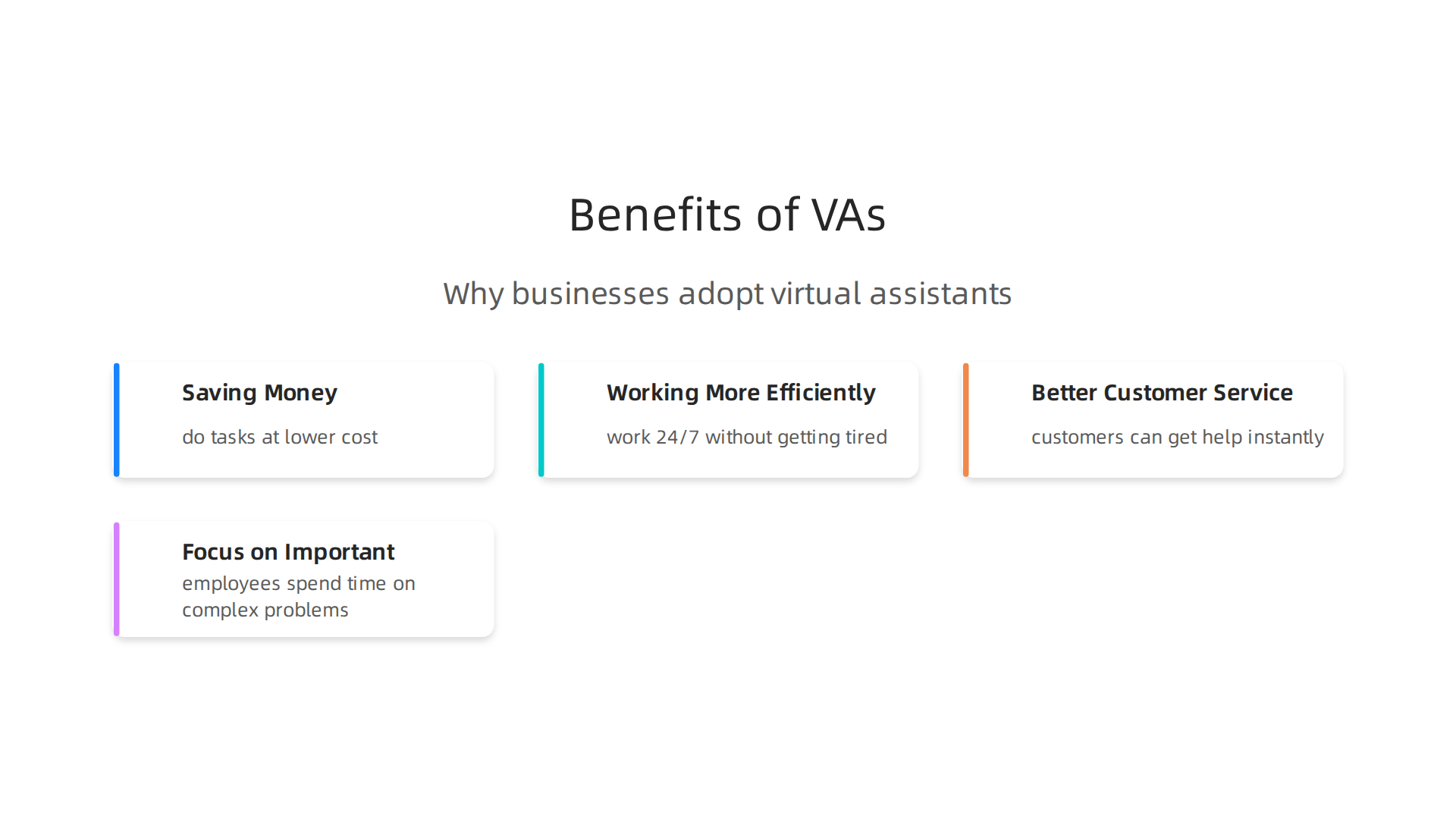
- Saving Money: Virtual assistants can often do tasks at a lower cost than hiring more full-time staff. Businesses report average cost savings between 60% and 78% by using virtual assistants compared to hiring full-time employees Virtual Assistant Statistics 2026 Full Data.
- Working More Efficiently: They can work 24/7 without getting tired, handling many tasks at once. This makes businesses run smoother and faster.
- Better Customer Service: Customers can get help instantly, day or night, which makes them happier.
- Focus on Important Work: When virtual assistants handle routine tasks, human employees can spend their time on more complex problems that need their special skills.
What Holds Businesses Back
Even with all these benefits, some things can make businesses hesitant to adopt virtual assistants:
- Starting Costs: Setting up a new virtual assistant system can cost money upfront.
- Safety and Privacy: Businesses worry about keeping customer information safe and private, especially with new rules about data. Understanding how to navigate these challenges is key, and resources like a guide to AI policy the 2026 roadmap for business compliance and trust can be very helpful.
- Making Them Smart Enough: Sometimes, it’s hard to make a virtual assistant understand everything a human might say or ask, especially if the questions are tricky.
- Fitting Them In: It can be a challenge to connect new virtual assistants with older computer systems a business already uses.
After looking at why businesses use virtual assistants and what stops them, it’s helpful to see who actually provides these services and how they deliver them. In 2026, many different kinds of virtual assistant companies exist, each with a special way of helping businesses.
Types of virtual assistant providers and delivery models
Let’s first explore the different kinds of businesses that create and manage virtual assistants:
- Platform Makers: These are big companies that build the core artificial intelligence (AI) technology that other virtual assistant companies use. Think of them as creating the building blocks, like an AI foundry. They offer powerful tools and large language models, sometimes even helping with things like artificial intelligence cost estimation for complex projects. Their platforms let many different businesses build their own smart helpers.
- Boutique Integrators: These smaller, expert firms focus on making virtual assistants fit perfectly into a business’s existing systems. They are very good at dealing with the challenge of connecting new AI tools with older computer programs, a common problem many businesses face. As experts know, poor integration is a main reason why some AI assistant projects do not succeed Why Some B2B AI Assistant Deployments Fail.
- Vertical-Specialist Firms: These virtual assistant companies focus on just one type of industry, like healthcare, finance, or retail. Because they only work in one area, they understand the specific needs and rules of that industry very well. This helps them create highly effective and useful virtual assistants for those particular fields.
- Managed Service Vendors: These providers handle everything for a business. They set up the virtual assistant, keep it running smoothly, update it, and make sure it’s always working its best. Businesses often choose this option when they want an easy, hands-off approach to using virtual assistants.
Knowing the different types of artificial intelligence is also key to choosing the right provider for your business needs, offering a clearer picture of what each can offer.
Beyond who provides them, there are also different ways virtual assistants are given to businesses:
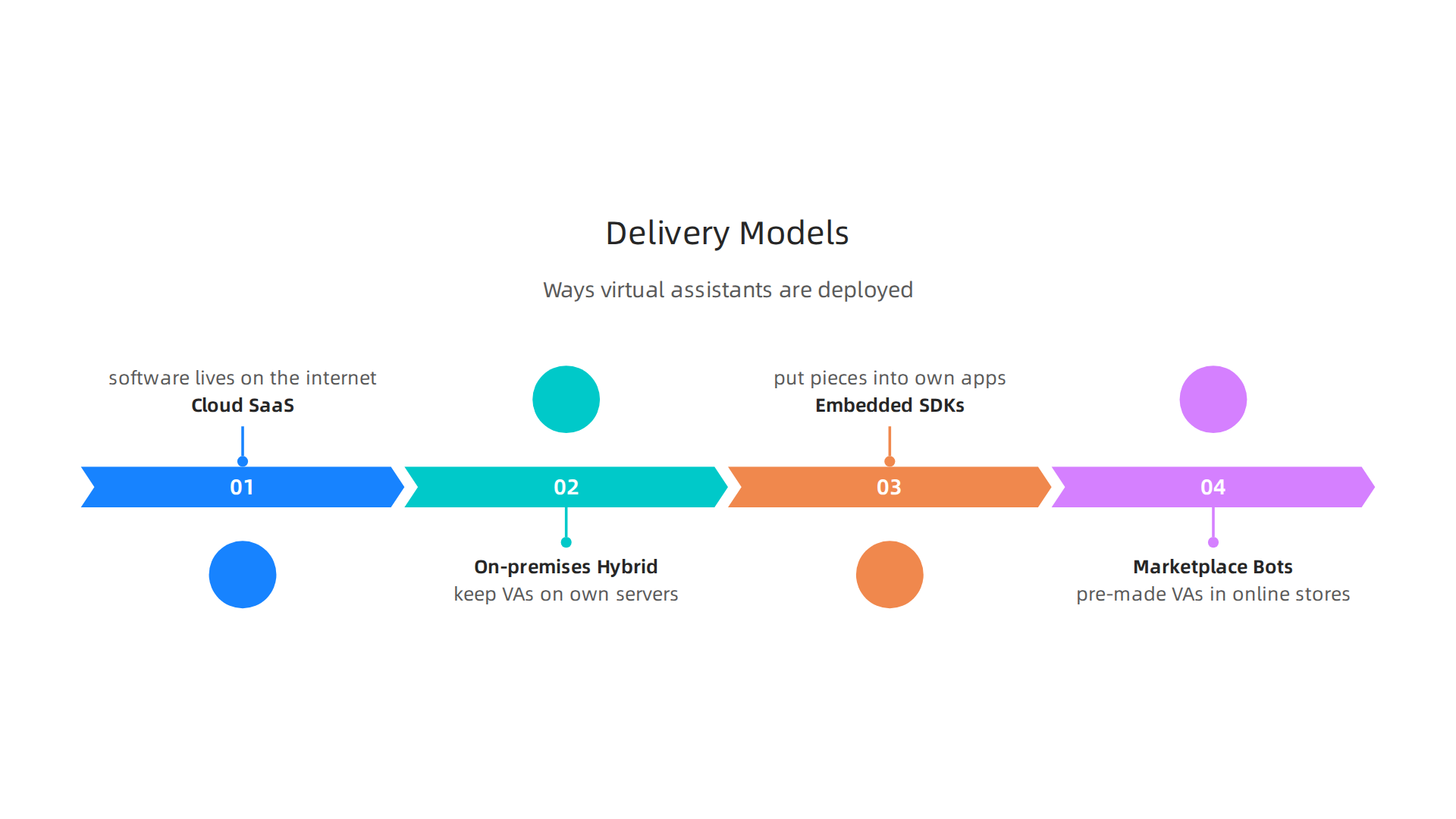
- Cloud-hosted SaaS (Software as a Service): This is the most common way. The virtual assistant software lives on the internet, and businesses use it through their web browser. It’s easy to start and doesn’t require businesses to install anything on their own computers.
- On-premises/Hybrid: Some companies, especially those dealing with very sensitive information or strict security rules, prefer to keep their virtual assistants on their own servers. This is often seen in large organizations, like certain operations in metropolis technologies, where data control is very important. A hybrid model means some parts are in the cloud, and some are kept locally.
- Embedded SDKs (Software Development Kits): With this model, developers can take pieces of virtual assistant technology and put them directly into their own apps or websites. This allows businesses to add smart assistant features directly into their own products.
- Marketplace-based Bots: These are pre-made virtual assistants found in online stores, much like apps on your phone. Businesses can quickly pick and use these bots for simpler tasks without needing to build anything from scratch.
Understanding these different ways to get and use virtual assistants helps businesses choose the best fit for their needs. To truly maximize business impact, consider using enterprise AI platforms.
Get clearer daily AI updates directly to your inbox with The AI Newsletter Worth Reading.
Choosing the right virtual assistant company is a big step for any business. It’s not just about picking the first one you find. It requires careful thought to make sure the virtual assistant truly helps your business grow.

Here’s how to properly look at and pick a virtual assistant company in 2026.
How to evaluate and select a virtual assistant company
To make a smart choice, you need to look at several important things. Think of it like a checklist to find the best fit for your needs.
What to look for: Key evaluation points
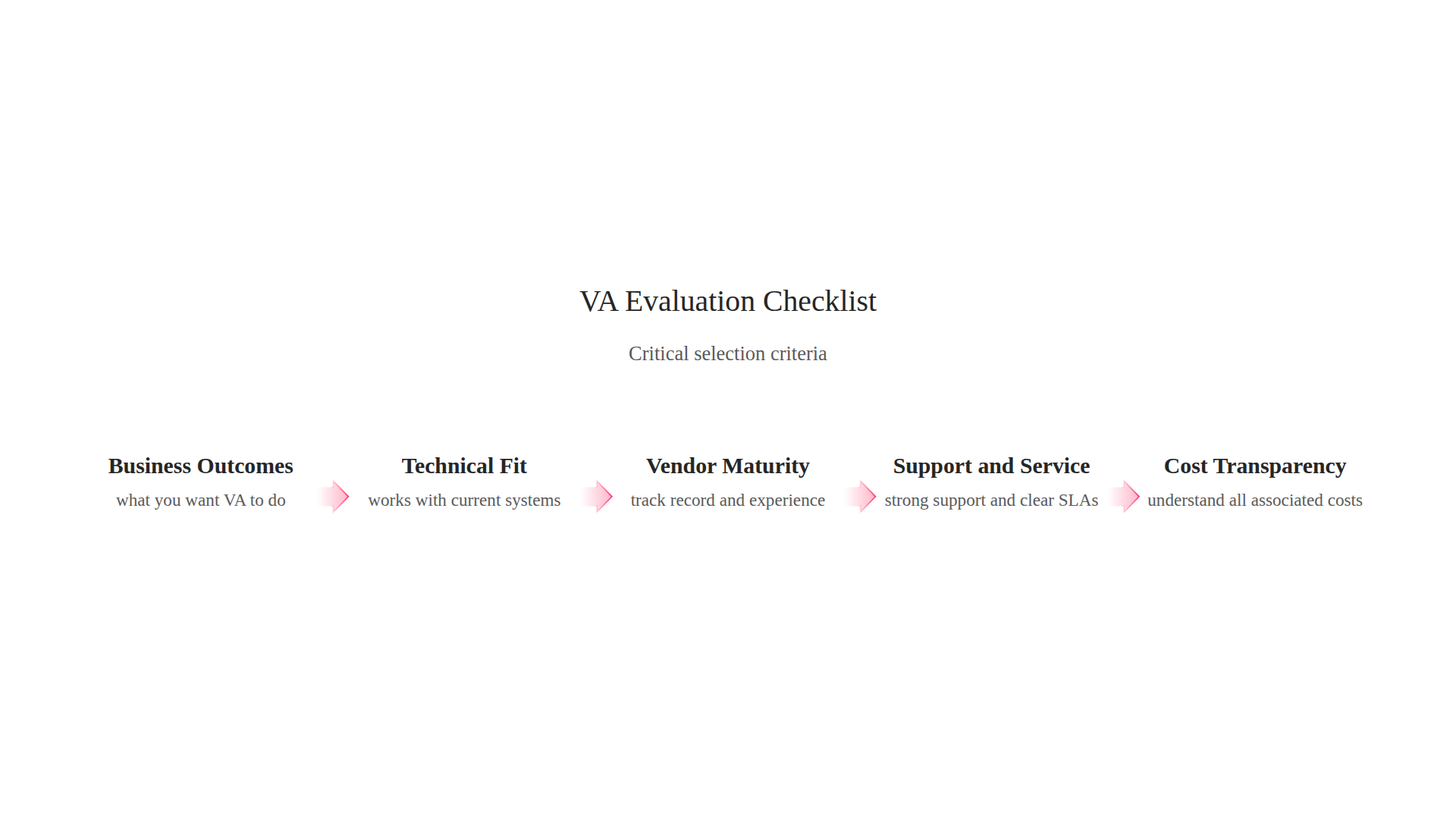
- Business Outcomes: First, think about what you want the virtual assistant to do for your business. Do you want to save money, make customers happier, or finish tasks faster? A good virtual assistant company will show you how their service can help you reach these goals. You should define your business problem and what success looks like before evaluating any vendor, as this helps you compare them fairly Mastering Vendor Analysis.
- Technical Fit: Does the virtual assistant work well with your current computer systems? It’s important that their technology can connect smoothly with your apps and programs. This includes checking if the architecture is right for your tech setup and if data can move easily between systems Vendor Evaluation Criteria Checklist for Procurement Teams. Also, consider if they use advanced artificial intelligence platforms, as knowing the types of artificial intelligence explained can help you decide if their technology is modern enough.
- Vendor Maturity: How long has the company been around? Do they have a good track record? It is important to know if they have helped other businesses like yours. You can ask for proof of their quality with other customers and check their training and hiring methods Vendor Assessment & Evaluation: How to Choose the Best. This shows they know what they are doing and can handle big projects, even for places like metropolis technologies.
- Support and Service Agreements (SLAs): What kind of help do you get if something goes wrong? A good company will offer strong support and clear rules about how quickly they will fix problems. Make sure these promises are written down in a contract, including service levels and security plans 9 key questions for evaluating AI assistant vendors in 2026.
- Cost Transparency: How clear are they about their prices? You want to understand all the costs, not just the basic fee. This includes things like the cost of getting started, monthly fees, and any extra charges. Understanding the overall cost of ownership is key to finding value Vendor Management Strategy: Procurement Guide 2026. Some may even offer tools for artificial intelligence cost estimation, which can be very helpful. Virtual assistant pricing can vary a lot, from hourly rates to monthly plans, so compare carefully Virtual Assistant Pricing Models Compared 2026.
A structured way to choose
Businesses often use a structured approach to pick the best virtual assistant company. This involves:
- Request for Proposal (RFP) or Checklist: You can create a detailed list of what you need and ask different companies to show how they meet those needs. This helps you compare them side by side. Many helpful tools and templates can guide you in this process Procurement Toolkit — Free Procurement Tools & Templates.
- Decision-Making Framework: Use a system to score each company based on your criteria. This could be a "weighted scorecard" where you give more points to things that are more important to your business, like how well the solution fits your existing tech or how much it costs. Scoring each vendor against a weighted system before you see their presentations helps keep things fair Vendor Evaluation Framework Guide.
- Pilot Programs: For bigger projects, you might want to try out a virtual assistant with a small group first. This "pilot" helps you see how well it works in real life before committing fully. It’s smart to set clear goals for the pilot before it even starts.
By following these steps, you can pick a virtual assistant company that truly supports your business goals and helps you succeed.
When picking a virtual assistant company, it’s really important to look closely at what the virtual assistant itself can actually do. This means checking its features and how well it fits with your business’s computer systems.

Think of it as making sure the new assistant has the right skills and can work well with your team.
Core features, integrations, and technical considerations
Let’s look at the key things that make a virtual assistant great.
What makes a virtual assistant smart?
Not all virtual assistants are the same. Some are much smarter and more helpful than others. Here are some key features to look for:
- Understanding what you say (NLU accuracy): A good virtual assistant should be able to understand what people say or type, even if they use different words for the same thing. This is called Natural Language Understanding, or NLU. If it can’t understand well, it can cause problems and make customers frustrated Why virtual assistants fail and how to avoid it. Modern virtual assistants use advanced AI to understand natural language much better than older chatbots The Enterprise Guide to Building AI-Powered Virtual Assistants.
- Remembering what was said (Context retention): Imagine talking to someone who forgets what you said two seconds ago. Frustrating, right? A smart virtual assistant remembers the whole conversation. This helps it give better answers and makes the chat feel natural. Without this "memory," AI assistants can’t truly help 10 Painful ways enterprise AI Assistants frustrate employees.
- Working with different ways to talk (Multimodal support): Some virtual assistants only work with text. Others can understand spoken words, pictures, or even videos. The more ways it can talk and understand, the more useful it will be. This involves complex conversational AI architecture Conversational AI Architecture for Enterprise CX.
- Checking how well it’s doing (Analytics): You want to know if your virtual assistant is actually helping your business. A good system will give you reports and numbers about how many questions it answers, how happy customers are, and where it might need to improve.
- Passing tasks to a human (Handoff to humans): Sometimes, a virtual assistant can’t solve a problem. It needs to know when to bring in a real person. This smooth handoff is very important so customers don’t get stuck. Not having a good way to switch to a human is a common problem for virtual assistants Digital Customer Self-Service Best Practices.
How it connects to your other systems
A virtual assistant is not a standalone island. It needs to connect with your other business tools to be truly useful. This is where integrations come in.
- Connecting to your customer and business tools (CRM/ERP connectors): Your business likely uses tools for managing customer information (CRM) or all its operations (ERP). The virtual assistant needs to be able to pull and push information from these systems to answer questions and complete tasks. Without this connection, it can’t be effective Why Some B2B AI Assistant Deployments Fail. This includes talking to systems like SAP or Salesforce Enterprise Data Access for Virtual Assistants.
- Managing who can access what (Identity & Access Management): You want to make sure only the right people (and the virtual assistant itself) can get to sensitive information. Good security measures are a must.
- Moving information around (Data pipelines): Your business creates a lot of data. The virtual assistant needs a smooth way to get this data and use it. This often involves careful planning of how data flows through different systems Architectures, Conversational Intelligence, and Knowle.
- Keeping an eye on things (Observability): You need to be able to watch how the virtual assistant is working. Is it fast? Is it making mistakes? Being able to see its performance helps you fix problems quickly.
Choosing virtual assistant companies means looking beyond just the price. You must carefully consider these core features and how well the assistant integrates with your existing technology. This will help you find a solution that genuinely supports your business goals, whether you are a small startup or a large organization like metropolis technologies looking for advanced solutions, or even working with an ai foundry.
For daily, in-depth updates on AI and other tech trends, you’ll find The AI Newsletter Worth Reading very helpful for staying informed in 2026.
After ensuring a virtual assistant has the right features and connects well with your other systems, it is vital to think about safety. This means looking at how the virtual assistant handles your information, keeps it private, and follows all the rules and laws. If you are looking at virtual assistant companies, knowing about these security and privacy points is just as important as knowing about the features.
Security, privacy, and compliance for virtual assistants
When you bring a smart virtual assistant into your business, it’s like trusting it with your secrets. You need to be sure it will protect those secrets. This is where security, privacy, and compliance come in.

They are about keeping your data safe and making sure your business follows the law.
Common risks with virtual assistants
Here are some typical problem areas to watch out for:
- Where data lives (Data residency): Your virtual assistant will use and store information. You need to know exactly where this information is kept. Sometimes, laws say that certain types of data must stay within a specific country or region. For example, if your company is in Europe, there might be rules about data staying in the EU.
- Handling private information (PII handling): Many virtual assistants deal with Personal Identifiable Information (PII), which is data that can directly identify a person, like names, addresses, or voiceprints. In 2026, rules like COPPA now clearly state that voiceprints are personal information and must be protected US Voice AI Regulations 2026: TCPA, BIPA, HIPAA. It’s crucial that any virtual assistant handles this kind of data with great care.
- How the AI works (Model governance): Who makes sure the artificial intelligence (AI) inside the virtual assistant is fair and does not make bad decisions? This is what model governance is about. It means having clear rules and checks on how the AI learns and operates to prevent unfairness or mistakes. Responsible use of AI is a focus for government agencies like the GSA CIO 2185.1C, Accelerating Responsible Use of Artificial ….
- Risks from partners (Supply-chain risk): A virtual assistant might use different tools or services from other companies. You need to make sure that all these parts are also secure. If one part of the chain is weak, it can put all your data at risk. This means using approved, secure environments for AI development and hosting RESPONSIBLE ARTIFICIAL INTELLIGENCE USAGE POLICY.
Laws and rules for virtual assistants
In 2026, there are more and more laws about how businesses use AI and virtual assistants. Virtual assistant companies need to understand these rules.
- GDPR (General Data Protection Regulation): If your business works with people in Europe, GDPR rules are very important. They cover how personal data is collected, stored, and used.
- HIPAA (Health Insurance Portability and Accountability Act): For businesses dealing with health information in the US, HIPAA is a must. This law ensures that patient health data is kept private and secure. Both voice recordings and any data taken from them fall under these rules Voice AI Compliance & Security Guide 2026.
- State AI Chatbot Laws: Many states in the US have created new laws about AI chatbots in 2026. For example, California’s SB 243, which started in January 2026, requires disclosing when a user is interacting with a companion chatbot State AI Chatbot Laws: Compliance Guide for Businesses. These laws can require businesses to tell users they are talking to an AI and protect minors. The number of such laws is growing fast across many states 2026 AI Compliance: Upcoming Laws Every Organization ….
- EU AI Act: As of August 2, 2026, parts of the EU AI Act are now in effect, especially those about transparency. This means virtual assistants that talk directly to people must be designed so that users know they are interacting with an AI system AI Agent Security and Compliance: A 2026 Enterprise Guide.
- Children’s Privacy: There are strict rules about AI systems that might interact with children. Companies need to do privacy checks before using AI that processes children’s data AI and Children’s Privacy: 2026 Regulatory Guide for ….
For businesses like metropolis technologies or those working with an ai foundry, understanding these rules is key to avoiding big problems and unexpected artificial intelligence cost estimation. Making sure your virtual assistant follows all these laws is not just about avoiding fines; it’s about building trust with your customers.
To stay on top of the many new rules, you might want to explore an AI policy the 2026 roadmap for business compliance and trust.
Putting a new virtual assistant into your business is an exciting step. But it needs more than just choosing the right tools. It’s about how you bring that tool into your everyday work, how you teach your team to use it, and how you keep making it better over time. This is what we call implementation, deployment, and change management. It’s how you make sure your virtual assistant doesn’t just work, but works well for everyone.
Phased Rollout Strategies
You would not run a marathon without training first. The same goes for bringing a new virtual assistant into your business. A smart way to do this is with a phased rollout. This means introducing the virtual assistant step by step.
- Pilot Phase: Start small. Pick a certain team or a specific task to try out the virtual assistant first. This is like a test run. During this time, you gather feedback and see what works and what doesn’t. Many virtual assistants fail if they are not planned carefully from the start, so this pilot stage is key to avoiding problems later on Why Virtual Assistants Fail (and How to Avoid Them). You can fine-tune how the AI understands questions and makes decisions.
- Scale Phase: Once the pilot is successful and you have made improvements, you can slowly bring the virtual assistant to more teams or for more tasks. This expansion should still be thoughtful, making sure the system can handle more use and that people are ready for it. Remember that modern virtual assistants need to understand natural language and connect to your other business systems to be truly useful across the enterprise The Enterprise Guide to Building AI-Powered Virtual Assistants.
- Optimize Phase: Even after your virtual assistant is fully deployed, the work is not over. You need to keep an eye on it, gather more feedback, and make continuous improvements. This part is called optimization. It means having clear rules and people in charge of how the AI learns and grows. This ongoing care helps prevent issues and keeps the virtual assistant working at its best.
Key Roles and Stakeholder Engagement
For a virtual assistant to truly succeed, many different people need to be involved. It’s not just an IT project. Everyone who will use or be affected by the virtual assistant should have a say.
- Project Leaders: These are the people who guide the whole process, making sure goals are clear and deadlines are met.
- IT and Technical Teams: They handle the actual setup and make sure the virtual assistant connects smoothly with your other computer systems. A virtual assistant needs to pull data from different places, like your customer records, to work well Enterprise Data Access for Virtual Assistants.
- Team Members (Users): The people who will use the virtual assistant every day are super important. Their feedback during the pilot and optimization phases is priceless. They need good training to feel comfortable using the new tool.
- Management: Leaders need to support the change and help their teams understand why the virtual assistant is being brought in.
- Virtual Assistant Companies: The partners you choose to work with can offer support and expertise during deployment. They can help you avoid common mistakes that lead to costly artificial intelligence cost estimation if not managed well. Actually, poor integration with existing systems is a common reason why these deployments fail Why Some B2B AI Assistant Deployments Fail. Getting everyone involved from the start makes a big difference in avoiding future problems.
To truly get the most out of your technology and ensure smooth deployment, it helps to keep learning about new tools and best practices.
Get clear daily AI updates from The AI Newsletter Worth Reading.
Understanding how to bring new technology into your business is a big part of staying competitive. You can also explore how different types of AI can reshape your business processes. For example, learning about types of artificial intelligence explained can help you think about future AI projects.
After understanding how to bring a new virtual assistant into your business, the next big step is figuring out the cost and how it will help your company grow. This means looking at different pricing models, how to calculate if it’s a good investment (ROI), and smart ways to talk to virtual assistant companies about what you need.
Pricing Models for Virtual Assistants
Virtual assistant companies use different ways to charge for their services. Knowing these models helps you pick the best fit for your budget and needs.
- Hourly Rates: This is simple. You pay for each hour the virtual assistant works. Rates can vary a lot, from around $5 to $75 per hour in 2026, depending on what skills are needed and where the assistant is located. Offshore options through a managed agency might be $4 to $15 per hour, while US or UK freelance assistants could be $18 to $40 per hour How Much Does a Virtual Assistant Cost in 2026? Real.
- Per-User or Per-Conversation: For AI-powered virtual assistants, you might pay a set amount for each person who uses it, or for each chat interaction it handles. For example, some AI executive assistants like Microsoft 365 Copilot can cost around $30 per user each month in 2026, while ChatGPT Enterprise is about $60 per user monthly AI Executive Assistant: Cost Analysis & Hybrid Model Guide (2026). Small business AI virtual assistants can also range from $45 to $395 per month depending on features and conversation limits AI Virtual Assistant for Small Business: 2026 Cost & Tool.
- Retainers or Managed Services: This model means you pay a fixed amount every month for a set block of hours or a dedicated full-time assistant. Many businesses choose this for consistent support, especially if they need 20 or more hours a week The 2026 Virtual Assistant Pricing Guide: Models, Rates, and. Managed plans with a dedicated assistant can be $699 to $899 per month.
Building an ROI Model and Negotiation Tips
To see if a virtual assistant is a good investment, you need to look at its Return on Investment (ROI). This means comparing how much you spend versus how much you gain.
- Measure the Benefits: Think about what problems the virtual assistant solves. Does it save your employees time? Does it reduce mistakes? Does it help your customers faster? These savings in time and better work directly add up to money saved or earned. For example, a virtual assistant could free up a CEO’s time, leading to an ROI of up to 8 times the cost, especially if it helps many parts of the business Virtual assistant costs for executives: What to know in 2026. Overall, many companies see an ROI of 5 to 12 times their investment, often within the first month Real Estate VA Statistics 2026: Adoption, Cost & ROI Data.
- Calculate Your Savings: Take the hourly rate of the tasks the virtual assistant will handle and multiply it by the hours saved. Then subtract the virtual assistant’s monthly cost. You can even use tools like an AI Agent ROI Calculator: Enterprise Business Case Template to help with your artificial intelligence cost estimation. Some studies show businesses can save 40-78% on labor costs with virtual assistants Virtual Assistant ROI 2026: 40-78% Labor | Stealth Agents.
- Negotiation Levers: When talking to virtual assistant companies, always ask questions about their services. Good questions cover company background, product fit, pricing, setup help, customer service, and security standards 23 Critical Vendor Evaluation Questions to Ask Before Signing in 2026. You can also look at how companies like Metropolis Technologies or AI Foundry structure their deals. Be sure to ask about training and ongoing support. Remember, a detailed look at all aspects helps you find the best value. To truly maximize the positive impact of any new technology, understanding how to best leverage powerful tools is key. Learning to maximize business impact with enterprise AI platforms can guide your choices beyond just the initial cost.
Summary
This article explains why virtual assistant companies are essential for businesses in 2026, covering market trends, provider types, delivery models, and the concrete benefits they deliver such as cost savings, 24/7 service, and improved customer experience. It breaks down who uses virtual assistants (consumer vs. enterprise), the difference between vertical specialists and horizontal platforms, and the kinds of vendors you’ll meet from AI platform makers to managed-service firms. You’ll learn the practical criteria for choosing a vendor—business outcomes, technical fit, vendor maturity, SLAs, and transparent pricing—and a structured selection process using RFPs, pilots, and scorecards. The article reviews key assistant features (NLU accuracy, context retention, multimodal support, analytics, and human handoff) and explains how integrations with CRM/ERP, IAM, and data pipelines determine success. It also outlines the major security and regulatory risks in 2026, including data residency, PII/voiceprint rules, model governance, and new state and EU AI laws. Finally, it offers deployment advice with phased rollouts, stakeholder roles, pricing models, ROI calculations, and negotiation tips to help businesses adopt assistants safely and get measurable value.