

Introduction: Why Quantum Computing Matters in 2026
You have probably heard the buzz around quantum computing for years. But here is the thing. In 2026, this technology is finally moving out of research labs and into real business use. It is no longer a far off promise. It is happening right now.
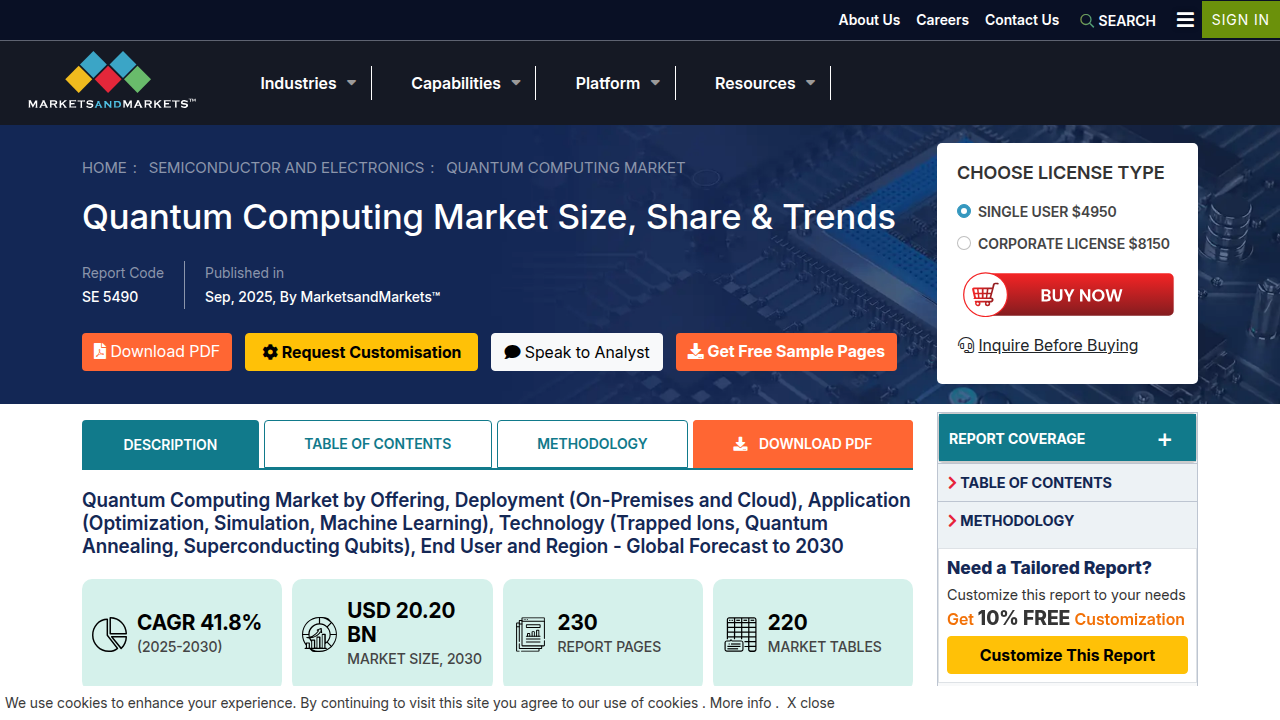
The numbers tell the story. According to Fortune Business Insights, the global quantum computing market is expected to grow from USD 2.04 billion in 2026 to USD 18.33 billion by 2034. That is a compound annual growth rate of over 31%. Other reports are even more optimistic. MarketsandMarkets projects the market could reach USD 20.20 billion by 2030.
This rapid growth means big changes are coming across many industries.

McKinsey reports that investments in quantum technology jumped more than six times year over year. And the economic impact could be enormous. Experts predict the sector could create up to 840,000 new jobs by 2035. This is disruptive innovation at its best.
So why should you care about quantum computing companies right now? Because understanding who the key players are can help you make smarter business decisions. Whether you work in computer systems technology, healthcare, finance, or logistics, quantum advances will touch your field. As we see with other breakthroughs in artificial intelligence gaming and entertainment, early adopters often gain the biggest advantages.
The landscape of quantum computing companies includes established tech giants, ambitious startups, and government backed initiatives. The science technology and society implications are huge. And with policies like the Chips and Science Act pouring funding into quantum research, the race is on.
Staying informed in this fast moving space is hard. That is why thousands of professionals rely on The Deep View Newsletter for clear, daily updates on the tech trends that matter most.
It helps you cut through the noise and focus on what actually impacts your work.
Let us dive into the top quantum computing companies you need to know in 2026.
Understanding Quantum Computing: A Primer for Business Leaders
Let us be honest. If you are a business leader, you have probably heard terms like "qubits" and "superposition" tossed around at conferences. And maybe you nodded along while quietly wondering what any of it actually means.
Here is the good news. You do not need a physics degree to understand the basics of quantum computing companies and why they matter for your bottom line.
What makes quantum different?
Regular computers use bits. Each bit is either a 0 or a 1. It is simple. Quantum computers use qubits. And here is where it gets weird. A qubit can be 0, 1, or both at the same time. This is called superposition.
Think of it like a spinning coin. While it spins, it is neither heads nor tails. It is both. That is superposition in action.
The other magic trick: entanglement
When two qubits become entangled, they stay connected no matter how far apart they are. Change one, and the other changes instantly. This sounds like science fiction. But it is real. And it is what gives quantum computers their incredible power.
Quantum gates are the tools that manipulate these qubits. They perform calculations that would take classical computers millions of years. As MarketsandMarkets reports, the market is growing fast because these machines can solve problems traditional computers cannot touch.
The main architectures you need to know
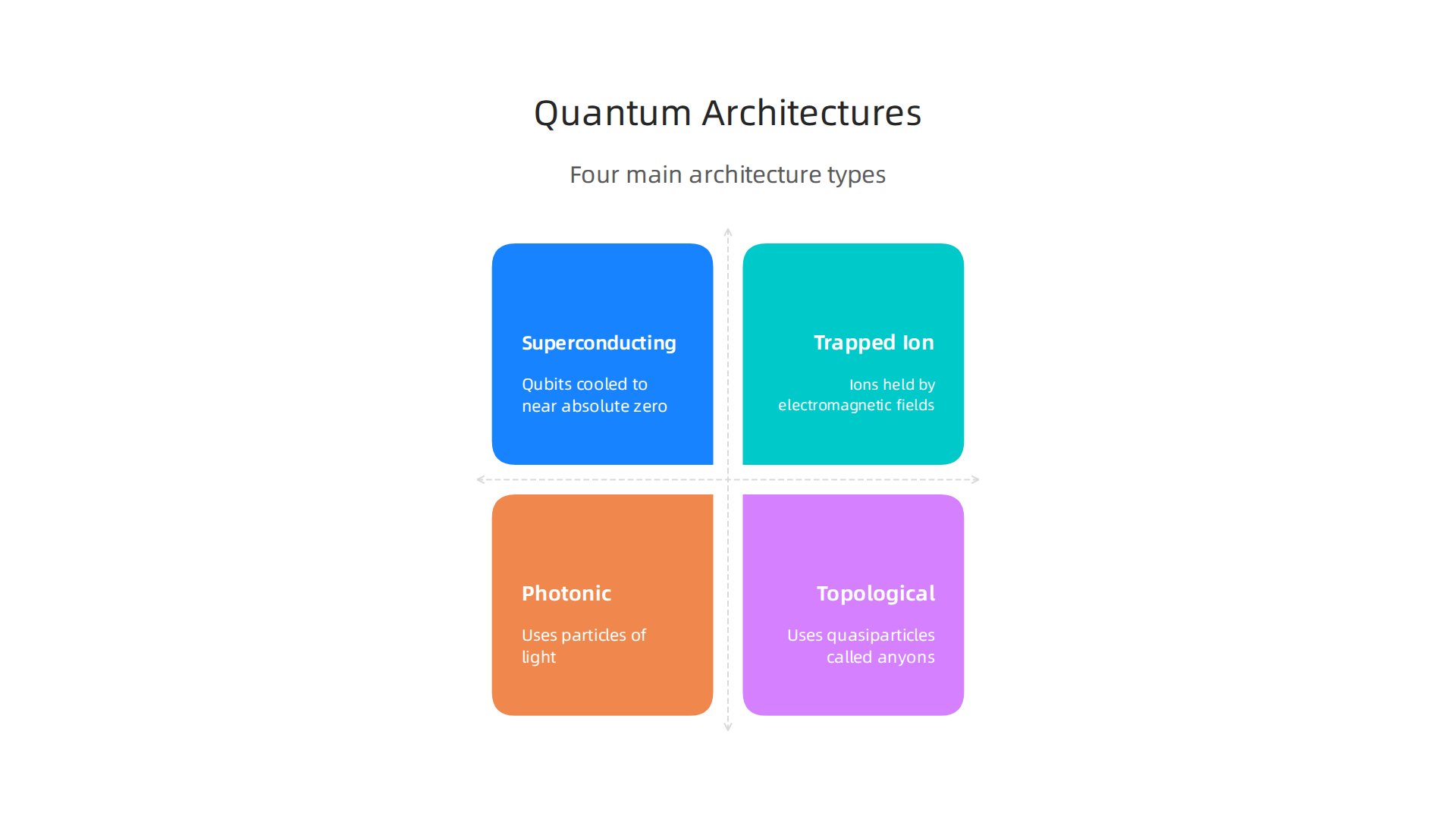
Not all quantum computers are built the same way. Different quantum computing companies use different approaches. Here are the four main types:
| Architecture | How it works | Who builds it | Best for |
|---|---|---|---|
| Superconducting | Qubits made from superconducting circuits cooled to near absolute zero | IBM, Google, Rigetti | General purpose quantum computing |
| Trapped ion | Qubits are individual ions held in place by electromagnetic fields | IonQ, Honeywell | High fidelity, low error rates |
| Photonic | Uses particles of light (photons) as qubits | Xanadu, PsiQuantum | Room temperature operation, scalable |
| Topological | Uses quasiparticles called anyons to create stable qubits | Microsoft | Highly stable, less error prone |
Each architecture has trade offs. Some are further along than others. But all represent the kind of disruptive innovation that will reshape computer systems technology over the next decade.
Why this matters for your business right now
You do not need to choose an architecture today. But you do need to understand that quantum computing is not about replacing your laptop. It is about solving problems that current computers simply cannot handle. Things like drug discovery, supply chain optimization, and financial modeling.
Understanding the science behind these machines helps you ask better questions when evaluating quantum computing companies for your own strategy. It also helps you spot the difference between hype and real progress.
The field of science technology and society is changing fast. And policies like the Chips and Science Act are pouring government money into quantum research. This is not a trend you can ignore.
Staying on top of these rapid changes is tough. But you do not have to do it alone. Thousands of professionals get clear daily updates on the tech trends that matter most by subscribing to The Deep View Newsletter. It cuts through the noise so you can focus on what actually impacts your work.
And if you want to go deeper on how other technology shifts are changing industries, check out our guide on how to turn data overload into strategic insight.
Leading Quantum Computing Companies in 2026
Now that you understand how quantum machines work, let’s talk about who is actually building them. The quantum computing market is not science fiction anymore. It is a real and growing industry. According to a recent report, the market is projected to reach $18.33 billion by 2034. And the players range from familiar tech giants to hungry startups.
The established giants keep pushing forward
IBM, Google, and Microsoft are the heavyweights. IBM recently shared its roadmap for Blue Jay, a system it plans to deliver by 2033.
This machine will run circuits of 1 billion gates on up to 2,000 logical qubits. Google made headlines with its Willow chip, which solved a problem in minutes that would take classical supercomputers an impossible amount of time. Microsoft is taking a different path with topological qubits. These promise higher stability and lower error rates. All three offer quantum cloud services, making it easier for businesses to experiment without buying hardware.
The startups making real progress
IonQ, Rigetti, and Xanadu are proving that you do not need to be a giant to lead. IonQ has launched commercial trapped-ion systems with high fidelity.
Rigetti continues to expand its superconducting platform through the cloud. Xanadu achieved a major milestone with its photonic Borealis machine, proving that light-based qubits can work at room temperature. These quantum computing companies are attracting serious money. BCG reports that quantum computing attracted $1.2 billion from venture capitalists even as overall tech investments dropped.
Partnerships that are changing industries
The real power of quantum shows up in partnerships.

Pharmaceutical companies like Pfizer and Roche are working with quantum firms to simulate molecules for drug discovery. This could cut years off development timelines. Financial institutions like JPMorgan Chase and Goldman Sachs are testing quantum algorithms for portfolio optimization and risk modeling. Automotive companies like BMW and Volkswagen are using quantum simulations to design better batteries. These collaborations turn theoretical science into practical business tools.
Why 2026 is a turning point
Quantum computing is no longer a lab experiment. It is a business tool with a clear timeline. The sector could generate 250,000 new jobs by 2030. Deloitte reports that vendors are accelerating their timelines for commercial scale. Government policy is also driving progress. The Chips and Science Act poured funding into quantum research, recognizing it as a critical piece of our science technology and society infrastructure. This is a disruptive innovation that will reshape computer systems technology at every level.
Whether you invest in quantum directly or partner with a provider, the time to pay attention is now. Staying ahead in a fast-moving field is hard. But you do not have to track every trend alone. Thousands of leaders rely on The Deep View Newsletter for clear daily updates on the technologies that matter most. It helps you focus on what actually impacts your business.
And if you want to see how other advanced technologies are reshaping entire fields, take a look at how AI is transforming medical imaging in 2026. The same pattern of innovation applies across industries.
How Quantum Computing Is Disrupting Industries: Real-World Use Cases
You have a clear picture of the companies building the hardware. But where is this power actually being used today? In 2026, quantum computing is not just a lab curiosity. It is already creating real disruption in key industries. Let’s look at three areas where quantum computing companies are making the biggest difference.
Drug discovery and molecular simulation
Think about how we create new medicines. Classical computers struggle to model the complex interactions between molecules. It takes years and billions of dollars. Quantum computers can simulate chemical reactions at the atomic level. This is a game changer. For example, pharmaceutical companies are already using quantum systems to speed up the search for new drug candidates. This kind of work is a direct example of how disruptive innovation in computer systems technology is saving time and money. You can see a similar transformation happening in healthcare, where AI is becoming a standard tool in medical imaging.
Financial services
Banks and investment firms sit on mountains of data. They need to find patterns and manage risk. Quantum algorithms are now being used for portfolio optimization, risk analysis, and even fraud detection. Major financial institutions like HSBC are experimenting with quantum computing to solve problems that classical computers simply cannot handle efficiently. The results so far point to faster and more accurate trading decisions. This is the kind of science technology and society shift that the Chips and Science Act was designed to support.
Supply chain and logistics
Every day, companies face massive optimization problems. Where should inventory go? What is the most efficient route for a delivery truck? Classical computers can help, but quantum computers can find better answers much faster. Logistics firms are using quantum systems to optimize global shipping routes and manage inventory across thousands of warehouses. This cuts costs and reduces waste. It is a perfect example of how quantum computing companies are moving from theory to real world application.
Where to go from here
Quantum computing is no longer a distant promise. It is reshaping industries right now. Staying ahead of these changes means staying informed. Thousands of leaders rely on a clear, daily source of technology insights. The Deep View Newsletter delivers exactly that. It cuts through the noise and helps you focus on what matters for your business.
Investment Landscape in Quantum Computing: Where Is the Money Flowing?
You now understand how quantum computing companies are reshaping industries. But all that progress needs fuel. That fuel is money.

In 2026, the investment landscape for quantum computing is hotter than ever. Let’s look at where the dollars are coming from and where they are going.
Record levels of global investment
The numbers are hard to ignore. The global quantum computing market was valued at around $1.53 billion in 2025. By 2034, some analysts predict it could hit $18.33 billion. That is a compound annual growth rate of over 31 percent. According to a new report from MIT, quantum computing firms received $1.6 billion in publicly announced investments. That was the biggest slice of the pie. Quantum software companies came in second. The overall quantum technology ecosystem saw a 6.3 times increase in investments year over year, according to McKinsey.
Governments are going all in
It is not just private money driving this growth. Governments around the world are making big bets. The United States, the European Union, and China are each investing billions into quantum research and infrastructure. The goal is clear. They want to lead in what many call the next industrial revolution. For example, the UK government announced a $160 million investment in quantum technology in 2025. These efforts tie directly into broader policies like the Chips and Science Act. This act supports disruptive innovation in computer systems technology and strengthens the connection between science, technology, and society.
Where venture capital is flowing
Private investors are focusing on two main areas. First, they are funding quantum hardware companies that build the physical machines. Second, they are pouring money into quantum software startups. Many of these startups offer quantum-as-a-service platforms. This model lets businesses access quantum power over the cloud. It lowers the barrier to entry. You do not need your own quantum computer to start experimenting. This trend is opening the door for more companies to explore real use cases.
What this means for you
Following the investment trends helps you spot where the real opportunities are. But keeping up with all this data can feel like a full-time job. That is exactly why learning how to turn data overload into strategic insight is so valuable in 2026.
If you want a simpler way to stay informed, you are not alone. Thousands of business leaders and tech professionals rely on a daily source that cuts through the noise. The Deep View Newsletter delivers clear, focused technology insights straight to your inbox. It helps you understand what matters most for your business.
Challenges and Roadblocks to Quantum Adoption
All that investment sounds exciting. And it is. But the road to practical quantum computers has some serious speed bumps. Even the most advanced quantum computing companies face three big challenges in 2026.
Error rates and coherence times are a real problem
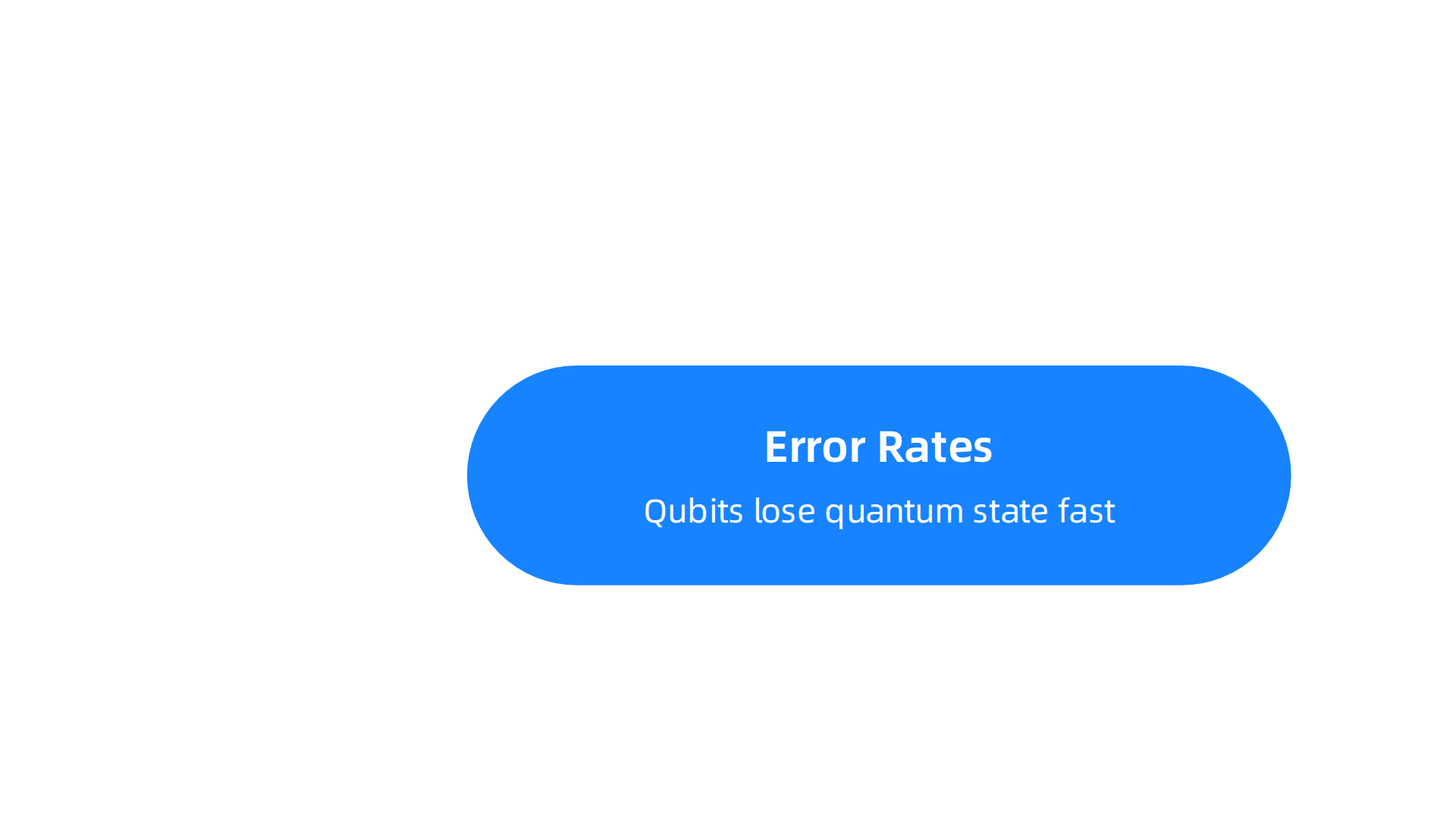
Here is the hard truth. Qubits are fragile. They lose their quantum state in microseconds or milliseconds. That is called short coherence time. And every calculation introduces small errors. Without fixing these errors, you cannot run useful algorithms. That is why progress in quantum computing is measured by error rates and coherence times, not just qubit count.
Scientists are making progress with quantum error correction techniques. These methods protect quantum information from noise and decoherence. According to researchers, neutral atoms may offer a path to just one error per trillion operations. That is called the Teraquop regime. But we are not there yet. For now, error correction still requires many physical qubits to create one reliable logical qubit. This is a major bottleneck.
The talent gap slows everything down
Here is another problem. There are not enough quantum engineers and software developers. Quantum computing requires a rare mix of physics knowledge, computer science skills, and engineering talent. Universities are ramping up programs, but the pipeline is still thin. Companies are competing fiercely for the same small pool of experts. This talent shortage directly slows progress in disruptive innovation across every sector.
The issue connects to a broader concern about science technology and society. As quantum technology advances, we need more people who understand both the science and the real world impact. Without that talent, even the best funded quantum computing companies will struggle to deliver results.
Integration with classical systems is costly and complex
Most businesses do not run on quantum computers today. They run on classical servers, cloud platforms, and traditional databases. Connecting quantum systems to this existing infrastructure is hard and expensive. You need new software layers, new security protocols, and new workflows. Many companies are still figuring out how to make these two worlds talk to each other.
These integration challenges are part of why the Chips and Science Act and similar policies focus on building entire quantum ecosystems, not just machines. The goal is to strengthen computer systems technology from the ground up.
If you want to track how these challenges evolve without spending hours digging through research, you do not have to do it alone. The Deep View Newsletter delivers clear daily updates on quantum progress and other tech trends straight to your inbox. It helps you focus on what matters for your business.
How to Evaluate Quantum Computing Companies for Your Business Strategy
So you know the challenges. Now you need to pick a partner. But with so many quantum computing companies making big promises, how do you separate hype from real potential? The global quantum computing market is projected to reach over $20 billion by 2030. Every major tech player and dozens of startups want your attention. Here is a practical framework to cut through the noise.

Start with the technology roadmap, not just the press release
Do not get distracted by qubit count alone. In 2026, smart buyers look at performance metrics like quantum volume and gate fidelity. These numbers tell you if a machine can actually do useful work. Ask about the company’s qubit type too. Superconducting qubits, trapped ions, and neutral atoms all have different tradeoffs. For example, neutral atoms are showing a clear path to the Teraquop regime, meaning roughly one error per trillion logical operations. That is a big deal.
Check if the company has a public roadmap with clear milestones. Companies that publish detailed plans, like IBM’s Quantum 2030 roadmap, give you something concrete to track. A roadmap shows you they are thinking about real-world deployment, not just lab experiments.
Look at the ecosystem and access model
Can you actually use their technology? Some quantum computing companies offer cloud access. Others require on-premise installation. Cloud models are cheaper and lower risk for testing. On-premise gives you more control but costs more.
Also look at partnerships. Companies with strong ties to research institutions, government programs like the Chips and Science Act, or major cloud providers are better bets. A strong ecosystem means better support, more frequent updates, and a lower chance the company disappears.
Demand real proof points
Anyone can show a slide deck. You want evidence. Look for:
- Pilot projects with real customers
- Published patents in key areas like quantum error correction
- Customer traction and case studies you can verify
- Independent validation from sources like the new MIT report on state of quantum computing
These proof points matter because they show the company is moving from science to business. Progress in quantum computing is measured by error rates and coherence times, not just hype. A company that can point to actual deployments is way ahead of one that can only talk about future potential.
If you want to track which companies are actually delivering without spending hours digging through reports, you do not have to do it alone. Get clear daily updates on quantum computing progress and other tech trends straight to your inbox with The Deep View Newsletter. It helps you focus on the moves that matter for your business.
Summary
This article explains why quantum computing moved from lab curiosity to practical business technology in 2026, and how leaders should respond. It covers the basic science—qubits, superposition, entanglement—and the four main architectures (superconducting, trapped ion, photonic, topological) so you can spot meaningful differences between providers. The piece profiles leading players from tech giants (IBM, Google, Microsoft) to startups (IonQ, Rigetti, Xanadu), and shows concrete use cases in drug discovery, finance, and supply-chain optimization. It reviews the investment landscape, government support, and why venture capital is funding both hardware and software. The article also lays out the real obstacles—error rates, talent shortages, and integration costs—and gives a practical framework for evaluating vendors, including the metrics and proof points buyers should demand. After reading, you’ll understand where quantum makes sense for pilots, what to watch in vendor roadmaps, and how to begin testing quantum solutions responsibly.