

Introduction
If your day is packed with contract reviews, legal research, and endless document drafts, you know how overwhelming things can get.

Many professionals in law and professional services spend hours sifting through information. The result? Burnout, missed deadlines, and costly mistakes.
That is where harvey ai comes in. Harvey AI is a specialized AI platform designed specifically for legal and professional services.

It uses GPT-4 to handle complex tasks like contract analysis, due diligence, compliance checks, and document drafting. The platform is built for large firms with strict security needs and complex workflows, as noted in a recent review of Harvey AI. Unlike general chatbots, Harvey focuses on delivering accurate, structured output that fits how legal teams actually work.
Companies today are drowning in data. They need reliable AI systems that go beyond basic Q&A. That is where artificial intelligence applications like Harvey and its competitors shine. Harvey’s ai powered study tools and workflow automations help teams reduce manual review time and improve accuracy. The platform covers everything from contract analysis to due diligence, making it a strong contender among modern ai systems.
This article explores Harvey AI’s capabilities, its real-world use cases, and how it compares to other tools on the market. We will also look at where Harvey fits in the broader landscape of galaxy ai platforms. If you are curious about how AI is transforming professional services, you might also enjoy our piece on how GPT models evolved from GPT-3 to GPT-5 and how these advances power tools like Harvey.
By the end, you will have a clear picture of whether Harvey AI is the right fit for your firm or team.
For daily insights on AI tools and trends that actually matter, subscribe to The Deep View Newsletter.
It is the go-to resource for professionals who want clear, actionable AI updates in their inbox every day.
What Is Harvey AI? A Deep Dive into the Platform
Picture this. You are a lawyer staring at a 200-page contract, and you need to find every indemnification clause by noon.

With a general chatbot, you would get a rough summary. With Harvey AI, you get citations, a structured analysis, and a draft memo ready for review.
That is the core difference. Harvey AI is a specialized AI platform built on OpenAI’s GPT-4 model. But unlike the ChatGPT you might use at home, Harvey is fine-tuned specifically for legal and professional services work. According to a detailed review from GC.AI, the platform handles everything from contract analysis and due diligence to legal research and compliance checks.
The output is detailed and structured the way a law firm expects.
Built for Enterprise, Not Casual Use
Harvey is not designed for students writing essays or marketers drafting emails. It is built for large law firms and corporate legal teams with complex workflows and strict security requirements. As one industry analysis explains, the platform is designed for organizations with "mature legal operations" that demand enterprise-grade protection, as noted in a comparison of Harvey AI alternatives.
Here are the key capabilities that set Harvey apart from general AI tools:
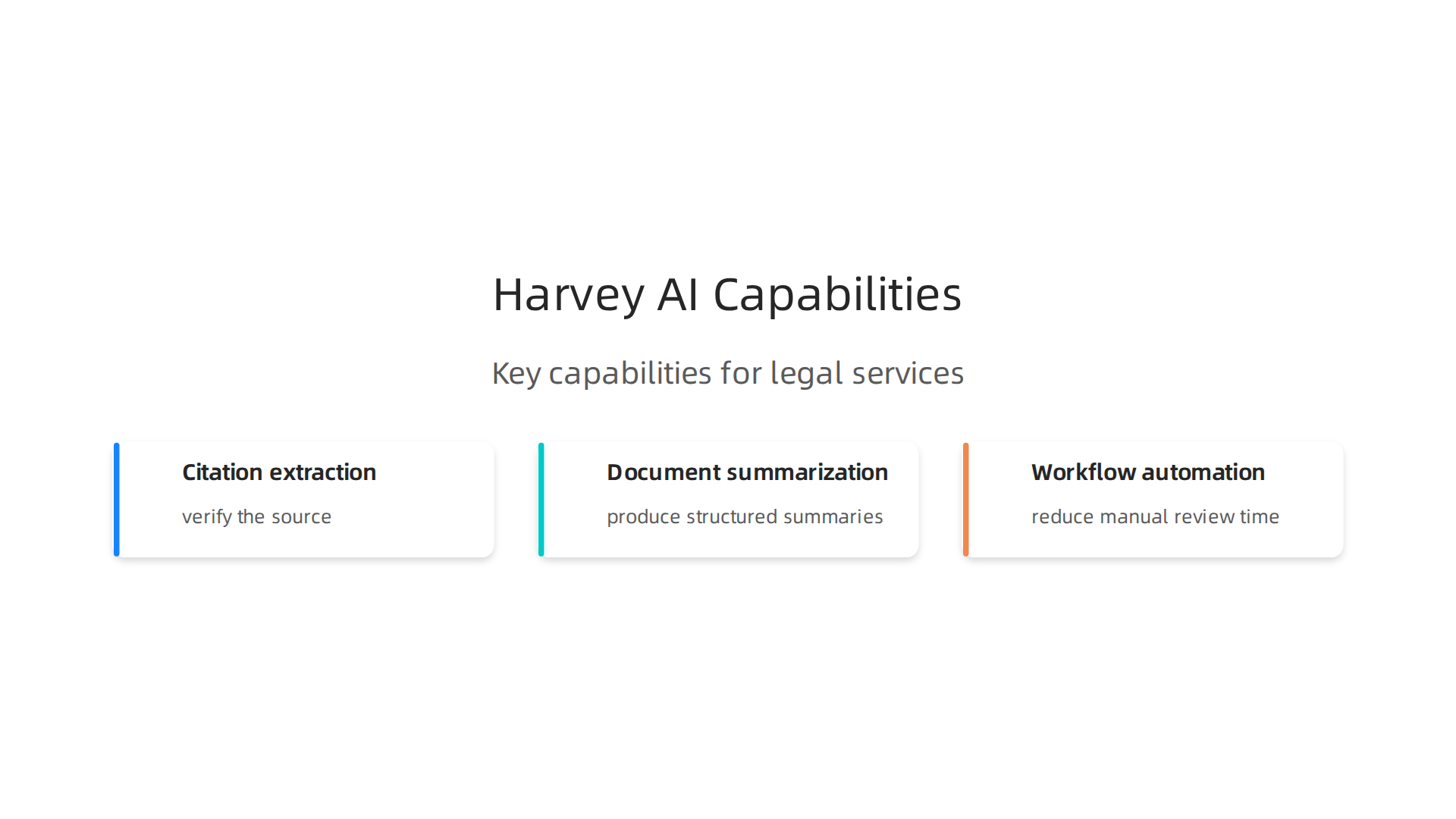
- Citation extraction and source verification. Every output links back to the original legal text, so you can verify the source.
- Document summarization. Harvey can digest thousands of pages and produce structured summaries with key clauses highlighted.
- Workflow automation. The platform helps teams reduce manual review time by automating repetitive tasks like compliance checks and due diligence.
These features make Harvey one of the most powerful artificial intelligence applications available for the legal sector today. It is a standout example of how ai systems are evolving from simple Q&A bots into specialized productivity engines.
How Harvey Compares to General Chatbots
Most people have used a general AI assistant for quick answers. But legal work demands accuracy, context, and compliance. A general chatbot might hallucinate a case citation. Harvey cannot afford to do that.
The platform uses a secure, enterprise-grade infrastructure that keeps client data private. It also integrates directly into how legal teams already work, covering contract analysis, due diligence, and compliance workflows, as confirmed by Harvey’s official website. For legal teams, Harvey also works as one of the best ai powered study tools available. It helps junior associates research case law, draft memos, and review documents faster. More experienced attorneys use it to double-check contract language and ensure nothing slips through.
If you want to understand the broader landscape of specialized AI platforms, check out our look at the world of AI in 2026 and how tailored systems like Harvey are reshaping professional services.
The Galaxy AI Connection
You might hear Harvey grouped under the broader galaxy AI ecosystem. That term refers to a growing collection of specialized AI platforms designed for specific industries. Harvey is the legal star in that galaxy, just as other platforms focus on healthcare, finance, or coding. This specialization is what makes Harvey more reliable than a general-purpose chatbot.
The platform continues to evolve rapidly. Recent updates have added better automation, new integrations, and expanded editing tools to streamline legal processes for teams. If your firm handles high volumes of legal documents, Harvey is worth a serious look.
For professionals who want daily insights on AI tools that actually matter for their work, subscribe to The Deep View Newsletter. It delivers clear, actionable AI updates straight to your inbox every day.
The Rise of AI-Powered Legal and Professional Services
Think about how fast things change in the legal world. Just a few years ago, reviewing contracts meant long hours and endless paper stacks. Today, that has changed completely.
The legal industry is going through a major shift. AI tools are no longer just experimental toys. They have become essential workflow partners. According to a 2026 survey, AI adoption in the legal industry reached 78%, with lawyers relying heavily on tools like ChatGPT and Microsoft Copilot. That is a huge jump from where things stood just a couple of years ago.
Here is what the numbers tell us about this acceleration:
- Generative AI adoption among legal professionals more than doubled between 2025 and 2026, climbing from 31% to 69%, according to the 2026 Legal Industry Report from 8am.
- More than 90% of legal professionals now use at least one AI tool in their daily work, as reported by Wolters Kluwer.
- 42% of law firms are already using AI technologies, and another 42% expect their use to increase in 2026, based on the 2026 Legal Tech and AI Outlook from U.S. Legal Support.
This is not just a trend. It is a real shift in how legal work gets done. Firms are using AI systems to cut down on manual document review, speed up contract management, and improve compliance checks. These are not small changes. They save firms money and help lawyers focus on higher-value work.
Harvey AI sits right at the center of this shift. Top global law firms already use it to reduce review time and lower costs. The platform handles the heavy lifting of document analysis, so lawyers can spend their time on strategy and client advice. It is a clear example of how artificial intelligence applications are evolving from general chatbots into specialized tools for specific industries.
You might wonder if this kind of change is limited to law. It is not. Across professional services, teams are finding ways to use AI to handle repetitive tasks. The same logic that makes Harvey work for contracts could apply to compliance in finance or regulatory review in healthcare. For a broader look at how AI is transforming business operations, read our article on how AI with images is changing business in 2026.
The bottom line is simple. AI is no longer optional for legal teams. Firms that adopt these tools early are gaining a real edge. They work faster, make fewer errors, and serve clients better. As one analysis from Legal AI Statistics 2026 shows, productivity gains and market growth are the main drivers behind this adoption.
If you want to keep up with how AI is reshaping professional services every day, you need a reliable source of updates. Subscribe to The Deep View Newsletter and get clear, practical AI insights delivered to your inbox daily.
Key Use Cases: How Harvey AI Transforms Business Operations
Picture this: You are a lawyer staring at a mountain of contracts that all need review before Friday. Your eyes are tired. Your coffee is cold. And you know you will miss something important.
Now imagine handing that whole pile to an AI system instead. That is exactly what Harvey AI does. It handles the boring, time consuming parts of legal work so humans can focus on the hard stuff. Let us look at the specific ways Harvey changes business operations.
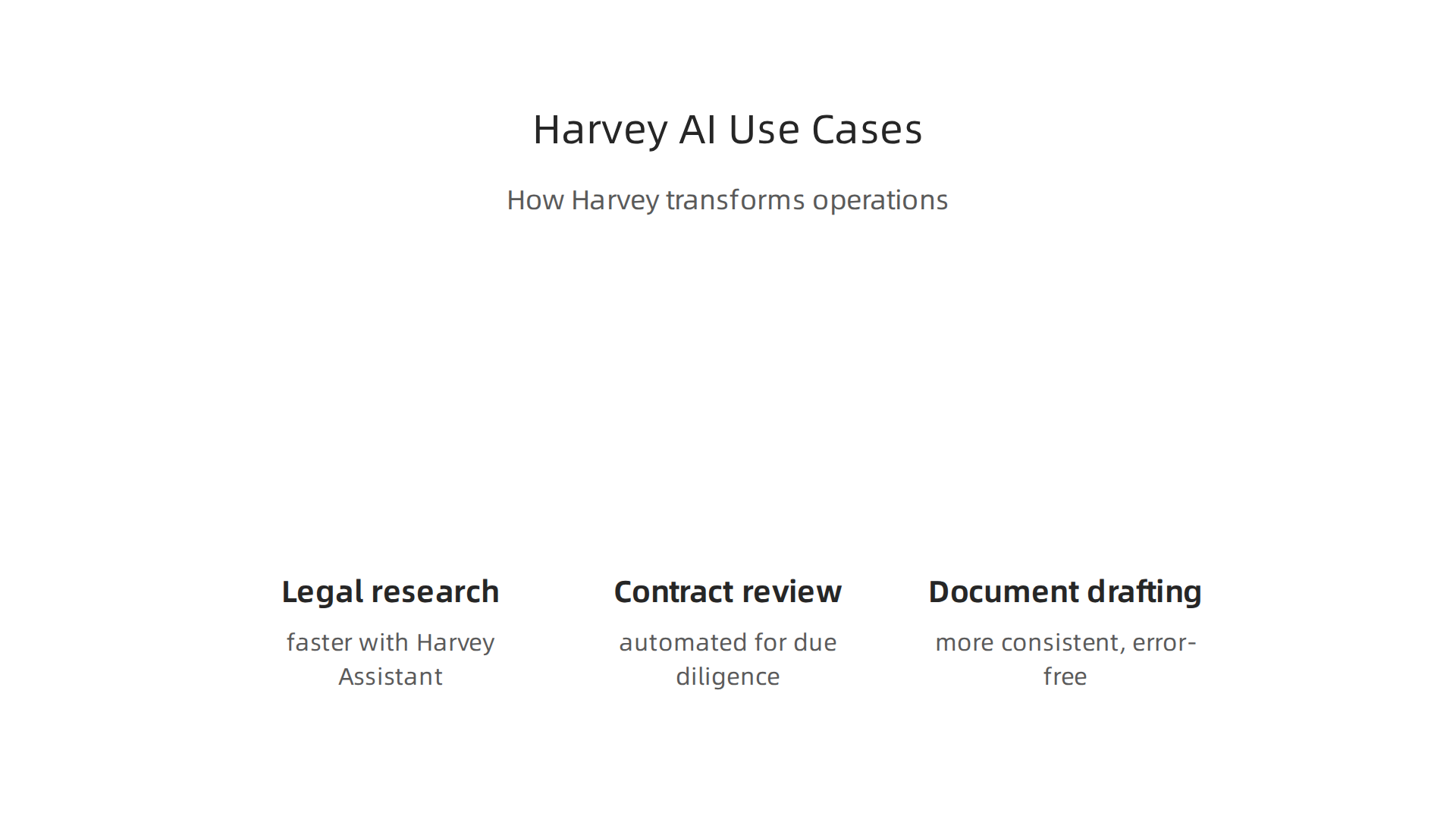
Legal research gets faster. Instead of digging through case law for hours, lawyers use a feature called Harvey Assistant. According to a detailed review of Harvey for legal teams, the Assistant handles research questions, document review, memo drafting, and clause alternatives. The output comes back detailed and structured for firm use. That turns a three hour research session into a ten minute job.
Contract review becomes automated. Harvey AI is purpose-built for contract analysis and due diligence. The platform scans contracts for risky clauses, missing terms, and inconsistencies. It flags problems in seconds. As the Harvey AI homepage explains, the software streamlines contract analysis, due diligence, and compliance for leading law firms worldwide. Legal professionals can then focus on negotiating the best deal instead of reading every line.
Document drafting is more consistent. When you draft contracts, every version needs to say the same thing. Harvey helps lawyers produce consistent, error free documents. It learns from your firm’s past work and suggests language that matches your style. That reduces mistakes and keeps clients happy.
Beyond the law firm. The same core technology works for compliance teams in banks, governance departments in large companies, and financial services firms. Harvey AI is built with a deep enterprise focus, meaning it handles complex workflows and strict security requirements. An analysis of Harvey AI alternatives notes that the platform is made for large firms with mature operations. So if your company handles sensitive documents regularly, Harvey can help.
Integration makes it easy. Harvey connects with the tools your team already uses. The April 2026 update from Harvey showed new integrations and expanded editing capabilities that allow teams to tailor the platform to their specific workflow.
All of these use cases add up to one big win: lawyers and professionals get hours back in their day. They spend more time on strategy and less time on paperwork.

For a broader look at how AI is reshaping every industry in 2026, read our guide to the world of AI in 2026.
Want to stay ahead of these changes? Subscribe to The Deep View Newsletter and get clear daily AI insights that help you work smarter, not harder.
Harvey AI vs. General AI Assistants: A Practical Comparison
So you have seen what Harvey AI can do. But you might wonder: why not just use ChatGPT for legal work? It is a fair question. Lots of people ask it. The answer comes down to one thing: purpose.
General AI assistants like ChatGPT are amazing tools. They write emails, brainstorm ideas, summarize articles, and even help with coding. They are versatile and cheap. But they are not built for law. They do not know the difference between a binding precedent and a footnote. They cannot guarantee their sources are real.
Harvey AI is different. It is built from the ground up for legal work. As one 2026 comparison explains, the gap is clear: Harvey is a legal AI platform while Claude and ChatGPT are AI tools that lawyers use. That distinction matters a lot when your client is counting on you.
What makes Harvey AI special?
The first big difference is accuracy. Harvey provides citations for every claim it makes. It pulls from real legal databases like LexisNexis and Westlaw. General AI assistants often hallucinate cases that do not exist. That is a huge liability for any lawyer.
Security is another major difference. Law firms handle sensitive client data. Harvey AI is designed with enterprise security in mind. It keeps your data safe and complies with strict professional rules. General AI assistants may store your conversations and use them to train future models. One review of Harvey for in-house legal teams notes that Harvey works well for high-volume M&A transactions and complex workflows where data privacy is non-negotiable.
Integration matters too. Harvey connects directly with the tools law firms already use. It plugs into document management systems and legal research platforms. A general assistant is a standalone chat window. That difference changes how teams actually work.
The cost trade-off
Here is the honest part. Harvey AI costs more. A lot more. Some comparisons show it can be 48 times more expensive than a general AI subscription. But for a law firm handling million dollar deals, the price of a wrong answer is far higher.
For a paralegal who just needs to draft one contract, ChatGPT might be enough. For a team that manages hundreds of documents a week, the specialization of Harvey AI is worth the premium. The choice depends on the stakes involved.
If you are curious about how different AI tools stack up for professional work, check out our comparison of top AI assistants for developers in 2026.
The bottom line
General AI is like a Swiss Army knife. It does many things decently. Harvey AI is like a surgical scalpel. It does one thing incredibly well. For legal professionals, that focused precision is what makes the difference between a good outcome and a career ending mistake.
Want to stay ahead of these changes? Subscribe to The Deep View Newsletter and get clear daily AI insights that help you work smarter, not harder.
Adoption Trends and Market Impact of Harvey AI
So Harvey AI is different from general AI assistants. But is anyone actually using it? The short answer is yes, and the numbers are growing fast. The legal industry is going through a major shift, and Harvey AI is right in the middle of it.
Legal AI adoption is exploding
You might be surprised by the numbers. According to a 2026 survey, AI adoption in the legal industry reached 78% in 2025. That is a huge jump. Another report from 2026 shows that generative AI adoption among legal professionals more than doubled from 2025 to 2026, going from 31% to 69%. And over 90% of legal professionals now use at least one AI tool in their daily work. These stats come from multiple sources including a report from Wolters Kluwer and the 2026 Legal Industry Report from 8am.
This is not just about general AI like ChatGPT. Specialized AI systems like Harvey AI are seeing strong uptake, especially in the top law firms.
How Harvey AI is gaining ground
Harvey AI has been busy building partnerships with some of the biggest names in law. Am Law 200 firms and corporate legal departments are leading the charge. They see Harvey as a way to handle high-volume tasks like contract review, due diligence, and legal research much faster. The company has also raised significant funding, which signals strong market confidence in the future of artificial intelligence applications for law.
The reason is simple: when you are dealing with millions of dollars in contracts or sensitive client data, you need a tool that is built for that world. General AI assistants cannot match the security, accuracy, and integration that Harvey AI offers. So firms are willing to pay the premium.
What the market predicts
Analysts expect the legal AI market to be worth billions of dollars by 2027. That growth is driven by more firms adopting AI, better tools coming out, and the pressure to work faster and cheaper. For law firms that want to stay competitive, adopting AI is no longer optional. It is becoming a requirement.
If you want to understand the bigger picture of how AI is reshaping entire industries, check out our article on the world of AI in 2026. It covers trends across many fields, not just law.
What this means for you
Whether you are a lawyer, a legal assistant, or a business owner working with legal teams, the takeaway is clear: AI powered tools like Harvey AI are here to stay. They are changing how legal work gets done. And the firms that adopt them early are gaining a real advantage.
Want to stay ahead of these changes without getting lost in the noise? Subscribe to The Deep View Newsletter and get clear daily AI insights that help you work smarter, not harder.
Implementing AI Solutions: Challenges and Best Practices
You have seen how Harvey AI is gaining traction in the legal world. But bringing any new AI system into a law firm or legal department is not always smooth. There are real hurdles to clear. And knowing what they are can save you a lot of headaches.
Let’s walk through the main challenges and the best ways to handle them.
The top challenges when adopting legal AI
Data privacy and security come first
This is the biggest concern for any legal team. You are dealing with confidential client information, privileged documents, and sensitive case details. If that data leaks, the consequences are serious. A 2026 guide from Cognativ highlights that data privacy and security are top risks when implementing AI in legal settings. You cannot afford to get this wrong.
Integration with existing systems
Most law firms already use a mix of tools for document management, case management, billing, and research. Plugging a new AI platform into that ecosystem without breaking anything is tricky. According to a 2026 article from AlphaBold, the main obstacles are not technical but come from fragmented data and legacy systems that do not talk to each other easily.
User training and adoption
Even the best AI tool is useless if people will not use it. Lawyers and legal staff are busy. They are used to their workflows. Getting them to trust and adopt a new system like Harvey AI takes time and effort. A 2026 report from Isometrik found that 73% of mid-market firms struggle with scaling AI from pilot to production, often because of training gaps.
Best practices for a smooth rollout
Here is what works based on real experience.
Start with a pilot project
Do not try to roll out Harvey AI across the entire firm on day one. Pick a specific use case like contract review or due diligence. Let a small team test it, give feedback, and show results. This approach reduces risk and builds confidence. A best practices guide from Cognativ recommends starting small and proving value before expanding.
Make data security a priority from the start
Choose AI platforms that are built for enterprise security. Look for compliance certifications, encryption, and clear data handling policies. Involving your IT and security teams early helps avoid surprises. The Harvey AI platform is designed with enterprise-grade security, which is one reason it is trusted by over 60% of Am Law 100 firms, according to their own blog.
Involve stakeholders early
Get buy in from partners, associates, and support staff before you launch. Explain how the AI will help them, not replace them. When people understand the benefits and feel heard, adoption goes much faster.
How Harvey AI helps solve these challenges
Harvey AI is not a general chatbot. It is a domain-specific legal AI platform built on OpenAI’s GPT, as noted by AIMultiple. That means it is trained on legal data and built for the way lawyers work. Its enterprise-grade security and compliance certifications directly address data privacy worries. It also integrates with many of the tools law firms already use, which reduces integration headaches. For high-volume tasks like M&A transactions and document diligence, Harvey AI fits right into existing workflows, as explained in a review from GC.ai.
So while implementing any new AI system takes planning, platforms like Harvey AI are designed to make the transition smoother.
Want to stay ahead of the latest AI trends in law and other industries? Subscribe to The Deep View Newsletter and get clear daily AI updates that help you work smarter, not harder.
The Future of AI in Business Operations: Where Is Harvey AI Headed?
Harvey AI has already made big waves in the legal world. But the team behind it is not stopping there. In 2026, we are seeing Harvey AI expand into new industries like finance, insurance, and regulatory compliance. This makes sense because many of the same challenges exist in those fields: lots of documents, heavy regulations, and a constant need for speed.
The move beyond law is part of a larger shift. According to the 2026 AI in Professional Services Report from Thomson Reuters, AI is transforming legal, tax, accounting, risk, fraud, and government sectors all at once. That means Harvey AI’s core strengths, like reading contracts and spotting risks, work just as well for a bank as they do for a law firm.
So what comes next for Harvey AI? Future versions may include new capabilities that go far beyond text. Think multimodal features where the AI can analyze images, charts, and even audio alongside documents. Improved multilingual support is also on the horizon. And deeper integrations with the tools firms already use, like CRM and ERP systems, will make adoption even smoother. These are exactly the kind of developments that PwC’s 2026 Digital Trends survey points to, where AI is increasingly applied to core business activities like planning, forecasting, and sourcing.
The bigger picture here is exciting. In 2026, the best AI systems are not trying to replace professionals. They are becoming trusted partners that amplify human expertise. A trends report from Kantata notes that high-performing firms now treat AI as an operational partner, not just another productivity tool. Harvey AI fits right into that vision. It is a specialized assistant designed to make experts better at their jobs.
If you want to understand where artificial intelligence applications are headed across industries, check out our full look at the world of AI in 2026. It covers the technologies and trends shaping the next wave.
And to stay ahead of these shifts every day, try The Deep View Newsletter. It delivers clear daily AI updates straight to your inbox so you can make smarter decisions for your business.
Summary
This article examines Harvey AI, a GPT-4–based platform built specifically for legal and professional services, explaining how it automates contract review, due diligence, legal research, and document drafting while providing enterprise-grade security and source citations. It covers Harvey’s key features, real-world use cases, and why specialized systems outperform general chatbots in high-stakes legal work. The piece compares Harvey to general assistants like ChatGPT on accuracy, integration, and cost, reviews adoption trends and market impact in 2026, and outlines practical rollout challenges and best practices for firms. Readers will learn when Harvey is worth the premium, how to pilot and scale the tool safely, and what to expect as the platform expands into other regulated industries.