

Why a clear, practical guide to AI matters now
In 2026, it feels like we hear about Artificial Intelligence, or AI, everywhere we look. There’s so much new information coming out every day. For people who run businesses or work with technology, it can be really hard to tell what’s important and what’s not. It’s like trying to find one special toy in a very big, messy toy box. This big pile of information makes it tough to know how AI really works or how it can help you.

Actually, many leaders and workers feel lost in all the talk about AI. They need simple answers to big questions like "what is artificial intelligence with examples" that make sense for their daily work. They want to know "how to learn ai" in a way that helps them use it right. The constant updates and new tools can be confusing. It’s hard to make smart choices when you’re not sure what’s real and what’s just hype.
That’s why a clear, practical guide to AI is so important right now. This guide, called "artificial intelligence: a guide for thinking humans," is here to help. It will break down big ideas into easy-to-understand parts. We’ll talk about what AI truly means. For example, AI systems are designed by people to act in the physical or digital world by taking in data, much like how humans perceive their surroundings An analysis of curricula building blocks – JRC Publications. Other experts describe AI as machines that can learn, reason, and act like humans, often by learning rules and using them to make decisions AI and Curriculum Development for the Future – GOUNI Repository.
This guide will explain the main ideas and how AI is built. We will look at real-world ways to use AI and talk about how to use it safely and wisely. Think of it as your map to understand AI without all the confusing words. We want to help you turn all that noise into clear signals, so you can make the best choices for your business and your future. If you want a basic understanding of how AI works in everyday life, check out our artificial intelligence basics: our clear guide to how AI works in everyday life.
Keeping up with the latest in AI doesn’t have to be a chore. Get clear daily AI updates from The AI Newsletter Worth Reading.
A short history and definitions: what people mean by ‘AI’
When we talk about artificial intelligence, it’s helpful to know that people often mean different things.

It’s like how "car" can mean a small sedan or a big truck. The guide "artificial intelligence: a guide for thinking humans" aims to make these ideas clear.
Most of the AI we use today is what we call Narrow AI (or Weak AI). This kind of AI is very good at doing one specific task. Think about a computer program that can play chess better than any human. Or the systems that suggest movies you might like on a streaming service. These systems can learn rules and make decisions for certain jobs. They can also handle new situations and solve problems within their designed limits, much like how AI is defined as the ability of machines to adapt and solve problems Artificial Intelligence in Education: A Review. But they don’t have general intelligence like a human does. For example, the chess AI can’t then go write a poem or understand your feelings.
Then there’s the idea of General AI (or Strong AI). This is what you see in movies: a machine that can think, learn, and understand anything a human can. It would be able to learn "how to learn ai" itself, respond to any situation, and have real consciousness. Many experts still see this as a goal far in the future. Today’s AI helps automate tasks, meaning it takes over jobs that machines can do well. But it doesn’t usually think like a person does. For a deeper dive into these different kinds of AI, you can explore our guide on types of artificial intelligence: narrow ai, general ai, and superintelligence explained.
A Brief Look Back at AI’s Journey
The idea of machines that can think isn’t new. People have been dreaming about it for a long time. But the real start of modern AI research began in the middle of the 1900s.
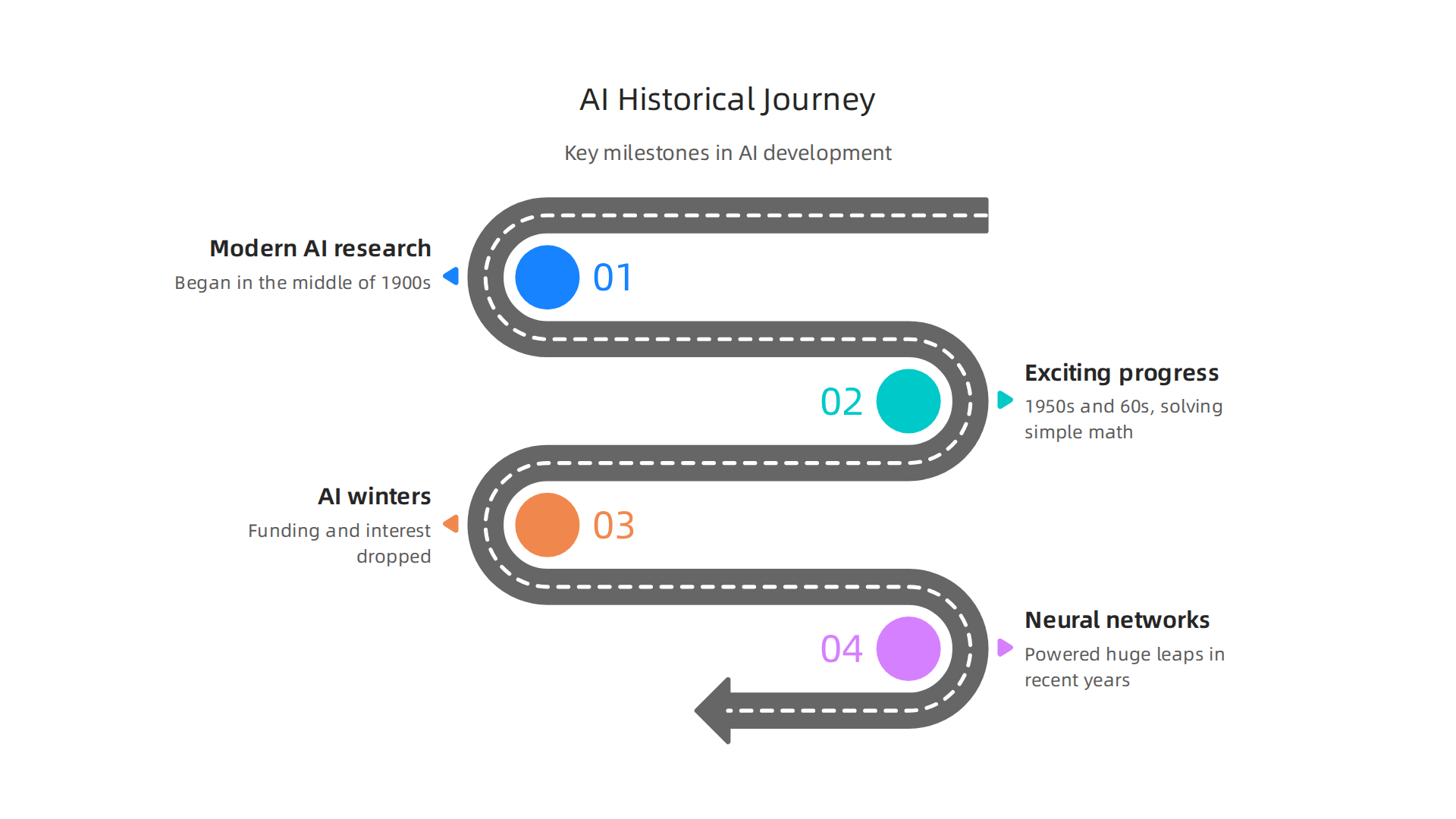
Folks like Alan Turing asked big questions about whether machines could "think." His work helped set the stage for much of what came later ARTIFICIAL INTELLIGENCE: HISTORY, FOUNDATIONS, ….
The field saw exciting progress in the 1950s and 60s, with computers learning to solve simple math problems and play games. However, there were also times called "AI winters" when funding and interest in AI dropped because the technology couldn’t live up to the big promises.
But AI kept growing. In more recent years, especially with powerful computers and a lot of data, AI has made huge leaps. Today, much of modern AI is powered by "neural networks" and "deep learning." These are computer systems that are built a bit like the human brain and can learn from vast amounts of information Annotated History of Modern AI and Deep Learning. This shift has led to the amazing AI responses we see today in things like voice assistants and self-driving cars. If you’re curious about the brilliant minds behind these advancements, learn more about who is the father of AI: exploring the many founders of artificial intelligence.
So, when someone asks "what is artificial intelligence with examples," you can now explain that it’s a field of computer science focused on creating intelligent machines. Mostly, this means machines that are very smart at specific tasks (Narrow AI). And while General AI is still a dream, the journey to get here has been long and full of breakthroughs.
To really understand artificial intelligence, a guide for thinking humans needs to go deeper than just what AI is. It’s also important to know how it works. Think of it like knowing how a car engine works, not just what a car is. At its heart, AI learns from things we give it. AI systems use rules and information to solve problems, much like humans do when they learn something new or make a plan AI and Curriculum Development for the Future – GOUNI Repository.
The AI Model: A Brain for the Computer
First, let’s talk about what an AI model is. Imagine you want to teach a computer to tell the difference between a picture of a cat and a picture of a dog. The AI model is like the student’s brain. It’s a special computer program built to learn a specific task. This model has many parts that work together to make sense of information. It learns patterns and rules from the data you show it.
The Power of Data: What AI Learns From
AI models need lots of information to learn. This information is called data. For our cat and dog example, you’d show the model thousands of pictures of cats and dogs.
- Training Data: This is the big pile of pictures (or text, or sounds) that the AI model looks at to learn. Each picture might be labeled "cat" or "dog." The model tries to find patterns that help it tell them apart.
- Loss Functions: As the model learns, it sometimes makes mistakes. A "loss function" is like a scorekeeper that tells the model how wrong its guess was. The goal is to make this score as low as possible.
- Generalization: After learning from the training data, the model needs to be able to guess correctly about new pictures it’s never seen before. This ability is called generalization. A good AI model can generalize well, meaning its "ai response" is accurate for unseen information.
- Evaluation: To see how well the model learned, we test it with a separate set of data. This "evaluation" step helps us know if the model is truly smart or just memorized the training pictures.
To understand more about the basic ways AI functions, check out our artificial intelligence basics: our clear guide to how ai works in everyday life.
How AI Learns: Different Methods
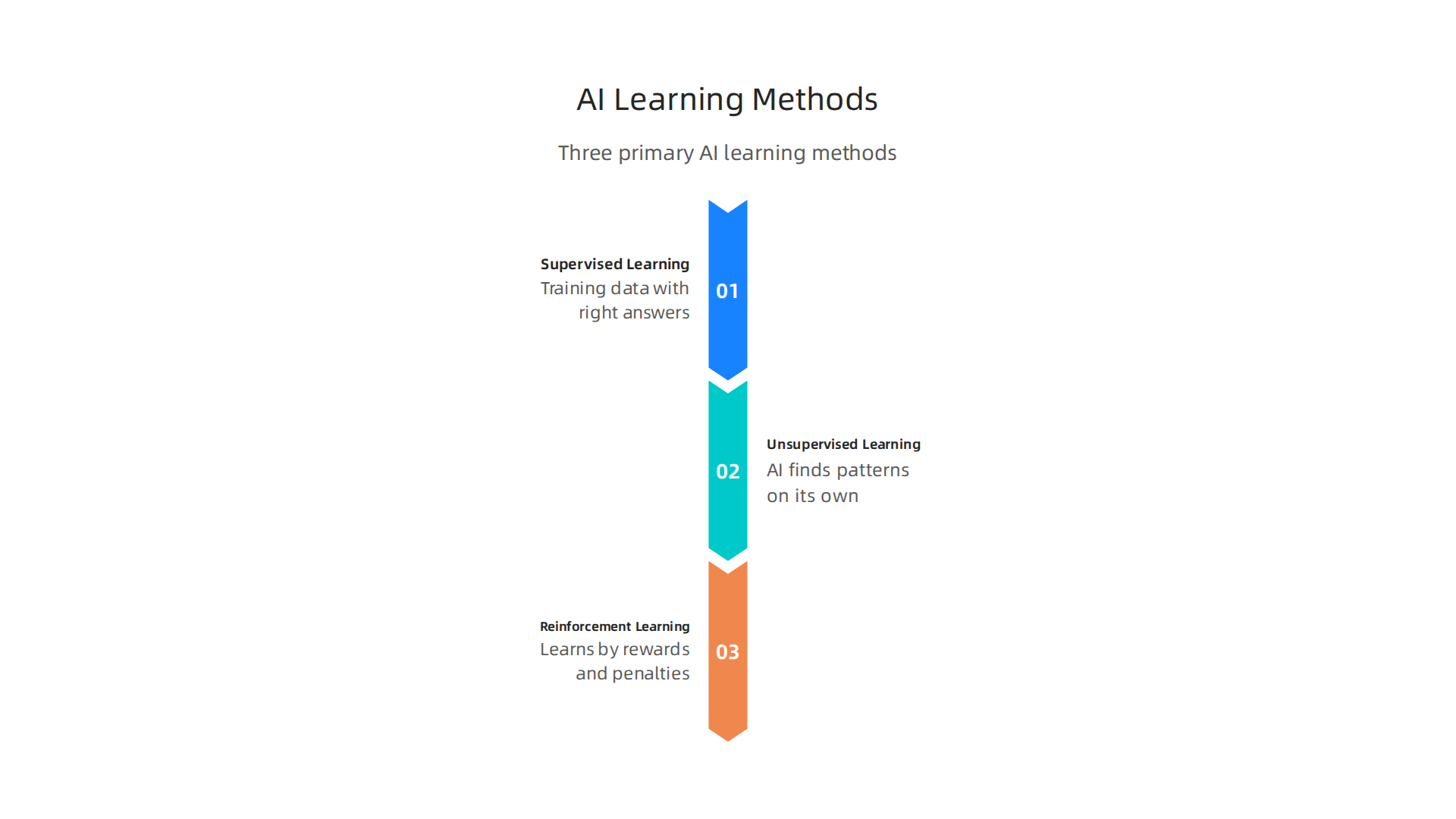
There are a few main ways AI models learn to do their jobs. These are like different teaching styles:
Supervised Learning
This is the most common way AI learns. It’s like a student with a teacher. The training data comes with all the right answers (like the "cat" or "dog" labels). The AI tries to guess the answer, and then the "teacher" tells it if it was right or wrong. The model then adjusts itself to make fewer mistakes next time. This is how many systems learn to predict things or sort items.
Unsupervised Learning
With unsupervised learning, there’s no "teacher" and no right or wrong answers in the training data. It’s like giving the AI a box of mixed toys and asking it to sort them into groups that make sense. The AI looks for hidden patterns or structures in the data on its own. It might find that all the red blocks go together, or all the soft animals. This is useful for finding trends or making customer groups.
Reinforcement Learning
Imagine teaching a dog new tricks with treats. This is a bit like reinforcement learning. The AI model, often called an "agent," learns by trying different actions in an environment. If it does something good (like winning a game), it gets a reward. If it does something bad, it might get no reward or even a penalty. Over time, it learns which actions lead to the most rewards. This is how AI learns to play complex games or control robots.
Knowing these core ideas about models, data, and learning types helps you truly understand the amazing things artificial intelligence can do today. If you’re interested in going deeper, there are many artificial intelligence academic resources your 2026 roadmap you can explore to further your understanding of how to learn AI and its workings.
Now that we know how AI learns, let’s talk about the bigger picture: how these smart systems are actually built and made ready for use. It’s more than just teaching a computer; it’s a whole process, like building a complex machine. This helps us understand what is artificial intelligence with examples of how it’s put together.
The Inner Workings of AI: Architectures and Workflows
Every AI model, whether it’s for recognizing faces or writing stories, has a certain "architecture." This is like the blueprint for its brain. Different tasks need different types of blueprints. For example, some AI models are good at seeing patterns in images, while others are better at understanding language. These architectures decide how the model will process information and make its ai response. If you want to dive deeper into these different kinds of AI, you can explore the types of artificial intelligence explained.
The process of building and teaching an AI model is called a training workflow. It involves several steps:
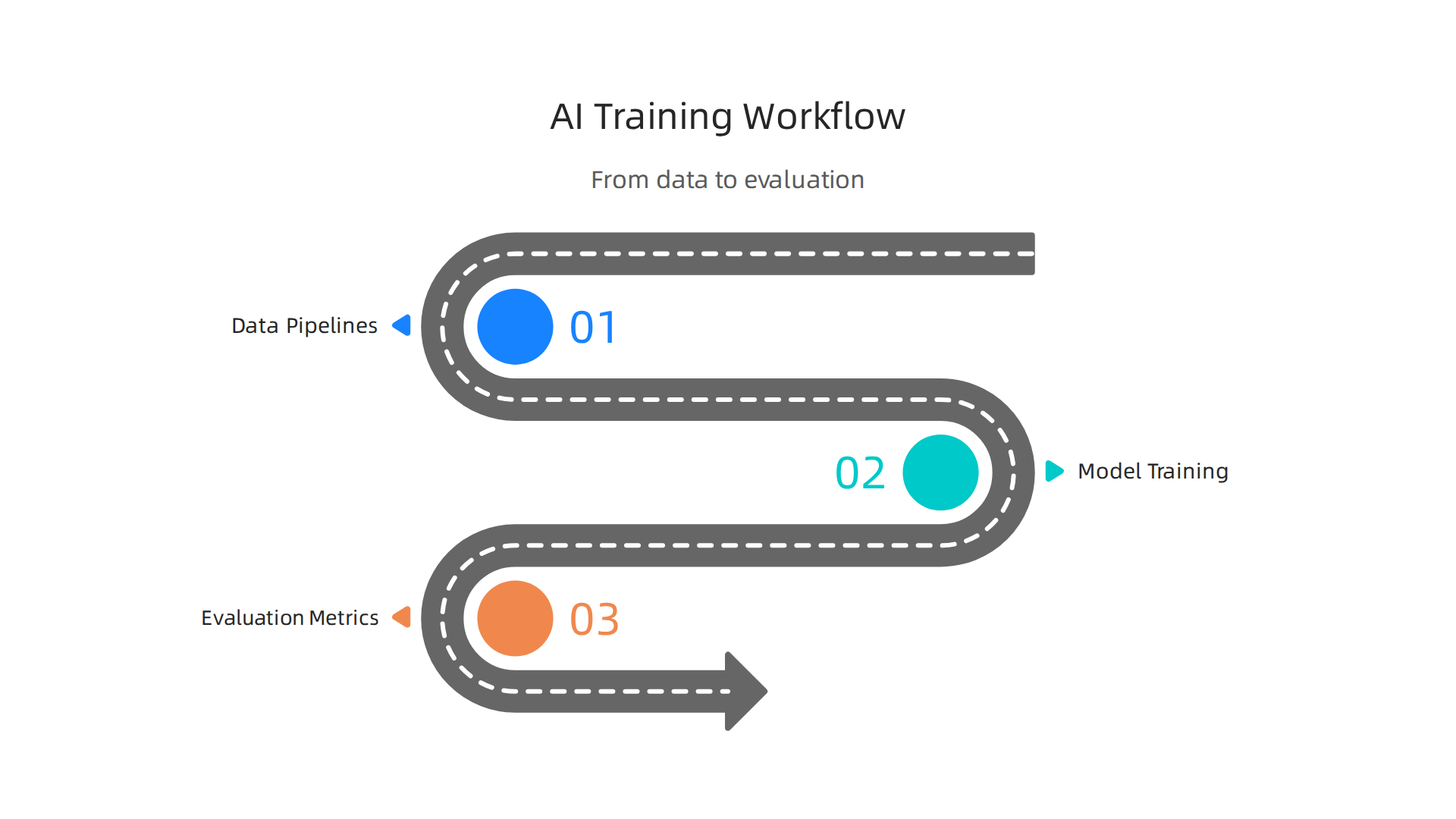
- Data Pipelines: Before an AI can learn, its data needs to be ready. Imagine sorting a huge library. This involves collecting, cleaning, and organizing vast amounts of information. This organized data then flows into the AI model, much like water through a pipe. The quality of this data pipeline is super important because AI learns from what it sees. Poor data means poor learning. In fact, machine learning needs large amounts of data to learn properly, which can include text, images, or sensor readings ML requires large amounts of data.
- Model Training: This is where the AI model actually "learns" from the prepared data using one of the methods we talked about earlier (supervised, unsupervised, or reinforcement learning). It adjusts its internal settings again and again until it gets better at its task.
- Evaluation Metrics: After training, we need to know if the AI is any good. This is where evaluation comes in. We use special "metrics," which are like scorecards, to measure how well the AI performs. For example, for a picture-recognizing AI, we’d check how often it correctly identifies a cat or a dog. These metrics help us see if the AI can truly generalize its learning to new situations, which is crucial for real-world use Advancing RecSys Benchmarking Practices. It also involves making sure the datasets used for testing are fair and representative A Benchmarking Framework for Model Datasets.
Real-World Hurdles: What Limits AI Today
Building powerful artificial intelligence systems isn’t always easy. There are some big real-world limits that shape what’s possible:
- Compute Power: AI models, especially the very big ones, need a huge amount of computing power. Think of it as needing a super-fast brain with lots of energy. The demand for this "compute" has grown hugely, with the largest increases coming from industry AI INDEX REPORT 2026 | Research and Development – Stanford HAI. Training a single large AI model can use as much power as many homes combined. This means we can’t just build any AI we dream up; we have to think about the computer resources needed. Some research shows that the training compute for notable AI models doubles about every five months, while the power needed increases each year CHAPTER 1: Research and Development – Stanford HAI.
- Data Quality and Amount: We’ve already said AI needs lots of data, but it also needs good data. If the data has mistakes, or is biased, the AI will learn those problems. Finding, cleaning, and preparing high-quality data is a massive and ongoing job. Without enough good data, even the smartest architecture can’t learn well.
- Engineering Challenges: It takes a lot of skilled engineers to build these AI systems. They need to set up the data pipelines, choose the right architectures, manage the training, and keep everything running smoothly. This also means dealing with "technical debt," which is like design shortcuts that need fixing later to keep the system working well Technical Debt in AI Platforms: What You Must Know. These engineering efforts shape what kinds of AI projects can actually be finished and used.
Understanding these technical foundations and practical limits is key for anyone trying to get a full picture of artificial intelligence: a guide for thinking humans needs to cover these details. These factors influence not just how AI is built, but also how fast it can improve and what it can truly achieve in 2026. This also impacts how quickly businesses can Maximize Business Impact with Enterprise AI Platforms.
Building smart AI systems is a bit like building a large, fancy city. We’ve talked about the blueprints (architectures) and how things are put together (workflows). But a city also needs good roads, clean water, and power. For AI, these hidden but very important parts are its data and the computer setup, or "infrastructure," that runs it. These are the true backbones of modern artificial intelligence.
The Power of Good Data: More Than Just Lots of It
Imagine trying to learn to cook from a cookbook where half the pages are torn, and the ingredients are all wrong. You wouldn’t learn much, would you? It’s the same for AI. We’ve mentioned that AI needs lots of data, but it also needs good data. This is where data curation and data labeling come in.
- Data Curation: This means carefully collecting, organizing, and cleaning data. It’s like a librarian making sure all the books are in the right place and free of scribbles. Good curation ensures the AI learns from useful, clean information. Deep learning, a common way AI learns, depends on a huge amount of data to build its models effectively Deep Learning: A Comprehensive Overview. Without proper curation, even a lot of data can lead to poor learning.
- Data Labeling: For many AI types, especially those that learn from examples (like identifying objects in pictures), the data needs "labels." This means someone or something has already marked the data with the correct answers. For instance, in a photo, a person might draw a box around a dog and label it "dog." This labeled data is what the AI uses to understand what it’s looking at. Supervised learning, a key AI method, truly relies on large amounts of this kind of labeled information Artificial Intelligence report.
The bottom line is that the quality of data matters far more than just its quantity. For anyone trying to understand artificial intelligence: a guide for thinking humans must emphasize this point.
The Muscle Behind the Brain: AI Infrastructure
Just as a city needs power plants, AI needs powerful computer hardware to run its complex calculations. This is its infrastructure.
- Powerful Computers (GPUs and Clusters): AI, especially the large models, requires special computer chips called GPUs (Graphics Processing Units) that are very good at doing many calculations at once. Often, many of these GPUs are linked together in "clusters" to work as one super-powerful machine. This is how AI models can process vast amounts of data and learn quickly.
- Data Storage: All that data we just talked about needs a place to live! AI systems require huge amounts of storage that can be accessed very quickly. Think of it as a massive, lightning-fast library for the AI.
These hardware setups are critical for a speedy and accurate ai response. Without them, even the best AI ideas would struggle to become real. To learn more about how AI works, check out our Artificial Intelligence Basics.
Choosing Your Playground: On-Premises, Cloud, or Hybrid
When building AI, companies have to decide where all this data and infrastructure will live. There are three main choices:
- On-Premises: This means a company buys and manages its own servers, GPUs, and storage, keeping everything in its own buildings.
- Pros: Full control over security and data, potentially cheaper in the long run if used constantly.
- Cons: High upfront cost, needs a lot of skilled staff to manage, can be hard to quickly make bigger or smaller as needs change.
- Cloud: This involves renting computing power and storage from big tech companies like Amazon, Google, or Microsoft. You access everything over the internet.
- Pros: No big upfront costs, easy to scale up or down as needed, less management work for your team.
- Cons: Ongoing costs can add up, less direct control over hardware, data security can be a concern for very sensitive information.
- Hybrid: Many companies choose a mix. They might keep sensitive data and core AI systems on their own servers (on-premises) while using the cloud for extra computing power during busy times or for less sensitive tasks.
- Pros: Offers flexibility and the best of both worlds.
- Cons: More complex to set up and manage than just one approach.
These choices deeply affect how long an AI project takes and how much it costs. Understanding these trade-offs is crucial for anyone wondering what is artificial intelligence with examples of how it’s actually deployed in the world today. The decision impacts everything from development timelines to the final bill.
Now that we understand the building blocks of AI, let’s talk about where it’s truly making a difference right now, in 2026. Artificial intelligence isn’t just for science labs anymore. It’s working hard in many different parts of our daily lives and businesses. It helps companies get things done, make smart choices, and even personalize things just for us. Many companies are seeing big benefits from using AI in their everyday work

AI Technology Investment Accelerates Across Industries as Strategic Deployment Defines Q2 2026.
Where AI is delivering value today: sector-by-sector view
In 2026, you’ll find AI helping in almost every business. It’s moved past just trying things out and is now a key part of how many companies work. This shows us what is artificial intelligence with examples that have real impact.
Here are some ways AI helps in different areas:
- Healthcare: AI helps doctors look at medical pictures, like X-rays, to find problems sooner. It also helps discover new medicines faster.
- Money Matters (Finance): AI is great at spotting fraud and strange money movements, keeping your money safe. It also helps make smart trading decisions.
- Factories (Manufacturing): In factories, AI can predict when machines might break down, so they can be fixed before stopping work. It also checks products for mistakes to make sure everything is perfect. Physical AI, which is AI built into machines, is growing very fast in this area AI by Industry: How Every Sector Is Using AI in 2026.
- Shopping (Retail): When you shop online, AI suggests products you might like. It also helps customer service by answering common questions quickly, which means a better ai response for you.
- Communication (Telecommunications): AI helps phone and internet companies work better and be more useful for their customers.
Across all these areas, AI is very good at doing tasks that normally take a lot of thinking, freeing up people to do other important work. It also helps people make better decisions because it can look at a lot of information very fast.
How to know if AI is worth it: Checking the value (ROI)
When companies decide to use AI, they want to make sure it’s a good investment. This is called figuring out the "Return on Investment" (ROI). It’s like asking, "If we put money and effort into AI, what good things will come back?"
- Saving Money: AI can automate boring or hard tasks, which saves companies money on labor and time.
- Making More Money: By helping companies understand customers better or create new products, AI can help them earn more.
- Working Faster: AI can do complex calculations and tasks much quicker than people, speeding up many processes.
To check the ROI, businesses need to set clear goals and measure how AI helps reach them. They might start with small projects to see the benefits first. For instance, many companies are seeing their money back from AI in less than a year AI Automation ROI Benchmark Report 2026. If you’re looking to understand more about how businesses use AI to grow, check out how to use AI to drive business growth. This kind of careful thinking is part of what it means to truly grasp artificial intelligence: a guide for thinking humans.
To stay updated on these rapid changes and learn how AI is shaping industries daily, there’s an excellent resource.
Get clear daily AI updates from The AI Newsletter Worth Reading.
When we talk about how useful AI is for businesses and daily life, it’s also very important to think about the other side: being fair and safe. Using artificial intelligence: a guide for thinking humans needs us to consider not just what AI can do, but what it should do. In 2026, companies are working hard to use AI in good ways and avoid problems.
Core Ethical Risks of AI
AI can sometimes cause problems if we are not careful. Here are some of the main worries:
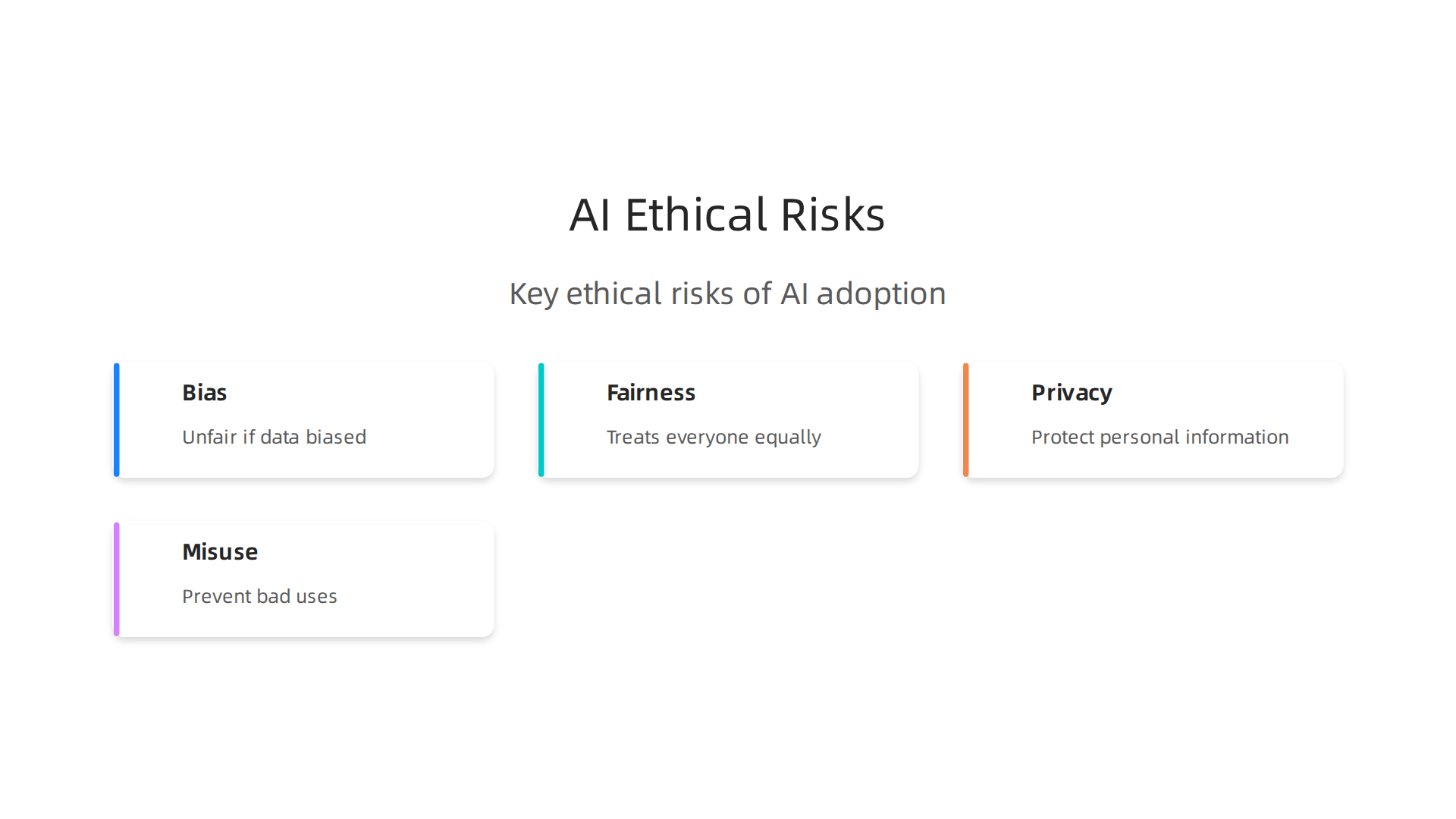
- Bias: AI learns from data. If the data has unfair parts, the AI can become unfair too. For example, if an AI is trained mostly on pictures of certain groups of people, it might not recognize others as well. This leads to unfair results or "AI response."
- Fairness: This means making sure AI treats everyone equally. We want AI to help everyone, not just a few.
- Privacy: AI often needs a lot of information, including personal data. Keeping this information safe and private is a big deal. We need to make sure our personal details are protected from being used wrongly.
- Misuse: Sometimes, AI can be used for bad things, like spreading wrong information or making decisions that hurt people. We need to prevent this.
To make sure AI is used ethically, it’s helpful to understand the basic ideas behind it. You can learn more about these core concepts in our artificial intelligence basics guide.
Basic Governance Controls for Companies
Because of these risks, companies need rules and plans for how they use AI. This is called "AI governance." It’s like having a set of instructions to keep AI safe and helpful. Here are some simple steps companies are taking:
- Clear Rules: Companies set up policies that explain how their teams should use AI. This includes what kind of data they can use and how they should check AI for fairness.
- Human Oversight: People must always be in charge. This means humans need to review what AI does and make the final decisions, especially for important tasks.
- Checking AI Often: Companies regularly test their AI systems to find any biases or mistakes. They look at how the AI makes decisions to ensure it’s fair and accurate.
- Who is Responsible: It’s important to know who is in charge of making sure AI works correctly and ethically. Someone needs to be accountable.
Experts suggest a detailed list of items, or a checklist, to help companies manage their AI safely. This covers things like how to track all AI systems and how to classify risks AI Governance Checklist for Enterprises (2026).
Regulatory Trends and Standards
Governments and international groups are also making rules for AI. In 2026, many new laws and standards are coming out to make sure AI is used responsibly. For example, there’s a big push for transparency, meaning users should know when they are interacting with AI and how it makes its key decisions AI Ethics Guide 2026: Principles, Challenges & Best Practices. The European Union, for instance, has introduced the AI Act to set clear rules for how AI can be developed and used. This helps make sure AI systems are safe, respect our rights, and do not cause harm.
Understanding these different types of artificial intelligence and the rules around them helps everyone, from big companies to everyday users, adopt AI more wisely. It’s all about making sure AI serves us well, without causing unexpected problems.
As we learn how to use artificial intelligence wisely and safely, it’s also important to look ahead. What are the big things happening with AI right now, and what should we expect in the future? In 2026, AI is no longer just an idea; it’s a real part of how many businesses work, making a big impact across almost all areas of business Global AI Pulse Q1 2026. This means everyone needs to know what’s coming to stay ready.
Real Trends vs. Quick Fads
With so much talk about AI, it can be hard to tell what’s truly important from what’s just a passing trend. For thinking humans, understanding AI means looking for the things that will last. For example, some kinds of AI, like Generative AI (which creates new content) and Agentic AI (which acts on its own to solve problems), are moving from experiments to being a core part of how companies operate. These are called "durable themes" because they are expected to stick around and keep growing, affecting everything from customer service to how we manage supply chains The State of AI in the Enterprise – 2026 AI report | Deloitte US. Instead of chasing every new tool that pops up, focus on these larger shifts in how artificial intelligence is changing work and life. To learn more about what’s next, check out our guide on the World of AI in 2026.
How Leaders Can Get Ready
For leaders in businesses, preparing for these AI changes means a few key things:

- Train Your Team: Help your people understand what is artificial intelligence with examples, so they can work better with AI tools. It’s about teaching them new skills, not replacing them.
- Build the Right Systems: Make sure your company’s computer systems can handle new AI tools. This means having good data ready for AI to learn from and clear ways to measure how well AI is working. Experts suggest starting with pilot projects in less risky areas to build experience AI ROI in 2026: 4 Steps for Founders, Leads, Operators.
- Start Small, Then Grow: Instead of trying to do everything at once, pick one area where AI can help a lot. See how it works, then slowly add more AI into other parts of the business. This careful approach helps avoid big mistakes and builds confidence.
Prioritizing What Matters for Investors and Operators
If you’re an investor or someone who runs a business, you’ll want to put your money and efforts into AI projects that are strong and will last, even when things change. This means looking for AI initiatives that promise a good return on investment (ROI). Many industries, like financial services and telecommunications, are already seeing big benefits from AI, such as better productivity and lower costs AI ROI by Industry 2026.
When choosing what to focus on, think about:
- Clear Goals: What problem will this AI solve? How will it make things better in numbers, like saving money or making customers happier?
- Testing and Measuring: Set up ways to check if the AI is truly making a difference. This includes tracking how it performs over time.
- Long-Term Impact: Choose AI projects that not only help today but also help your business grow and adapt for many years to come. This helps you move from just an "AI response" to truly smart strategy.
Being smart about AI adoption means always learning and adapting. To keep up with the daily changes in this fast-moving field, consider getting The AI Newsletter Worth Reading for clear daily AI updates from The Deep View Newsletter. This will help you continually evolve your understanding of artificial intelligence: a guide for thinking humans in this exciting era.
Summary
This article explains why a clear, practical guide to artificial intelligence is essential in 2026 and then walks readers through the core ideas they need to use AI wisely. It defines common terms (Narrow vs General AI), gives a short history, and lays out how AI models learn using supervised, unsupervised, and reinforcement methods. The guide explains the critical roles of data quality, model evaluation, and infrastructure choices (cloud, on‑premises, hybrid), and it covers real business use cases and how to measure ROI. It also highlights technical limits like compute and data challenges, and it sets out basic ethical risks and governance steps companies should adopt. After reading, leaders and practitioners will better evaluate AI projects, choose deployment paths, design pilots, and put simple controls in place to manage risk and value.