
Introduction: Navigating the Vast World of AI
Have you ever felt like the world of AI is moving faster than you can keep up? Every day there is a new tool, a new breakthrough, or a new warning. It is easy to feel buried under the noise. You are not alone. In 2026, the artificial intelligence market is already worth hundreds of billions of dollars. According to Fortune Business Insights, the global AI market is projected to grow from $375.93 billion in 2026 to $2.48 trillion by 2034. That is a compound annual growth rate of over 26%. AI is not one single technology anymore. It is a whole ecosystem reshaping healthcare, finance, gaming, manufacturing, and more.
The problem is information overload. Most professionals do not have time to read every report or try every new app. They need a clear, structured overview to separate what matters from what is just hype.

That is exactly what this guide is for. We will walk through the full spectrum of the world of AI, starting with the core ideas behind artificial intelligence and machine learning, then looking at the latest AI research, and finally peeking at where things are heading next.
If you want to cut through the clutter and get smarter about AI without spending hours each day, you are in the right place. And if you are looking for a daily dose of clear, reliable AI news, the The Deep View Newsletter delivers the key updates straight to your inbox.
But first, let us make sure we are all on the same page about what AI even means today. We will also explore how you can turn data overload into strategic insight in the information society so that you never miss what truly matters.
The Foundations of AI: Defining the World of AI
So what does the world of AI actually look like under the hood? To understand where we are in 2026, it helps to see how we got here.
Artificial intelligence is not a brand new idea. Researchers have been dreaming about it since the 1950s. The field officially kicked off at the Dartmouth Conference in 1956, where a group of scientists first used the term "artificial intelligence." Back then, the approach was mostly symbolic. Researchers tried to program logic and rules into computers by hand. It worked for simple problems, but it could not handle real world complexity.
Then came expert systems in the 1980s. These were programs designed to mimic the decision making of a human expert in a specific area, like medical diagnosis. They were useful but rigid and hard to update.
The real shift happened with machine learning. Instead of hard coding every rule, we started to train models on data. As IBM explains, deep learning models allow AI applications to learn how to perform new tasks that need human intelligence. That change unlocked everything we see today. According to the Stanford Emerging Technology Review, three of the most important subfields of AI are computer vision, machine learning, and natural language processing.
Each of these subfields has seen massive advances. Through deep learning architectures like convolutional neural networks, systems can now classify images, detect objects, and segment scenes. Generative AI, a subfield of machine learning, allows businesses to create new data, content, and 3D models. This has led to breakthroughs like modern image generation tools, which you can explore in our guide on AI image generation trends and business applications.
Today, experts separate AI into three broad categories. First, narrow AI handles one specific task. This powers your email spam filter, Netflix recommendations, and voice assistant. It is everywhere, and it is the only type of AI that actually exists today. Second, general AI would match human level intelligence across any task. We are not there yet, but researchers are actively working on it. Third, superintelligence would surpass human ability across the board. That is still theoretical.
For now, the practical focus stays firmly on narrow AI. In 2026, almost every business application falls into this bucket. If you are curious about how close we are to artificial general intelligence, you can explore the full AGI 2026 landscape covering rivals, benchmarks, and safety.
The big picture is this. The world of AI is built on decades of steady progress. The tools we use today, from image generators to chatbots, rest on foundations laid long ago. And that foundation keeps getting stronger every year.
To keep up with the latest breakthroughs without getting overwhelmed, the The Deep View Newsletter delivers clear daily updates straight to your inbox. It is the easiest way to stay informed without drowning in noise.
Core Subfields of AI: A Spectrum of Technologies
Now that we have a clear picture of what the world of AI looks like overall, let’s zoom in on the specific technologies that make it all work. Think of these subfields as the specialized tools in the AI toolbox. Each one handles a different type of problem.
According to the Stanford Emerging Technology Review, three of the most important subfields are computer vision, machine learning, and natural language processing. Robotics is another major pillar, though it often combines the other three. Together, they cover almost every real world AI application you encounter.
Machine Learning: The Core Engine
Machine learning is the backbone of modern AI. Instead of being programmed with explicit rules, ML systems learn patterns from data. As IBM explains, deep learning models (a subset of ML) allow AI to learn how to perform new tasks that require human-like intelligence. If you want to start learning this yourself, the Machine Learning Roadmap from Coursera offers a clear path from beginner to expert.
Machine learning algorithms fall into a few categories. Supervised learning uses labeled data to predict outcomes. Unsupervised learning finds hidden patterns without labels. Reinforcement learning learns through trial and error. Each type requires different data and works best for specific problems.
Natural Language Processing: Teaching Machines to Read and Talk
Natural language processing, or NLP, gives machines the ability to understand, interpret, and generate human language. It powers everything from chatbots to translation tools to sentiment analysis. In 2026, advanced NLP models like GPT-4 and beyond have become standard in customer service, content generation, and even healthcare documentation. Devabit’s overview of new AI technologies highlights how these models continue to improve.
Computer Vision: Giving Machines Eyes
Computer vision allows systems to extract meaning from images and video. Through deep learning architectures like convolutional neural networks, systems can now classify images, detect objects, and segment scenes with impressive accuracy, as detailed in this 2026 guide on machine learning in computer vision. You see this in action with medical imaging analysis, autonomous vehicles, and quality control in manufacturing. For a deeper dive into how visual AI is transforming business, check out our article on AI image generation trends and business applications.
Robotics: Bringing AI into the Physical World
Robotics combines AI with mechanical systems to perform tasks in the real world. It often integrates computer vision for navigation, NLP for human interaction, and machine learning for adaptive control. From warehouse robots to surgical assistants, robotics is becoming more intelligent and autonomous every year.
Deep Learning: The Unifying Force
One thing ties many of these subfields together: deep learning. This technique uses neural networks with many layers to model complex patterns. It has been the main driver behind the breakthroughs in computer vision, NLP, and generative AI. According to AppInventiv’s analysis of AI trends, generative AI (a subfield of ML) now allows businesses to create new content, data, and 3D models automatically.
But deep learning is not a silver bullet. It requires huge amounts of data and computing power. For simpler problems, traditional machine learning or rule based systems might work better and cost less.
Each of these subfields has its own unique algorithms, data requirements, and real world use cases. The best AI systems often combine multiple subfields to solve complex problems.

Understanding this spectrum helps you see where the real value lies.
If you want to keep up with how these technologies evolve day by day, the The Deep View Newsletter delivers clear, daily updates straight to your inbox. It is the easiest way to stay informed without drowning in noise.
The Generative AI Revolution: Creativity and Automation
Now you know the core subfields that make up the world of AI. But there is one category that has changed everything in the last few years: generative AI. This is the technology behind tools that can write essays, create photorealistic images, generate computer code, and even produce video from a simple text prompt.

Generative AI has exploded since 2023. And in 2026, it keeps getting better. According to detailed comparisons of the latest models, GPT-5, Claude 4, Gemini 2, and Llama 4 now compete head to head in reasoning, creativity, and accuracy. Each has its own strengths. GPT-5 excels at broad knowledge tasks. Claude 4 wins on safety and careful reasoning. Gemini 2 leads with its ability to handle text, images, audio, and video in one model. And open-source models like Llama 4 give developers the freedom to customize without paying per call.
If you want to see how these models stack up, the comprehensive AI model benchmarks from Epoch AI and Scale AI provide the latest scores for over 30 frontier models. It is the best way to compare performance for your specific needs.
Where Generative AI Shines in 2026
Businesses now use generative AI for three main tasks.
First, content creation. Marketing teams generate blog posts, social media copy, and ad variations in seconds. Video creators produce short clips with AI generated footage. Music producers experiment with AI composed melodies.
Second, software development. Code assistants like GitHub Copilot and other AI tools help developers write, debug, and document code faster. For a closer look at the top options this year, check out our guide on AI assistants for developers in 2026.
Third, product design. Companies use generative AI to brainstorm new product concepts, create 3D models, and test variations before building physical prototypes. This saves both time and money.
The Hard Parts Enterprises Face
Generative AI is powerful, but it is not plug and play. Enterprises run into three big challenges.
The first is integration. Getting a generative AI model to work with existing data systems, customer databases, and internal tools takes serious engineering effort. It is not as simple as turning on a switch.
The second is cost. Running large models at scale is expensive. The biggest frontier models require powerful hardware. For small teams, this can be a barrier.
The third is quality control. Generative models can produce wrong, biased, or harmful content. Companies need human reviewers, guardrails, and testing processes to catch problems before they reach customers. A thorough comparison of leading GenAI chatbots shows how each model handles safety differently.
What Comes Next
The generative AI revolution is still young. Every month brings new capabilities and new challenges. The key is to stay informed without getting overwhelmed by hype.
That is exactly why we recommend The Deep View Newsletter. It delivers clear, daily updates on generative AI and the broader world of AI straight to your inbox. No fluff. Just the signal you need to make smarter decisions.
Real-World Applications: AI Across Industries
So you have seen how generative AI changes the way we create and automate. But the real story of the world of AI is bigger than writing tools and chatbots. In 2026, AI is reshaping entire industries from the ground up. The numbers prove it. The global AI market was valued at around $390 billion in 2025 and is expected to surge past $3.4 trillion by 2033 according to Grand View Research. That kind of growth does not happen by accident. It happens because companies across healthcare, finance, and retail are finding real, measurable returns on their AI investments.
Healthcare: From Diagnosis to Drug Discovery
Healthcare is arguably the sector where AI saves the most lives. In 2026, diagnostic AI tools help radiologists spot tumors, fractures, and early signs of disease faster than ever before. A recent analysis of the top AI healthcare use cases ranked by ROI shows that ambient documentation and early warning systems for sepsis deliver the highest returns, with some hospitals saving millions of dollars each year. For a deeper look at how AI is changing medical imaging, check out our coverage on 81 percent of radiology departments now using AI. Beyond diagnostics, AI speeds up drug discovery by analyzing millions of molecular combinations in days instead of years. Robotic surgery systems, guided by AI, help surgeons perform more precise operations with fewer complications.
Finance: Fraud Detection and Smarter Banking
Finance has always been data heavy, and AI fits naturally here. Banks and credit unions use artificial intelligence and machine learning to catch fraudulent transactions in real time. Algorithms spot patterns that humans would miss, stopping scams before money leaves an account. Algorithmic trading platforms now execute trades based on market signals faster than any human trader could. And for everyday customers, AI powered banking apps offer personalized budgeting advice, savings recommendations, and even loan approvals based on a broader picture of financial health. The 2025 AI Index Report from Stanford HAI notes that U.S. private AI investment reached $109.1 billion in 2024, and a big chunk of that went into fintech and financial services.
Retail: Personalized Shopping and Smarter Supply Chains
Retail is all about knowing what customers want before they do. Recommendation engines powered by AI are the reason your favorite online store seems to read your mind. They analyze past purchases, browsing behavior, and even weather data to suggest products you are likely to buy. Behind the scenes, AI optimizes inventory levels so stores do not run out of popular items or get stuck with too much stock. Customer service chatbots handle questions, returns, and order tracking around the clock. Retailers using AI for these tasks report significant ROI improvements, as highlighted in a recent benchmark study on AI use cases in retail.
How to Make Sense of It All
These are just three industries, but the same pattern plays out in manufacturing, logistics, energy, and education. The world of AI is vast and evolving fast. Keeping up with every breakthrough is tough. That is exactly why we created The Deep View Newsletter. Every weekday, you get a clear, honest summary of the most important AI developments and how they affect your industry. No hype, just the signal you need to stay ahead.
Ethical and Societal Challenges: Navigating Risks in the World of AI
All this progress sounds amazing, right? But we cannot ignore the tough stuff. As AI becomes more powerful, it brings serious ethical and societal questions with it. In 2026, these challenges are front and center for companies, governments, and everyday people.
Bias, Fairness, and Transparency
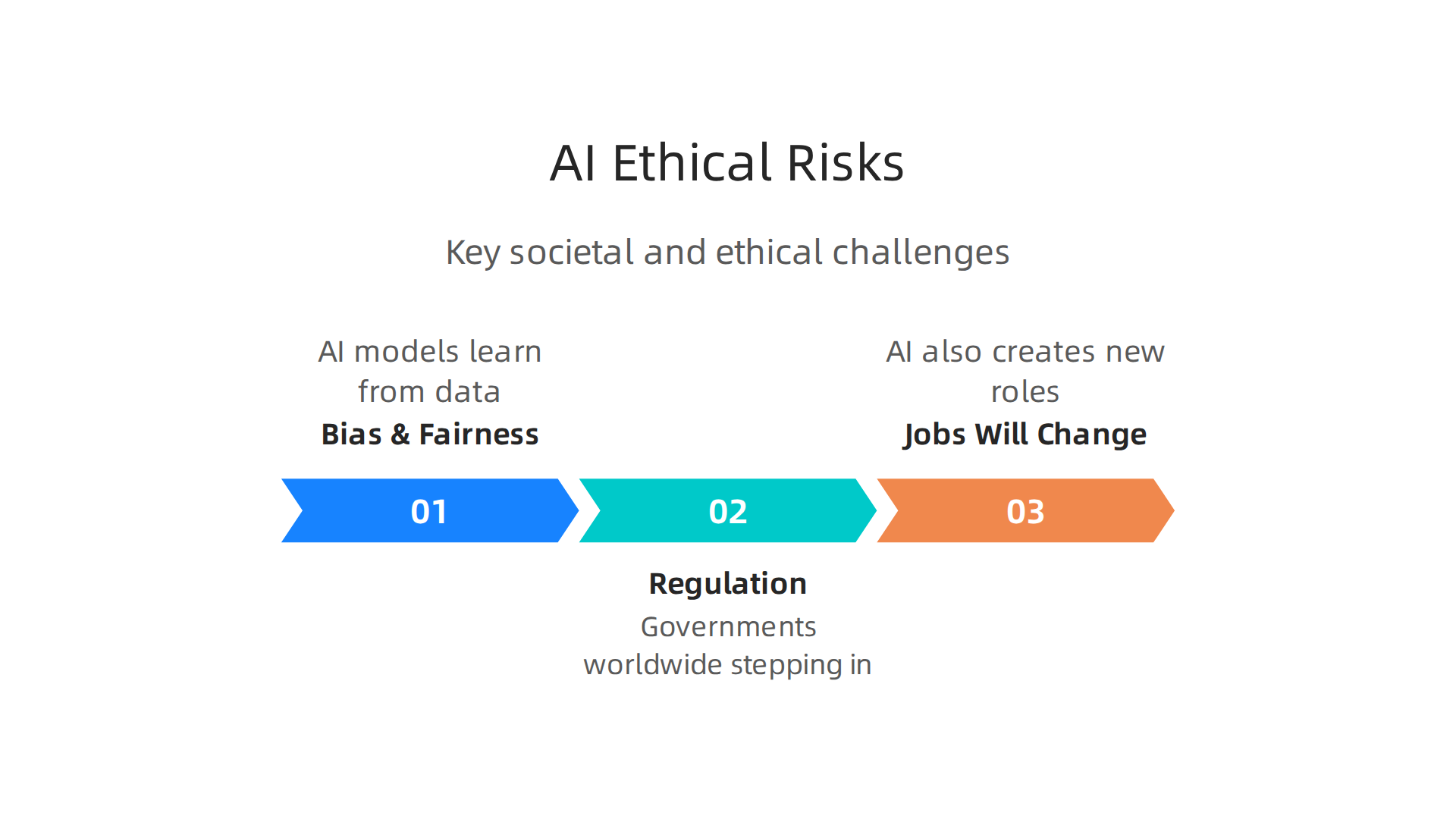
Here is a hard truth: AI models learn from data, and that data often contains human biases. If you train a hiring algorithm on past decisions that favored certain groups, the AI will repeat those same mistakes. We have already seen facial recognition systems that work less accurately on people with darker skin. In healthcare, biased models could give worse care to certain populations. That is why fairness and transparency are not nice-to-have features. They are must-haves. Companies that build or buy AI systems need to audit them for bias and explain how decisions get made. When a bank says "no" to your loan application, you deserve to know why.
Regulation Is Catching Up Fast
Governments around the world are stepping in. The biggest story in 2026 is the EU AI Act. It is the first comprehensive AI law anywhere. It entered into force in August 2024 and becomes fully applicable in August 2026, with some rules already in effect. The law sorts AI systems by risk level. High-risk uses like hiring, credit scoring, and critical infrastructure face strict requirements. And here is a key detail for U.S. companies: the law applies extraterritorially. If your AI system affects people in the EU, you must comply, even if your office is in Texas. Recent changes also postponed transparency rules for marking AI-generated content until December 2026. The world of AI is not a free-for-all anymore. Rules are here to stay.
Jobs Will Change, Not Just Disappear
Everybody worries that AI will steal jobs. And some jobs will go away. That is real. But the picture is more complicated. AI also creates new roles. Companies need people who can train models, audit them for bias, and interpret their outputs. The demand for prompt engineers, AI ethicists, and data curators is growing fast. The key is upskilling. If you learn how to work alongside AI tools, you become more valuable. Think of it like the internet in the 1990s. Some jobs vanished, but many more appeared. We are in a similar shift now.
Navigating these challenges requires staying informed. Rules change, new risks pop up, and the smartest companies adapt quickly. The Deep View Newsletter delivers honest daily updates on AI regulation, ethics, and what it all means for your work. No hype, just clarity.
The Future Outlook: Where Is the World of AI Heading?
So we have looked at the risks and the rules. Now let us turn to the road ahead. The world of AI in 2026 is not slowing down. In fact, many experts agree that this year marks a real shift. We are moving past simple chatbots and into systems that actually do things for us.

Here are three big trends to watch.
AI Agents and Autonomous Systems Take the Stage
The biggest change is happening right now. AI is moving from generating text and images to taking action on its own. These are called AI agents. They can book meetings, manage your email, order supplies, and even run parts of a business without a human in the loop. Autonomous agentic workflows are becoming the new standard in everything from customer service to logistics. At the same time, physical AI is growing fast. Robots powered by AI are leaving the factory floor and entering warehouses, hospitals, and even homes. The combination of smarter software and better hardware means we will see machines that can navigate the physical world more safely and usefully than ever before.
AI for Everyone: Open-Source and No-Code
You do not need a PhD to build with AI anymore. That is the second big trend. Open-source models like Llama and Mistral are getting better every month. They let companies and individuals create custom AI without paying for expensive APIs. And no-code platforms put that power into the hands of anyone who can drag and drop. A small business owner can now train a model to answer customer questions. A teacher can build a tutoring bot for their class. This democratization of artificial intelligence and machine learning is accelerating adoption faster than almost anyone predicted. The tools are getting easier, cheaper, and more capable.
The Long View: AGI and Alignment
But we cannot only look at the bright side. The conversation about artificial general intelligence (AGI) is getting louder. Many experts, including those from Stanford, predict that we will not achieve AGI in 2026. But some researchers, like former OpenAI co-founder Ilya Sutskever, warn that the timeline might be shorter than we think. That is why alignment research matters so much. Alignment means making sure that if we ever build an AGI, it shares human values and goals. This is one of the hardest problems in computer science. It is also one of the most important. We need to get it right before the technology gets too powerful. The world of AI is full of promise, but also full of responsibility.
Want to stay ahead of what is coming next? The Deep View Newsletter delivers daily updates on AI agents, policy changes, and research breakthroughs. Get clarity without the hype.
Subscribe to The Deep View Newsletter
Summary
This guide maps the modern world of artificial intelligence, explaining what AI means in 2026 and why it matters for businesses and professionals. It walks through the field’s history and core subfields—machine learning, natural language processing, computer vision, robotics—and shows how deep learning and generative models power today’s breakthroughs. The article outlines practical applications across healthcare, finance, and retail, and describes the main commercial uses of generative AI such as content creation, code assistance, and product design. It also addresses real enterprise challenges—integration, cost, and quality control—and the ethical, legal, and workforce implications including bias, regulation (like the EU AI Act), and job transformations. Finally, the piece highlights future directions such as autonomous agents, democratized AI via open-source and no-code tools, and the ongoing discussion about AGI and alignment, offering readers a clear framework to stay informed and act strategically.