
Why Google’s Quantum Computer Matters Now
Imagine a world where the toughest problems for businesses can be solved in a flash. That’s the promise of quantum computing.

In 2026, technology is moving faster than ever, with amazing leaps in quantum hardware. When these new computers mix with smart Artificial Intelligence (AI), it creates big chances for companies. But it also brings a lot of confusion for leaders and tech experts. You might be asking, "What does all this mean for my business?"
Google has been at the front of this new wave. Back in 2019, Google showed off its Sycamore quantum processor, which had 54 qubits. This chip did a special math problem much faster than the best supercomputers at the time, a big step forward in what’s called quantum supremacy [^1^]. Since then, Google has kept building more powerful machines. In 2024, they announced the Willow processor, which has 105 qubits [^2^]. Having more qubits means these machines can tackle harder problems. They even announced a new breakthrough algorithm called Quantum Echoes on the Willow processor, showing a verifiable quantum advantage [^3^].
These fast changes are exciting, but they can feel like a lot to keep up with. It’s hard to tell what’s real progress and what’s just talk. The truth is, the way quantum computing and AI are coming together will change many industries, from making new medicines to improving how we move around [^4^]. This mix of quantum power and things like an artificial neural network can unlock new ways to innovate. Business leaders and tech teams need to understand these shifts to stay ahead.
This article is here to help you make sense of it all. We will break down Google’s latest advancements with its quantum computer. We’ll explain what these developments truly mean for your business, giving you a clear timeline of what to expect. More importantly, we’ll give you practical next steps to use this knowledge. This way, you can turn today’s confusing tech talk into real plans for tomorrow’s success. Staying updated on these fast changes, especially in areas like R&D Technology Trends 2026: Reshaping AI, Quantum, Cybersecurity, and Biotech, is key.
Looking for a clear path through the AI landscape?
Get daily, in-depth AI updates that cut through the noise. Discover The AI Newsletter Worth Reading to make informed decisions for your business.
[^1^]: Quantum supremacy using a programmable superconducting processor – Nature
[^2^]: Meet Willow, our state-of-the-art quantum chip
[^3^]: Google Quantum AI
[^4^]: Artificial intelligence in the age of quantum computing
You just learned about how Google’s quantum computer is changing things, and how it’s speeding up with more qubits. But what does a Google quantum computer actually look like inside? How does it do its amazing tricks?
The Building Blocks of Google’s Quantum Computer
At its heart, a quantum computer, like the ones Google builds, uses special tiny parts called "qubits."
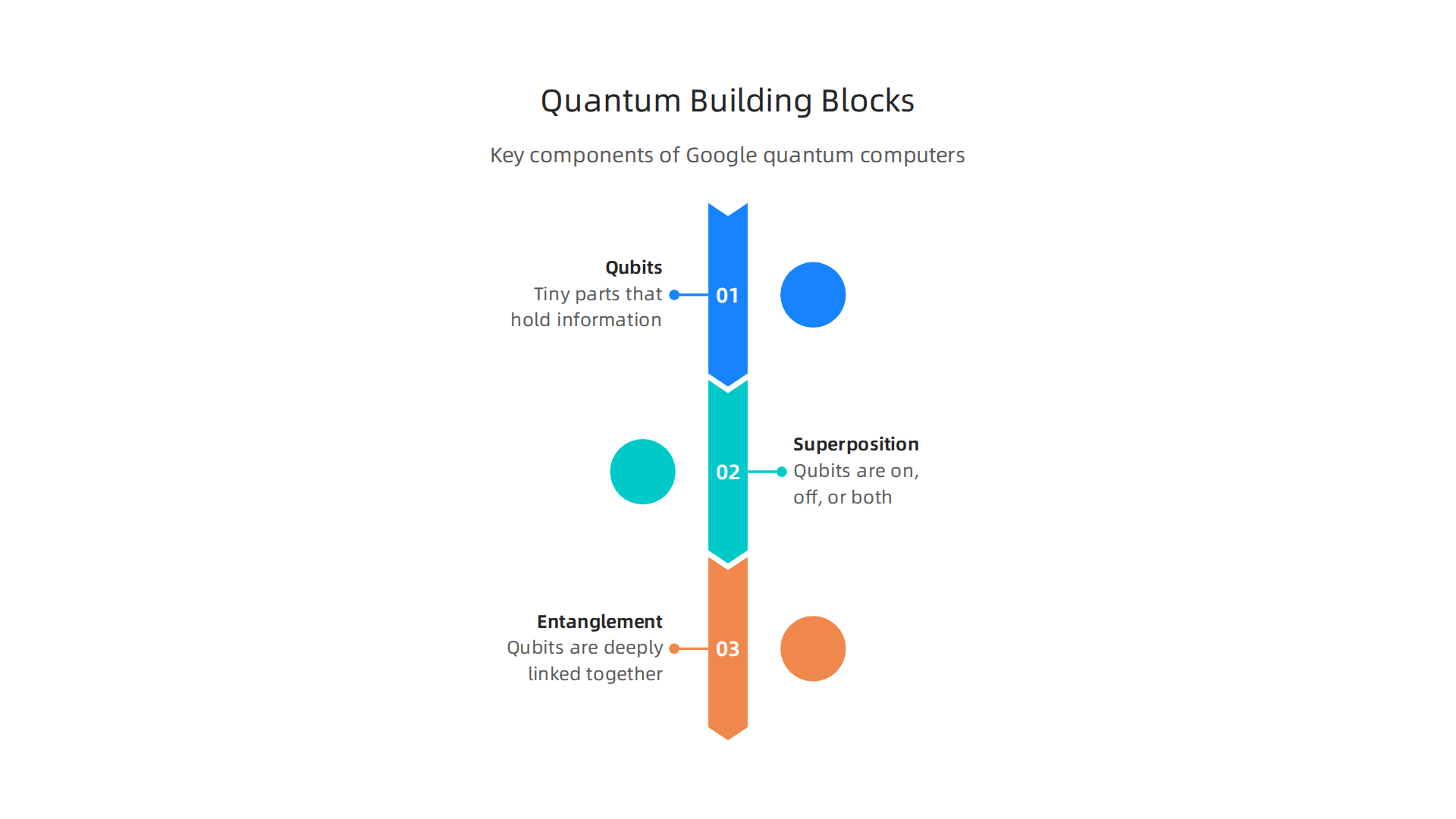
Think of a regular computer. It uses bits that are like light switches that can be either "on" (1) or "off" (0). Qubits are much more magical. They can be "on," "off," or both "on AND off" at the same time! This special ability is called superposition.
Google’s Sycamore processor, which made big news, has 54 of these qubits. The newer Willow processor, announced in 2024, has 105 qubits Willow processor – Wikipedia. These qubits are not like the computer chips in your laptop. They are made from tiny, super-cold electrical circuits, called superconducting circuits, kept at temperatures colder than space. These circuits allow the qubits to hold and process information in their special quantum ways. Each qubit is connected to its neighbors, forming a grid, which helps them work together. This setup helps them do really complex calculations Google Quantum AI: The Complete 2026 Guide To Chips ….
Understanding Quantum Advantage
When we talk about quantum computers, you often hear terms like "quantum speedup" or "quantum advantage." These terms describe when a quantum computer can solve a problem much, much faster than any regular computer, even the best supercomputers we have today. It does not mean a quantum computer is better at every task. It means for certain, very specific math problems, it can find answers in minutes or hours, while a traditional computer might take thousands of years.
Google first showed this with its Sycamore chip by solving a complex random number problem far quicker than a classical supercomputer. This was a big step in showing what quantum computers can really do. The recent breakthrough with the Quantum Echoes algorithm on the Willow processor also showed a clear "verifiable quantum advantage" for a specific kind of problem. This is important because it proves that these new machines are not just interesting, but actually useful for certain hard tasks.
This unique power comes from qubits not only being able to be "on and off" at the same time (superposition) but also being "entangled." Entanglement means qubits are deeply linked, so the state of one instantly affects the others, no matter how far apart they are. This allows them to explore many possible solutions at once, giving them a huge edge for complex problems that an artificial neural network or traditional AI might struggle with. Understanding how artificial intelligence works can help you better understand these connections. You can learn more about this by reading our guide to artificial intelligence explained.
In short, Google’s quantum computer is a new kind of machine built on special physics. It uses qubits that can do things classical bits cannot. This lets it find solutions to certain hard problems much faster, offering a true "quantum advantage" that could lead to creating powerful superhuman AI in the future.
Recent Milestones & Benchmarks (What changed since 2024–2026)
The journey of the google quantum computer has been full of exciting steps, especially between 2024 and 2026.
These years have shown us much about what these powerful machines can truly do.
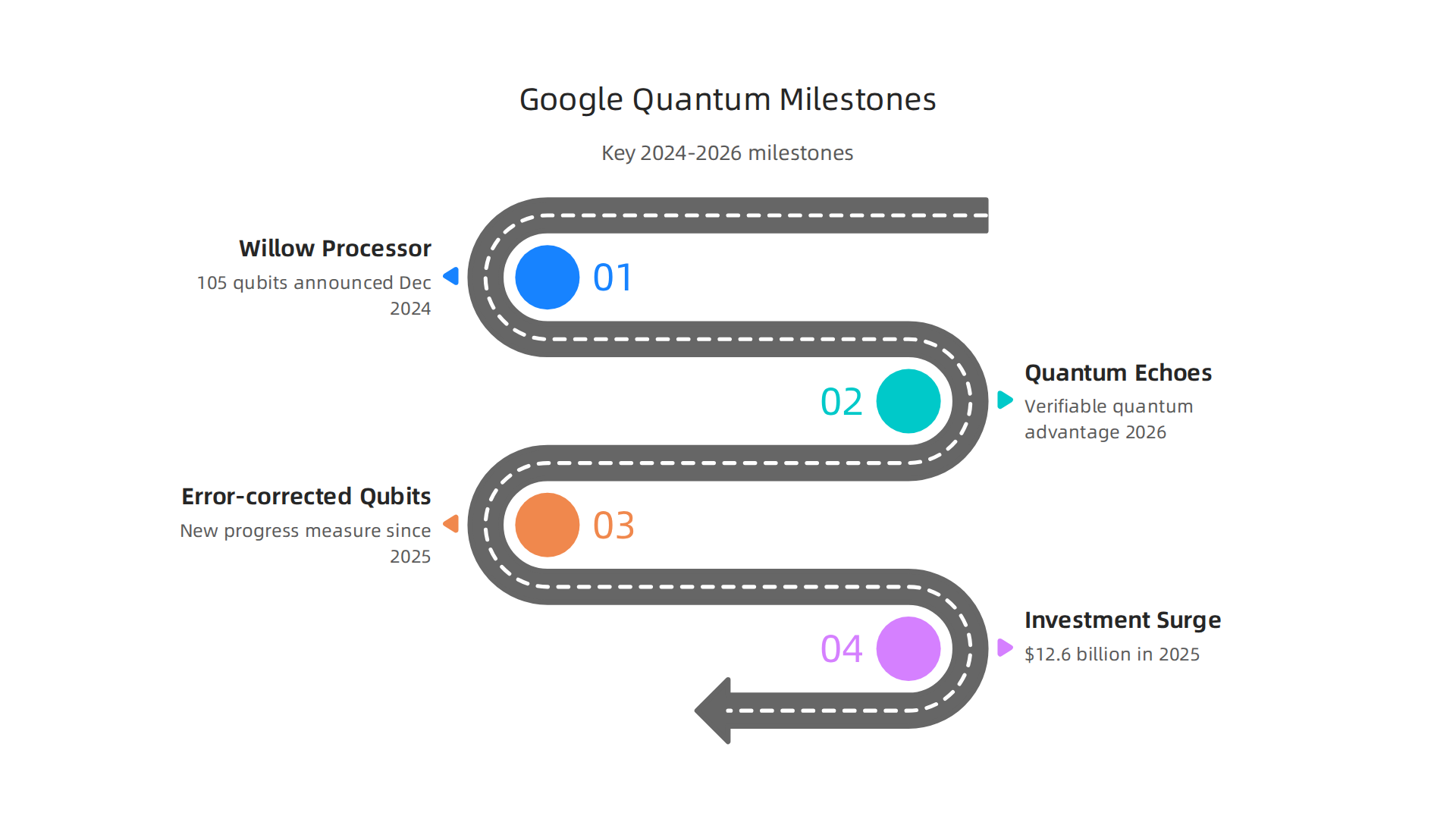
A big moment came with the Willow processor, which Google announced in December 2024. This chip was a step up from the Sycamore processor, packing 105 qubits, compared to Sycamore’s 54 qubits. More qubits mean more power to solve harder problems. Google noted that they continued to use benchmarks to show progress across their chips, including updated results for Sycamore in October 2024, leading up to Willow’s reveal Meet Willow, our state-of-the-art quantum chip.
In 2026, Google made another splash with its "Quantum Echoes" algorithm running on the Willow processor. This was important because it showed the first "verifiable quantum advantage" for a certain type of problem. This means the google quantum computer proved it could solve a specific task much faster than any regular computer, with clear proof Google Quantum AI. It’s like finding a super shortcut for a very tricky maze that a traditional artificial neural network would take ages to figure out. This kind of breakthrough hints at how quantum technology might one day help create superhuman AI. If you want to dive deeper into how artificial intelligence works, we have a helpful guide on AGI 2026 landscape rivals benchmarks and safety.
The community has been watching closely. These milestones are not just for scientists in labs. They matter a lot for businesses and big companies planning for the future. In 2025, the quantum computing industry reached a key turning point. Progress is now measured by error-corrected qubits and how well systems can grow, not just by how many basic qubits they have The State Of Quantum Computing, 2026.
This shift shows that quantum computing is moving closer to real-world uses. Companies are starting to see how these powerful machines could help them. For instance, the money put into quantum technology startups grew a lot in 2025, reaching $12.6 billion Quantum investment surge. Reports like the 2026 State of the Global Quantum Industry also highlight this growing interest and investment State of the Global Quantum Industry 2026 | QED-C.
For businesses, these developments mean it’s time to pay attention. Quantum computing is no longer just a distant dream. It’s becoming a part of the bigger picture of R&D and technology trends, alongside advancements in AI and cybersecurity. Knowing about these changes can help leaders in 2026 make smart choices for their companies. Understanding these rapid advancements is key to mastering computing innovation for business success in 2026.
Want to stay on top of the latest in AI and tech?
Get clear daily AI updates from The AI Newsletter Worth Reading.
As quantum computing gets closer to being useful in the real world, a big question is how it will work with Artificial Intelligence, or AI. It turns out, AI and quantum computing are a great team, especially for some tough problems that even today’s powerful computers struggle with.

In 2026, we are seeing more ways these two fields can help each other.
One of the biggest ideas is called "hybrid quantum-classical models." This means using the best parts of both types of computers. Regular computers, which we call classical computers, are great at many things. Quantum computers, like the ones Google is building, are very good at certain special tasks. So, with hybrid models, classical computers do the heavy lifting, like handling lots of data, and then pass really tricky parts to the quantum computer to solve quickly Hybrid Quantum-Classical Machine Learning Methods – arXiv. This setup can make artificial neural network programs much smarter and faster.
What Quantum AI Can Do Now and Soon
Right now, quantum AI is showing promise in a few key areas:
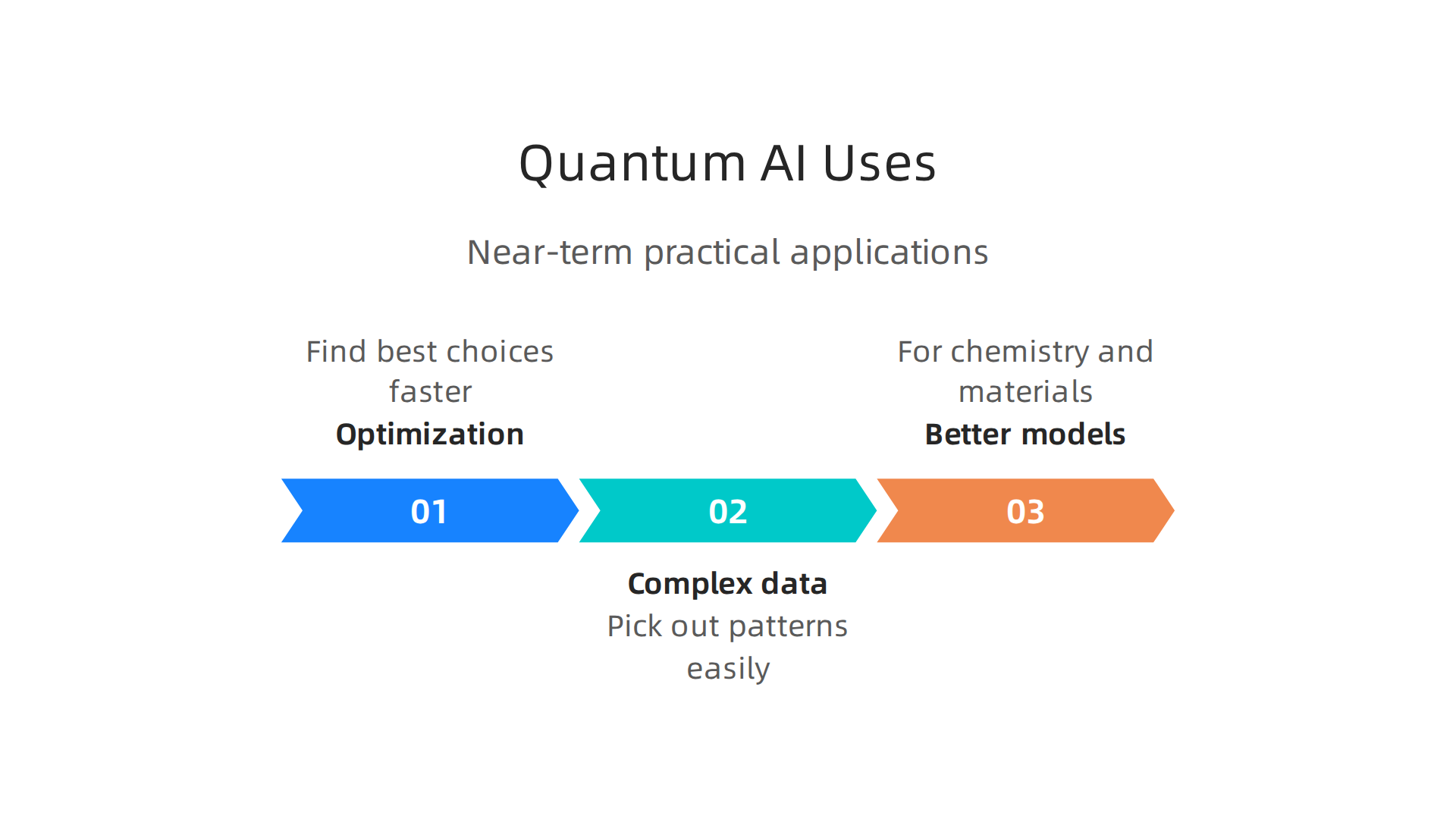
- Solving tough optimization problems: Imagine you have many choices and need to find the very best one. This could be for planning the fastest delivery routes or making sure a company’s money is spent in the smartest way. Quantum computers can explore many possibilities at once, helping find those best solutions faster.
- Understanding complex data: Some information is very hard for regular computers to make sense of because there’s just too much of it or it’s too mixed up. Quantum methods can help pick out patterns and meanings from this "high-dimensional data."
- Making better models for chemistry and materials: Quantum computers are naturally good at understanding how tiny particles behave. This means they can help scientists create new medicines or materials with special properties much faster.
According to experts, the areas where quantum machine learning will help first include chemistry, new materials, and figuring out the best ways to do things What is Quantum Machine Learning (QML)?. We are already seeing research on how hybrid models can help with things like classifying images or finding defects in factory products.
Looking Ahead: What’s Still a Dream?
While many uses are becoming clearer, some ideas are still in the early stages. For instance, creating true "superhuman AI" that works mostly on a google quantum computer is still a long way off. Today’s advancements are more about giving classical AI a boost for very specific tasks, rather than replacing it entirely. We are focused on building tools that help our existing AI systems do more.
The shift we’re seeing in 2026 is that the connection between AI and quantum computing is less about one replacing the other and more about how they can work together. If you’re interested in how different kinds of AI work, you can read our guide on Types of Artificial Intelligence: Narrow AI, General AI, and Superintelligence Explained. This team effort is helping us tackle problems that seemed impossible before. Knowing about these new developments is part of understanding the big changes happening in R&D Technology Trends 2026: Reshaping AI, Quantum, Cybersecurity, and Biotech.
Google plays a big part in bringing quantum computing to more people. In 2026, the company is focusing on making its powerful quantum computers available through the cloud. This means you do not need to own a quantum computer to use one. Instead, you can connect to a google quantum computer over the internet, much like how you use other online services.
Google’s Way of Sharing Quantum Power
Google’s plan, often called its roadmap, involves a few key steps:
- Cloud Access: Google offers its quantum computing services through Google Cloud. This lets scientists and companies try out quantum programming and run experiments on actual quantum hardware. This kind of access helps many people learn about and use this new technology Quantum Cloud Platforms Compared: How to Access Real Quantum ….
- Partnerships: Google works with many groups, including other companies and universities. These partnerships help share knowledge and make quantum tools better. For instance, Google Quantum AI focuses on special superconducting parts and new ways of writing quantum programs. It offers cloud access for researchers and works with partners on topics like machine learning 2026 Global: Cloud-Based Quantum Computing ….
- Developer Tools: Google builds tools and software kits that make it easier to write programs for quantum computers. These tools help developers create new quantum applications.
In 2026, Google Cloud is one of the main players in the quantum cloud world, alongside companies like AWS, Microsoft Azure, and IBM. These are known as "hyperscaler aggregators" because they offer a wide range of computing services, including quantum Top Quantum Cloud Providers 2026: Complete AWS, Azure, IBM ….
How Businesses Can Use Quantum Services
For companies, choosing how to use quantum computing comes down to a few options:
- Cloud Quantum Services: This is the most common way to get started. You "rent" time on a quantum computer through a cloud platform. This means you do not have to buy and maintain very expensive and complex quantum hardware. It is like choosing to stream movies online instead of buying a DVD player and all the movies. Providers like Google, IBM, and Azure Quantum offer different features, and your choice might depend on what you need to do. For example, Google Cloud Platform’s Quantum Computing Service gives access to its advanced chips, but mostly to approved partners right now AWS vs Azure vs GCP vs IBM: Quantum Computing ….
- On-Premise or Hybrid Options: For quantum, having your own quantum computer (on-premise) is very rare and mostly for top research labs. A "hybrid" option means you use your own regular computers for most tasks and then send the hardest parts to a quantum computer in the cloud. This makes quantum computing more practical for many businesses.
Most companies today choose cloud quantum services because they are easier to access and use. This lets them experiment with quantum technology without a huge upfront cost. If you are interested in learning more about the big companies making progress in this area, you can check out our guide on the Top Quantum Computing Companies in 2026.
Keeping up with these fast changes in AI and quantum computing is vital for businesses. To stay informed about the latest happenings, consider subscribing to a reliable news source.
The AI Newsletter Worth Reading
Keeping up with these fast changes in AI and quantum computing is vital for businesses. To stay informed about the latest happenings, consider subscribing to a reliable news source. Now, let’s look at how big companies can wisely use quantum computing, focusing on how to spend money, find the right people, and plan for the future.
Enterprise Implications: Investment, Talent, and Roadmaps
For leaders in businesses today, quantum computing can seem a bit far off. But making smart choices now about this new technology is important for the future.

This means thinking about how much to invest, who to hire, and how to plan for quantum projects.
Smart Ways to Invest in Quantum
Right now, quantum computing is growing fast. In 2025, companies working on quantum technology received a lot of money, about $12.6 billion in investments. This shows that many people believe in its future Quantum investment surge.
But for a single company, it is usually not about buying a google quantum computer right away. Instead, it’s about taking small, smart steps.
- Start Small: Many businesses begin by trying out quantum computing with cloud services. This is like renting a tool instead of buying it. It lets them see what quantum can do without a huge cost. About 35% of companies are already trying quantum computing, and many more are planning to Quantum Monitor | Studie 2026.
- Focus on Problems: Companies should look for big problems that normal computers struggle with. These could be in areas like making new materials, developing better medicines, or improving finance models. This helps decide if quantum is really needed.
- Gradual Spending: Instead of one big investment, companies can spend money in stages. First, a small amount for learning and testing. Then, if things look good, more money for bigger projects. This is a careful way to approach such a new field. For more help on making smart tech choices, see our guide on Science machine your blueprint for smarter tech investment.
Finding the Right Talent
You cannot just buy a quantum computer; you also need people who know how to use it. Finding the right talent is key.
- Build a Core Team: Start with a small group of experts. These people might have skills in physics, computer science, or advanced math. They will be the ones to lead quantum projects.
- Train Existing Staff: It’s also smart to teach your current employees about quantum ideas. They can learn how quantum computing might help their part of the business.
- Work with Universities: Many universities are doing great work in quantum. Partnering with them can help companies find new talent and get fresh ideas. For those looking to hire in advanced tech, understanding the skills needed is crucial, as explored in The tech interview handbook 2026.
Planning Your Quantum Roadmap
A roadmap is a plan for how your company will use quantum computing over time.
- Pilot Projects: Start with small "pilot" projects. These are like test runs. They help you learn what works and what doesn’t.
- Move to Production: If a pilot project is successful, the next step is to make it a real part of your business. This means using quantum to solve real problems every day. This takes careful planning and more investment.
- Look to the Future: Keep an eye on how quantum technology is changing. New developments, like improved artificial neural networks or the understanding of npj artificial intelligence impact factor, could open new doors for your business. Companies should update their plans as the technology grows. For deeper insights into managing technological innovation, check out Mastering computing innovation for business success in 2026.
Deciding to Experiment, Partner, or Wait
For any business, deciding when and how to jump into quantum computing can be tricky.
- Experiment: If you have complex problems that current computers can’t handle, experimenting with quantum cloud services might be a good first step. It lets you learn without a big commitment.
- Partner: If you do not have the internal talent or resources, working with a quantum company or research group can be a smart move. They can help you explore possibilities.
- Wait and Watch: For some businesses, it might be best to wait a little longer. Quantum computing is still developing. If your problems are not super complex, or if you prefer to see more proven results, watching the market closely is fine. However, stay informed, as the landscape for things like superhuman ai and quantum advancements is always shifting.
No matter your choice, staying informed about quantum computing is important. It helps you be ready when the time is right for your business.
No matter your choice, staying informed about quantum computing is important. It helps you be ready when the time is right for your business. But being ready also means understanding the possible dangers and how to use this powerful technology in a safe and smart way.
Risks, Limitations & Responsible Adoption (Security, Ethics, and Hybrid Approaches)
As businesses look to use quantum computing, it is vital to think about the risks. These include how it might affect data security, what ethical rules we need, and how we can use it safely with our current computers.

Security: The Quantum Threat to Data
One of the biggest worries with quantum computers is their power to break today’s security codes. Many of our online defenses, like those protecting bank accounts and personal emails, rely on math problems that are too hard for regular computers to solve. But a powerful quantum computer could solve them very quickly.
Experts are already setting timelines for when our current security methods will no longer be safe. For example, some common security methods like RSA-2048 are set to be phased out by 2030 and completely disallowed after 2035 by government standards Quantum Security Deadlines are Here. This means companies need to start moving to "post-quantum cryptography" or PQC now. PQC uses new math that even quantum computers cannot easily crack. The National Institute of Standards and Technology (NIST) has already shared new PQC standards, and companies are encouraged to start using them today Post-Quantum Cryptography: A Practical 2026 Roadmap.
Making Things Safer: Hybrid Approaches and New Rules
To deal with these risks, businesses are looking at a few smart ways to move forward.
- Hybrid Solutions: This means using quantum computers for certain tasks and regular computers for others. For instance, a regular computer might handle most data, but send very complex or secret parts to a quantum system that uses new PQC security. This is like having two kinds of tools, each best for a different job.
- Secure Cloud Access: Many companies access quantum power through cloud services, much like how we use cloud storage today. Providers like Google Quantum AI, IBM Quantum Platform, and Azure Quantum offer ways to use quantum computers online Top Quantum Cloud Providers 2026. Choosing a provider with strong security is very important.
- Building New Rules: As quantum technology grows, we also need clear rules and best practices for how to use it responsibly. This includes thinking about privacy, fairness, and how powerful systems like those leading towards superhuman ai will affect society. Good company policies are needed to guide these new technologies. For more on this, check out our guide on AI Policy: The 2026 Roadmap for Business Compliance and Trust.
Thinking about these risks and planning for them now will help businesses use quantum computing for good, without putting their data or trust at risk. Staying informed about both quantum and AI developments is key to making wise choices.
If you want to keep up with the fast-moving world of AI and how it connects with other advanced tech like quantum computing, you might find our newsletter helpful. It brings you fresh insights every day.
The AI Newsletter Worth Reading
Summary
This article explains why Google’s recent quantum computing progress matters now for businesses and technology leaders. It covers the basics of how Google’s qubits and processors (Sycamore and Willow) enable a verifiable quantum advantage, and why that matters for hard problems like optimization, materials and chemistry. The piece describes how quantum and AI are pairing through hybrid quantum‑classical models, practical use cases where gains are likely first, and how companies can access quantum power via cloud services and partnerships. It also lays out enterprise implications — how to invest incrementally, build or train teams, run pilot projects, and evolve roadmaps as capability grows. Finally, the article addresses risks around security and ethics, urging early migration to post‑quantum cryptography and responsible hybrid approaches so organizations can adopt quantum safely and strategically.