

Introduction: Why Ground Yourself in AI Fundamentals
AI is everywhere in 2026. The Stanford HAI 2026 AI Index Report shows that generative AI reached 53% population adoption within three years, faster than the personal computer or the internet ever did. Organizations are at 88% adoption. Nearly two-thirds of Americans say they have used an AI tool in the past month.
But here is the thing most people miss. Using AI tools and understanding AI are two completely different skills. Anyone can open ChatGPT and ask a question. Far fewer people can explain why the answer makes sense, where the model might fail, or how the underlying algorithms actually work.

That gap is why you need a solid theoretical foundation. And the single best place to build that foundation is one book.
Artificial intelligence a modern approach by Russell & Norvig is the most popular AI textbook in the world. It has been used at over 1,500 universities and has more than 59,000 citations on Google Scholar. The artificial intelligence: a modern approach 4th US ed covers everything from search algorithms and logic to deep learning, robotics, and AI safety. It gives you a complete map of the subfields of artificial intelligence and shows how they all connect.
In this article, we will explore why this textbook remains essential in 2026, how to study it without getting lost, and what other resources can help you along the way.
If you want clear daily updates on AI and tech trends while you work through your studies, check out The AI Newsletter Worth Reading for practical insights that keep you informed.

Understanding the types of artificial intelligence is a great first step before diving into the book’s deeper chapters.
Why AIMA Remains the Gold Standard in 2026
You might wonder if a textbook first published back in 1995 can still matter in 2026. The answer is a clear yes. artificial intelligence a modern approach by russell & norvig has stayed relevant because the authors kept updating it. Each new edition added chapters that matched real advancements in the field. The fourth edition, released in 2020, brought in deep learning, probabilistic programming, multiagent decision making, and safety topics. You can see the full list of updates by checking the 4th edition of Artificial Intelligence: A Modern Approach on the Pearson site.
This means the book covers both the old foundations and the new frontiers.
The structure of AIMA is another reason it stands out. It walks you through AI in a logical order. You start with agents and problem solving. Then you move to knowledge representation and reasoning. After that come uncertainty, probability, and decision making. The machine learning section covers example-based learning, probabilistic models, deep learning, and reinforcement learning. Finally, you explore how AI perceives, communicates, and acts in the real world through natural language processing, computer vision, and robotics. This path gives you a complete map of the subfields of artificial intelligence. You see how search algorithms connect to neural networks and how ethics fits at the end.
Top universities still agree that AIMA is the best starting point. Over 1,500 schools worldwide use it as their primary textbook. It is widely considered the standard text in the field. If you want a thorough understanding of who invented ai and how each piece evolved, this book gives you the full story. It does not skip the hard parts. It explains both the successes and the limitations.
For a book this dense, having extra resources helps a lot. You can find additional learning tools by exploring some top AI websites for reliable research. These sites offer explanations, examples, and code that make the concepts easier to grasp.
What’s Inside: A Tour of the Book’s Architecture
Now let’s open the covers and see how this book is actually put together. The fourth edition of artificial intelligence a modern approach by russell & norvig is split into seven major parts.
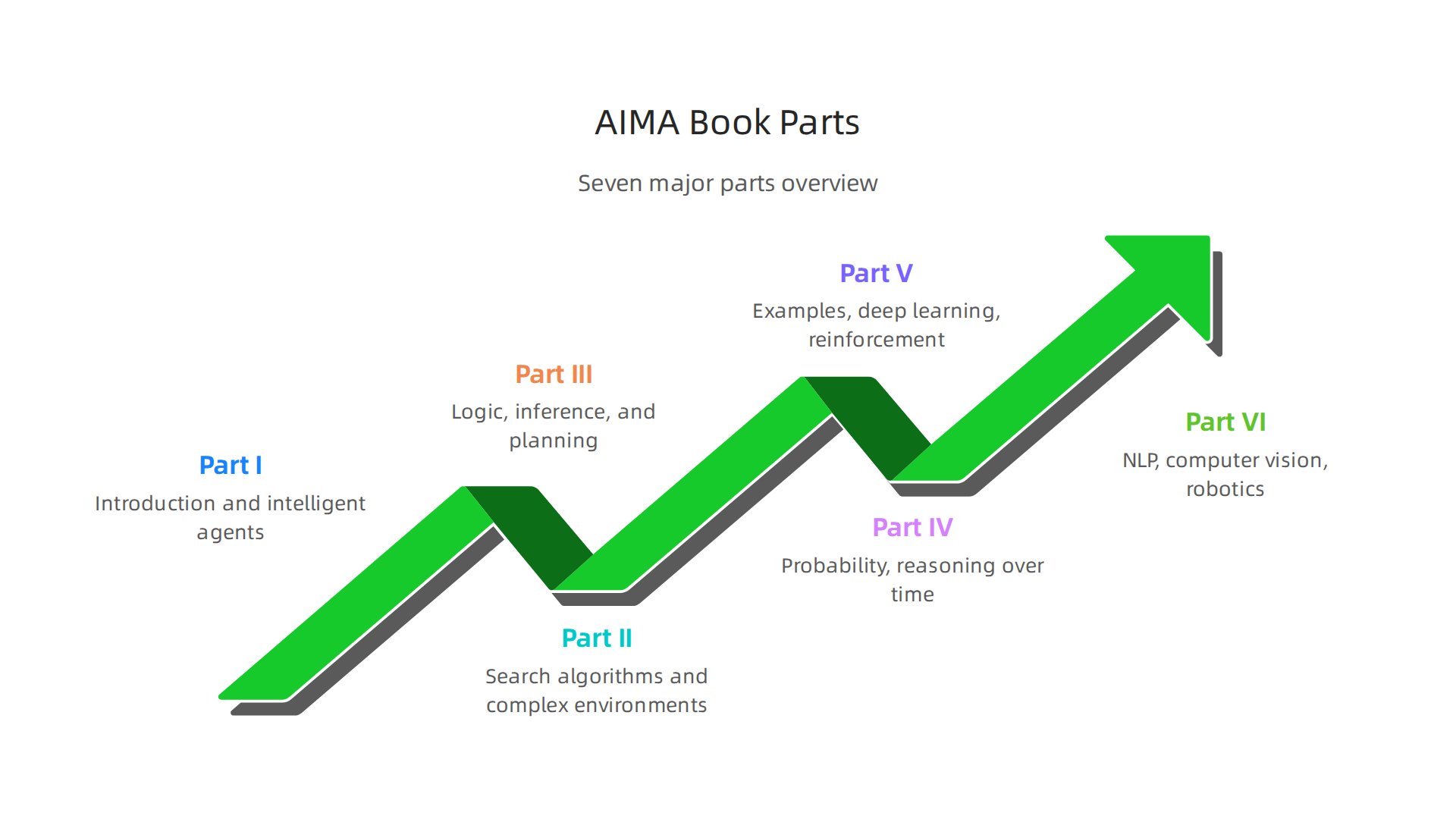
Each part acts like a building block. You cannot understand reinforcement learning without first understanding probability. And you cannot grasp probabilistic programming without knowing some logic first. That is the genius of the design. It leads you step by step.
Part I: Artificial Intelligence covers the introduction and intelligent agents. This is where you learn the big picture. You find out what AI is, how agents perceive their environment, and how they act on it. This part sets the stage for everything else.
Part II: Problem-solving dives into search algorithms. You get solving problems by searching, search in complex environments, adversarial search, and constraint satisfaction problems. These are the classic methods that still power many modern AI systems today.
Part III: Knowledge, reasoning, and planning takes you into logic. Logical agents, first-order logic, inference, knowledge representation, and automated planning. This is the brain of classical AI. You learn how to represent what the world looks like and how to make deductions from that knowledge.
Part IV: Uncertain knowledge and reasoning brings in probability. Quantifying uncertainty, probabilistic reasoning, reasoning over time, probabilistic programming, and decision making. This is where the book really shines. The 4th edition added a full chapter on probabilistic programming, which was a big deal when it came out. You can see the full table of contents on the AIMA official site to understand the depth of each chapter.
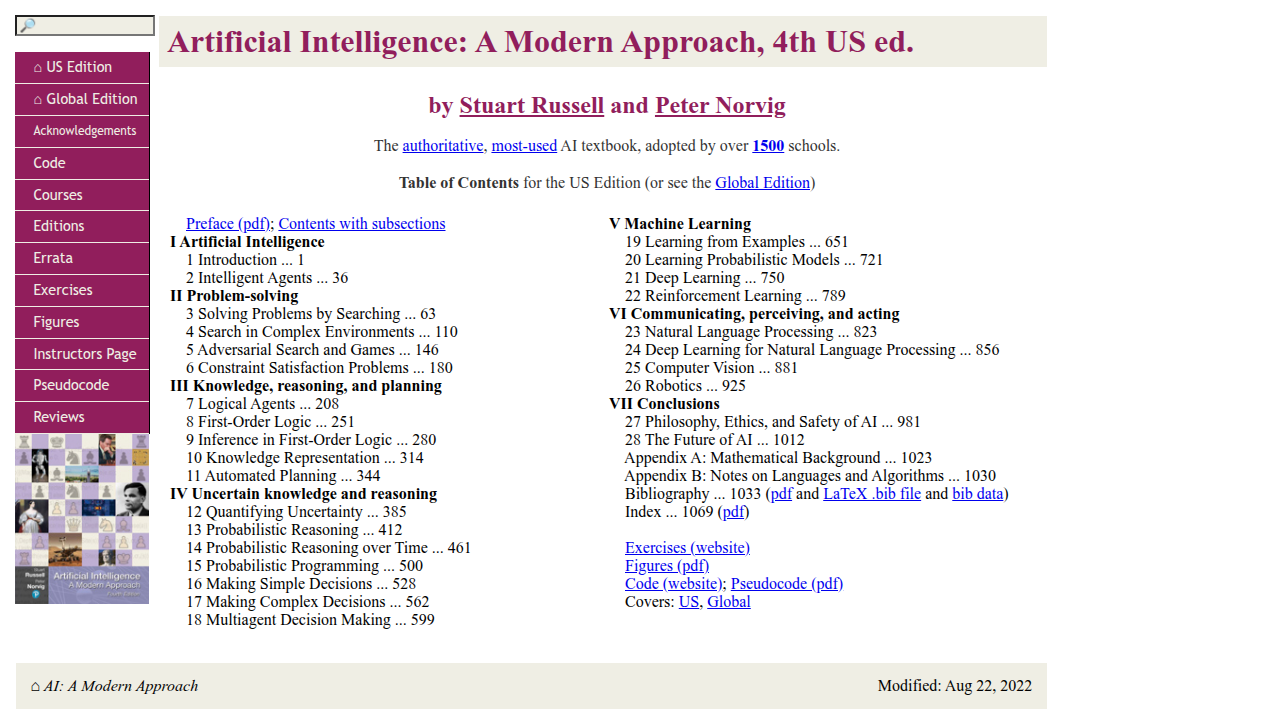
Part V: Machine Learning is the biggest part. Learning from examples, probabilistic models, deep learning, and reinforcement learning. This section alone could be its own textbook. The deep learning chapter, co-written with Ian Goodfellow, gives you a strong foundation in neural networks.
Part VI: Communicating, perceiving, and acting covers natural language processing, deep learning for NLP, computer vision, and robotics. This is where theory meets the real world. You see how AI actually sees, hears, and moves.
Part VII: Conclusions wraps up with philosophy, ethics, and the future of AI. This is not an afterthought. The authors take ethics seriously and discuss safety, fairness, and what comes next.
Want to see how these building blocks connect to the latest trends in 2026? You can explore how the world of AI in 2026 is shaping up and compare what the textbook teaches with what is happening right now.
The AI Newsletter Worth Reading can help you stay current on how these concepts evolve. The Deep View delivers daily updates on AI breakthroughs, policy shifts, and practical tools. It will connect everything you learn in the textbook to real developments in the field.
How to Read AIMA for Maximum Understanding
So you have the book. Now what? You might be tempted to read it like a novel, from page one to the end. Do not do that. It will not work. This book is dense. It throws hundreds of equations, algorithms, and philosophical arguments at you. To actually learn from it, you need a smarter approach.
Active reading is the only way. Do not just highlight sentences. Close the book and test yourself.

Explain the last paragraph in your own words. Work through every example with pen and paper. When you hit an exercise, solve it before looking at the answer. This active recall forces your brain to build real connections.
Combine that with spaced repetition. Instead of reading chapter 5 once and forgetting it by the time you reach chapter 10, review concepts at increasing intervals. One day after learning, three days, one week, two weeks. A practical guide on the active learning techniques that actually work shows you exactly how to set up this schedule with flashcards and self-quizzing. It is a game changer for technical books like this one.
Do the problems. AIMA includes hundreds of exercises scattered throughout each chapter. They are not optional. The authors designed them to test deep understanding, not surface recall. Spend as much time on the exercises as you do on the reading. Struggle through them. That struggle is where real learning happens.
Pair the book with a video lecture series. The UC Berkeley CS188 course follows AIMA closely and is available for free online. Watch a lecture after reading the corresponding chapter. The professor explains the same ideas in a different way, and hearing them out loud cements the concepts. Many learners report that the combination of text plus video cuts their study time in half.
Brush up on math first. The book assumes you know linear algebra, probability, and calculus. If you are rusty, spend a week reviewing these topics before starting Part II. You will avoid getting stuck on math and missing the AI ideas. Without this foundation, the sections on probabilistic reasoning and machine learning will feel like a foreign language.
Before diving in, it helps to understand the big categories of AI you are about to study. A great overview of the different types of artificial intelligence from narrow AI to general AI will give you context for why AIMA covers such a wide range of topics.
Here is a summary of the study sequence that works for most people:
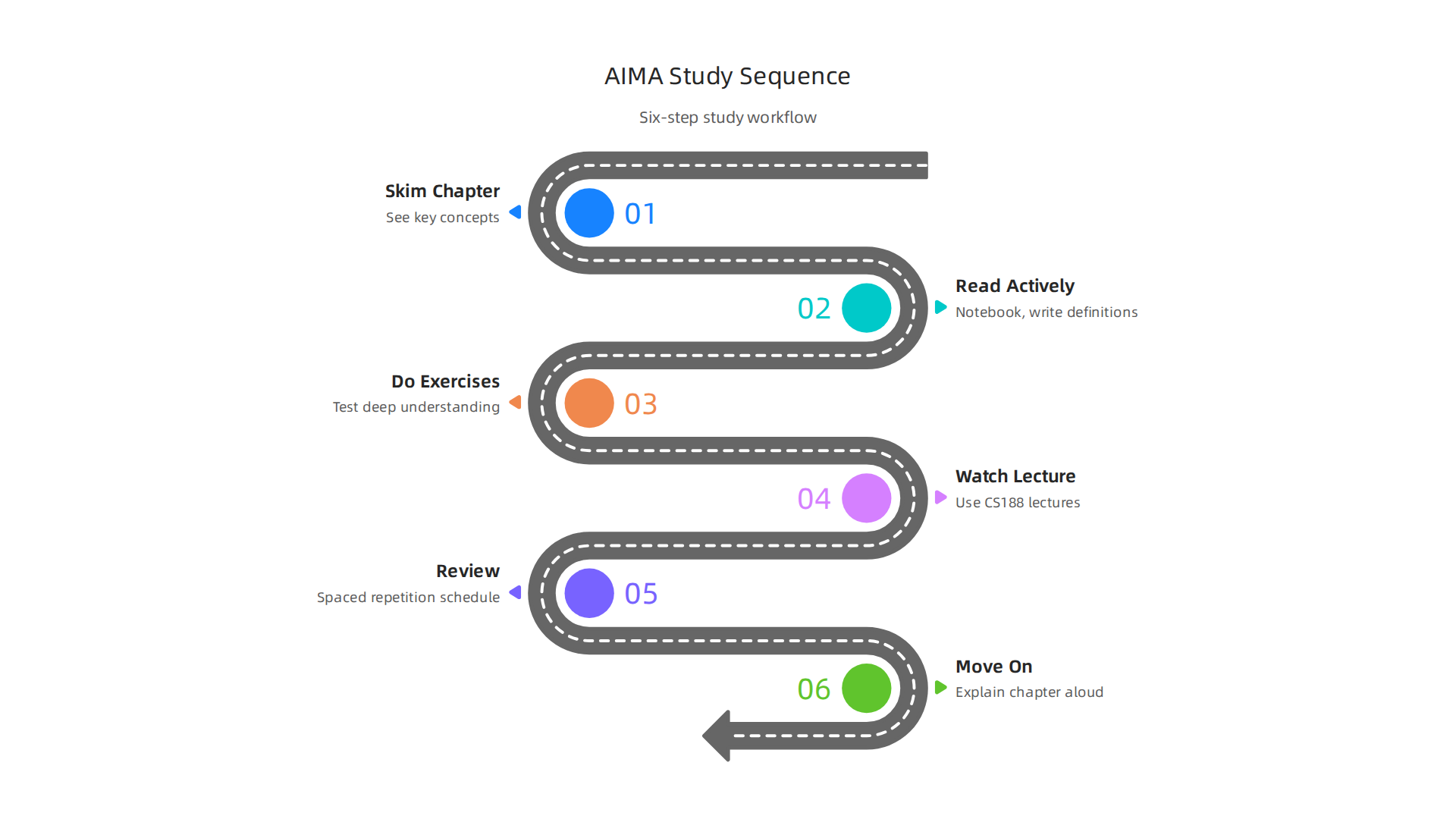
- Skim the chapter for ten minutes to see the key concepts
- Read actively with a notebook, writing definitions and formulas in your own words
- Do every exercise and check your answers against the official solutions online
- Watch the corresponding CS188 lecture to reinforce the material
- Review using spaced repetition one day, three days, and one week later
- Move on only when you can explain the chapter out loud to someone else
This book is a marathon, not a sprint. Give yourself three to six months to work through it properly. The reward is not just knowledge. It is the ability to think like an AI researcher.
The Role of Foundational Learning in AI Careers
Working through Artificial Intelligence: A Modern Approach is not just an academic exercise. In 2026, the job market rewards people who understand the foundations of AI, not just the surface-level tools. Here is the thing: frameworks like TensorFlow and PyTorch change every few years. But the core concepts of search algorithms, probability, and machine learning that Russell & Norvig explain? Those stay the same.
Employers are starting to notice this. They have watched too many candidates rely on memorized API calls without understanding why an algorithm works. When a new model or library arrives, those candidates struggle to adapt. The people who learned from artificial intelligence a modern approach by russell & norvig can pick up any new tool quickly because they see the pattern underneath. That flexibility is exactly what hiring managers pay for.

Data backs this up. According to a complete guide to AI careers in 2026, AI engineers earn an average of $165,000 per year in the US, and roles that require deep theoretical knowledge like AI research scientist command even more. Professionals who understand the subfields of artificial intelligence and how they connect tend to advance faster and face fewer salary ceilings. Self-taught tool users often top out around $150,000 to $180,000 without formal credentials. Foundational learning removes that ceiling.
This is not just about money though. It is about future-proofing your career. The field moves fast. What is cutting edge today might be obsolete in two years. But if you know the fundamentals, you can pivot into any new area. You can even start to see the big picture of where who invented ai and the history of the field still shapes current research directions.
To see how these foundational skills apply in real business settings, check out the broader AI trends in 2026. And to stay ahead of the constant changes, consider subscribing to a daily update. The AI Newsletter Worth Reading delivers clear, concise news that helps you connect the dots between theory and industry practice.
When you invest in deep knowledge now, you build a career that lasts. The book is just the first step. The real reward is the career it unlocks.
Beyond the Book: Building a Complete AI Curriculum
Reading Artificial Intelligence: A Modern Approach gives you the theory. But to really learn AI, you need to build things too. Think of it like learning to cook from a cookbook. Reading the recipes is helpful. But you only get good when you actually chop vegetables and turn on the stove.
The same goes for AI. The experts who wrote that book are widely respected. In fact, the best artificial intelligence books guide for 2026 calls this textbook the top pick for beginners. These experts recommend hands-on practice. For example, you can build a search agent that solves a puzzle. Or code a simple neural network from scratch.

These small projects turn abstract ideas into real skills you can show employers.
Many universities now offer free courses that pair perfectly with the book. Stanford CS221 teaches AI principles with coding assignments. MIT 6.S191 covers deep learning with hands-on labs. And fast.ai gives you a practical path to building models quickly. Combining one of these courses with the artificial intelligence a modern approach by russell & norvig textbook creates a powerful learning loop. You read about a concept in the book, then you code it in the course.
The best study plan mixes theory with practice. Set a weekly schedule. Spend two days reading chapters from AIMA, including the sections on subfields of artificial intelligence and who invented ai. Then spend three days coding. Join Kaggle competitions to test your skills on real data. The 2026 edition of AIMA even includes updated exercises and online resources to guide you.
To support your learning journey and stay current with the tools professionals use, check out a list of top AI websites that professionals trust for reliable news and research. And once you have a study routine, keep your finger on the pulse. The AI Newsletter Worth Reading delivers daily insights that help you connect textbook theory to what is happening in the world right now.
By mixing book knowledge with applied projects, you build a complete skill set. That is what separates hobbyists from professionals. Start building today.
Common Challenges in Self-Study and How to Overcome Them
Studying Artificial Intelligence: A Modern Approach on your own is exciting, but it comes with real hurdles.
Many learners hit a wall with math. The book assumes you know calculus, linear algebra, and probability. If you feel rusty, do not panic. Plenty of free refresher courses exist on Khan Academy and MIT OpenCourseWare. Spend a few weeks brushing up on these topics before diving deep into the algorithms.
Another big challenge is information overload. AIMA is packed with details. Reading chapter after chapter can feel overwhelming. The trick is not to read passively. Use proven study methods like active recall and spaced repetition. These techniques help you retain more in less time. For example, after reading a section, close the book and explain the concept in your own words. Then review it one day later, three days later, and a week later. This pattern locks the knowledge into your long-term memory. You can learn more about active learning techniques that actually work from a detailed guide.
Lack of community support is another reason people give up. Without a study partner or group, it is easy to lose motivation. Try joining AI forums like Reddit’s r/artificial or r/learnmachinelearning. You can ask questions, share progress, and find study partners. Some learners also form virtual book clubs focused on AIMA. Being part of a group keeps you accountable and makes learning more fun.
Finally, remember that you do not need to master every subfield at once. The book covers many areas. Pick one that interests you first, like search algorithms or neural networks. For a clear overview of the different subfields, check out this guide on types of artificial intelligence. It can help you decide where to focus your energy.
By tackling these challenges head on, you turn a tough solo journey into a manageable and rewarding experience.
The Future of AI Education Resources: Where Does AIMA Fit?
AI education is changing fast. In 2026, most people learn through short videos, interactive coding labs, and bite-sized courses. Platforms like Coursera and DeepLearning.AI offer hands-on projects that teach you to build models in hours. This shift toward micro-learning is great for quick wins.
But here is the truth: no flashy tutorial gives you the deep foundation that artificial intelligence a modern approach by russell & norvig provides. This textbook is still the gold standard because it explains the "why" behind every algorithm. The best AI books for 2026 guide confirms that AIMA remains the go to resource for serious learners.
The authors are likely to release updates or companion digital resources soon. The field moves too fast for a printed book to stay current forever. Expect future editions to include new chapters on large language models and generative AI. That is where the real challenge lies. You need to balance the timeless theory from AIMA with modern breakthroughs like ChatGPT and DALL E.
One way to bridge this gap is by supplementing your textbook study with real time news. The world of AI in 2026 page shows how quickly new developments reshape the landscape. Following daily updates helps you connect what you read in AIMA to what is happening right now.
If you want to stay ahead of the curve without spending hours searching for news, The AI Newsletter Worth Reading delivers clear daily AI updates straight to your inbox. It is a practical way to keep your knowledge modern while you master the fundamentals.
Summary
Artificial Intelligence: A Modern Approach (AIMA) remains the premier textbook for building a deep, connected understanding of AI in 2026, covering agents, search, logic, probability, machine learning, perception, and ethics. This article explains why AIMA is still the gold standard, gives a guided tour of its seven major parts, and shows how to study it effectively without getting lost. You’ll learn a practical study sequence—skim, read actively, solve exercises, watch complementary lectures, and use spaced repetition—plus how to pair the text with hands-on courses and projects. The piece also addresses common self-study obstacles (math gaps, overload, isolation) and offers solutions like refresher courses and community study groups. Finally, it argues that mastering fundamentals pays off in the job market and recommends ways to supplement the book with up-to-date news and tooling so your knowledge stays relevant.