
Introduction: Why the ‘Father of AI’ Question Still Matters
When we talk about Artificial Intelligence, a big question often comes up: who is the "father of AI?" It’s not as simple as naming just one person. Actually, many brilliant AI people helped build this field, each in their own way. Depending on what part of AI you look at, different names might come to mind. Some focused on the big ideas and theories, while others worked on making machines actually do smart things. Still others helped make AI popular so more people knew about it.
For example, a famous early AI researcher, Alan Turing, explored the idea of machines that could think back in 1950. He even came up with a way to test if a machine could act like a human, called the Turing Test The birth of Artificial Intelligence (AI) research. Later, in 1956, the term "Artificial Intelligence" itself was first used by John McCarthy at a special workshop held at Dartmouth College Who Coined the Term Artificial Intelligence: Know the History. This important meeting is often seen as the official start of the AI field Artificial Intelligence – Stanford Encyclopedia of Philosophy.

In 2026, AI is everywhere, changing how businesses work and how we live. Knowing the different roots of AI helps us understand its journey. For business leaders, it’s more than just history. It helps you decide which new ideas and directions in AI are worth investing in for your company’s future.

When you understand the different "lineages" or paths AI has taken, you can better pick the right AI tools and strategies. This knowledge helps you make smart choices as you explore the ever-changing world of AI in 2026.
Want to stay on top of daily AI updates and dive deeper into its impact? Get clear daily AI updates from The AI Newsletter Worth Reading.
Who is called the ‘Father of AI’ and the Origin of the Label
After looking at the early big ideas and the formal start of AI, it’s natural to wonder why certain individuals get called the "father of AI." This special label often goes to the AI people who made truly groundbreaking moves. It’s not always about just one single event, but rather a mix of important contributions.
For many, the title of "father of AI" is given to John McCarthy, largely because he coined the term "Artificial Intelligence." He did this in 1955 when he wrote a proposal for a summer workshop at Dartmouth College. This event, held in 1956, brought together many smart minds and truly marked the beginning of AI as a formal field of study The History of Artificial Intelligence.

McCarthy didn’t just name it; he helped organize a space for AI researchers to meet and share ideas, which was very important for the field to grow.
But what does it really mean to be the "father of AI"? The label can point to different kinds of pioneering efforts:
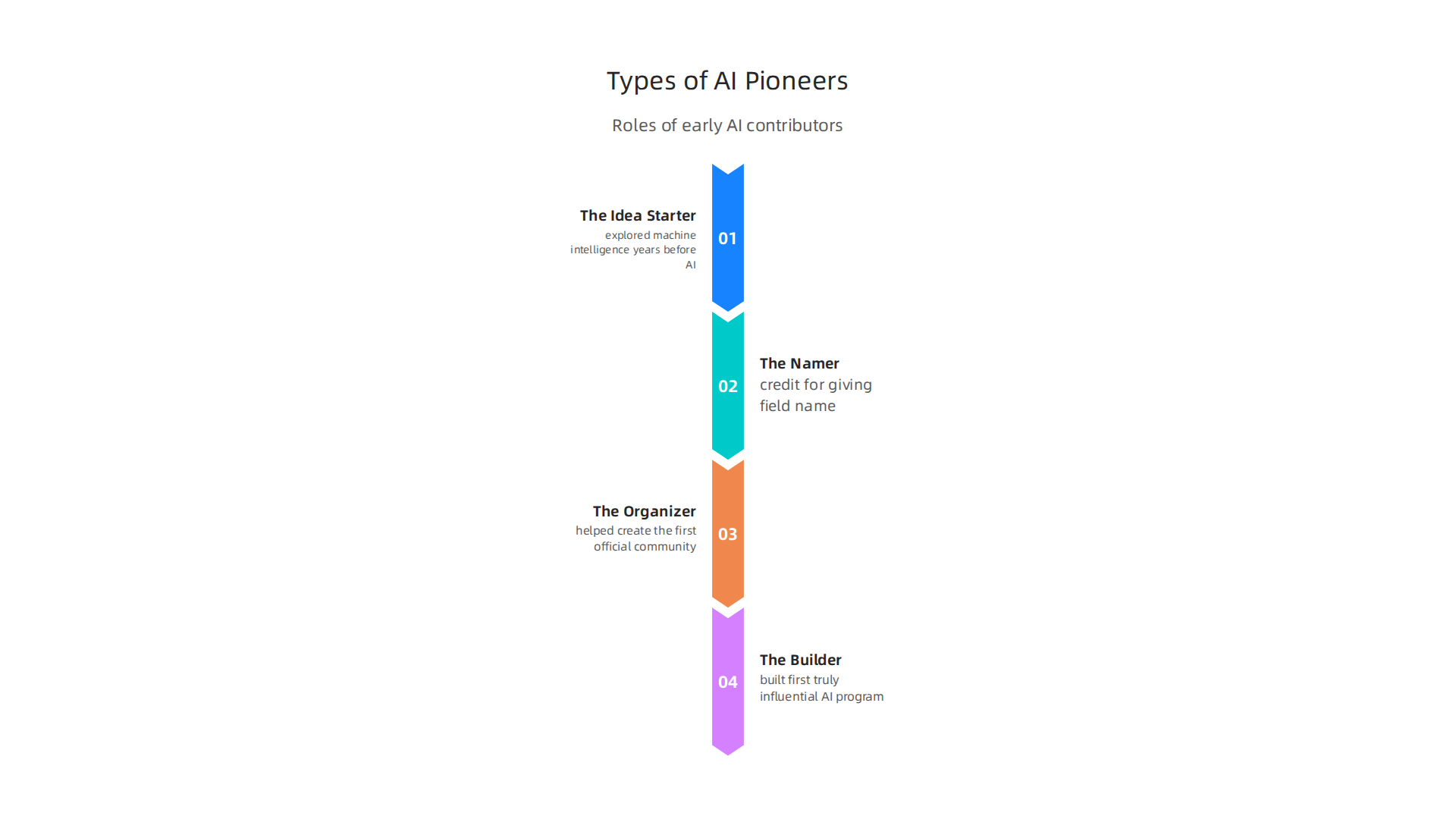

- The Idea Starter: Someone like Alan Turing, who explored the idea of machine intelligence years before the term "AI" even existed. He laid down the deep thoughts and questions about whether machines could think. His work was foundational for many AI people who followed.
- The Namer: John McCarthy, as discussed, gets credit for giving the field its official name. This act of naming helped define the area and bring it into focus for other scientists and the public.
- The Organizer: The Dartmouth workshop itself was a group effort. McCarthy, along with Marvin Minsky, Nathaniel Rochester, and Claude Shannon, proposed the event A Very Short History Of Artificial Intelligence (AI). These early AI researchers helped create the first official community for AI. The meeting aimed to bring together top thinkers to figure out how to make machines think, helping establish when AI became popular as a research topic.
- The Builder: Some might argue the "father" is someone who built the first truly influential AI program or set up the first AI lab, showing that machines could do intelligent tasks.
So, while John McCarthy is widely known as the "father of AI" for coining the term and bringing early AI researchers together, it’s clear that many brilliant AI people contributed to the field’s birth and early growth. Understanding these different viewpoints helps us appreciate the rich history of artificial intelligence. If you’re keen to learn more about the basic concepts, exploring resources that explain Artificial Intelligence Basics can provide a solid foundation.
It’s true that the title "father of AI" can be looked at in different ways, depending on what kind of big step someone took. Looking back at the mid-1900s, several AI people laid the groundwork for what we know as artificial intelligence today.
The Visionary Thinker: Alan Turing
Before the term "artificial intelligence" was even thought of, Alan Turing explored what it would mean for a machine to think. He was a brilliant mind who helped set the stage for computer science and AI. In 1936, he came up with the idea of the Turing machine, which is a simple model that shows how any computer program can work. Then, in 1950, he proposed the famous Turing Test. This test was a way to see if a machine could act smart enough to fool a human into thinking it was human The Founding Fathers of AI: Pioneers Who Shaped …. Turing’s deep ideas gave future AI researchers a strong base to build upon. He was truly the "Idea Starter" for machine intelligence.
The Namer and Developer: John McCarthy
While Turing gave us the big ideas, John McCarthy gave the field its name. As we know, he coined "Artificial Intelligence" in 1955, leading to the important Dartmouth workshop in 1956. This event was when AI became popular as a focused area of study. But McCarthy didn’t stop there. He also created the LISP programming language in 1958. LISP was very important because it was the first programming language designed especially for AI research and is still used today What is the history of artificial intelligence (AI)? – Tableau. This made him a "Builder" too, providing tools for other AI people to create smart programs.
Other Early Builders and Organizers
Many other smart AI researchers contributed greatly in these early years:
- Warren McCulloch and Walter Pitts: Back in 1943, these two came up with a mathematical model for neural networks [AI’s Pioneers: The Unsung Heroes of the Mid-20th Century]. This was a very early step towards how AI systems learn today, much like the human brain.
- Herbert Simon and Allen Newell: These two worked together to create some of the very first AI computer programs. In 1955, they wrote "Logic Theorist," which could solve logic problems. Then, in 1959, they developed the General Problem Solver (GPS), a program that could tackle a wide range of problems using human-like reasoning The History of Artificial Intelligence: Key Events from 1920 …. Their work showed that computers could actually "think" in a basic way.
- Marvin Minsky: Along with John McCarthy, Marvin Minsky helped start the MIT AI Laboratory in 1959 [Timeline of artificial intelligence – Wikipedia]. This lab became a major hub for AI research and development, bringing together many talented minds to push the field forward. Minsky also had a big impact on how AI systems should be designed.
These early pioneers, with their mix of theoretical ideas, new programming languages, and clever programs, laid the solid foundation for all the AI we see in 2026. Their work showed what was possible and truly kickstarted the journey of artificial intelligence.
To understand how these foundational ideas grew into today’s complex systems, diving deeper into how AI works is a great next step. Many experts believe that understanding the basic approaches from these early days is still very important for knowing why artificial intelligence a modern approach remains essential in 2026.
Want to stay informed about all the latest breakthroughs and trends in AI, from its history to its future? The AI Newsletter Worth Reading can help you get clear daily AI updates.
After the first big steps were taken, many smart AI people and academic researchers helped artificial intelligence grow even more. Their ideas led to different ways of making machines think, moving from simple logic to more complex learning.
The Rise of Symbolic AI
In the beginning, much of the AI research focused on what we call "symbolic AI." This approach was about making computers use clear rules and symbols, much like how we solve problems with logic. Think of it like a computer following a recipe step-by-step.
One important area here was expert systems. These were computer programs designed to act like human experts in specific fields. For example, a doctor might use an expert system to help diagnose a sickness. In 1961, James Slagle created a program called SAINT, which was one of the first of these expert systems. It could solve math problems that involved symbols The birth of Artificial Intelligence (AI) research. These systems showed that AI could be useful in real-world jobs.
Academic leaders like Marvin Minsky and Seymour Papert also played a big role during this time. While Minsky helped start the MIT AI Lab, he also worked with Papert to explore how AI should tackle problems. They looked at simpler, controlled settings called "microworlds" to build AI programs history of artificial intelligence (AI). This helped other AI people figure out how to make AI systems smarter in a focused way.
We also can’t forget important figures like Barbara Liskov, whose work helped in designing AI systems that were easier to build and update by making their parts more organized and modular. She is one of the important Female AI Pioneers Who Changed the Game.
Shifting Towards Statistical and Connectionist AI
As the years went by, some AI researchers started looking at other ways to make machines learn. Instead of just using fixed rules, what if AI could learn from lots of examples, much like how humans learn from experience? This led to the growth of "statistical AI" and "connectionist AI," which uses things like neural networks.
A huge step forward came in 1986 with the backpropagation algorithm. This was developed by Geoffrey Hinton, David Rumelhart, and Ronald Williams. This special math trick allowed neural networks to learn much more effectively by fixing their mistakes as they went along Getting to know The Godfathers of AI | by Tom Eck – Medium. This was a big change because it opened the door for AI to learn complex patterns, which is key to many of the smart AI systems we see in 2026.
This move from symbolic AI to statistical and connectionist methods showed a big shift in how AI people thought about machine intelligence. It laid the groundwork for the modern AI world, where computers can do things like recognize faces, understand speech, and even drive cars. If you’re curious about the different kinds of smart systems that exist today, you can explore the Types of Artificial Intelligence Explained.
The math trick called backpropagation truly set the stage for modern AI. From that point, many bright AI people kept pushing the limits, leading to the amazing AI we see in 2026. This era is all about deep learning, transformer models, and foundation models.
Contemporary Influencers and Researchers (2000s–2026)
Even though Geoffrey Hinton helped create backpropagation in 1986, he and other important AI researchers like Yoshua Bengio and Yann LeCun are still often called the "godfathers of deep learning" because their work laid the groundwork for today’s smart systems.
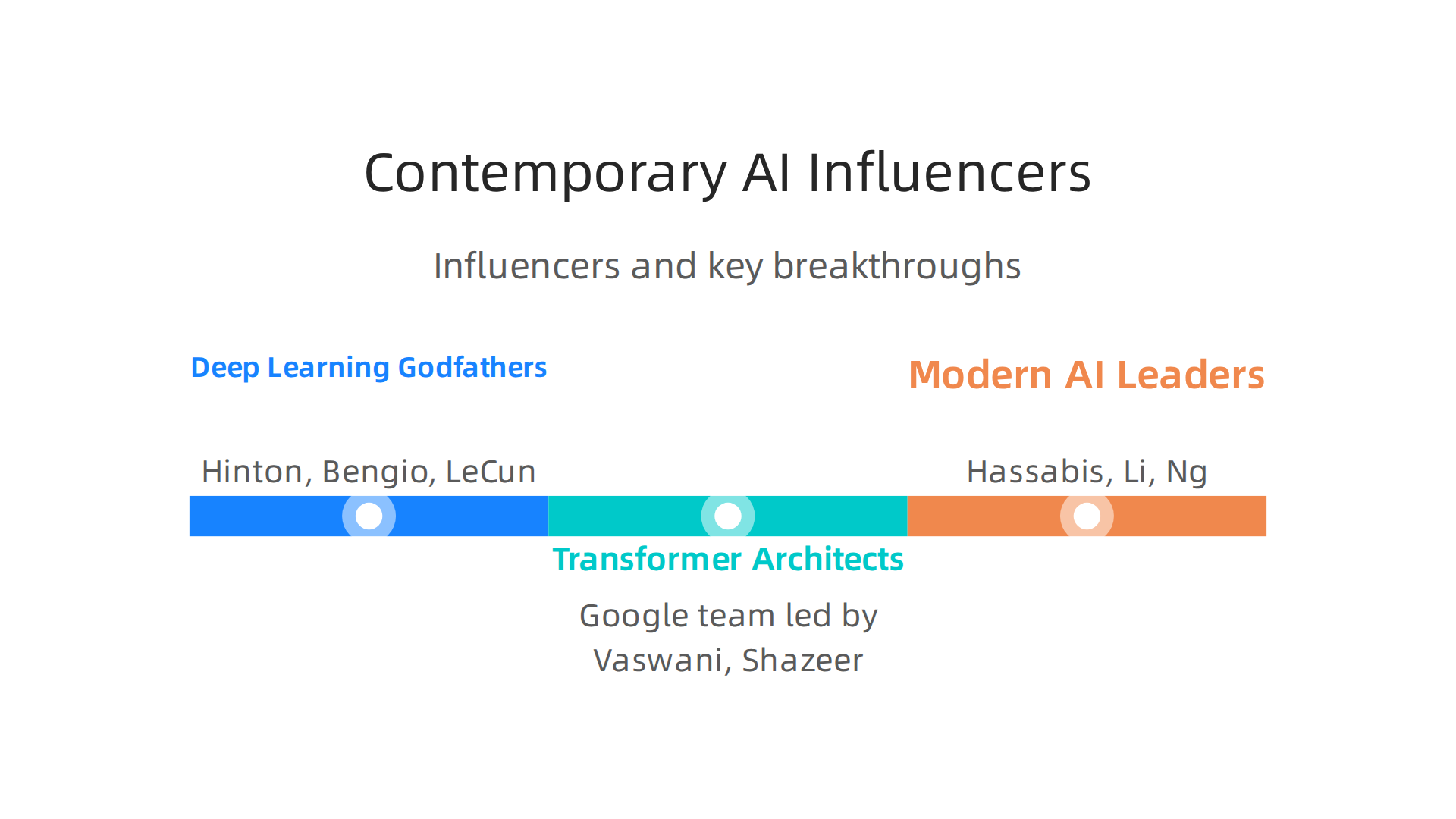
These three are among the most cited AI researchers in 2026 Top 20 AI Researchers 2026: Ranking by Citations & h-Index. They helped AI go from just learning patterns to truly understanding complex information.
When did AI become popular in the way we think of it today? A big moment was in 2017 with the invention of the Transformer architecture. A group of eight AI researchers from Google, including Ashish Vaswani and Noam Shazeer, wrote a paper called "Attention Is All You Need." This paper introduced a new way for AI models to look at data, which was much faster and better for tasks like understanding language AI Experts. This breakthrough made models like GPT possible. These researchers are now seen as key figures, showing how new ideas can quickly change who is most influential in AI.
Today, the focus is on foundation models. These are huge AI models trained on a massive amount of data, designed to be adapted for many different jobs Foundation Models – Stanford HAI. Think of them as a very smart general helper that can learn new skills quickly. Because of these advances, new AI people are leading the way. Figures like Demis Hassabis of Google DeepMind, Fei-Fei Li who created ImageNet, and Andrew Ng are recognized as top AI experts in 2026 for their leadership and ongoing contributions Who Are The Best AI Experts in the World in 2026?.
These modern AI people and their work have brought AI into our everyday lives, from helping us write emails to creating amazing art. Their ongoing efforts continue to shape the world of AI, making it more powerful and useful every year. If you want to keep up with how AI is changing our world, you can learn more about the World of AI in 2026 technologies trends and what comes next.
To stay on top of all the fast changes in AI, it’s helpful to get regular updates.
Get clear daily AI updates from The AI Newsletter Worth Reading.
Industry leaders, founders and entrepreneurs who made AI ubiquitous
While smart researchers laid the groundwork for AI, it took a different kind of leader to bring it into our homes and workplaces. These are the company founders and business people who saw the big ideas and turned them into products and services everyone could use. They moved AI from academic labs to real-world impact, making it truly ubiquitous by 2026.
Some of the most important AI companies today were started by these forward-thinking individuals. For example, OpenAI was founded in 2015 by a team including Sam Altman, Elon Musk, and Greg Brockman. They aimed to make AI useful for everyone OpenAI – Wikipedia.

Another key player is DeepMind, started in 2010 by Demis Hassabis, Shane Legg, and Mustafa Suleyman. It later joined with Google’s AI efforts to become Google DeepMind in 2023 [History of artificial intelligence – Wikipedia]. Then there’s Anthropic, founded in 2021 by Dario Amodei and Daniela Amodei [AI Companies, with their founding year and founder(s) – Info Media]. These AI people are now top leaders, guiding the way AI is developed and used across the world [AI Founders & Leaders Database – AI Guerrilla].
These companies and their leaders have been key in answering the question of when did AI become popular. It wasn’t just amazing inventions; it was putting those inventions into easy-to-use tools.

They focus on making AI platforms that businesses can use to solve problems and grow. This is where academic breakthroughs get turned into real-world solutions that touch our daily lives, from helpful chatbots to complex business software. For instance, you can see how these advancements lead to various types of artificial intelligence explained that businesses use.
The influence of these business leaders goes beyond just starting companies. They are also shaping how AI is developed, making it safer and more useful for everyone. They help bridge the gap between complex research and practical applications, allowing companies to maximize business impact with enterprise AI platforms. Other big names like Jensen Huang from NVIDIA and Satya Nadella from Microsoft are also vital. NVIDIA makes the powerful computer chips that AI needs to run, while Microsoft works to bring AI into many of its popular products. These are some of the 82 Artificial Intelligence (AI) Companies to Know that are making AI so widespread.
These leaders are truly making AI ubiquitous, moving it from specialized science into something that helps almost everyone, every day. Their work shows how business vision can transform cutting-edge research into a powerful force that changes industries and our lives. To understand the bigger picture, it’s helpful to know how to spot major tech companies shaping 2026 and their roles in this AI revolution.
We’ve seen how many smart ai people and companies helped make AI so widespread by 2026. But sometimes, people want to find just one person to call the "father of AI." This idea is often debated. Is it truly helpful or can it cause problems to pick a single person for such a big invention?

Thinking about a single "father of AI" can be tricky. It often suggests that one person did all the work, which isn’t usually how big changes happen. Most times, many ai researchers and thinkers contribute over a long period. This "lone inventor" story often hides the hard work of countless others There are no lone inventors. History shows that inventions, especially in technology, are usually built by many hands and minds working together, not just one "great man" Tech’s Enduring Great-Man Myth.
There are also concerns about fairness when we try to name one "father of AI." This kind of thinking can lead to biases. For example, it might focus on inventors from certain parts of the world, often overlooking important contributions from different countries or cultures. It can also ignore the work of women or people from diverse backgrounds who played key roles. When we tell the story of innovation, we need to be careful not to create a narrative that leaves out many true pioneers. Studies have even looked into how the story of inventions can be shaped by specific viewpoints, sometimes ignoring the real teamwork involved Testing the "lone inventor" narrative.
Instead of looking for a single "father of AI," it might be more useful to think about all the different individuals and teams who made AI what it is today. This helps us understand the full, rich history of this technology. It also helps answer the question of when did AI become popular, showing it was a slow build-up of many ideas. Looking at all the different ideas and breakthroughs, and how they connect, gives us a more complete picture of how AI grew. If you’re interested in diving deeper into the history and future of AI, a good place to start is with artificial intelligence academic resources your 2026 roadmap.
Ultimately, AI is a field built on the efforts of many, making the idea of a single "father of AI" less accurate and perhaps even misleading. It’s important to recognize the collective genius that has brought AI from simple ideas to the advanced systems we use daily in 2026.
Staying informed about the constant changes in AI is key.
The AI Newsletter Worth Reading can help you get clear daily AI updates.
What Business Leaders Should Take From These Histories
Understanding that no single "father of AI" created this field gives us important lessons for business. Instead of looking for one genius, leaders should focus on how many different ai people and groups work together. This way of thinking helps us make smart choices for the future.
For business leaders and investors in 2026, the big takeaway is this: great ideas usually come from many different minds, not just one. When you think about new technologies, don’t just look at one person. Look at the whole team, the company culture, and how they work with others. Big names like OpenAI, Anthropic, and Google DeepMind were all started by groups of smart ai researchers, not just one person. For example, OpenAI was co-founded by several people, including Sam Altman and Elon Musk, in 2015, and DeepMind had three founders: Demis Hassabis, Shane Legg, and Mustafa Suleyman in 2010 AI Companies, with their founding year and founder(s).
To really understand where AI is going, it’s helpful to watch a few key things:
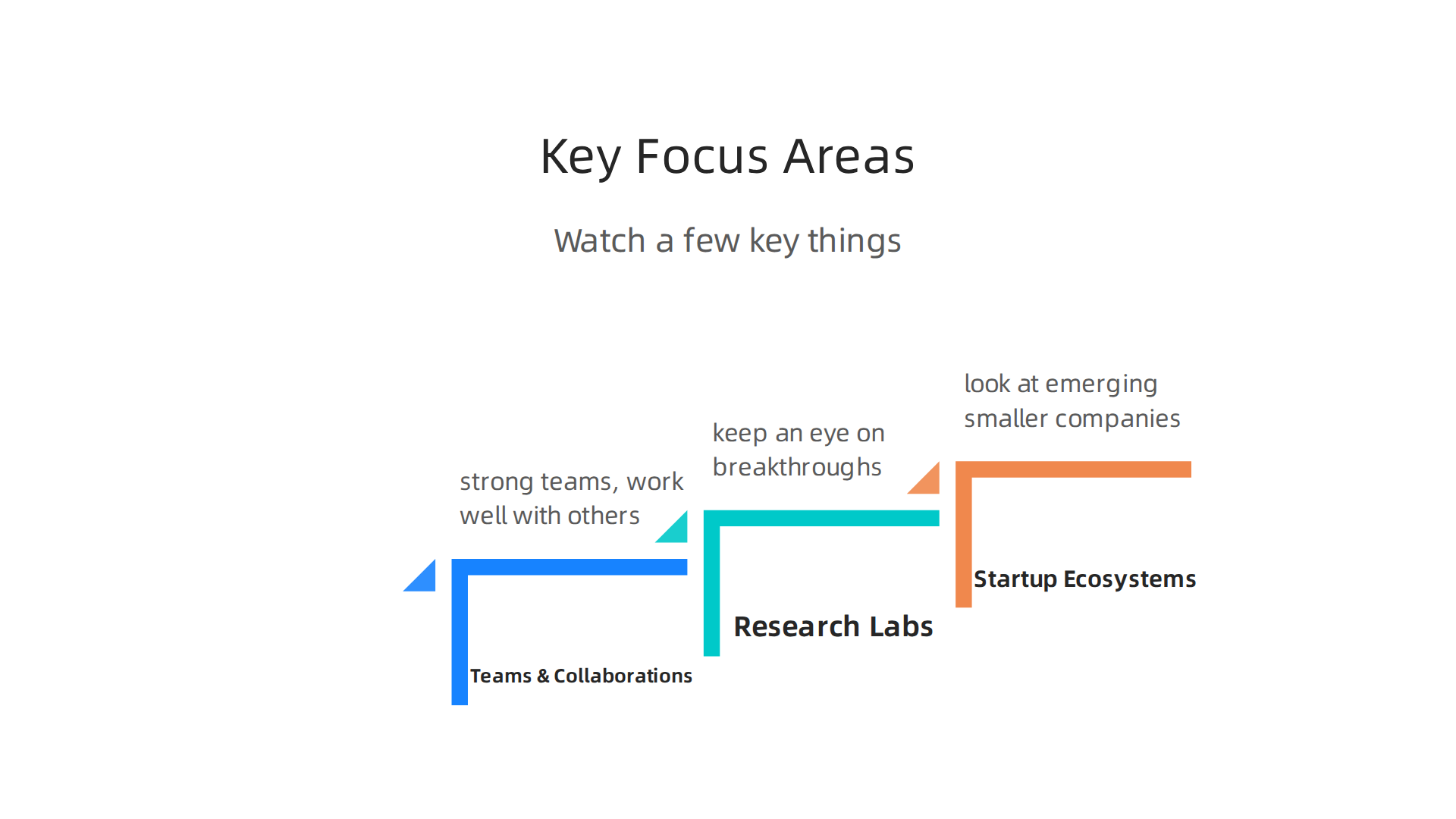
- Teams and Collaborations: Pay attention to companies that have strong teams and those that work well with others. AI success often comes from diverse groups bringing different skills to the table.
- Research Labs: Many big steps in AI still come from dedicated research labs. Keep an eye on breakthroughs from places like Google DeepMind and Anthropic, not just what a single famous person is doing.
- Startup Ecosystems: New ideas often start in smaller companies. Look at emerging startups that are tackling unique problems or approaching AI in new ways.
Knowing that AI became popular through a long history of shared effort helps you spot where future growth will come from. It’s about finding places where many talented ai people are working together on tough problems. To learn more about figuring out which tech groups matter most, you can read about how to identify key tech entities and evaluate them effectively.
In short, instead of searching for the next "father of AI," smart business leaders in 2026 will focus on the power of many working together. This collective effort is what truly moves the needle in AI and helps us see what’s coming next.
Summary
This article examines the long debate over who deserves the label