
Why behavioral tech matters now: a concise overview and what this article promises
In today’s super-fast world, businesses often feel swamped with too much information. It’s like trying to drink from a firehose, and it can be really hard to figure out what all that data means for how people act and what it means for business success.

This is a big problem for companies trying to make smart moves in 2026. They need to turn all those small hints and actions people take (behavioral signals) into real business results.
This is where behavioral tech steps in. Behavioral change technology, also known as BCT, uses digital tools, apps, and software to help understand and even gently guide human behavior online and offline
What Is Behavioral Change Technology? ABA & BCT Tools. It’s not about being pushy; it’s about using smart tools to see patterns and make things better for customers and businesses alike. For example, AI tools like Smith AI, Limitless AI, and Eightfold AI are changing how we gather and use these insights in different areas. These tools help companies turn raw data into helpful actions. If you want to learn more about making sense of all your business data, check out how to turn data overload into strategic insight in the information society 2026.
This article will be your friendly guide to the world of behavioral tech. We will clearly explain what it is, show you many practical ways businesses are using it right now, and talk about important ethical rules to keep things fair and safe. We will also give you a clear roadmap for how your business can start using these powerful tools effectively. Our goal is to help you understand how to use behavioral tech to solve real problems and achieve great outcomes.
Staying updated with the latest in AI and tech is key to understanding behavioral tech.
The AI Newsletter Worth Reading
Get clear daily AI updates from The Deep View Newsletter.
What is behavioral tech? Definitions, scope, and core concepts
Let’s make sure we’re all on the same page about what behavioral tech really is. Simply put, behavioral tech refers to digital tools, apps, sensors, and software that are made to thoughtfully guide or change how people act. It’s about using technology to understand human behavior and then gently encourage actions that are good for both people and businesses. This is different from just gathering data; it’s about taking action based on what the data tells us.
Sometimes, people confuse behavioral tech with other terms, but they are not the same. For example, a "behavioral technician" is a job title for someone who works directly with people, often in health care, to help them with certain behaviors or conditions, like those with autism spectrum disorder What is a Behavior Technician?. Our focus here is on the technology itself, which can be seen as "behavioral intervention technologies" or BITs, using digital tools to help with mental health and behavior Behavioral Intervention Technologies: Evidence review.
So, how does behavioral tech work? It has a few main parts:
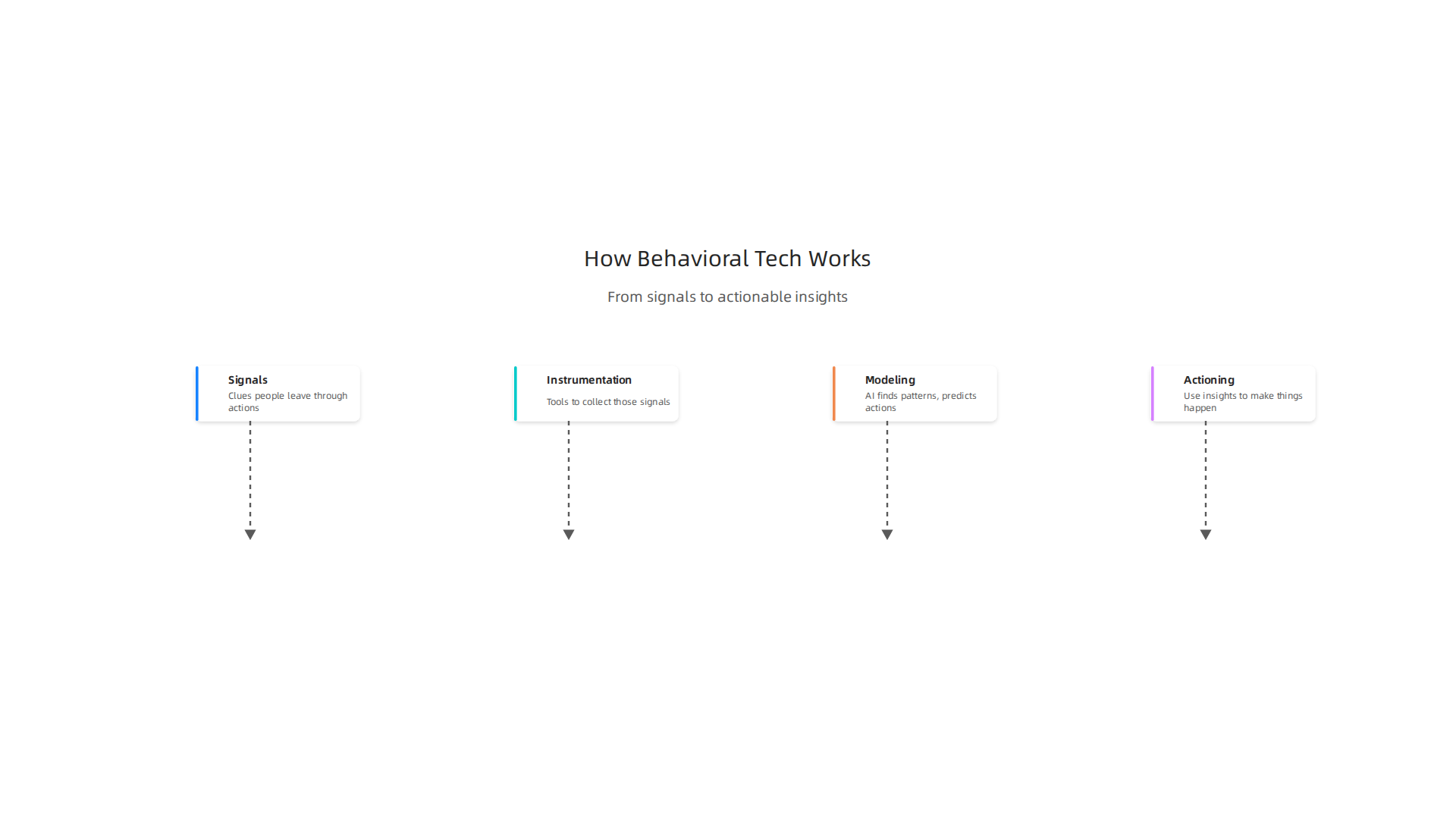
- Signals: These are the clues people leave behind through their actions. Think about what they click on, what they buy, how long they stay on a page, or what they say in a chat. These are all signals about their behavior.
- Instrumentation: This is how businesses collect those signals. It means using special tools and setups to track and record what users do online or with devices.
- Modeling: Once the signals are collected, smart computer programs, often using artificial intelligence, look for patterns. They try to understand why people act the way they do and predict what they might do next. Learning about different types of Artificial Intelligence explained can help you see how these tools make sense of patterns.
- Actioning: This is the most important part. It’s about using the insights from modeling to make things happen. This could mean showing a customer a special offer they might like, sending a helpful reminder, or changing how an app works to make it easier to use. The goal is to encourage a specific, positive outcome.
Behavioral tech is really special because it’s not just about looking at numbers. It’s a strategic way for businesses to truly connect with customers. It helps companies move past just knowing what happened to actively shaping future experiences and choices. This powerful approach helps businesses make smart choices that improve customer satisfaction, build loyalty, and drive growth in 2026. Understanding the true meaning of technology can help your business gain an edge and lead to a strategic business advantage.
How behavioral data is collected and processed: practical mechanics
To truly use behavioral tech, businesses need to get good at collecting and handling information about how people act. Remember how we talked about "signals" and "instrumentation" before? This is where we dive deeper into those ideas. It’s about how raw actions turn into useful insights.
Where Behavioral Data Comes From
Behavioral data comes from many places where people interact with technology. Think of it as leaving digital footprints.
- Product Events: These are actions people take within an app or on a website. Things like clicking a button, viewing a product, adding something to a cart, or even just scrolling down a page are all events. Each event is a signal about what a user is doing.
- Telemetry: This is data about how a system or device is working and how people use it. For example, how long someone stays on a screen, how fast an app loads for them, or if they run into an error. This kind of data helps understand the user experience itself. Experts say that focusing on important events and taking a step-by-step approach is key for getting this data right
Best Practices for Behavioral Data Collection.
- Interaction Paths: This is the journey a user takes. It’s not just one click, but a whole series of clicks and views that lead to a goal, like buying something or signing up for a service. Understanding these paths helps businesses see what truly matters to their customers.
How Data is Collected (Instrumentation)
Collecting this data needs special tools. When you visit a website or use an app, tiny pieces of code are often at work, tracking your actions. These tools are set up to capture every signal mentioned above. This could involve special software development kits (SDKs) in apps, tracking scripts on websites, or sensors in smart devices. The goal is to gather data without bothering the user, making it a seamless part of the experience.
Turning Raw Data into Useful Information: Data Pipelines
Once collected, all this raw data can be messy. Imagine a huge pile of puzzle pieces. You can’t see the full picture until they are sorted and put together. That’s what a "data pipeline" does for behavioral tech. It’s a series of steps that takes raw data and makes it ready for analysis.
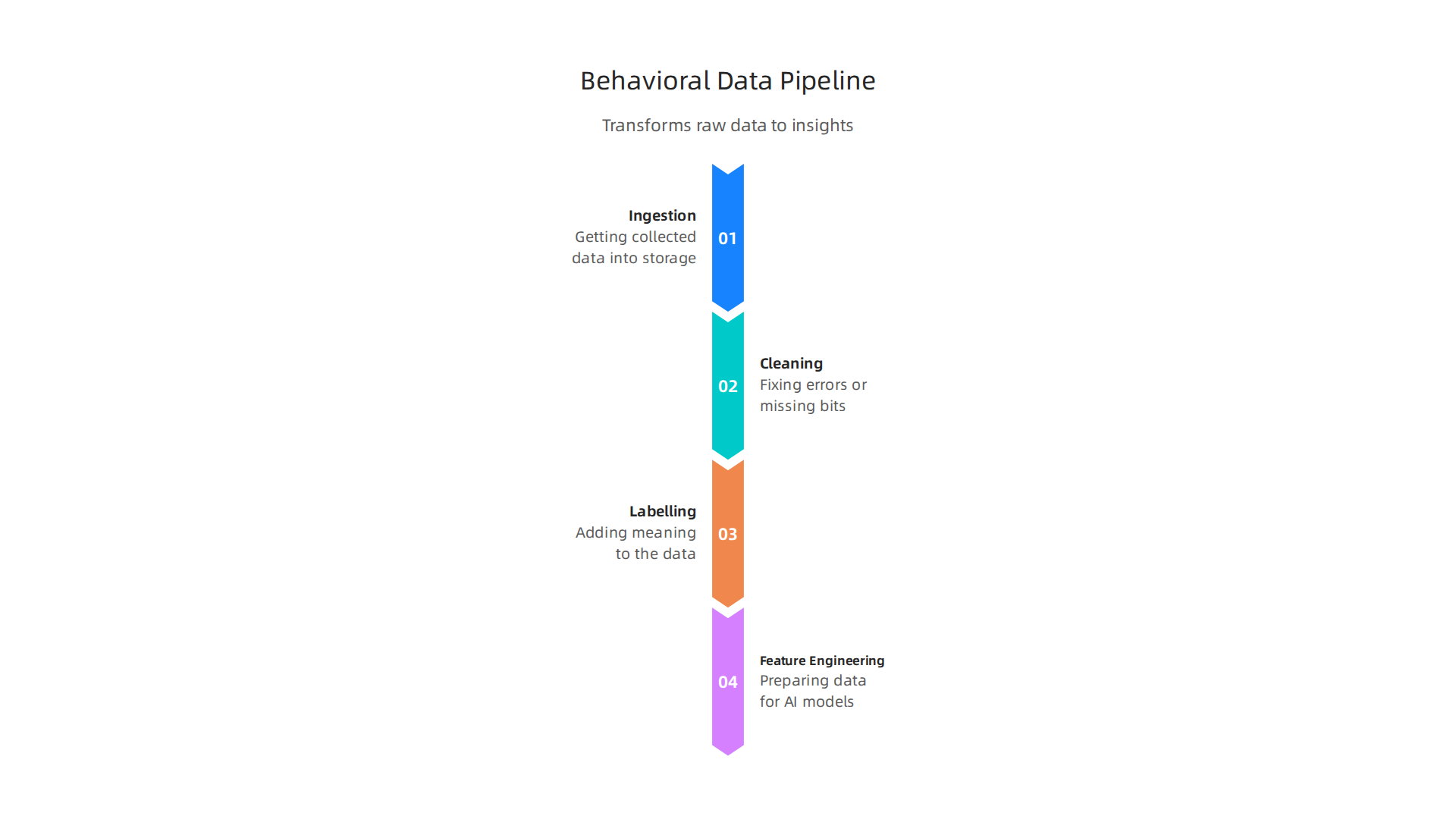
Building a good data pipeline is very important in 2026 for any business using behavioral insights How to Build Data Pipeline Architecture.
Here’s how it works:
- Ingestion: This is the first step, simply getting all the collected data into a central storage place. Think of it like pouring all the puzzle pieces onto a table.
- Cleaning: Raw data often has errors or missing bits. Cleaning means fixing these problems, like removing duplicate information or correcting mistakes. This step makes sure the data is accurate and ready to use.
- Labelling: This is about adding meaning to the data. For example, if a user clicked "add to cart," you might label that event as "purchase intent." This helps computers understand what happened.
- Feature Engineering: This is a fancy term for getting the data ready for AI models. It means taking raw data points and turning them into "features" or characteristics that the AI can learn from. For instance, instead of just "clicked three times," a feature might be "high engagement user." Advanced AI systems, like those you might see from leaders such as Smith AI, Limitless AI, or Eightfold AI, are crucial for this complex data work. They help businesses turn data overload into strategic insight.
Data Quality and Rules
With so much data being collected, it’s really important to have good rules in place. This is called "data governance." It means making sure the data is of high quality, accurate, and kept safe. Good data governance also ensures that businesses use data in fair and responsible ways, especially when it comes to understanding and influencing user behavior. When data quality is high, the AI models built on it are better, leading to smarter behavioral tech tools.
If you want to keep up with the latest ways AI and other technologies are shaping how businesses collect and process data, there’s a great resource for you.
The AI Newsletter Worth Reading
After businesses have collected good, clean data, the next big step is to make sense of it using smart AI. This is where the real power of behavioral tech comes alive. It’s about using special AI methods to find patterns in how people act, helping businesses understand and even predict what customers might do next.
AI techniques powering behavioral tech: models, evaluation, and trade-offs
Making behavioral tech work means choosing the right AI brains for the job. These brains, or models, help us understand the signals hidden in all the data we collect.
Different Ways AI Models Learn
AI models learn in different ways, just like people do. Here are some common methods used in behavioral tech:
- Supervised Learning: This is like teaching a child with flashcards. You show the AI lots of examples of user behavior with clear answers. For instance, you might show it past customer actions labeled as "made a purchase" or "did not buy." The AI then learns to predict future actions based on new, unlabeled data. This is very common for predicting things like who might click an ad or buy a product.
- Sequence Models: Sometimes, the order of actions matters a lot. Think of someone’s journey through a website: first they browse, then they add to cart, then they leave. Sequence models are good at understanding these steps in order. They can predict the next step in a user’s journey. Modern AI systems, especially those that understand language, often use advanced ways to trace these step-by-step interactions, which is key for understanding complex user paths in 2026, as discussed in guides on Setting Up LLM Observability Pipelines in 2026.
- Reinforcement Learning: This is like teaching through trial and error. The AI tries an action, like showing a certain product, and then gets a "reward" if the user responds well (e.g., clicks on it). Over time, the AI learns which actions lead to the best rewards. This is great for things like smart recommendations or personalizing app layouts in real time.
- Bayesian Methods: These models use what we already know about people’s behavior and combine it with new data to make better guesses. They are good when you don’t have a ton of data but still want to make smart predictions.
These different kinds of AI models are the engines behind modern behavioral tech. Leading AI companies like Smith AI, Limitless AI, and Eightfold AI use these advanced techniques to build powerful systems that can make sense of very complex behavioral data. To learn more about how these different smart systems work, you can explore resources on Types of Artificial Intelligence Explained.
How We Know if AI Models Are Working
It’s not enough to just build an AI model; you also need to know if it’s doing a good job. This is where evaluation comes in.

- A/B Testing: This is a simple but powerful way to test. You show two different versions of something (A and B) to different groups of users. For example, half your users see an old website design, and the other half see a new one. Then, you look at the data to see which version leads to better behavior, like more purchases. Many companies use this to fine-tune their digital products and improve user experience. You can see examples of how digital changes lead to real impact in various Digital Behaviour Change Case Studies.
- Uplift Modeling: This goes a step further than A/B testing. It tries to figure out not just which version is better overall, but who will react positively to a certain change. This helps businesses offer the right things to the right people.
- Causal Inference: This is about figuring out cause and effect. Did our AI really cause the customer to buy something, or would they have bought it anyway? This helps businesses understand the true impact of their
behavioral techefforts. In 2026, AI is even being used to help people manage their daily habits, like a smart chatbot helping students with their health behaviors and showing real, positive changes Using AI Chatbot to Assist Students’ Behavior Management for.
What We Give Up for Better AI: Trade-offs
When building behavioral tech systems, businesses often have to make choices. There are always trade-offs.
- Latency (Speed): How quickly does the AI need to make a decision? For things like real-time fraud detection or instant recommendations, the AI needs to be super fast, meaning very low latency. But making AI run that fast can be expensive and complex. Designing data pipelines for real-time needs is a big focus for businesses in 2026 to achieve this speed Designing an Observability-Driven Data Pipeline for Real-Time Analytics. For more on speedy AI, check out Real-Time AI in 2026 Delivers Millisecond Decisions.
- Interpretability (Understanding): Can we understand why the AI made a certain suggestion or prediction? Some powerful AI models are like "black boxes" where it’s hard to see their inner workings. For some uses, like medical diagnoses, understanding why is super important. For others, like recommending a movie, it might be less critical.
- Online vs. Offline Learning:
- Offline Learning: This means the AI models are trained using old data. They are updated regularly, maybe once a day or once a week. This is simpler to do.
- Online Learning: This means the AI models learn and update in real time as new data comes in. This keeps the AI very fresh and responsive to changes in user behavior, but it’s much harder to build and maintain.
Finding the right balance between these factors is a key challenge for any company using behavioral tech to improve their products and services.
After understanding how AI models work and the choices businesses make when using them, the big question is: where do we use this smart behavioral tech to get real results? The truth is, it’s making a big splash across many different industries, changing how companies connect with people and solve tough problems.
High-impact use cases across industries: product, marketing, risk, and operations
Behavioral tech isn’t just a fancy idea; it’s a powerful tool helping businesses in 2026 see clear improvements. Let’s look at some key areas where it makes a real difference.
Where Behavioral Tech Shines
Here are some main ways companies are using behavioral tech today:
- Making Things Personal (Personalization & Recommendation): Imagine logging into a streaming service and seeing movies you actually want to watch. That’s
behavioral techat work. It uses your past viewing habits to suggest new things you might like. For shopping, it can recommend products. For news, it shows articles that match your interests. This helps businesses keep customers happy and engaged. Case studies show how digital changes can lead to better user experiences and outcomes, as seen in various Digital Behaviour Change Case Studies. - Keeping Customers Around (Churn Prevention): Sometimes, customers stop using a service or product. This is called "churn." Behavioral tech can spot early warning signs, like a customer suddenly using an app less often or skipping payments. By finding these patterns, businesses can reach out to these customers with special offers or help before they leave for good.
- Stopping Bad Things (Fraud & Risk Detection): Financial companies use
behavioral techto protect your money. If your credit card is suddenly used for a large purchase in a far-off country, the system might flag it as unusual based on your normal spending habits. This helps catch fraud quickly. It’s about looking for behaviors that don’t fit the usual picture. - Helping Teams Work Better (Workforce Productivity): Beyond customers,
behavioral techcan also help employees. It can suggest better ways for teams to work together, spot if someone is struggling, or help improve overall well-being. For example, AI chatbots are even being used to help students manage their health behaviors, showing positive changes in their daily lives, according to research on Using AI Chatbot to Assist Students’ Behavior Management for. The overall human behavior tool market is growing fast, projected to reach $2.68 billion in 2026, which highlights the broad impact of these tools.
Leading AI companies like Smith AI, Limitless AI, and Eightfold AI are at the forefront, building solutions that leverage these behavioral insights across various sectors. You can read more about how AI is transforming customer engagement in insights like Transforming Customer Engagement With Agentic AI.
How Behavioral Signals Help Achieve Business Goals
For different parts of a business, behavioral tech helps achieve different important goals, also known as Key Performance Indicators (KPIs).
- For Product Teams: They look at how people use a product. Behavioral signals can show which features are popular and which aren’t. This helps them improve the product, making users stick around longer and enjoy it more.
- For Marketing Teams: These teams want to get new customers and keep old ones. Behavioral tech helps them send the right message to the right person at the right time. This can lead to more clicks on ads, more sign-ups, and more sales. Businesses often use
behavioral techto boost things like conversion rates and customer loyalty. - For Finance/Risk Teams: Their goals are often about reducing losses and making smart money decisions. Behavioral tech helps by quickly identifying risky behaviors, like potential loan defaults or insurance claims that look suspicious. This protects the company financially.
Picking the Best Use Cases for Your Business
When thinking about using behavioral tech, it’s smart to pick projects that will give you the most back for your effort. Here’s a simple checklist to guide you:
- Is there a clear problem? Do you know exactly what behavior you want to change or understand? For example, "we want fewer customers to leave" is a clear problem.
- Do you have the data? Can you collect the right information about people’s actions that relates to your problem?
- Can you measure success? How will you know if your
behavioral techsolution is actually working? What numbers will you look at (like sales, customer retention, or fraud cases prevented)? This helps you see the Return on Investment (ROI). - What’s the impact? Will solving this problem make a big difference for your business? Choosing high-impact areas means better returns.
- Is it realistic? Think about the trade-offs we talked about earlier, like speed and how easy it is to understand the AI. Choose a project that fits your team’s abilities and resources.
By carefully choosing where and how to use behavioral tech, businesses can see major improvements in how they operate and how they serve their customers. For more cutting-edge insights and daily updates on how AI is shaping these business strategies, make sure to get The AI Newsletter Worth Reading. You’ll receive clear, actionable information to stay ahead in the fast-paced world of technology.
While behavioral tech offers many exciting ways to help businesses grow, it also brings up very important questions about trust, fairness, and how people’s information is handled. Just as companies work to get good results, they must also act responsibly. This means thinking carefully about ethics, protecting privacy, and following the rules.

Privacy Considerations: Keeping User Data Safe
When businesses use information about how people act, they must be very careful with it. This involves a few key ideas:
- Consent: People need to clearly agree to their data being collected and used. This means businesses should ask for permission in a way that is easy to understand, making sure users know what they are agreeing to. New rules in 2026 demand clear consent management, often with easy ways to say no to data collection Privacy Laws 2026: Global Changes, Enforcement & ….
- Data Minimization: Companies should only collect the exact amount of data they need for a specific purpose. They should not gather more information than necessary.
- Anonymization and Re-identification Risks: Businesses try to make data anonymous so it cannot be linked back to a single person. But sometimes, even with anonymous data, it can be possible to figure out who someone is if different pieces of information are put together. Companies must work hard to prevent this "re-identification" to truly protect privacy. Also, once data is collected, businesses need to provide reasonable security for it and only keep it for as long as truly needed for business or legal reasons A Legal Guide To PRIVACY AND DATA SECURITY 2026.
Regulatory Landscape and Compliance Priorities
The rules for data privacy are always changing and getting stronger, especially in 2026. Businesses that use behavioral tech must stay up-to-date with these laws.
- Growing Laws: In the United States, several new state privacy laws took effect on January 1, 2026, including in Indiana, Kentucky, and Rhode Island. These laws give people more rights over their data, like being able to see, delete, or correct it Data privacy laws: what to expect for 2026. Other states, like Connecticut, are also making their laws apply to more businesses in mid-2026 Privacy Laws Ring in the New Year: State Requirements ….
- International Rules: Other countries are also putting new rules in place. For example, Canada introduced Bill C-36 in June 2026, aimed at protecting privacy and consumer data The Protecting Privacy and Consumer Data Act (Bill C-36). The UK also has new guidance for agentic AI and how it works with their General Data Protection Regulation (GDPR) Data law | UK Regulatory Outlook June 2026.
- What This Means for Businesses: Companies need to make sure their data practices meet these changing legal needs. This is not just about avoiding fines; it’s about earning customer trust.
Organizational Governance: Transparency and Accountable AI Practices
Beyond just following laws, companies need to set up their own rules and ways of working that build trust.
- Transparency: Businesses should be open about how their
behavioral techworks. This means explaining in simple terms what data they use, why they use it, and how it helps make decisions. - Human Oversight: Even though AI is smart, people should still be in charge. This means having humans review AI decisions, especially in sensitive areas, to make sure they are fair and correct. To truly understand the power and limitations of these systems, it helps to grasp the artificial intelligence basics.
- Accountable AI Practices: Companies like Smith AI, Limitless AI, and Eightfold AI, which are leaders in creating AI solutions, must make sure their AI systems are fair, unbiased, and can explain their decisions. This means building AI in a way that minimizes harm and upholds ethical values. Being accountable for AI’s actions is key to long-term success.
In summary, while behavioral tech offers incredible power for businesses, its real value comes when used with care and responsibility. By focusing on strong privacy, following regulations, and practicing good governance, companies can build lasting trust with their customers.
Bringing behavioral tech into your business can feel like a big step. But with a clear plan, you can make sure it helps you reach your goals. This kind of technology, which looks at how people act, is growing fast. Experts believe the global behavior analytics market, a key part of behavioral tech, will grow from $2.06 billion in 2026 to $7.63 billion by 2034 Behavior Analytics Market Size, Share | Statistics, 2026-2034. Here is a simple roadmap to help your team use it well.
Step-by-Step Adoption Roadmap for Teams
To start using behavioral tech wisely, think of it in three main steps:
- Pilot and Learn: Begin with a small project. Pick one area where you think
behavioral techcan make a real difference, like improving a specific customer interaction. Run a test, watch closely, and see what happens. This lets your team learn without a huge risk. Think of it as trying out a new recipe before cooking for a big party. Collecting behavioral data in smart ways from the start is a good practice during this phase Best Practices for Behavioral Data Collection. - Scale Up Smartly: If your pilot project goes well, you can start to use
behavioral techin more parts of your business. This means expanding its use, maybe to other teams or products. As you grow, you’ll need to make sure your systems can handle more information and decisions. - Watch and Adjust (Monitor): After
behavioral techis running, you need to keep an eye on it. This means checking if it’s still working as expected and if it’s bringing the results you want. Just like you’d check a car’s oil, you need to monitor your tech to make sure it’s running smoothly and safely. You can learn more about keeping your data systems healthy by understanding Observability for Data Pipelines: A Complete Guide (2026).
Choosing What to Use: Build or Buy?
When thinking about behavioral tech, you have two main choices: build your own tools or buy them from other companies.
- Buying is Good When: You need something quickly, or if there’s already a great tool out there that does exactly what you need. Companies like
Smith AI,Limitless AI, andEightfold AIoffer smart solutions that can help. This path often saves time and money because someone else has already done the hard work. To make a good choice, it helps to know how to identify key tech entities and evaluate them effectively. - Building is Good When: Your needs are very special, and no ready-made tool fits perfectly. Building your own gives you full control and lets you customize everything. But it takes more time, money, and skilled people to do.
Measuring Success: What to Look For
How do you know if your behavioral tech is actually helping your business? You need a clear plan for measuring success. This means looking at the results, not just how much data you collect.
- Key Metrics: These are the numbers that tell you if things are getting better. For example, if you’re using
behavioral techto make customers buy more, you’d look at sales numbers. If it’s about making customer service faster, you’d track how long it takes to solve problems. - Outcomes-Focused Plan: This means focusing on the actual improvements you want to see. Don’t just track clicks; track if those clicks led to a sale or a happier customer. This way, you know the tech is making a real difference.
By following this roadmap, choosing the right tools, and carefully measuring your results, your business can use behavioral tech to grow and better serve your customers.

To stay on top of the latest advancements and insights in the world of AI, make sure you sign up for The AI Newsletter Worth Reading.
Summary
Behavioral tech uses digital tools, sensors, and AI to observe, model, and gently influence how people act, turning raw signals into measurable business outcomes. This article explains the core concepts—signals, instrumentation, modeling, and actioning—then walks through how behavioral data is collected, cleaned, labeled, and fed into AI models like supervised, sequence, reinforcement, and Bayesian systems. It highlights practical, high-impact use cases across product, marketing, risk, and operations (personalization, churn prevention, fraud detection, workforce productivity) and describes the trade-offs teams must manage around latency, interpretability, and online learning. The guide also covers ethics, privacy, evolving 2026 regulations, and governance practices such as consent, data minimization, and human oversight. Finally, it offers a simple adoption roadmap—pilot, scale, monitor—plus advice on build-versus-buy decisions and how to measure success with outcome-focused KPIs so teams can deploy behavioral tech responsibly and effectively.