
Introduction
You hear the word "technology" every day. It is everywhere. Smartphones, cloud software, AI tools, and even simple machines all fall under this one big umbrella. But here is a surprising truth: experts still disagree on a single, clear definition of technology.
Even though we use the term constantly, its meaning shifts depending on who you ask. A historian defines it one way. An engineer sees it differently. A philosopher adds a whole other layer. This confusion creates a real problem for professionals trying to keep up in a fast-moving world.
The word itself has a long and winding story. It comes from an ancient Greek word: techne, which meant art, skill, or craft. You can trace the history of the term technology back to the very roots of Western philosophy. Back then, it was about making things with skill and reason.
But the word "technology" in its modern form did not even exist in English until a little over 100 years ago. Between 1820 and 1910, it slowly started to mean what we recognize today. Even then, it remained a vague and shifting idea until the late 1900s, when computers and digital devices made it the buzzword we know.
So why does this matter to you? Because when the definition of technology stays fuzzy, it is hard to make smart decisions. Professionals face a flood of news, hype, and jargon every day. Without a solid framework, you risk chasing the wrong trends or missing the real game changers.

This article gives you that framework. We will walk through the origins, the evolution, and the real world meaning of technology. You will get the technology background you need to cut through the noise and focus on what actually matters for your work and strategy.
For a deeper look at how this concept applies to business today, check out our guide to the true technology meaning for strategic advantage.
The goal is simple: help you understand technology clearly so you can use it wisely. Whether you are an executive, a marketer, or just someone who wants to stay informed, this structured exploration will make the abstract concrete.
Stay ahead of these discussions with clear daily insights from The AI Newsletter Worth Reading.

The Historical Evolution of the Term ‘Technology’
The word itself holds the first clue to its own history. The definition of technology we use today rests on two ancient Greek roots: techne, meaning art, skill, or craft, and logos, meaning discourse or systematic study. Put them together, and the original idea was something like "a systematic treatment of an art." That is a far cry from our image of smartphones and cloud servers.
For the ancient Greeks, techne was about making something with reason and skill. Philosophers like Plato and Aristotle placed it in a hierarchy of knowledge, below pure science but above simple labor. As the myths from Greek philosophy about technology show, thinkers worried that new inventions could distance humans from truth. Even writing itself was seen as risky.
But the word "technology" as we know it did not appear in English until the 17th century, and even then it meant something narrow. In the 1700s, a German term Teknologie was used for classifying practical arts. Then the Industrial Revolution hit.
From Crafts to Machines
Between 1750 and 1850, factories, steam engines, and railways transformed the world. The old definition of technology as skilled craftwork no longer fit the scale of these new machines. According to the long history of the term technology, the word slowly shifted to mean the practical arts and mechanical inventions that drove industry. By the late 1800s, "technology" became tied to engineering and manufacturing.
This is when your technology background as a professional likely starts to match what you learned in school. The focus was on tools, machines, and systems.
A Broader View in the 20th Century
Then the 20th century arrived, and the definition exploded. Thinkers realized technology was not just hardware. It included knowledge systems, organizational methods, and social processes. The philosophy of technology field began to treat technology as a human activity that shapes and is shaped by society. This is known as a sociotechnical perspective.
Suddenly, the definition of technology had to cover everything from a pencil to a nuclear reactor to a corporate management system. It became a vague but powerful concept.
Why This Matters for You Today
Knowing this evolution helps you cut through buzzwords. If someone says "global tech," you can ask: do they mean hardware, software, systems, or culture? The history of the word shows that it has always been flexible. That flexibility is both a strength and a trap.
To understand how modern technology terms confuse business strategy, check out our guide on how synonym technologies clear up costly tech jargon confusion. And to keep pace as the definition continues to shift, get clear daily AI updates from The AI Newsletter Worth Reading.
Core Dimensions of Technology Definitions
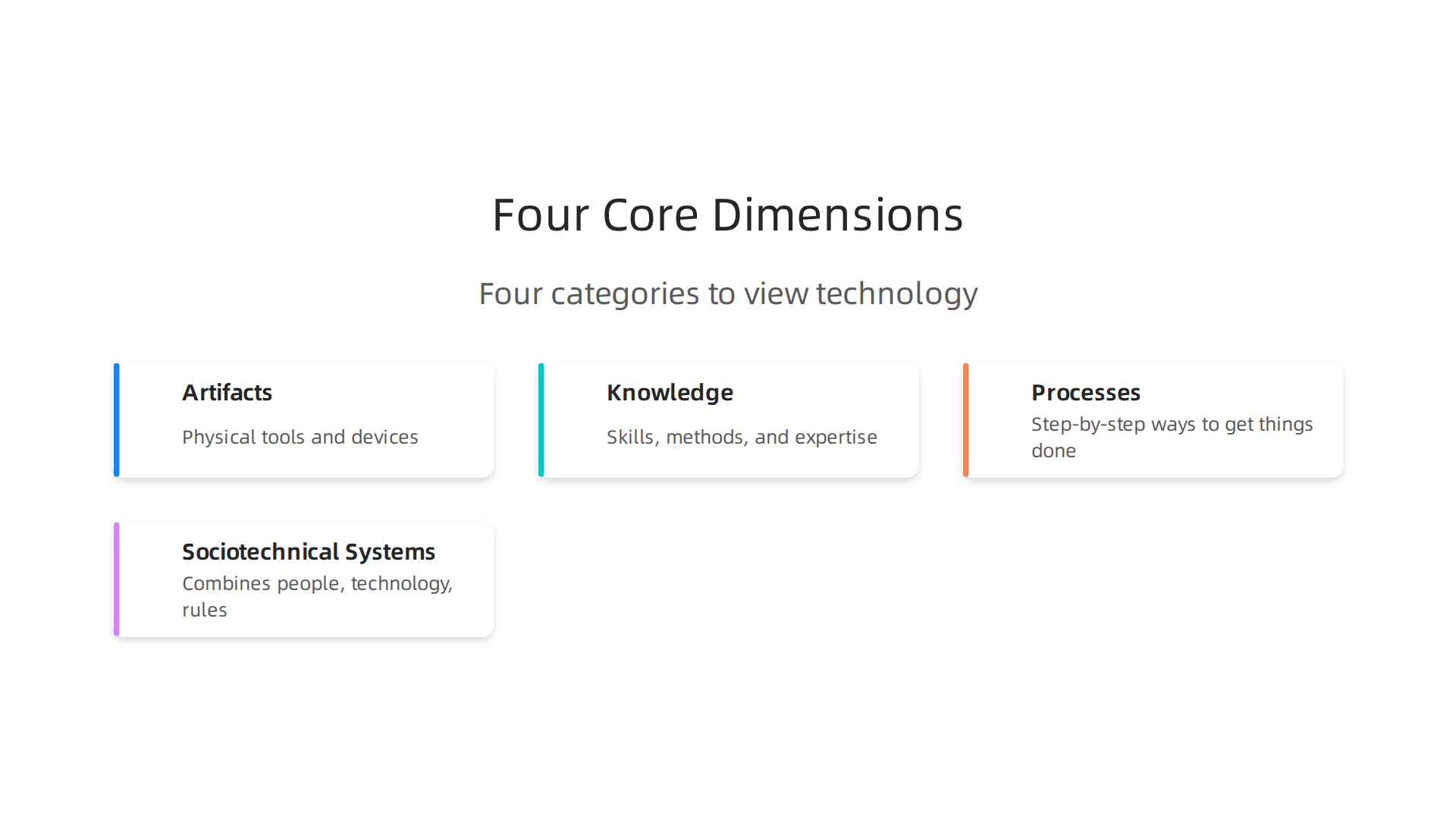
Here is where things get practical. Scholars have broken the definition of technology into four clear categories. Each one gives you a different way to look at what technology actually is.
Artifacts
This is the easiest dimension to understand. Artifacts are the physical tools and devices. Think smartphones, laptops, sensors, and robots. These are the tangible things most people picture when they hear the word technology. Your technology background probably started here with the first gadget you ever used.
Knowledge
Technology is not just stuff. It is also know-how. This dimension covers the skills, methods, and expertise needed to create and use artifacts. It is the reason a factory worker and an engineer have different kinds of technology knowledge even though they work with the same machines.
Processes
Processes are the step-by-step ways we get things done. They include manufacturing workflows, software development cycles, and maintenance routines. This dimension shows that technology is about action, not just objects.
Sociotechnical Systems
This is the big picture. A sociotechnical system combines people, technology, rules, and the environment into one connected whole. According to the socio-technical theory from TheoryHub, organizations are made up of people who produce products using some technology, and each part affects the other. The Oxford Academic overview of sociotechnical systems adds that all factors, including people, machines, and context, need to be considered together.
Understanding these dimensions helps you spot gaps in how your organization talks about technology.

You can learn more about applying these concepts by checking out our guide to unlock the true technology meaning. And to keep your thinking sharp as these definitions keep evolving, get clear daily AI updates from The AI Newsletter Worth Reading.
Technology as Artifacts and Tools
When most people try to form a definition of technology, they start with the stuff they can see and touch. That is the artifacts dimension. It covers every physical object humans have designed and built to solve a problem.
Think about the range here. A simple lever made from a tree branch is technology. So is a hammer, a wheel, a smartphone, and a magnetic resonance imaging machine. Your personal technology background probably began with a toy, a game console, or a family computer. We tend to remember our first gadget because it was our first real encounter with a human-made tool.
One interesting piece of science technology trivia is that the oldest known artifacts used as tools are stone flakes from around 3.3 million years ago. Fast forward to today, and we have surgical robots that can perform procedures with sub-millimeter precision. Both fit the same basic definition of technology as artifacts.
But here is the catch. Critics point out that focusing only on physical objects misses a huge part of the picture. Tools do not exist in a vacuum. A lever is useless without someone who knows how to position the fulcrum. A smartphone is just glass and metal without the software and networks that make it work. The artifact definition alone cannot explain how global tech systems function.
That is why technology scholars also study knowledge, processes, and social systems. These dimensions turn a pile of objects into something truly useful. For a deeper look at how these pieces fit together, check out how technologies synonyms clear up common confusion about what counts as technology. And to see why the human side matters just as much as the hardware, read about Complex Socio-Technical Systems and how they shape modern design.
Technology as Knowledge and Expertise
Think of a master carpenter. They do not just own hammers and saws. They carry decades of skill in their hands and mind. That skill is technology too. This second dimension of the definition of technology covers know-how, techniques, and methods.
Some of this knowledge is codified. Think of a repair manual, a software patent, or a textbook on circuit design. Anyone can read these documents and learn the basics.
But a huge part of technology expertise is tacit. That is the kind of knowledge you cannot write down. It is the feel of an experienced surgeon guiding a scalpel. It is the intuition a pilot develops after thousands of flight hours. These unspoken skills are what truly drive innovation.
When you look at global tech systems, you see that knowledge flows matter more than physical goods. The most valuable technologies often start as an idea in someone’s head, not as a product on a shelf. Scholars who study From sectoral systems of innovation to socio-technical systems explain that these systems are built on competence networks rather than simple trade.
Understanding this intangible side of technology is essential for staying ahead. If you want to go deeper, check out this guide on how to unlock the true technology meaning for your business.
To keep your own technology background sharp, you need reliable sources of new knowledge. One great way is to subscribe to The AI Newsletter Worth Reading for clear daily AI updates.
Technology as a Sociotechnical System
Here is the thing. The knowledge and skills we just discussed do not exist in a vacuum. Technology lives inside human systems. This brings us to the third dimension of our definition of technology: the sociotechnical system.
Think about the internet. It is not just cables and servers. It is also the people who build websites, the laws that govern online speech, and the cultural norms around how you use social media. All these pieces work together as one system.
Researchers who study the Socio-Technical Theory: A review explain that any work system has social, technical, and environmental parts. The social part includes people and their relationships. The technical part includes tools and machines. And the environmental part is the context where everything operates.
Large-scale systems like the electricity grid show this clearly. The grid is not just power plants and wires. It includes utility companies, government regulators, energy markets, and millions of homes using power. Change one part, and the whole system shifts.
This way of thinking about global tech matters for policy and ethics. When you build a new technology, you must also consider its social effects. If you want to understand how modern systems handle these complex interactions, check out this guide on how to identify key tech entities and evaluate them effectively.
Technology is never just about gadgets. It is always about people too.
Contemporary Perspectives: Digital, AI, and Emerging Technologies
The same is true for today’s most exciting technologies. Digital tools and artificial intelligence are changing how we think about the definition of technology itself.
Think about the difference between a simple calculator and a modern AI system. A calculator does exactly what you tell it. It follows fixed rules and never changes. But an AI system works differently. It learns from data, spots patterns, and can even create new things on its own.
According to IBM’s explanation of what artificial intelligence is in 2026, AI involves computers that simulate human abilities like learning, reasoning, and creativity. This makes AI fundamentally different from older tools. It acts more like a partner than a simple machine you control.
This shift from passive tool to active agent is a big deal. It forces us to update the definition of technology. Older definitions focused on machines that extend human physical abilities. Think of a hammer or a crane. New definitions must account for systems that can think, decide, and act on their own.
Algorithmic systems and autonomous technologies push this boundary even further. A system that can drive a car without a human is no longer just a tool. It is a decision-maker. A generative AI model that writes code or designs a product is not just following instructions. It is creating something new.
Policymakers around the world are paying close attention to this change. The Aspen Digital report on defining AI technologies for legal contexts shows how different countries take different approaches. Some focus on what the system can do. Others focus on the risks it creates. This matters because laws and regulations depend on getting the definition right. If you cannot define something clearly, you cannot regulate it well.
The broader technology background also includes advances like quantum computing and the Internet of Things. The 2026 overview of top emerging technologies for digital transformation shows how generative AI, IoT, and other innovations are reshaping entire industries. These technologies expand the definition of what counts as technology even further.
For professionals, understanding these new dimensions is crucial. It helps you anticipate regulatory changes and make smarter strategic decisions. When you know how a technology is being defined by regulators and industry leaders, you can prepare for what comes next. For a deeper look at this topic, check out this guide on why artificial intelligence remains essential in 2026.
The global tech landscape moves fast. Staying informed means choosing the right sources for your daily updates. If you want clear, practical insights on AI and emerging technology, consider The AI Newsletter Worth Reading.
Differentiating Technology from Science and Engineering
Many people mix up technology, science, and engineering. It is easy to see why. They all work closely together. But each one has a different job to do. Understanding where they split apart helps you make better choices about education, business investments, and even government funding.
Here is the simplest way to think about it. Science asks "what is?" It tries to understand how the natural world works. A scientist studies gravity, genes, or atoms just to learn the truth. Technology asks "what should be?" It creates useful tools and systems that solve real problems. Engineering sits right in the middle. It takes scientific knowledge and combines it with technological methods to design and build things that work.
Consider the famous example of electricity. Scientists like Michael Faraday studied what electricity is and how it behaves. That is pure science. Later, engineers like Thomas Edison used that knowledge to design a practical light bulb. That is engineering. And the light bulb itself is technology — a tool that changes how people live. The definition of technology focuses on utility. If it does not help someone do something better, it is not really technology.
The Stanford Encyclopedia of Philosophy’s explanation of the philosophy of technology makes this point clearly. It says science concerns itself with what is, whereas technology concerns itself with what is to be. The engineer designs for how things ought to work.
Why does this distinction matter in real life? For one thing, it affects how money flows. Governments and companies fund science differently than they fund technology development. If you confuse the two, you might invest in basic research when what you really need is a practical product. For education, students need to know if they are training to become scientists who discover new knowledge or engineers who build new solutions.
A good technology background helps you see these boundaries. They are not always sharp. In fact, they blur often. Engineers use scientific theories. Scientists use advanced tools. But keeping the core differences in mind gives you clarity. If you want to dive deeper into how these definitions play out in business, check out how to unlock the true technology meaning for strategic advantage.
Knowing the difference between science, engineering, and technology is not just trivia. It helps you communicate better, spend smarter, and innovate faster.
Societal and Ethical Implications of Technology Definitions
The way you define technology does more than clear up confusion. It shapes the rules we live by and the future we build. Governments use the definition of technology to write regulations. Investors use it to decide where to put money. And ethicists use it to argue about what is right or wrong.
Think about data privacy. If you define technology narrowly as just hardware and software, you might miss how social media platforms collect and use personal information. A narrow definition treats each device separately. That makes it easy to overlook the big picture. Rules written this way often leave gaps. Companies can exploit those gaps because the law did not consider how tools connect with people’s lives.
A broader definition changes everything. When you see technology as a sociotechnical system, you include people, culture, and the environment in the conversation. This view forces regulators to think about consequences beyond the product itself. It also pushes investors to consider long-term risks like data misuse or environmental harm.
The conversation about these definitions is alive and well in 2026. Philosophers and engineers gather every year at events like the Forum on Philosophy, Engineering and Technology to discuss these exact questions. They ask whether technology is value-neutral and who should carry responsibility for its risks. The Wikipedia article on the philosophy of technology explains how these debates examine the assumptions and values embedded in the tools we build.
When you adopt a broader sociotechnical definition, responsible innovation becomes easier. You start asking questions like "Who does this help?" and "Who might it hurt?"

Instead of only asking "Does it work?" You design systems that consider fairness, safety, and sustainability from the start. That is why the global tech community is pushing for this kind of thinking.
If you want to understand the real-world impact of these definitions, check out how to identify key tech entities and evaluate them effectively. It gives you a practical way to apply these ideas in business.
The definition of technology is not just an academic idea. It directly affects your privacy, your money, and your future. Keeping up with how these definitions evolve is essential. One of the best ways to stay informed is to get clear daily AI updates from The Deep View Newsletter. It helps you cut through the noise and focus on what matters most in 2026.
Once you understand how definitions shape the big picture, it is time to put that insight to work in your own job or business. The way you define a technology directly affects the decisions you make every day. A clear definition of technology helps your team stay on the same page, avoid costly misunderstandings, and evaluate new tools with confidence.
One practical approach is to use a dimensional framework. Instead of asking "Is this technology good or bad?" you break it down into several layers. Look at the technical layer: what does it actually do? Look at the social layer: how will people use it and who does it affect? Look at the ethical layer: what risks or biases might it carry? This method keeps your analysis grounded. Policymakers already use this kind of thinking. The Aspen Digital report on frameworks for defining AI systems shows how different legal and technical angles can produce different rules and outcomes.
A consistent definition also helps align teams. When your engineering, marketing, and leadership groups all share the same understanding of what a technology is, you reduce confusion during strategy discussions. Everyone knows what they are evaluating. That shared language makes risk assessment faster and more accurate. You can spot potential problems earlier because you are all looking at the same set of dimensions.
Practical tools make this even easier. Technology taxonomies are one example. They classify tools by type, purpose, and impact level. For instance, if you categorize AI by its capability range, you can immediately see whether a tool is narrow or general. This helps you decide where to invest time and budget. Another tool is mapping exercises. Draw a simple diagram that connects a new technology to the people, processes, and data it touches. This reveals hidden dependencies and stakeholders you might have missed. Scenario analysis also works well. Ask "What happens if we adopt this definition versus that one?" Walk through two or three possible futures and compare the outcomes.
If you want to see a practical taxonomy in action, check out the different types of artificial intelligence. Understanding these categories helps you apply the right framework to the right tool.
The bottom line is simple. A thoughtful definition of technology turns abstract debate into actionable strategy.

Whether you are a founder planning next year’s product roadmap or a consultant advising a client, the way you define what you are working with determines how clearly you can think about it and how well your team can execute. Use frameworks, taxonomies, and scenarios to make your definitions work for you.
Future Directions in Defining Technology
The work of defining technology is far from finished. As new fields like synthetic biology and quantum computing move from labs into the real world, they will keep pushing the boundaries of what we think of as "technology." A gene-editing tool like CRISPR is not a gadget you hold in your hand. It is a biological process turned into a precise instrument. Is it technology? Yes, according to most definitions. But it also challenges our old idea that technology is always a machine or a piece of software. The same goes for quantum computers, which do not use the usual ones and zeros. They work on completely different physics. These examples show that any single definition of technology will keep getting stretched.
That is why future definitions need to come from many perspectives at once. Engineers, ethicists, social scientists, and policymakers all see different sides of the same tool. When they talk to each other, the definition gets richer and more useful. The OECD has been studying this and offers an Emerging technologies overview from the OECD that looks at how different fields can work together to understand new tech before it is too late. Cross-disciplinary dialogue helps catch risks early and spot opportunities that a single viewpoint would miss.
Another big shift is that definitions will become more flexible. One size does not fit all. A definition that works for a government regulator may be too stiff for a startup founder. In the future, we will likely see context-sensitive definitions. You adapt the definition depending on where you are using it. This idea ties into the broader technology background of adaptive governance, where rules and language evolve as fast as the tech itself.
To stay ahead of these changes, you need to keep learning. Trends shift quickly, and yesterday’s definition may not work tomorrow. For a solid overview of where things are heading, check out this guide on what comes next in AI and technology. And for a simple way to stay current every day, The AI Newsletter Worth Reading delivers clear daily updates on the technologies that are reshaping how we define the world around us.
Summary
This article clarifies what people mean by "technology" by tracing its history, unpacking core definitions, and showing why the term matters for strategy and policy. It reviews the word’s ancient Greek roots, its shift during industrialization, and the 20th‑century expansion that made technology include not just machines but knowledge, processes, and social systems. The piece explains four practical dimensions—artifacts, knowledge, processes, and sociotechnical systems—and shows how that framework helps cut through hype around digital tools and AI. It contrasts technology with science and engineering, highlights ethical and regulatory implications, and offers practical tools (taxonomies, mapping, scenarios) to evaluate new tech. Finally, it looks ahead to emerging fields like quantum and synthetic biology and argues for flexible, context‑sensitive definitions that support better decision‑making.