

Introduction
Imagine walking into your office and your computer has already sorted your emails, scheduled your meetings, and generated a draft report based on yesterday’s sales data. You never clicked a button or typed a command. The AI just did it.
That is the promise of invisible AI.
Most people picture AI as a chatbot you talk to or a tool you open in a browser. Those are called generative AI assistants, and they are helpful. But they still need you to start the conversation. You prompt. It responds. You wait. It works.
But there is a quieter shift happening. An AI personal assistant that doesn’t wait for instructions at all. It lives in the background of your systems, your apps, and even your physical spaces. It senses what is happening, makes decisions, and takes action without you ever knowing it is there.

This is known as ambient intelligence or invisible AI. According to a detailed analysis on the subject, invisible AI operates proactively rather than reactively, handling everything from network security to automated workflow triggers without requiring a single prompt from a human. It is the new operating system of modern business.
Here is the problem: businesses today are drowning in AI hype. Every vendor promises a flashy copilot or a powerful new chatbot. Executives feel pressure to "do something with AI," so they add chatbots to their websites or buy expensive licenses for tools that end up collecting dust. The real opportunity is not in visible AI. It is in the invisible kind.
Companies like HubSpot are already embedding AI deeply into their platforms.

HubSpot AI helps sales teams prioritize leads, predicts customer churn, and automates follow-up emails all without the user needing to open a separate AI tool. That is invisible AI in action.
This article will cut through the noise. We will define what invisible AI really means, explain why it matters for your 2026 strategy, and show you how to spot real opportunities hiding in plain sight. Whether you are a founder, a marketer, or a tech professional, understanding invisible AI will help you make smarter decisions.
To get a broader picture of where AI is heading this year, check out this overview of the world of AI in 2026 trends. And if you want daily updates on AI developments delivered straight to your inbox, consider subscribing to The AI Newsletter Worth Reading.

It provides clear, daily AI insights to help you stay informed without the hype.
The future of AI is not a talking robot. It is a system that works so quietly you forget it is there. Let us explore how to make that future work for you.
What Exactly Is ‘Invisible AI’? Defining the Trend
Think about electricity for a second. You never think about how it works. You flip a switch and the light comes on. You plug in your laptop and it charges. It is just there, doing its job, completely out of sight.
That is the best way to understand invisible AI.
Invisible AI refers to intelligent systems embedded into your workflows, devices, and environments. They act autonomously and intuitively without requiring you to interact with them. You do not open an app. You do not type a prompt. The system senses what is happening, makes decisions, and takes action all on its own.
This is very different from the AI tools you are used to. When you open ChatGPT or ask a smart speaker a question, that is visible AI. You start the conversation. You give the command. The AI waits for you.
Invisible AI flips that model completely. As one clear guide explains, ambient AI describes intelligent systems that operate continuously in the background, sensing context and acting proactively without explicit user commands. It never asks for permission. It just works.
Here are the three key traits of invisible AI:
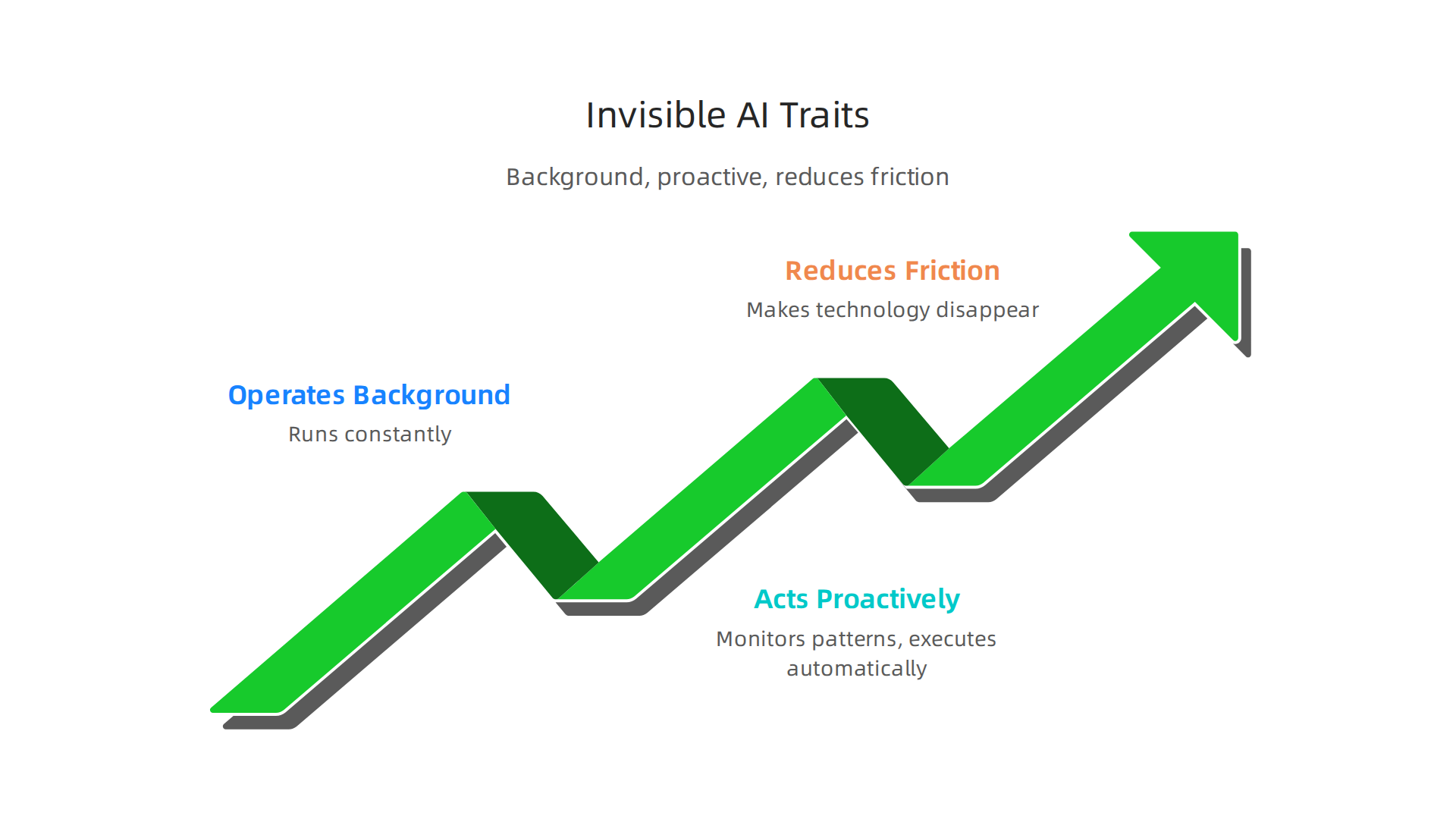
- It operates in the background. Like the nervous system in your body, it runs constantly but you never notice it.
- It acts proactively. It does not wait for a prompt. It monitors patterns, spots opportunities, and executes improvements automatically.
- It reduces friction. The whole point is to make technology disappear so you can focus on what actually matters.
This is why people also call it ambient intelligence. The intelligence surrounds you like the air you breathe. It is everywhere but visible nowhere.
To better understand where invisible AI fits within the broader landscape, it helps to know the types of artificial intelligence that exist today. Invisible AI is just one piece of a much larger puzzle.
Later sections of this article will show you exactly how businesses are applying invisible AI right now. But first, realize this: invisible AI is not a futuristic concept. It is already running inside the software you use every day, quietly making your life easier without asking for a thing.
The Core Technologies Powering Invisible AI
Invisible AI might feel like magic, but it is built on four very real technologies working together behind the scenes.
Edge AI is the foundation. Instead of sending data to the cloud for processing, the intelligence runs directly on the device itself. Your phone, your camera, your thermostat. They all make decisions locally without needing to phone home. This is a massive shift. According to recent how edge AI is reshaping industrial operations, edge AI is now firmly established as operational infrastructure, with real-time inference happening directly at the point of work.
Machine learning inference at the edge is what makes this possible. Tiny models running on small chips analyze data instantly. They spot patterns, detect anomalies, and trigger actions all without internet access. This is why your smart thermostat learns your schedule without sending your data anywhere.
Natural language processing (NLP) gives invisible AI contextual awareness. It understands not just what you say but the situation around your words. This is how a voice assistant knows you are talking to it even when you do not say a wake word. It senses the room, hears your tone, and responds only when appropriate.
Computer vision adds eyes to the system. Smart cameras and sensors monitor environments passively. They watch for problems without human supervision. A security camera that alerts you when a package is left at your door? That is computer vision working invisibly.
These technologies do not operate alone. They combine through sensor fusion. Data from cameras, microphones, motion detectors, and temperature sensors all merge into one real-time picture. The system processes everything simultaneously, making split-second decisions that feel intuitive. Real-time AI systems like this are becoming standard across industries.
Because invisible AI runs locally, it also handles privacy better. Your data stays on your device. That is a big deal in 2026 when privacy concerns are growing.
If you want to stay ahead of these fast-moving developments, consider subscribing to The AI Newsletter Worth Reading. It delivers clear daily AI updates straight to your inbox.
Real-World Applications: Where Invisible AI Is Already at Work
All that technology we just covered isn’t sitting in a lab somewhere. Invisible AI is already deployed in hospitals, stores, factories, and banks today. These systems work quietly in the background, and they are producing serious results.
Healthcare: Diagnosis Without the Wait
In healthcare, invisible AI assists radiologists by scanning medical images for tumors, fractures, and other abnormalities. It runs continuously in the background, flagging urgent cases first. According to a recent report on the top AI business use cases by industry, hospitals that use AI have cut diagnostic errors by 42%. That means fewer missed cancers and faster treatment for patients.
Some systems now use generative AI assistants to help doctors write patient notes automatically. The AI listens to the conversation and drafts the record. This frees up hours per day for physicians.
Retail: Shelves That Think for Themselves
Walk into a modern store and invisible AI is watching the inventory. Smart shelves with built-in sensors track every item. When stock runs low, the system alerts staff automatically. No one has to walk around with a clipboard.
Retailers using this technology have cut out-of-stock items by up to 30%. The system also helps with pricing. It updates digital price tags based on demand, time of day, and nearby competition. All of this happens without a single employee typing a number into a computer.
Manufacturing: Fixing Machines Before They Break
Unplanned downtime costs manufacturers billions every year. Invisible AI solves this with predictive maintenance. Sensors on motors, conveyor belts, and pumps constantly monitor vibration, temperature, and sound.
The AI learns the normal patterns and spots tiny changes that humans would miss. When something looks wrong, it schedules a repair before the machine fails. Data from the comprehensive look at AI use cases by industry shows this approach cuts unplanned downtime by up to 45%. Maintenance costs drop too because workers only fix things that actually need it.
Finance: Stopping Fraud in Milliseconds
Every time you swipe a card or make an online payment, invisible AI checks the transaction. It analyzes your spending habits, location, and hundreds of other data points in under a second. If something looks suspicious, it blocks the payment and alerts you.
This technology is now standard at every major bank. The best AI use cases in finance highlight that fraud detection systems catch threats in real time, saving banks and customers huge amounts of money.
Quick Look: Invisible AI at Work
Here is a snapshot of how invisible AI delivers value across industries right now.
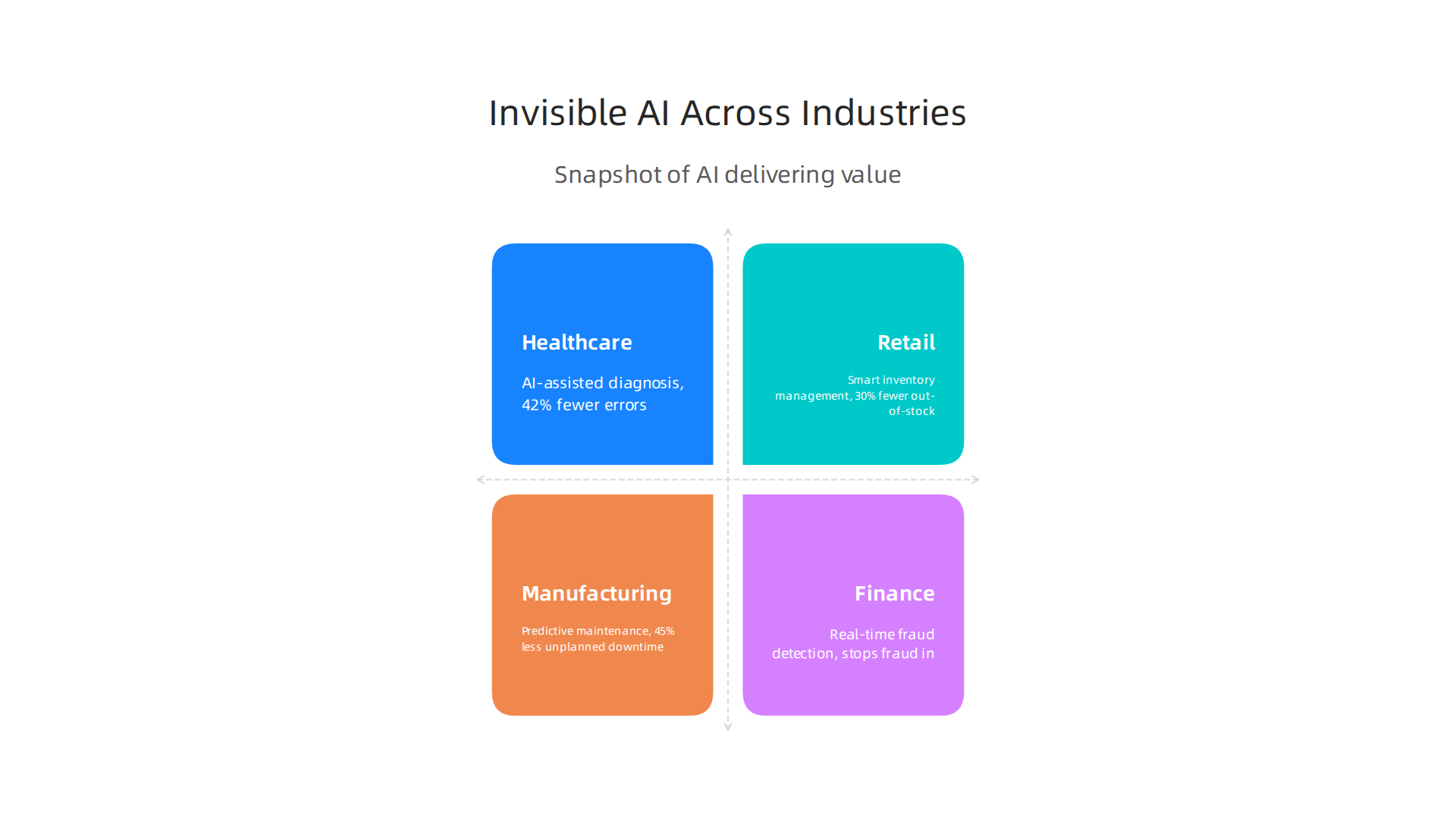
| Industry | Application | How It Works | Measurable Impact |
|---|---|---|---|
| Healthcare | AI-assisted diagnosis | Scans medical images and patient records | 42% fewer diagnostic errors |
| Retail | Smart inventory management | IoT sensors on shelves and products | Up to 30% fewer out-of-stock items |
| Manufacturing | Predictive maintenance | Sensors monitor equipment health | 45% less unplanned downtime |
| Finance | Real-time fraud detection | Analyzes transaction patterns instantly | Stops fraud in milliseconds |
These applications are not one-off experiments. They are running at scale in 2026, and they keep getting better as the technology improves.
If you want to learn more about putting these tools to work in your own business, take a look at this practical guide on how to use AI to drive business growth with practical applications in 2026. It covers real strategies that companies are using today.
Why Invisible AI Matters for Business Strategy and ROI
You have seen how invisible AI works in hospitals, stores, factories, and banks. But the real question every leader needs to answer is this: Does it deliver actual business value? The answer is a strong yes. Invisible AI is not just a fancy tech upgrade. It is a strategic shift that changes how companies operate, compete, and grow.

The Strategic Advantage
Invisible AI reduces friction everywhere. When a machine schedules its own repair, no one has to stop production to check it. When a shelf alerts staff about low stock, no one walks aisles counting items. When a fraud system blocks a bad transaction instantly, no one reviews logs after the loss.
These small moments add up. Faster decisions happen because the AI processes data instantly, not after a human gets around to it. Lower operational costs come from automating repetitive tasks that used to require full teams. And new revenue streams appear when companies use the data collected by these systems to understand customers better.
Real ROI Numbers
The return on investment speaks for itself. The best AI business use cases by industry show that hospitals using AI for diagnostic imaging achieved a 280% ROI within 12 months. Physician documentation tools gave doctors back 1.5 hours per day. In manufacturing, predictive maintenance cut unplanned downtime by 45% and reduced maintenance costs by 25%. In retail, AI-driven inventory optimization improved stock availability by 15% to 25%.
These numbers come from real deployments in 2026. They are not pilot projects or lab tests. They are running at scale and getting better every quarter.
Employee Productivity and Customer Retention
Invisible AI also improves how your team works. When an AI personal assistant handles scheduling, note taking, and data entry, employees focus on higher value work. They solve problems instead of pushing paper. That boosts morale and output.
Customer retention gets a lift too. AI systems that spot early signs of churn can trigger a personalized offer or a check-in call. Companies using this approach have seen churn drop by 10% to 20% in sectors with recurring contracts. The AI works in the background, and customers feel valued without knowing why.
The Competitive Necessity
Here is the hard truth. By 2026, invisible AI has moved from nice to have to must have. Companies that ignore it will fall behind. Their competitors will make decisions faster, spend less on operations, and keep customers longer. The gap will widen fast.
To get a full picture of where AI is heading, read this overview of AI trends in 2026. It covers the major shifts still to come.
If you want to stay on top of these changes every day, subscribe to The AI Newsletter Worth Reading. It delivers clear updates straight to your inbox. No fluff, just what matters.
Overcoming the Key Challenges: Data Privacy, Integration, and Trust
Invisible AI only works when no one notices it. But here is the paradox. The more data it collects to stay useful, the bigger the privacy questions become. When a sensor tracks foot traffic, a camera watches inventory, or an AI personal assistant listens to meetings, you are gathering information constantly. And that creates three big hurdles: how you protect privacy, connect old systems, and earn trust.
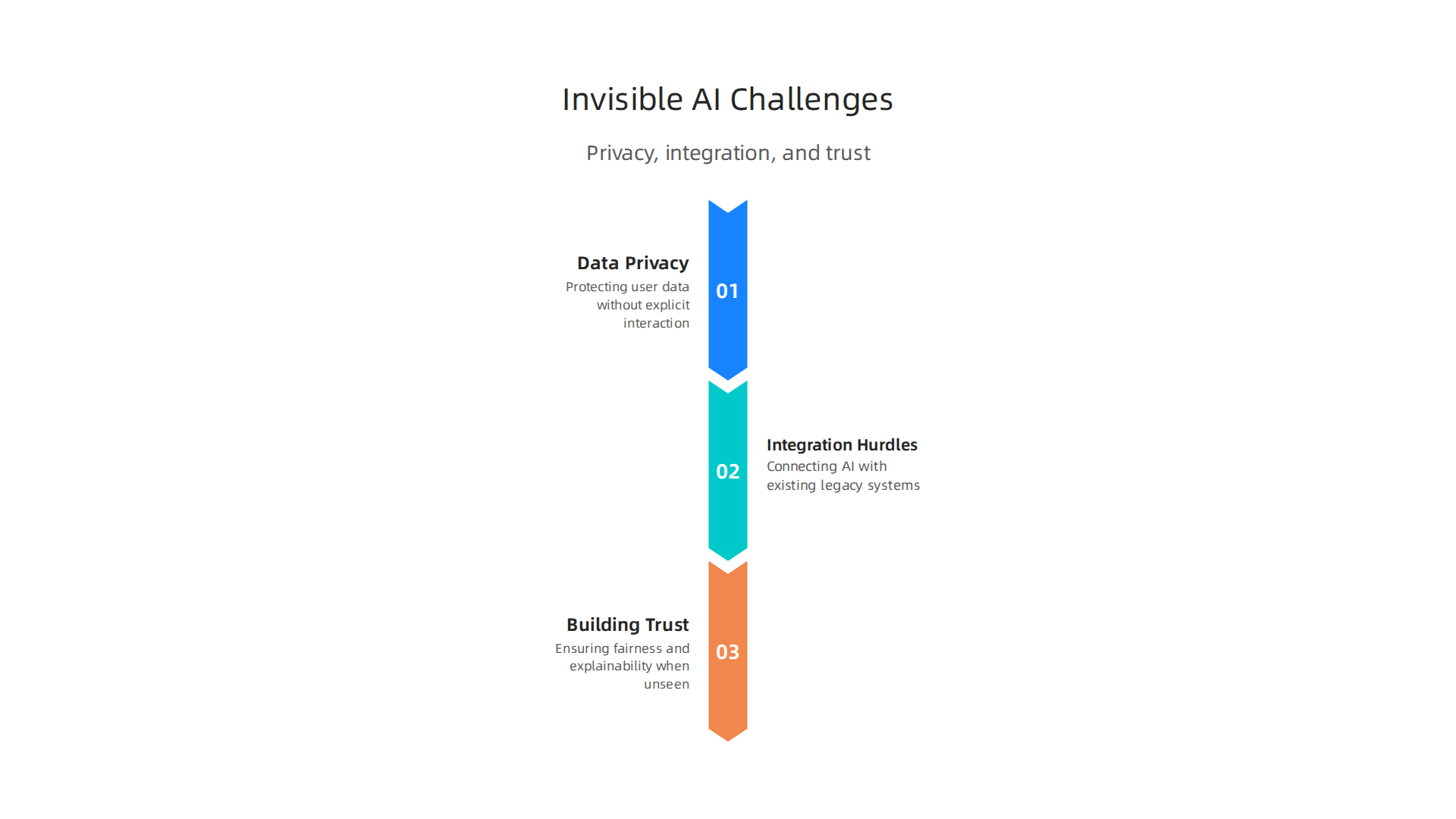
Privacy Without Breaking the Invisible Experience
You cannot ask users to click a consent button every time a shelf detects low stock. That would wreck the whole invisible idea. Yet regulations like the GDPR and the EU AI Act demand transparency about how data is collected and used. The EU AI Act introduces data governance rules for high risk systems, while the GDPR gives individuals rights over automated decisions. Companies that design invisible AI must build privacy in from the start, not as an afterthought. That means using techniques like data anonymization and limiting collection to only what is needed.
Integration Hurdles with Legacy Systems
Most businesses run on old software that was never built to talk to AI. Your customer database might sit in one silo, your inventory system in another, and your HR tools somewhere else. Invisible AI needs smooth data flow across all of them to work properly. Bridging those gaps takes planning, testing, and sometimes replacing outdated platforms. If you want a deeper look at how businesses are applying AI to real world problems like this, check out this guide on how to use AI to drive business growth. It covers practical steps for connecting AI with your existing tools.
Building Trust When No One Sees the AI
The hardest challenge is trust. If users never interact with the AI directly, how do they know it is fair and accurate?

Explainability becomes crucial. Even when the AI works silently, your team and your customers need a way to understand why a decision was made. For example, if an algorithm denies a loan or flags a shipment as suspicious, someone should be able to ask why and get a clear answer. Building that transparency layer requires effort, but it is the only way to keep people confident in the system.
Applying These Principles in the Real World
The EU AI Act requires risk assessments for high risk systems and a human oversight loop. The key is to follow the same privacy principles that apply to any system handling personal data, even when the AI is hidden. Companies that take these steps seriously reduce legal risk and earn long term loyalty.
Want to stay up to date on the latest rules, tools, and strategies for deploying invisible AI responsibly? Subscribe to The AI Newsletter Worth Reading. It delivers clear, daily updates straight to your inbox so you never miss what matters.
How to Identify and Evaluate Invisible AI Solutions for Your Organization
Finding the right invisible AI tool can feel like looking for a needle in a haystack. Every vendor claims their solution is seamless, smart, and easy. But how do you separate the truly hidden helpers from the flashy distractions?
Start with a simple checklist. Look for solutions that slip quietly into your existing workflows. Do they connect to the systems you already use? Do they require your team to learn a whole new tool? A good invisible AI setup needs almost no training. You should not have to read a manual to use it.
Another must-have is clear explainability. Even if the AI works behind the scenes, someone in your organization should be able to understand how it reaches its decisions. The GDPR and EU AI Act both emphasize transparency, especially for high risk systems. You can learn more about these rules from this overview of the EU AI Act’s relationship with data protection law. It explains why explainability is not just nice to have, it is often a legal requirement.
Red Flags to Watch For
Some solutions claim to be invisible but are actually quite the opposite. Watch out for these warning signs:
- Overt user interfaces – If the tool pops up with buttons, dashboards, and settings you have to adjust regularly, it is not invisible.
- High friction – Does the solution force extra steps on your team? Does it slow down their normal routine? If yes, move on.
- Opaque logic – Can you ask the vendor how the AI reaches a certain output? If they cannot give a straight answer, that is a serious problem. Poor explainability can lead to compliance trouble and lost trust.
Vendor Evaluation Criteria
Once you have a shortlist, dig deeper. Look for vendors with a proven track record. Ask about their security certifications. Are they SOC 2 compliant? Do they follow data governance best practices?
Scalability matters too. Will the solution work when your data grows ten times larger? You do not want to replace it next year.
Finally, check how seriously they treat data privacy. Do they offer data anonymization? Do they limit collection to what is truly needed? Companies that build privacy into their designs from the start are the ones you can trust long term. Good data governance tools can help you conduct risk assessments on the models you use, as noted by IBM’s guide on AI privacy.
If you want a practical framework for choosing any technology partner, take a look at this guide on how to evaluate tech entities effectively. It gives you a repeatable process that works for invisible AI and beyond.
The Future of Invisible AI: Trends to Watch in 2026 and Beyond
Once you have your evaluation framework in place, it is time to look ahead. Invisible AI is not a static concept. It is evolving fast, and 2026 is shaping up to be a landmark year.

Three major trends are already taking shape, and each one will change how your organization operates.
Autonomous Agents That Act on Your Behalf
The first big trend is the rise of autonomous agents. These are systems that do not wait for you to ask. They watch, learn, and act on their own. Think of an AI scheduler that books your meetings without you ever opening a calendar. Or an AI personal assistant that reorders supplies the moment inventory gets low. These tools are part of a quiet shift toward agentic AI that works in the background. As one expert explains, this type of invisible AI operates proactively rather than reactively, running continuously without human commands. You can read more about this shift in an overview of invisible AI as ambient intelligence that works in the shadows. The result is less busywork and more time for the things that matter.
Invisible AI in the Physical World
The second trend brings invisible AI out of the digital world and into the real one. Smart buildings already adjust lighting and temperature based on who is in the room. But 2026 will take this further. Autonomous logistics systems will route deliveries without human planners. Warehouses will use sensors and machine learning to restock shelves before they run empty. This is ambient invisible intelligence in action. It blends AI, sensors, and the Internet of Things into everyday spaces so technology fades into the background. You can see how this concept is evolving in this look at ambient invisible intelligence at IIT Kanpur.
Regulatory Frameworks Play Catch Up
The third trend is less flashy but just as important. Laws and ethical norms are finally catching up with ambient intelligence. The EU AI Act already sets rules for high risk systems. As invisible AI becomes more widespread, regulators will demand even more transparency. Data privacy, explainability, and accountability can no longer be afterthoughts. Companies that build with trust from the start will have a clear advantage. To keep up with policy changes, you can follow expert predictions on what is at stake in AI policy in 2026.
Staying informed about these trends is the best way to prepare. A simple way to do that is to subscribe to a daily update that cuts through the noise. Get clear daily AI updates from The Deep View Newsletter. It delivers the most important developments straight to your inbox so you never miss a shift in the invisible AI landscape.
Summary
This article explains the rise of invisible AI—intelligent systems that run proactively in the background of workflows, devices, and physical spaces without explicit user prompts. It defines the concept, describes the core technologies that enable it (edge AI, on-device inference, NLP, computer vision, and sensor fusion), and gives concrete examples across healthcare, retail, manufacturing, and finance showing measurable ROI. The piece also covers strategic implications for business leaders, including productivity gains, cost savings, and competitive necessity, while addressing practical hurdles like data privacy, legacy integration, and explainability. You will find a vendor-evaluation checklist, red flags to avoid, and guidance on meeting regulatory requirements such as GDPR and the EU AI Act. Finally, the article highlights 2026 trends—autonomous agents, ambient intelligence in physical spaces, and evolving regulation—so readers can prioritize investments and deploy invisible AI responsibly.