
Why the idea of an "Artificial Intelligence Olympics" matters for strategy
Imagine the world of artificial intelligence as a giant competition, much like the Olympic Games. Companies and researchers are constantly trying to build smarter, faster AI. They compete in different "events," showing off how well their AI can do tasks. This idea of an "artificial intelligence olympics" helps us understand how quickly AI is growing and changing how businesses work in 2026.
In this exciting race, we see many companies pushing the limits of what AI can do. They want to get an AI advantage over others. For instance, in 2025, new AI models proved to be as good as, or even better than, humans at very hard science problems and math challenges. They also excelled at understanding many different kinds of information, like pictures and sounds, not just text. This shows how strong these AI models are becoming, almost like winning gold medals in these tough challenges, according to The 2026 AI Index Report.
But here’s the thing: while these competitions are fun and show off amazing AI skills, there’s a bigger picture. It’s easy to get caught up in winning short-term contests. However, true success means thinking about the long run. How do you really apply AI to make your business better, not just win a one-time game?
This is where the idea of long-term strategic capability comes in. Instead of just focusing on quick wins, companies need to build lasting AI systems that fit their goals. They also need good artificial intelligence guidance to make sure they use AI safely and responsibly. It’s a balance between showing off AI’s power today and making sure it serves your company well for many years to come.

To stay on top of the rapidly changing AI landscape and understand how these "AI Olympics" will affect your strategy, you need clear and consistent information.
Get clear daily AI updates from The AI Newsletter Worth Reading.
Strategic implications: Treating AI like a sport vs. building enduring capability
The idea of the "artificial intelligence olympics" definitely makes things move faster. When companies compete, they push harder to make AI better. Think of it like a race where everyone wants to build the fastest car. This is good because it helps new AI tools come out quickly. Big events like the NeurIPS 2026 Competitions happen often, showing off new AI skills. These competitions often use special tests, called benchmarks, to see which AI is best at certain tasks. Public scoreboards also show who is winning. This kind of competition helps speed up how fast AI grows and changes.
But sometimes, focusing too much on winning these games can make companies forget their main goals. They might spend all their time making an AI that is super good at just one small test. This can be like training an athlete to win just one type of race, even if that race doesn’t help them in their daily life or career. So, while these "artificial intelligence olympics" lead to great breakthroughs, they can also make companies put their effort into things that look good on a scoreboard but don’t really help their business in the long run.
This leads us to a big question: Should you just try to win short-term AI contests, or should you build strong AI systems that work well every day for many years?

There is a trade-off. Winning a benchmark challenge might give a company a quick ai advantage and good headlines. But these quick wins often do not mean the AI is truly useful or can be used easily in a real business setting.
Real success comes from building robust, dependable AI systems. These are AI tools that can solve many different problems for your business consistently. They might not always win the flashiest competitions, but they give lasting benefits. For example, a reliable AI system helps make decisions faster and more accurately, and it can even make employees work better. This is called measuring AI adoption and impact, and it’s key to seeing true business value in 2026, according to a report on Measuring AI Adoption: Metrics for Business Impact in 2026.
To really apply AI and make it work for you, you need to look beyond just winning. It is about careful planning and making sure your AI efforts fit into your bigger business picture. This means focusing on things like:
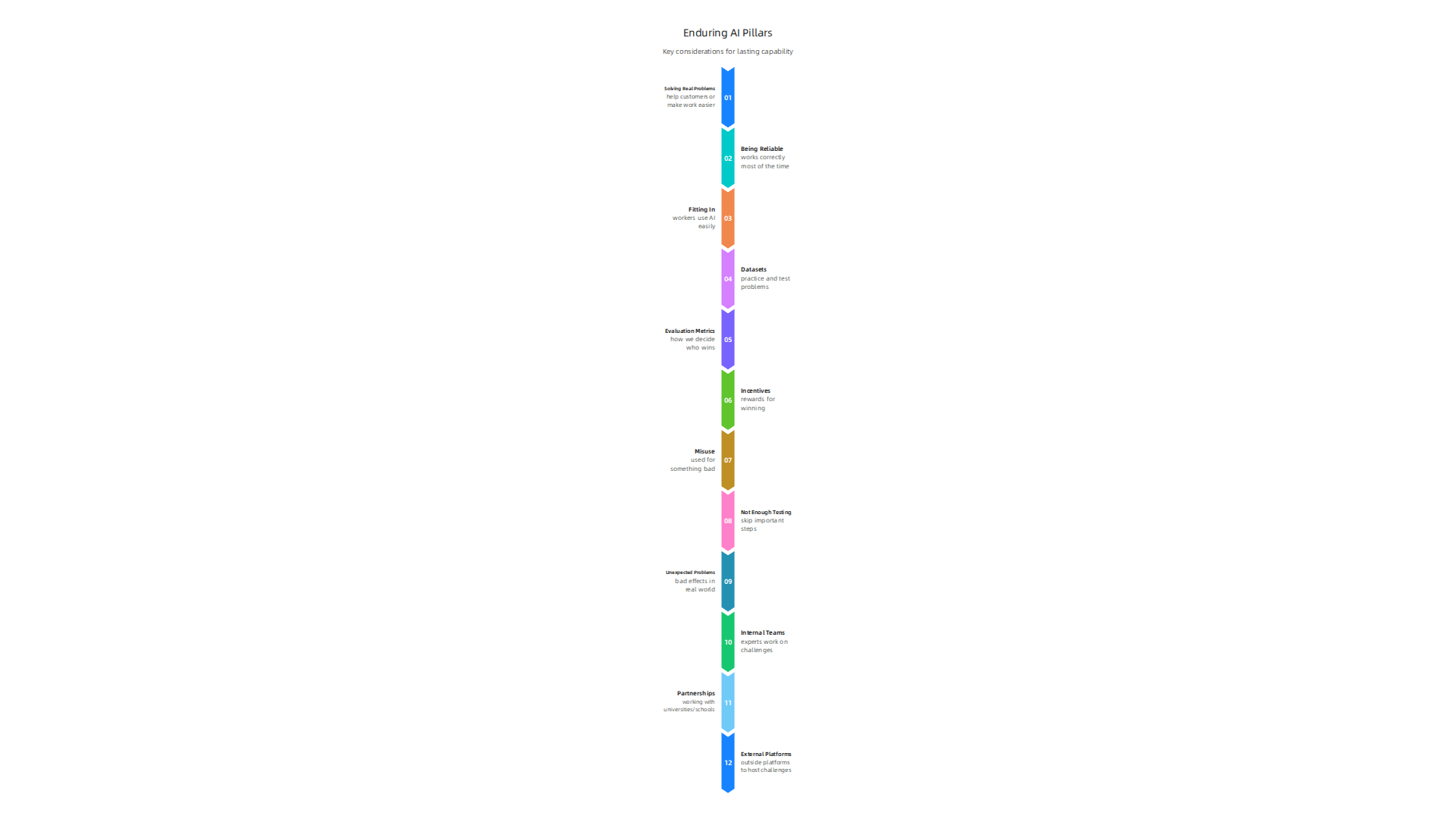
- Solving real problems: Does the AI truly help your customers or make your work easier?
- Being reliable: Does the AI work correctly most of the time, not just in perfect test conditions?
- Fitting in: Can your workers use the AI easily without needing a lot of special training?
These are the things that build lasting AI capability. It’s about getting good artificial intelligence guidance and learning how to use AI to drive business growth with practical applications in 2026. Companies should aim to maximize business impact with enterprise AI platforms, making sure their AI choices serve their long-term goals.
The previous section talked about how companies sometimes focus too much on winning short AI games instead of building strong AI tools for the long run. To understand this better, let’s look at how these AI competitions, or "artificial intelligence olympics," are put together. The way these games are designed really changes how AI models are built and what they become good at.
Tournament dynamics: Designing incentives, rules, and valid benchmarks
Every AI competition has special rules and parts that make it work. Think of it like a sports game. You need a field to play on, ways to score, and clear rules. In AI contests, these parts include:
- Datasets: These are like the practice and test problems for the AI. They are special collections of information that the AI learns from and is then tested on. For example, some datasets might have many pictures for an AI to identify, or lots of words for it to understand.
- Evaluation Metrics: This is how we decide who wins. It is a way to measure how well an AI performs a task. It could be how accurate the AI is, how fast it works, or how few mistakes it makes. For example, the AGIBOT WORLD CHALLENGE 2026 uses automated testing and standard ways to measure AI systems.
- Openness: This means how much information about the competition is shared. Sometimes, everything is open for everyone to see. Other times, parts are kept secret to make the challenge harder and fairer.
- Incentives: These are the rewards for winning. They can be prizes, money, fame for the researchers, or even helping a company get a big ai advantage. Competitions like those announced by NeurIPS 2026 set clear goals and awards.
The way these contests are designed can have big effects. Sometimes, AI teams focus so much on winning a specific benchmark test that their AI becomes too good at that one test. This is called "overfitting." It means the AI might score very high in the competition but then not work well in real life, because real-world problems are often a bit different from the test questions. It is like an athlete who only trains for one specific move and can’t perform well in a full game.
Another problem is "dataset leakage." This happens when secret information from the test data accidentally gets mixed into the training data. This makes the AI look smarter than it truly is because it has already seen parts of the answers. Experts say it is best to assume an evaluation is "leaked" if it has been shared online, just to be safe, according to a paper on AI Competitions Provide the Gold Standard for Empirical Rigor in …. This kind of leakage makes the competition unfair and doesn’t show true AI ability.
For an AI competition to be truly helpful and lead to useful AI, it needs good design. This means making sure the tests are fair and can be repeated by others. This is called reproducibility. Many big events, like IJCAI 2026, now put a lot of focus on whether results can be reproduced easily. This helps make sure that when an AI wins, it’s a real win that can actually help us apply ai in useful ways. Building good benchmarks means they should not only measure how well an AI does on known tasks, but also how well it can handle new, unseen problems. We also need to be careful with the data we use. For example, new rules from NeurIPS in May 2026 require details about responsible AI for dataset submissions. This shows how important it is to think about the bigger picture, not just the win.
To truly excel and understand the latest developments beyond the competition headlines, you need to stay informed. Get daily, clear updates on AI and tech with The AI Newsletter Worth Reading.
When we think about making AI better and better, like in the big artificial intelligence olympics, it is easy to focus only on who wins. But there’s a really important side that can’t be forgotten: making sure these AIs are safe, fair, and used in good ways. This is all about governance, safety, and ethics.

When Competition Meets Safety
Sometimes, the drive to win in AI contests can cause problems. Teams might rush to make their AI score high without thinking enough about how safe it is. Here are some of the risks:
- Misuse: An AI made to be very powerful for a game might later be used for something bad in the real world. For example, an AI good at finding patterns could be used to invade privacy if not controlled.
- Not Enough Testing: To win quickly, teams might skip important steps like testing their AI in many different real-world situations. This means the AI might not work well or even cause harm when faced with new, unexpected challenges outside the competition. Making sure an AI is robust, or strong against problems, is super important.
- Unexpected Problems: Even if an AI works great in a competition, it might have bad effects in the real world that no one thought about. These are called "externalities." For example, a super-efficient AI might take away jobs or create new types of bias if not guided carefully.
To stop these problems, we need clear rules and ways to check what AI systems do. This is where policies and peer review come in.
Rules and Check-Ups for AI
Many groups are now working to put these checks in place. For example, countries around the world are creating rules for AI. In 2026, many places have new guides and laws about how AI should be used. These guidelines often talk about making AI fair, safe, private, and open, as noted in a 2026 guide to AI regulations.
Peer review is another important tool. This is when other experts look at an AI project or competition to make sure it’s done right and follows good practices. It’s like having other teachers check your homework to ensure it’s fair and correct. These checks help to make sure that AI developments have good artificial intelligence guidance and are built to help, not harm.
Organizations like the World Health Organization (WHO) even publish ethics and governance recommendations for artificial intelligence for health, showing how important it is to have clear guidelines in special areas. These efforts help ensure that even when AI teams are competing fiercely, they are also building tools that are good for everyone. There is a strong push to move beyond just having frameworks to actually having enforceable rights and good oversight, according to a 2026 report on Responsible AI. This way, the excitement of the artificial intelligence olympics can still lead to amazing new tech, but with safety built in from the start.
Beyond ensuring AI systems are safe and fair, a big part of winning with AI means getting your own house in order. Companies need to be ready inside to truly use what comes out of events like the artificial intelligence olympics. This means having the right people, building smart teams, and managing all the changes that come with new AI tools.

Organizational readiness: Talent, teams, and change management for competitive AI programs
To turn exciting AI competition wins into real value for a business, an organization needs strong internal capabilities. It is not enough to just watch the artificial intelligence olympics or see what other companies do. You must build your own way to run AI programs, support them, and make sure their results help the company grow. This process is about moving AI ideas from a small test to something that works for everyone, which is known as going from "pilot to production." Even though many companies are trying out AI, only about 25% have moved a good number of their AI tests into full use, according to a 2026 report from Deloitte. Building a strong foundation is key before you try to make things more complex.
One important part is finding and growing the right talent. Companies get these skilled people in a few ways:
- Internal Competition Teams: Many businesses create their own teams of experts who work on AI challenges from within the company. These teams learn to apply AI to real business problems, helping the company gain an ai advantage.
- Partnerships with Academia: Working with universities and schools is another smart move. This lets companies tap into fresh ideas and bright young minds, often through research projects or special programs. This helps provide valuable artificial intelligence guidance.
- External Challenge Platforms: Sometimes, companies use outside platforms to host challenges. This allows them to find new talent or get solutions from a wider pool of experts without needing to hire everyone full-time.
As AI becomes more common, the way we find and keep talent is changing a lot. In 2026, there is a big focus on creating a human-AI partnership in hiring. This means AI helps with tasks like sorting resumes and scheduling interviews, freeing up people to focus on important parts like understanding candidates and making big decisions. This mix of human and AI skills is vital for mastering AI and human capabilities for 2026 business advantage.
Successfully using AI also means managing change well. When new AI tools are brought in, people’s jobs might shift, and new ways of working will be needed. Making sure everyone understands why these changes are happening and how they will benefit is a big part of making sure AI projects actually deliver value. Building this strong internal setup is how companies move from just experimenting with AI to truly making it a core part of their success. It helps them build the necessary foundation to scale production AI effectively.
Staying on top of these trends is crucial for any business leader.
The AI Newsletter Worth Reading
After setting up strong teams and managing changes well, companies also need to think carefully about the technology they use. This means choosing the right tools and ways to build AI systems so they can actually work in the real world, not just in a lab. It’s like the difference between winning a medal at the artificial intelligence olympics and actually using those winning skills to help your business every day.
Technology choices: Architectures, reproducibility, and tooling for competitive advantage
To truly get an AI advantage, companies must pick technology wisely. The tools and how you build your AI (its "architecture") make a big difference. You want systems that can easily move from being a test project to something everyone in the company can use.
One important idea here is "reproducibility." This means that if someone builds an AI system, another person should be able to get the exact same results by following the same steps and using the same code and data. This is very important, especially when looking at the findings from AI competitions or research papers. For example, some AI challenges require teams to share their code and instructions so others can check their work, showing how vital reproducibility is in events like the NeurIPS 2026 RealPDE Competition where winning teams must provide complete, open-source solutions to be eligible for prizes NeurIPS 2026 RealPDE Competition – Track 2: LTTTA. Being able to reproduce results ensures that AI systems are fair, trustworthy, and can be improved over time. It also helps reduce the gap between quick prototypes made for leaderboards and strong systems ready for everyday use. Many experts agree that clear reproducibility requirements are needed for AI, especially for complex systems like large language models Test-Time Scaling in Reasoning LLMs: Inference Regimes, Evaluation, and Reproducibility.
When choosing technology, companies face a big decision: should they use open-source tools or proprietary platforms?
- Open-Source Stacks: These are tools and software that anyone can use and change for free. They offer a lot of flexibility and often have big communities of people who help improve them. Using open-source can make it easier to share and reproduce results because the code is out in the open. However, managing these tools can be complex, and you might need skilled people to keep everything working smoothly.
- Proprietary Platforms: These are AI systems and tools built and owned by one company. You usually pay to use them. They often come with good support and are designed to be easy to use. These platforms can offer strong performance and help meet rules about data privacy and security. The trade-off is that they might be less flexible, and you depend on one company for updates and changes.
The choice depends on what a company needs. Some might mix both, using open-source for early tests and then moving to a proprietary platform for large-scale operations. No matter what, companies need to keep checking how their AI tools perform, how reliable they are, and if they follow all the rules. This careful planning helps businesses truly apply AI to their challenges and achieve their goals. It’s about finding the right balance to turn exciting AI breakthroughs into real-world success, providing clear artificial intelligence guidance for future projects. To understand how AI works in simpler terms, you might want to read more about Artificial Intelligence Explained: A Clear Guide for Thinking Humans.
Measuring success: KPIs, guardrails, and meaningful evaluation beyond leaderboards
To really see the benefits of AI in the real world, it is not enough to just pick the right technology. Companies also need to know how to measure if their AI is truly helping them. It is like the difference between winning a medal at an artificial intelligence olympics and using those skills to make a real difference every day.
What does real success look like? It means going beyond simple scores on a test or competition leaderboard. Instead, businesses need to set up smart ways to measure how well their AI systems are working for them. These are called Key Performance Indicators, or KPIs. These KPIs should link what the AI does directly to what the company cares about most, such as making more money, lowering risks, or making daily tasks run smoother. For example, a 2026 report shows how companies are focusing on metrics like revenue, faster decisions, and risk reduction to measure their AI success in the real world Global AI Pulse Q1 2026. This helps businesses truly apply AI to their challenges and gain an AI advantage.
It is also important to set up "guardrails" and keep a close eye on AI systems once they are up and running. Think of guardrails as safety rules that make sure the AI stays on track. Monitoring means watching the AI all the time to catch any problems early. For example, you need to check if the AI’s performance changes over time, also called "drift." You also want to make sure the AI is strong and works well even with new or unexpected information (robustness), and that it treats everyone fairly (fairness). Keeping an eye on things like speed, how much work the AI can do, and if it is always available helps ensure it delivers real business value Pillars of monitoring generative AI application performance. This ongoing check-up is key for good artificial intelligence guidance. According to a 2026 study, measuring AI’s business impact needs to cover how much people use the tool, how well they use it, the actual business outcomes, and if its use is safe and lasting Measuring AI Adoption: Metrics for Business Impact in 2026.
By focusing on these clear business metrics and safety checks, companies can turn the promise of AI into actual results. It helps them move past just winning the artificial intelligence olympics to truly changing how they do business and getting a real competitive edge. To learn more about how to make AI work for your company, check out our guide on how to use AI to drive business growth with practical applications in 2026.
Want to stay on top of the latest AI trends and insights?
The AI Newsletter Worth Reading from The Deep View Newsletter offers clear daily updates.
Future scenarios and strategic playbooks: How leaders convert competition signals into advantage
When we see amazing things happen in events like an artificial intelligence olympics, it tells us a lot about what AI can do next. Leaders need to pay close attention to these signals. They show what new skills AI systems are gaining and how these might change markets forever. To get ahead, companies must think about what the future might look like. This is called scenario planning.
Scenario planning means imagining different possible futures instead of just guessing one. For example, what if AI gets so good it changes how whole industries work? Or what if a new kind of AI creates a completely new type of business? By thinking about these "what if" questions, companies can get ready for anything. It helps them build plans that work even when things are uncertain. This way, they can turn ideas from the latest AI breakthroughs into a real AI advantage. Tools like AI can even help companies create these future models and test different ideas. For instance, in 2026, many companies use AI to build special simulation models that predict what happens if a new product launches or if a competitor changes prices, helping them with AI-Assisted Strategic Planning & Scenario Modeling.
Once leaders have thought about different futures, they need a plan of action, or a "playbook." This playbook helps them apply AI in smart ways while also managing any risks.
Here are some key parts of an operational playbook:
- Procurement: This means how companies get their AI tools and services. It is important to pick the right AI for the job. In 2026, many businesses are looking at how to get AI tools that truly help them. Experts suggest starting with small, valuable tasks that AI can easily improve, like in buying processes, and then growing from there How AI agents are transforming procurement.
- Partnerships: Sometimes, it is better to work with other companies that are good at AI. This can help businesses get new AI skills or technologies faster than if they tried to build everything themselves.
- Funding: Companies need to set aside money for AI projects. This includes paying for the AI tools, the people who manage them, and any training needed.
- Governance: This is about setting up rules and ways to oversee AI systems. It is like having traffic laws for AI to make sure it is used safely and fairly. Good artificial intelligence guidance includes rules about ethics, safety, and making sure the AI is fair to everyone. Many countries are working on new rules for AI governance in 2026, focusing on human values and safety AI Regulations Around the World: A 2026 Guide.
By thinking ahead with scenario planning and having clear playbooks, leaders can take what they learn from the "artificial intelligence olympics" and use it to truly apply AI in their businesses. This helps them not just keep up, but actually lead the way.
Want to stay on top of the latest AI trends and insights? The AI Newsletter Worth Reading from The Deep View Newsletter offers clear daily updates.
Summary
This article uses the