

Why STRIPS and foundational AI concepts still matter in 2026
In 2026, it feels like new AI terms and tools pop up every single day. For anyone trying to learn about AI or make smart choices with it, this can be a lot to handle.

There’s an "avalanche" of information, making it tough to figure out what’s truly important and what’s just noise.

How do you decide what to focus on when you want to truly study ai and not just hear the "unfiltered ai" buzz?
It’s actually very important to look back at the basic ideas that built artificial intelligence in the first place. These foundational concepts are like the ABCs of AI. If you understand them, the newer, fancier stuff makes a lot more sense. This is why books like "artificial intelligence a modern approach stuart russell peter norvig" are still so helpful today, teaching the core ideas.
One of these key foundational ideas is called STRIPS in artificial intelligence. STRIPS stands for Stanford Research Institute Problem Solver. It was first developed way back in 1971 by Richard Fikes and Nils Nilsson at SRI International to help robots plan their actions Stanford Research Institute Problem Solver. Think of it as a simple but powerful way for AI to figure out a step-by-step plan to reach a goal.
Even though STRIPS is an older idea, it’s still super important for how AI systems work today, especially when they need to plan things out or learn sequences of actions. It’s the simplest and most common way to describe how AI can solve planning tasks What Is STRIPS in AI? | Definition, Planning, and K-STRIPS. Understanding STRIPS helps us see how AI thinks about problems: it looks at what’s true now, what needs to be true for an action to happen, and what changes after the action. This core logic is still part of many complex AI systems we use in 2026.
This guide will help you cut through the noise. We will make it clear what STRIPS is, why its concepts are still vital for understanding modern AI planning and learning, and how you can look at and use these ideas in practical ways. By getting a good grip on these basics, you’ll be better prepared to understand and use all the new AI trends coming your way.
Staying updated with the fast-changing world of AI can be a challenge. For clear, daily insights into AI and technology, consider getting The AI Newsletter Worth Reading. You’ll find it a valuable resource. If you want to dive deeper into how AI works in everyday life, our guide on Artificial Intelligence Basics: Our Clear Guide to How AI Works in Everyday Life can help.
Core definitions: STRIPS, symbolic planning, and related terms
To truly understand how AI works, especially for planning, we need to get clear on some basic terms. These terms are like building blocks that help us make sense of even the most complex AI systems in 2026.
What is STRIPS in Artificial Intelligence?
As we talked about, STRIPS stands for Stanford Research Institute Problem Solver. It’s a foundational way for AI to think about how to reach a goal. Think of it as a clear language that helps AI describe problems and actions. It’s one of the most common and simple ways to set up planning tasks for AI STRIPS in AI.
A STRIPS planning task has four main parts:
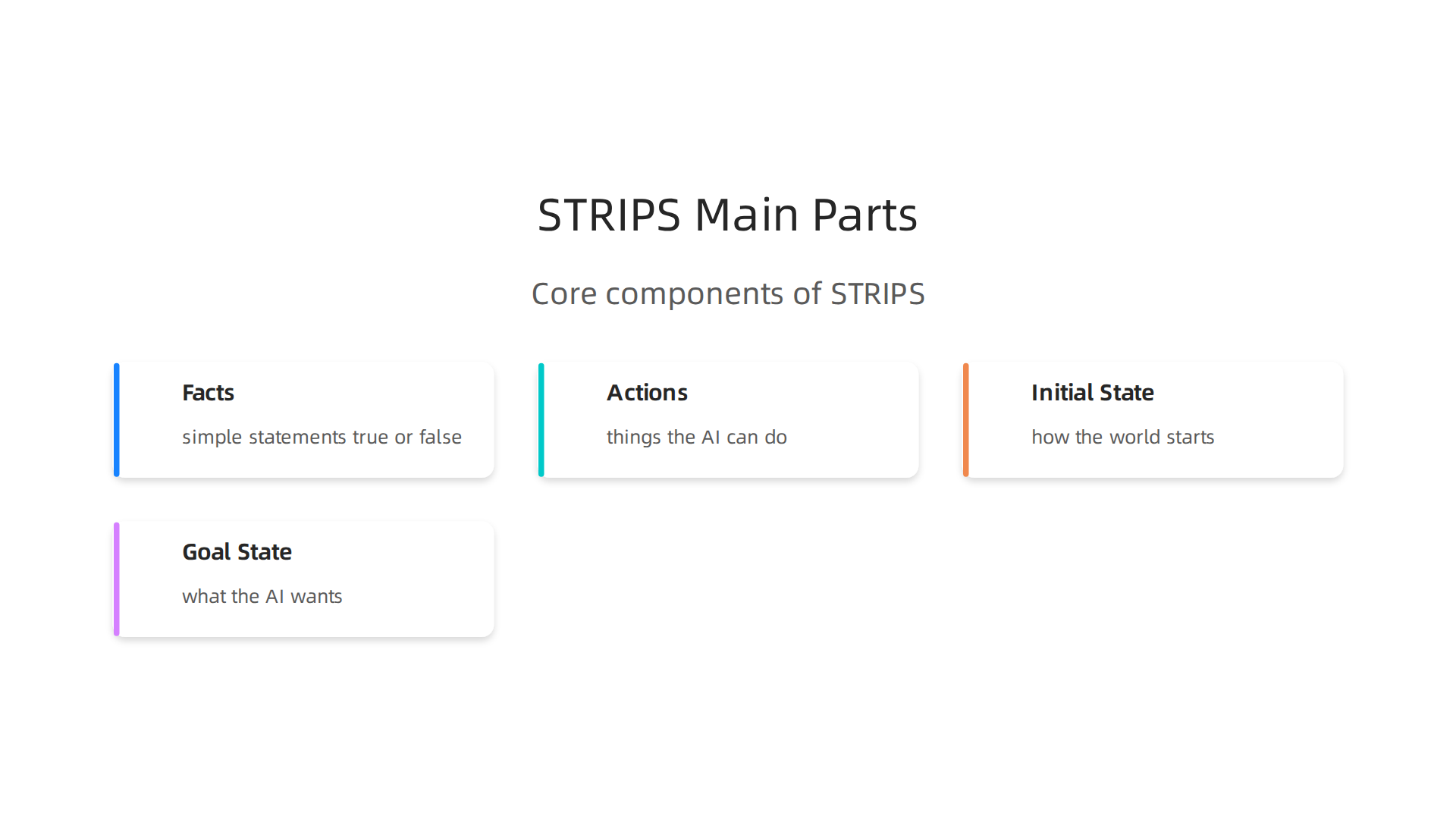
- Facts (Propositions): These are simple statements that are either true or false, like "the door is open" or "the robot is holding the cup." They describe the world.
- Actions (Operators): These are things the AI can do, like "open door" or "pick up cup." Each action has rules about when it can be done and what happens after.
- Initial State (I): This is how the world starts. It’s a list of all the facts that are true at the very beginning.
- Goal State (G): This is what the AI wants to achieve. It’s a list of facts that need to be true for the task to be considered finished.
A STRIPS task is often called a "4-tuple" because of these four parts AI Chapter 13: Planning, Part I.
Symbolic Planning (State-Space Planning)
STRIPS is a key part of what we call symbolic planning or state-space planning. In this kind of planning, the AI creates a step-by-step plan by moving through different "states" of the world. A state is just a snapshot of all the facts that are true at a certain moment. The AI starts from the initial state and uses actions to change the state until it reaches the goal state. This is a very logical way for AI to solve problems.
Actions, Preconditions, and Effects
Every action in STRIPS has three crucial parts that define how it works:
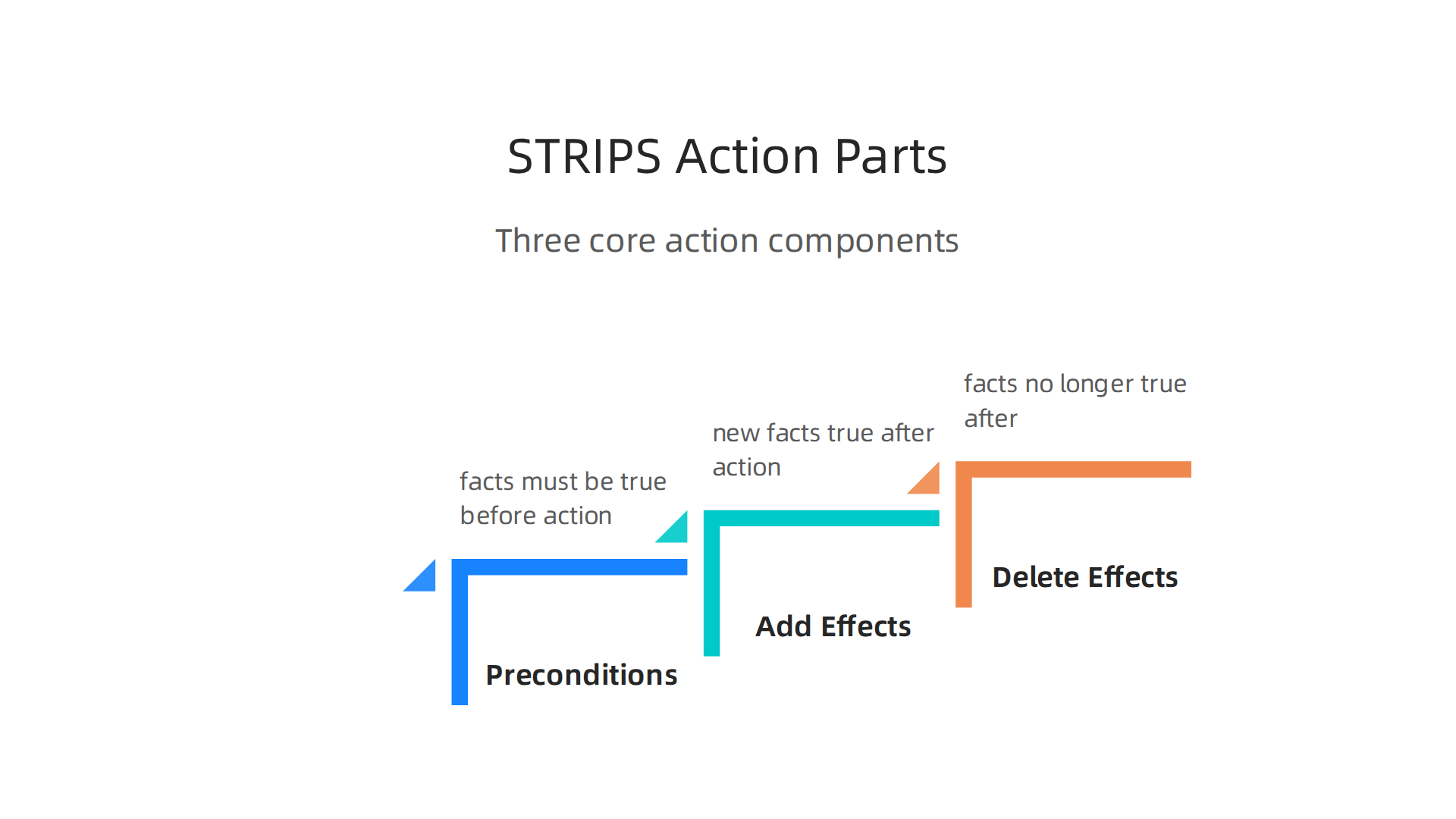
- Preconditions: These are the facts that must be true before an action can be taken. For example, to "pick up cup," a precondition might be "robot is next to cup." If the preconditions are not met, the action cannot happen.
- Add Effects: These are the new facts that become true after an action is performed. If the robot "picks up cup," then "robot is holding cup" becomes true.
- Delete Effects: These are the facts that are no longer true after an action is performed. When the robot "picks up cup," "cup is on table" might become false.
These simple rules for actions are what make STRIPS so powerful for AI to create plans Classical STRIPS Planning.
STRIPS vs. Other AI Planning
While STRIPS is a simple and widely used way for planning, it’s not the only one. Other planning methods might allow for more complex descriptions of the world, like facts that have different values (not just true or false), or actions that happen at the same time.
It’s also different from modern machine learning (ML) approaches. ML often learns by looking at huge amounts of data and finding patterns, like how ChatGPT generates text. STRIPS, on the other hand, uses clear, logical rules that are given to the AI. While modern AI often blends these ideas, understanding STRIPS helps us see the logical roots of how AI systems can plan and solve problems in a structured way, without the "unfiltered ai" noise of new terms. For more on the different types of AI, you can read our guide on types of artificial intelligence narrow ai general ai and superintelligence explained.
Now that we know what STRIPS is made of, let’s see how these parts work together to help an AI solve problems. This is about understanding the simple yet powerful way STRIPS in artificial intelligence creates a step-by-step plan.

How STRIPS works: a conceptual walkthrough
Imagine a robot trying to complete a task. STRIPS gives this robot a way to think and plan its moves. It starts by looking at the world, figuring out what can be done, and then finding the best path to its goal.
State Representations
First, the AI needs to know what the world looks like at any given moment. This is called the state. A state is just a list of all the facts that are true right then. For example, if our robot is in a room, the state might include facts like "robot is at door A," "light is off," and "box is on floor." Each of these facts helps the AI understand its current situation. The process of planning involves moving from one state to another until the goal is achieved Chapter 2: Planning Formalisms.
Operators (Actions)
Next, the AI uses operators, which are its actions. These operators are like instructions that tell the AI how it can change the world. Remember, each operator has:
- Preconditions: What needs to be true to do the action.
- Add Effects: What becomes true after the action.
- Delete Effects: What stops being true after the action.
When the preconditions are met, the AI can apply an operator. This changes the current state into a new state. It’s like pressing a button that causes certain things to happen and other things to un-happen.
Plan Generation and Search
The big job for STRIPS is plan generation. This means finding a whole sequence of operators that starts from the initial state and finally reaches the goal state. To do this, the AI uses a process called search.
Think of it like trying to find your way through a maze. You start at the beginning (initial state) and know where you want to go (goal state). You try different paths (applying operators) and see where they lead. If a path looks promising, you keep going. If it hits a dead end, you try another way. The AI explores these different possibilities, one step at a time, until it finds a path, or "plan," that gets it from start to finish. This is a key part of how AI systems can plan and solve problems in a structured way, helping us to study AI in detail.
An Abstract Walkthrough Example
Let’s use a very simple example to show how STRIPS planning works.
Initial State:
- Robot is at Door A
- Door A is closed
- Key is on Hook
Goal State:
- Robot is outside
Available Operators:
-
Action:
Grab Key- Precondition: Robot is at Hook
- Add Effect: Robot has Key
- Delete Effect: Key is on Hook
-
Action:
Open Door A- Precondition: Robot is at Door A, Robot has Key
- Add Effect: Door A is open
- Delete Effect: (None)
-
Action:
Move Robot to Hook- Precondition: Robot is at Door A
- Add Effect: Robot is at Hook
- Delete Effect: Robot is at Door A
-
Action:
Move Robot to Door A- Precondition: Robot is at Hook
- Add Effect: Robot is at Door A
- Delete Effect: Robot is at Hook
-
Action:
Exit- Precondition: Robot is at Door A, Door A is open
- Add Effect: Robot is outside
- Delete Effect: Robot is at Door A
How the AI Plans (simplified steps):
- Start: The AI sees the Initial State. The goal is
Robot is outside. - Step 1: Get the Key. The AI realizes it needs the key to open the door, and to get the key, it needs to be at the hook.
- It applies
Move Robot to Hook. - New State: Robot is at Hook, Door A is closed, Robot has Key. (No, wait, it just moved, it doesn’t have the key yet).
- New State (Corrected): Robot is at Hook, Door A is closed, Key is on Hook.
- It applies
- Step 2: Grab the Key.
- It applies
Grab Key. - New State: Robot is at Hook, Door A is closed, Robot has Key.
- It applies
- Step 3: Go back to Door A.
- It applies
Move Robot to Door A. - New State: Robot is at Door A, Door A is closed, Robot has Key.
- It applies
- Step 4: Open the Door.
- It applies
Open Door A. - New State: Robot is at Door A, Door A is open, Robot has Key.
- It applies
- Step 5: Exit.
- It applies
Exit. - New State: Robot is outside, Door A is open, Robot has Key.
- It applies
The AI has now reached the Robot is outside goal. The plan is: Move Robot to Hook → Grab Key → Move Robot to Door A → Open Door A → Exit. This example shows the core idea of how STRIPS in artificial intelligence uses clear steps to solve a problem. If you want to dive deeper into these foundational concepts, a great resource is to understand why Artificial Intelligence A Modern Approach remains essential in 2026.
We just saw how STRIPS helps an AI make a clear plan, step by step, using rules that are already set. But what happens when an AI needs to learn those rules itself, or when the world is too messy for simple rules? This is where other ways of teaching AI come in, and they often work together with STRIPS.
Foundational learning concepts that intersect with STRIPS
STRIPS is a kind of "symbolic planning." This means it uses symbols and rules that we, or another AI, have given it. It’s like giving a child a recipe with exact steps. But not all AI learns that way. Sometimes, AI learns by looking at many examples or by trying things out and seeing what works best. This is where learning methods like supervised learning and reinforcement learning come in.
Symbolic Planning and Learning: How They Connect
Think of it this way: STRIPS gives an AI a map and clear directions. But what if the map is old, or the directions are not perfect? This is where learning can help the AI make its own, better map or adjust the directions.
- Supervised Learning: This is like learning from a teacher. The AI sees many examples of correct actions and their results. For example, it might watch humans perform tasks and learn the best
PreconditionsandAdd/Delete Effectsfor differentOperators. This can help build or improve the knowledge base that STRIPS uses. Researchers are always looking for new ways to learn action models this way Chapter 1. - Reinforcement Learning: This is like learning by doing. The AI tries out actions in an environment and gets "rewards" or "penalties" based on how well it did. If it reaches its goal, it gets a reward. If it fails, a penalty. Over time, it learns which actions lead to the best outcomes. This kind of learning can help an AI figure out the best sequence of STRIPS actions to reach a goal, especially in situations where the rules aren’t completely known or are hard to write down. This approach is key to understanding how AI works in many fields, including complex planning tasks.
- Hybrid Approaches: Often, the best way is to mix and match. An AI might use STRIPS for the main, big steps of a plan, because STRIPS is good at clear logic. Then, for smaller, harder parts of the task, it might use learned policies. For example, STRIPS could plan to "get the key" and "open the door," but a learned policy could figure out the best way to move the robot’s arm to
Grab Keywithout dropping it. This combines the clear reasoning of symbolic planning with the adaptability of learning. Such combinations are part of the broader study of AI and its foundational aspects foundations, advances, and future trajectories.
When to Use Which Approach
Choosing between pure symbolic planning like STRIPS and learning depends on the problem:
- Use STRIPS (Symbolic Planning) when:
- The rules of the world are clear and don’t change much.
- Safety is very important, and you need to understand every step the AI takes.
- You need to guarantee the AI will reach its goal if a solution exists.
- You want a clear, explainable plan.
- Use Learning (Supervised or Reinforcement) when:
- The rules are fuzzy, complex, or unknown.
- The environment changes a lot, and the AI needs to adapt.
- You have lots of data (for supervised learning) or can let the AI try things many times (for reinforcement learning).
- The problem is too complicated to write out all the rules by hand.
In 2026, many advanced AI systems use a blend of these methods. They might use STRIPS to set the overall strategy and then use learning to fine-tune actions or discover new rules. This "unfiltered AI" approach helps them tackle very complex challenges. If you want to dive deeper into these foundational concepts, you might be interested in resources that provide a comprehensive roadmap for those who want to study AI.
Stay informed about the latest breakthroughs and practical applications in AI. Get clear daily AI updates from The Deep View Newsletter.
The previous section explained how AI can learn new rules or improve old ones through methods like supervised and reinforcement learning, often working hand-in-hand with STRIPS. Now, let’s look at the actual tools and libraries that help put these ideas into practice, especially for strips in artificial intelligence and planning tasks.
To make an AI plan using STRIPS, you need specific tools. These tools help you write down the problem, figure out the steps, and then see if the plan works.
Key Tools for Planning and STRIPS
When working with strips in artificial intelligence, you’ll find different software tools that help create, run, and test plans. Many of these tools use a special language called PDDL (Planning Domain Definition Language). It’s like a common language for planning problems, letting different planners understand the same task.
- PDDL Parsers and Editors: Before an AI can solve a planning problem, it needs to understand the problem’s details. PDDL is how you describe the starting situation, the goal, and all the possible actions (
Operators) with theirPreconditionsandAdd/Delete Effects. Tools that parse PDDL help make sure your problem is written correctly. You can even find collections of PDDL examples to learn from, such as theSTRIPS benchmarks for classical planningon GitHub, which offers many problems for testing. Other collections also providePDDL benchmarks from the International Planning Competitions 1998-2023for studying how AI planning has grown over time. - Classical Planners: These are the brains that take a PDDL problem and find a solution. They use algorithms like STRIPS to search for a path from the start to the goal. There are many planners available, often as libraries you can use in your own code. For example, some tools like
Pyperplanare planners written in Python that handle STRIPS-style problems. You can also find projects that show how to useAI Automated Planning with STRIPS and PDDL in Node.js. - Simulation Environments: Once an AI creates a plan, you need to test it. Simulation tools let you run the plan in a pretend world to see if it actually works as expected without causing real-world problems. This is especially important for complex systems.
- Debugging Tools: Sometimes, a plan doesn’t work, or the AI can’t find a plan at all. Debugging tools help you look closely at the AI’s thinking process. They show you why certain actions weren’t chosen or why the goal wasn’t reached, helping you fix mistakes in your problem setup or the AI’s logic.
- Integration with Machine Learning: As we discussed, STRIPS often works with learning methods. Many modern frameworks allow you to connect classical planners with machine learning tools. This means AI can learn parts of a problem (like how an object might behave) and then use a STRIPS-style planner to combine those learned pieces into a full plan. This combination is key to
unfiltered AI, where systems can handle very complicated tasks. To learn more about how different AI technologies come together, you might want to explore resources onreal-time AI in 2026 delivers millisecond decisions across industries.
In 2026, many open-source projects offer libraries for classical planning. These libraries let you add strips in artificial intelligence capabilities to your own programs, whether you are building a simple puzzle solver or a complex robot controller. If you are starting your journey to study AI and its tools, exploring these hands-on resources can be incredibly helpful.
After exploring the tools and ways strips in artificial intelligence helps build plans, it’s time to see where these clever methods are put to work in the real world. Symbolic planning, like STRIPS, shines in many areas because it creates plans that are easy to understand and predict. You can see each step and why it was chosen, which makes it simple to fix problems or explain how the AI made its decision. This clear way of planning is very useful for important tasks where mistakes can be costly.
Let’s look at some key places where STRIPS and symbolic planning are used in 2026.
Real-world applications: where STRIPS and symbolic planning shine
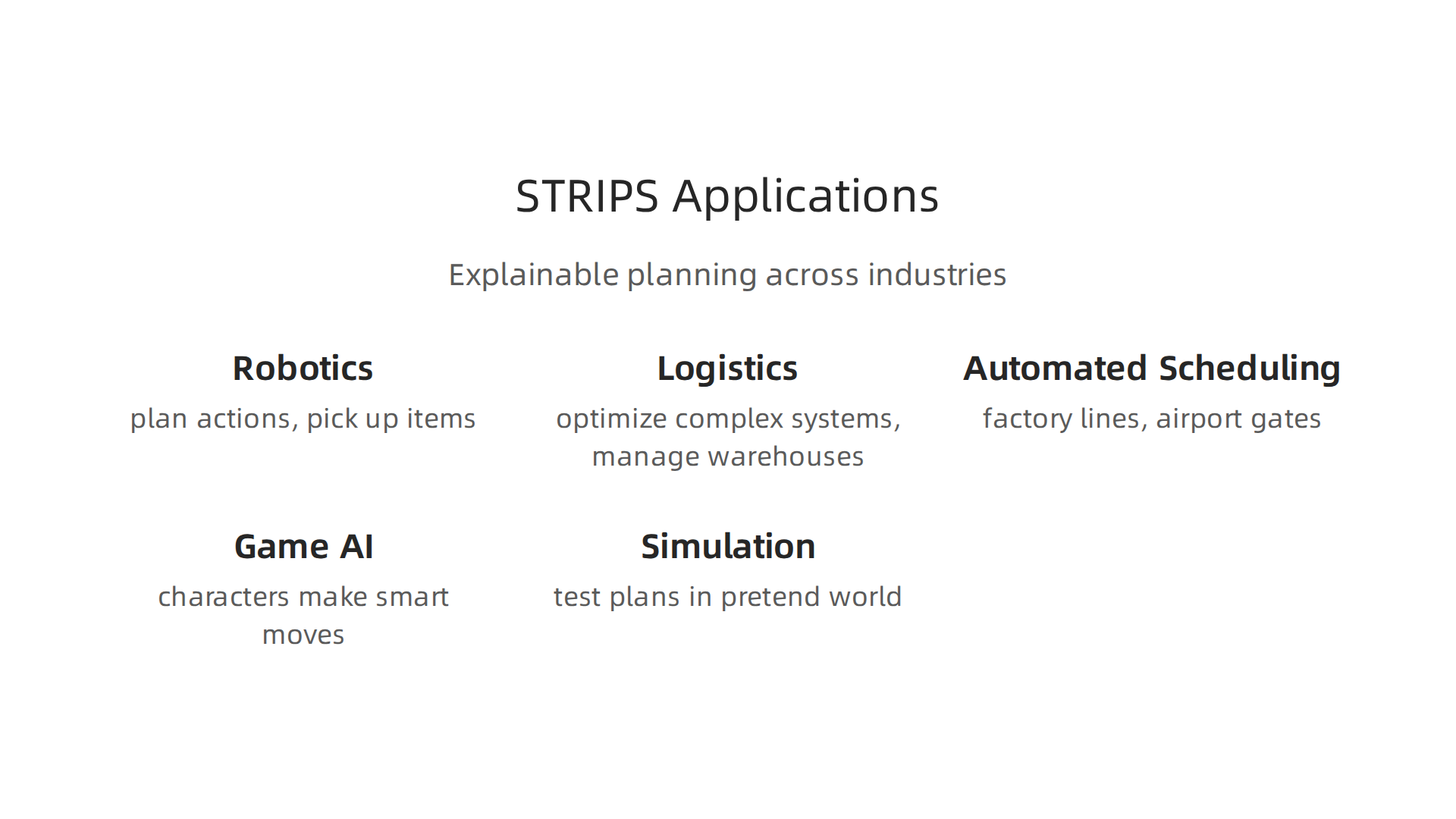
- Robotics: Robots need clear instructions to move and complete tasks.
strips in artificial intelligencehelps robots plan their actions, like picking up items or navigating a room. A famous early example was Shakey the robot, which used STRIPS to figure out how to move blocks and solve simple problems. This idea still helps modern robots plan their movements step by step. You can learn more about this by exploring resources on STRIPS for Automated Reasoning: A Deep Dive. - Logistics: Imagine managing thousands of packages or planning delivery routes. STRIPS can help optimize these complex systems by finding the best sequence of actions to move goods, load trucks, and manage warehouses. This makes shipping faster and more efficient.
- Automated Scheduling: From factory production lines to airport gate assignments, many real-world problems need careful scheduling. STRIPS can create schedules that follow all the rules and make the most out of available resources. It ensures that tasks happen in the correct order without conflicts.
- Game AI: In video games, AI characters use planning to make smart moves. Whether it’s an enemy finding the best way to attack or a character completing a quest, STRIPS-like planning helps them decide on actions that lead to a specific goal, making the game more challenging and fun.
- Simulation: Before putting a complex plan into action in the real world, it’s often tested in a simulation. STRIPS-based planners can generate plans that are then run in these virtual environments. This lets developers check if the plan works as expected and find any issues without any real-world risk.
The ability of STRIPS to create understandable and predictable plans means it continues to be a vital part of strips in artificial intelligence and planning systems. If you’re interested in how foundational AI concepts like these shape today’s technology, you might find it helpful to read why Artificial Intelligence: A Modern Approach remains essential in 2026.
To keep up with the newest developments and deeper insights into AI and technology, consider subscribing to The AI Newsletter Worth Reading.
While STRIPS and symbolic planning offer clear benefits, putting them into action in the real world comes with its own set of challenges. It’s like having a great blueprint, but finding out the building site isn’t perfectly flat or the materials aren’t always exactly as ordered.
Deployment, limitations, and ethical considerations
One big challenge for strips in artificial intelligence is how well it can scale up. STRIPS works really well for problems that are not too big, where you don’t have too many steps or choices. But when the world gets very complex, with countless actions and states, finding a plan can become very hard, sometimes impossible, for STRIPS planners to handle quickly. They might need a lot of computing power and time, which is not practical for fast-moving real-world tasks that require real-time AI. This limitation means that even though the core idea is simple, applying it to very large problems is tough, a point often discussed when you study AI.
Another key problem is dealing with information that isn’t perfect. STRIPS works best when everything is clear and known. It assumes things will happen exactly as planned, and it doesn’t have a way to handle things like guesswork, changing situations, or noisy data built right in. For example, it doesn’t naturally deal with uncertainty or continuous time, which are common in real life scenarios, as outlined in guides like What Is STRIPS in AI? and STRIPS in AI Planning: A Comprehensive Guide for 2025. This can make it hard to use STRIPS in places where the world is always a bit blurry.
Then there are important ethical questions. Because symbolic planning is very logical and step-by-step, people tend to trust its outputs a lot. But if the rules or starting facts given to the AI are wrong, the plan will also be wrong, and it can be hard to spot the mistake. This issue is called "brittleness" because the system might break down unexpectedly if the situation changes even a little. Making sure these systems are transparent, meaning we can understand why they made certain choices, is super important. However, there are also concerns about these systems making people trust automation too much or even being used to mislead, raising questions about Safety, Security, and Cognitive Risks in Neuro-Symbolic AI. The balance between symbolic AI, which is clear but sometimes inflexible, and newer "learned" systems, which can be more flexible but less clear, is a big topic in 2026. This requires careful thinking about ethical AI practices, ensuring we don’t just use unfiltered AI without understanding its full impact.
Future trends: hybrid models, neuro-symbolic planning, and research directions for 2026 and beyond
Because strips in artificial intelligence faces challenges with complex, uncertain, and real-time problems, experts are now looking for smarter ways to combine its logical power with the flexible learning abilities of newer AI systems. This mix is often called hybrid models or neuro-symbolic planning. It’s like trying to get the best of both worlds:

the clear rules of symbolic AI and the smart pattern-finding of systems that learn from data.
In 2026, a big push is towards neuro-symbolic AI. This new kind of AI aims to build systems that can both use logical rules and learn from experiences, just like a person might. Imagine an AI that understands "if A, then B" but can also get better at figuring out "how to do B" over time. This approach helps to fix some of the scaling and uncertainty problems that traditional STRIPS planning has. For example, research shows that combining logical models with machine learning can improve how AI handles planning, especially in situations where a lot of information is unknown or changes often. Some studies explore how partial STRIPS models can help machine learning-based planning work better. Other efforts are looking at how advanced learning systems, like Transformers, can create their own "world models" that act like a STRIPS system underneath, allowing for more adaptable planning, as seen in "From Next Token Prediction to [STRIPS] World Models](https://arxiv.org/html/2509.13389v3)".
These hybrid systems are also making use of "learned heuristics." This means the AI learns shortcuts or good guesses (heuristics) that help it find plans much faster, instead of trying every single possibility. To make sure these new systems work well, researchers are developing new tests, called benchmarks, that combine both learning and symbolic planning challenges. This will help us see how well these mixed approaches truly perform in real-world situations, moving beyond the limits of older unfiltered AI applications.
For leaders and anyone who wants to study AI and its future, it’s important to keep an eye on these developments. Understanding how these hybrid models are created and tested will be key to deciding when and how to adopt them in your own work. The field is moving fast, and staying informed is crucial for making smart choices about technology. To get deep insights into the rapid changes in this field and other tech trends, you can explore resources like Why Artificial Intelligence a Modern Approach Remains Essential in 2026.
Want to stay informed on these cutting-edge AI advancements? Get clear daily AI updates from The AI Newsletter Worth Reading.
Summary
This article explains why STRIPS—the Stanford Research Institute Problem Solver—and other foundational AI ideas remain essential in 2026, despite rapid change and new buzzwords. It defines STRIPS’ four parts (facts, actions, initial state, goal), shows how actions use preconditions and add/delete effects, and walks through a simple planning example to make the mechanics clear. The guide contrasts symbolic state‑space planning with data‑driven machine learning, describes when to choose STRIPS versus supervised or reinforcement learning, and surveys tools like PDDL parsers, classical planners, and simulators. It also covers real applications (robotics, logistics, scheduling, games), practical limitations (scale, uncertainty, brittleness) and ethical risks, and points to future directions in hybrid and neuro‑symbolic systems that combine clear rules with learned flexibility. After reading, you’ll understand STRIPS’ role, when to apply it, what tools to try, and how it fits into modern AI workflows.