
Introduction
Imagine your company is sitting on a breakthrough in artificial intelligence, quantum computing, or advanced materials. The science works. The patents are filed. But somehow the project stalls.

Budgets get cut. Teams pull in different directions. Leadership loses confidence. This scenario is more common than you think.
Deep tech is exploding. According to a recent deep tech market analysis for 2026, deep tech now makes up 36% of all global venture capital funding, up nearly three times since 2016. That kind of growth brings huge opportunities, but also new challenges. The same complexity that makes deep tech powerful also makes it hard to manage.
Deep tech is complex, and the volume of information about it can be overwhelming. Learning to turn data overload into strategic insight is a skill every tech leader needs in 2026.
That is where a technology strategy board comes in. A technology strategy board (TSB) is a structured governance group that aligns deep tech innovation with real business goals. It is not another committee that slows things down. It is a decision making body that helps companies move fast in the right direction.
Without that kind of oversight, even promising projects can fail. Teams chase cool technology instead of solving real problems. Money gets wasted on tools that do not fit the strategy. The result is missed deadlines, burned out engineers, and lost market position.
In this article, we will explore how building a technology strategy board can help your organization succeed with deep tech. We will look at real examples, practical steps, and common mistakes to avoid. Whether you work at a startup or a large enterprise, these insights can help you turn innovation into lasting impact.
If you want to stay ahead of fast moving tech trends, consider subscribing to a daily source that cuts through the noise.

The AI Newsletter Worth Reading delivers clear daily AI updates to help you make smarter decisions.
What is a Technology Strategy Board?
A technology strategy board is a dedicated advisory group that oversees your organization’s technology direction and innovation pipeline. Think of it as a steering committee for your biggest tech bets.

Its main job is to make sure every R&D dollar supports your broader business goals.
This is different from your regular corporate board. Corporate boards focus on financial performance, legal compliance, and overall governance. A TSB focuses on long-term technology investments that may take years to pay off. It also looks at ecosystem partnerships that can speed up innovation.
So what makes up a good TSB? You want a mix of people. Internal executives who understand your business. External domain experts who bring fresh perspectives and deep technical knowledge. This combination helps you spot opportunities you might miss on your own.
As one governance guide explains, a Tech Board provides board-level oversight of technology strategy, investments, and risk management. But it does not handle day-to-day IT operations. That belongs to management. The TSB stays at the strategic level.
For a deeper look at how technology connects to business advantage, read more about unlocking the true technology meaning for strategic advantage.
The group typically meets quarterly. They review the technology roadmap, approve major investments, and track progress against milestones.
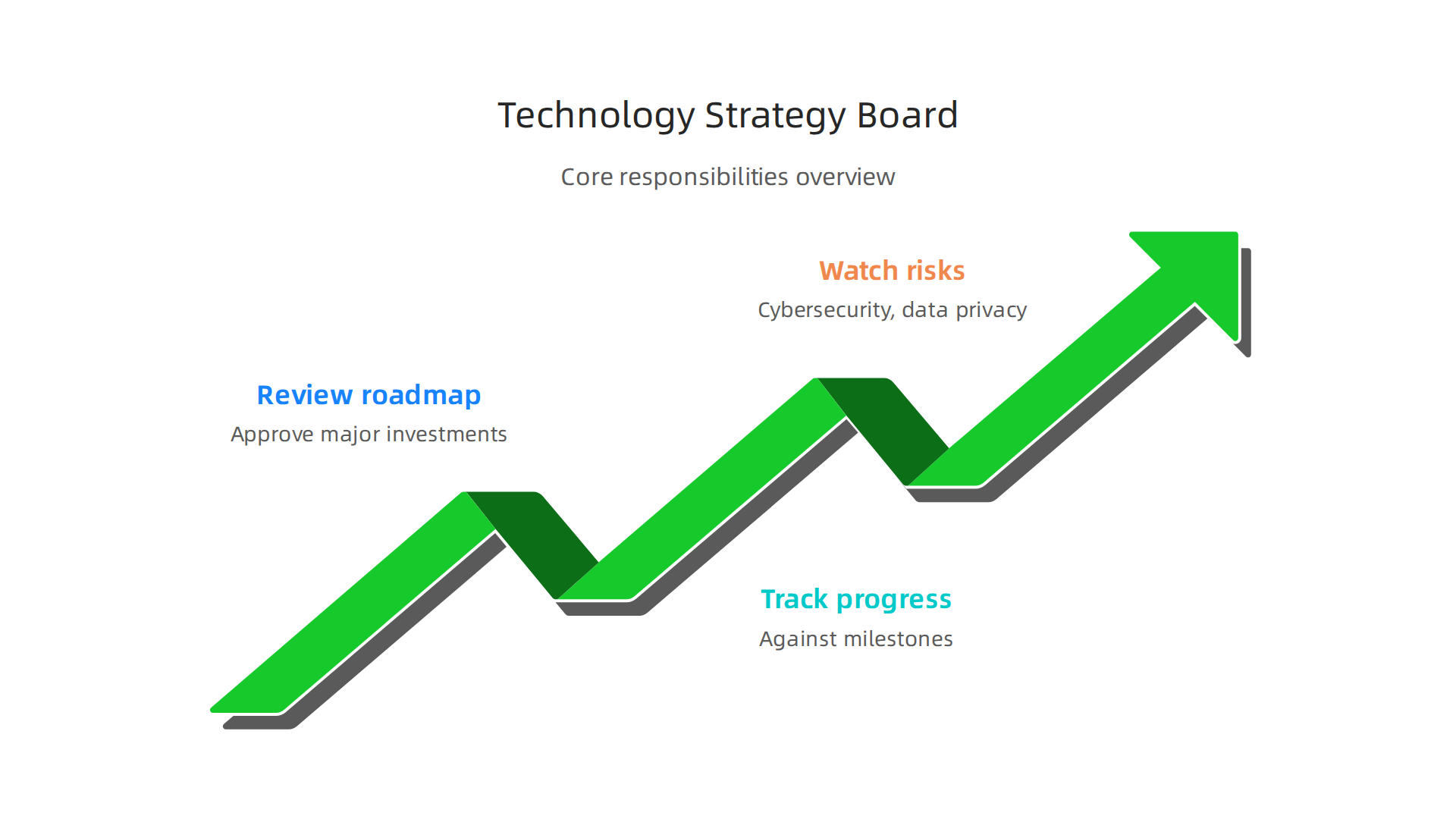
They also watch for emerging risks in cybersecurity, data privacy, and compliance.
This structure keeps your deep tech efforts focused. It prevents teams from chasing cool but irrelevant technology. And it gives leadership confidence that innovation spending is going where it matters most.
The Evolution of Technology Strategy Boards
Technology strategy boards did not always exist in their current form. They grew out of corporate R&D committees that focused mainly on product development timelines and research budgets. Those older groups rarely looked at long-term technology bets or external ecosystem partnerships.
The shift started in the 2000s. By the 2010s, many organizations realized they needed a more formal governance body to oversee technology investments. The UK government’s own Technology Strategy Board, established in 2004, is a good example. It started as an advisory body and later became a full executive non-departmental public body in 2007. You can read more about the evolution of the UK Technology Strategy Board to see how public sector governance paved the way.
Then came the explosion of AI, biotech, and quantum computing. These fields move fast and carry huge risk and reward. A standard corporate board often lacks the deep technical knowledge to evaluate these bets. That is why specialized technology strategy boards became essential.
Modern TSBs look different from those early models. They are more agile. They bring in cross-functional experts from cybersecurity, data science, and product development. Meetings happen more frequently when needed. And they focus on adaptability over rigid five-year plans.
The convergence of AI and network intelligence in 2026 is a perfect example of why this evolution matters. Read more about how AI and network intelligence are reshaping business to see why dedicated oversight is more important than ever.
Staying on top of these fast changing fields is tough. That is where getting clear daily AI updates from a trusted source helps. Check out The AI Newsletter Worth Reading for straightforward insights delivered to your inbox.
Why Deep Tech Innovation Needs Strategic Governance
But deep tech goes far beyond typical software startups. Think about fields like quantum computing, synthetic biology, and advanced materials. These sectors come with a unique set of challenges that regular business leaders are not trained to handle.
For one, deep tech ventures face high technical uncertainty. You can read a detailed breakdown of these traits in a Wikipedia article on deep tech and its defining features. They require very long development cycles and huge amounts of capital before they ever see a profit.
This is exactly why a technology strategy board becomes essential. A TSB brings the right kind of strategic governance to the table. It helps leaders allocate resources wisely across these high-risk, high-reward projects. A big part of that job involves learning how to identify key tech entities and evaluate them effectively. The board can also spot potential regulatory hurdles early. It can build the deep tech diplomacy needed to navigate global rules. A recent article on Foresight 2025 explains why deep tech risk governance and diplomacy is now a critical boardroom topic.
A TSB also gives you something hard to find in deep tech: outside proof that your idea works and a network of people who can help.

The board connects the company to top research labs, potential partners, and patient investors. Countries like Switzerland are building ecosystems specifically for this purpose. The Deep Tech Nation Switzerland foundation is a great example of how structured support helps these ventures scale.
Without this level of governance, deep tech innovation stays stuck in the lab. A technology strategy board is the bridge that turns breakthrough science into real-world solutions.
Key Functions of a Technology Strategy Board
So what does a technology strategy board actually do day to day? Think of it as three jobs rolled into one: oversight, advisory, and networking.
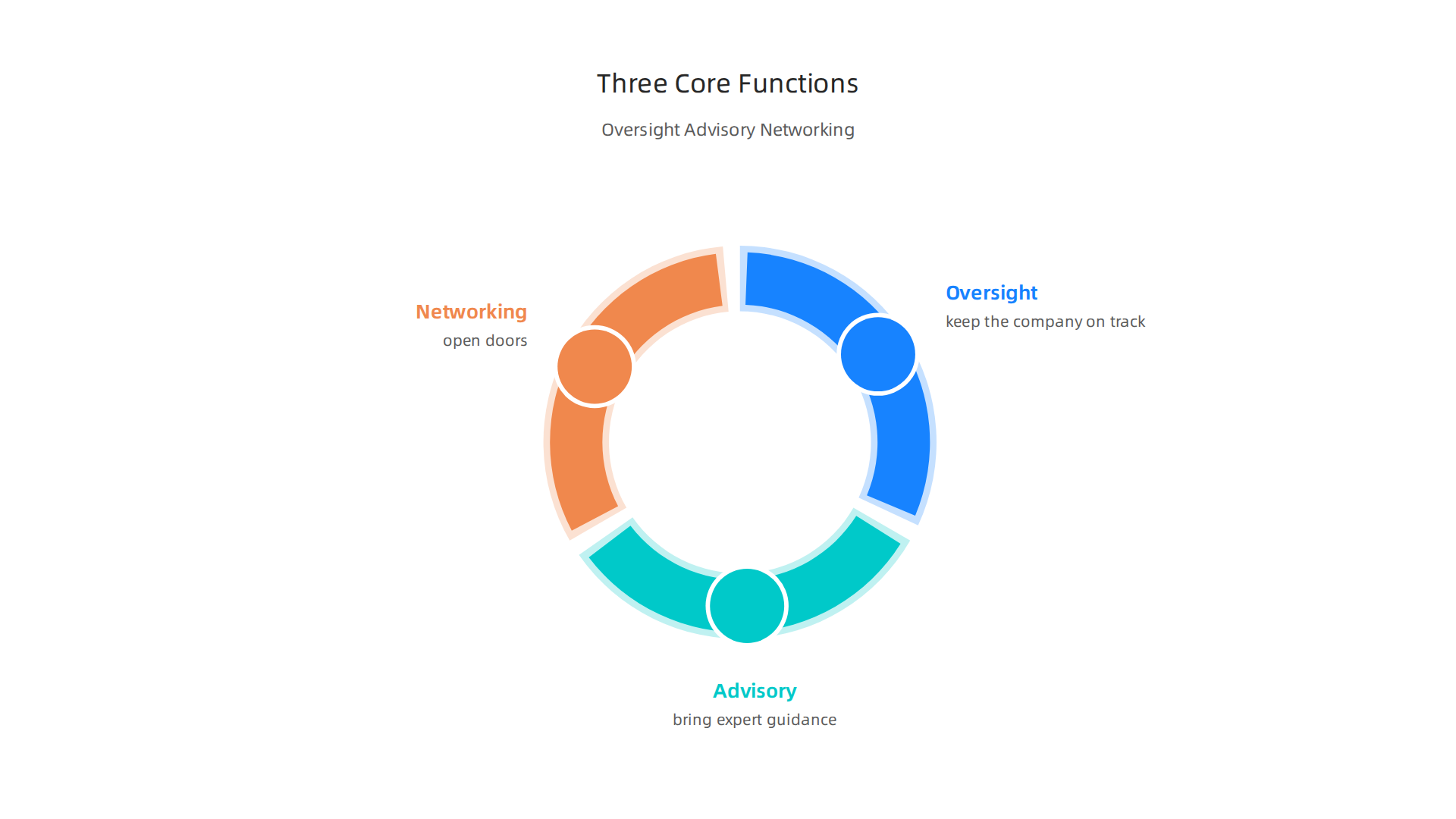
Each role helps companies turn complex science into market success.
Oversight functions keep the company on track. The board makes sure every tech project lines up with the overall business goals. This is called strategic alignment. Without it, a company might spend millions on quantum computing research that has nothing to do with what customers actually need. The board reviews the tech portfolio regularly. It decides which projects get more funding and which ones get cut. This portfolio management role is critical because deep tech ventures require long development timelines and substantial capital, as highlighted in the recent National Deep Tech Startup Policy framework. The board also tracks progress against milestones and flags risks early.
Advisory functions bring expert guidance to the table. Board members do not just approve budgets. They help the leadership team think through hard technical questions. Should we build this in house or partner with a university lab? Is this patent strong enough to protect our work? What regulations are coming down the pipeline that could affect us? The board provides the outside perspective that internal teams often miss. This is especially valuable when companies are exploring how information systems differ from information technology to make better strategic choices. Advisory also covers technology scouting. Board members spot emerging trends and new tools before they become obvious to everyone else.
Networking functions open doors that would otherwise stay closed. A good technology strategy board does not just sit in a conference room. It actively connects the company to the right people and places.

This means introductions to top research labs, government agencies, and patient investors who understand long development cycles. The board helps forge partnerships with universities and industry consortiums. It also helps attract the rare talent needed for deep tech fields like synthetic biology and advanced materials.
These three categories oversight, advisory, and networking together make the technology strategy board a powerful engine for responsible innovation. Each function fills a gap that most deep tech companies struggle with on their own.
If you want to stay ahead of these fast moving technology trends, you need reliable information delivered daily. That is exactly why we recommend The AI Newsletter Worth Reading. It gives you clear, practical updates on AI and deep tech so you never miss what matters.
Case Studies: TSBs Driving Breakthroughs
You might wonder if a technology strategy board actually makes a difference in the real world. The answer is yes, and the evidence comes from companies that have lived it.
Take quantum computing, for example. Several quantum startups that reached major technical milestones had a strong technology strategy board guiding their decisions from the start. These boards helped founders decide which qubit architecture to pursue, when to publish research versus file patents, and how to partner with national labs. The result? Faster paths to prototype and stronger IP portfolios that attracted serious funding.
In synthetic biology, a similar pattern emerges. Companies designing engineered organisms for sustainable materials often struggle with long R&D timelines. Their TSBs provided something critical: patient oversight. Board members with experience in both biology and manufacturing helped these companies avoid expensive detours. The UK deep tech chemistry sector offers great examples of this approach in action, with companies like Exscientia and Mimica showing what happens when scientific vision meets strategic board guidance. You can read more about these breakthroughs in a detailed UK deep tech chemistry case study.
Clean energy tells a similar story. Companies working on next generation battery materials and carbon capture technologies face massive capital requirements before they see any revenue. A technology strategy board that includes energy industry veterans and climate policy experts helps these startups navigate grant programs, regulatory pathways, and manufacturing scale up decisions. One standout area is advanced battery materials, where TSBs have guided companies toward faster charging, safer chemistries, and longer lifetimes.
What do these success stories share? Three patterns stand out.
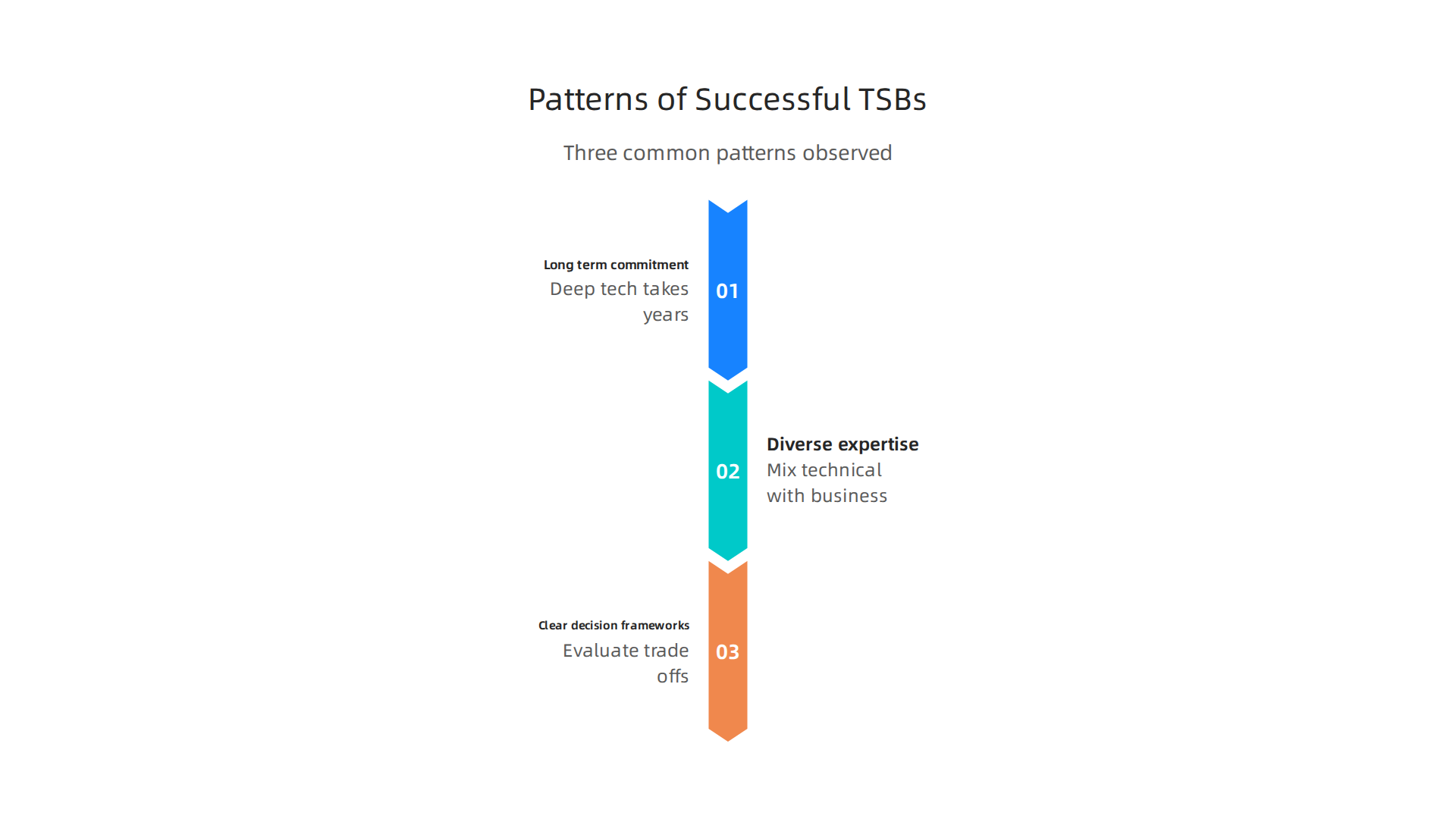
Long term commitment. The best TSBs do not jump ship when progress slows. They understand deep tech takes years, not months.
Diverse expertise. The most effective boards mix technical depth with business experience and regulatory knowledge. No single person has all the answers.
Clear decision frameworks. Great TSBs do not just talk. They create structured ways to evaluate trade offs and make hard calls about resource allocation.
These case studies show that a technology strategy board is not just a nice to have. It is often the difference between a brilliant idea that stalls and one that changes an industry.
Metrics for Measuring TSB Impact
So how do you know if your technology strategy board is actually working? You need the right measurements. The case studies above prove TSBs can drive breakthroughs, but to show real impact to investors or leadership, you need hard data. Here are the metrics that matter most.
Innovation KPIs. Patents filed, time from lab to market, and return on R&D spending are classic measures. A strong TSB helps a company file better patents or shorten development cycles. Deep tech incubators that use structured board oversight have helped startups attract over $80 million in private investment and $300 million in follow on capital. You can read more about these results in a report on unleashing innovation in deep tech from Callaghan Innovation.
Board member surveys. Sometimes the best data comes straight from the people in the room. Regular anonymous surveys of TSB members reveal how well the board is actually functioning. Are decisions being made efficiently? Is the right expertise being used? This kind of feedback catches small problems before they become big ones.
Outcome-based metrics over activity-based. Here is a common trap. Many teams measure how many meetings their TSB holds or how many reports are reviewed. Those are activity metrics. They do not tell you if the board is making a real difference. Instead, focus on outcomes. Did the TSB help the company avoid a costly technical mistake? Did it open doors to key partners? Did it accelerate a funding round? The deep tech ecosystems report from Boston Consulting Group notes that startups thrive when they have access to experienced guidance. That is exactly what a well measured TSB provides.
If you want to stay current on the technology trends that feed into smart board decisions, consider The AI Newsletter Worth Reading. It delivers clear daily updates that help you spot emerging patterns before your competitors do.
Challenges and Pitfalls to Avoid
Even a well designed technology strategy board can fail. Knowing the most common problems before you start helps you build a board that actually delivers instead of one that wastes time and money.
Groupthink is the biggest hidden risk. When a TSB is filled with people who all think the same way, they tend to agree too quickly. Strong governance needs diverse viewpoints and ongoing education. A report on board management best practices for 2026 from Diligent highlights that directors must keep learning, especially around technology governance. Without diversity, your board becomes an echo chamber where bad ideas never get challenged.
Misalignment with business strategy. This one is surprisingly common. The TSB gets excited about cool technology while the rest of the company focuses on revenue, customers, and operations. When the board’s work does not connect to real business goals, it loses support from leadership. Research from NACD on boards prioritizing strategic execution in 2026 shows that strategy execution is the top oversight area directors want to improve. Every TSB recommendation must tie back to a business outcome.
High cost without clear payoff. Running a TSB takes real money and time. Board members need compensation. Meetings need preparation. Without strong metrics like the ones we covered earlier, stakeholders may see the board as an expensive distraction. You need to prove value early or risk losing support.
Lack of clear authority. A TSB that can only advise but never decide will frustrate everyone. Members need a real mandate to approve, reject, or redirect technology investments. Without that power, the board becomes a talk shop where nothing ever changes.
Cultural resistance to outside guidance. Some companies, especially those with strong technical teams, resist external input. Engineers may see the TSB as outsiders telling them how to do their jobs. If you do not build buy-in from the start, the advice gets ignored. One way to navigate this is to learn how to identify key tech entities and evaluate them effectively within your organization. Knowing who really drives technology decisions helps you understand where the resistance comes from.
The best TSBs avoid these traps by staying self-aware, connecting every decision to business goals, and making sure they have real authority to act.
How to Build an Effective Technology Strategy Board
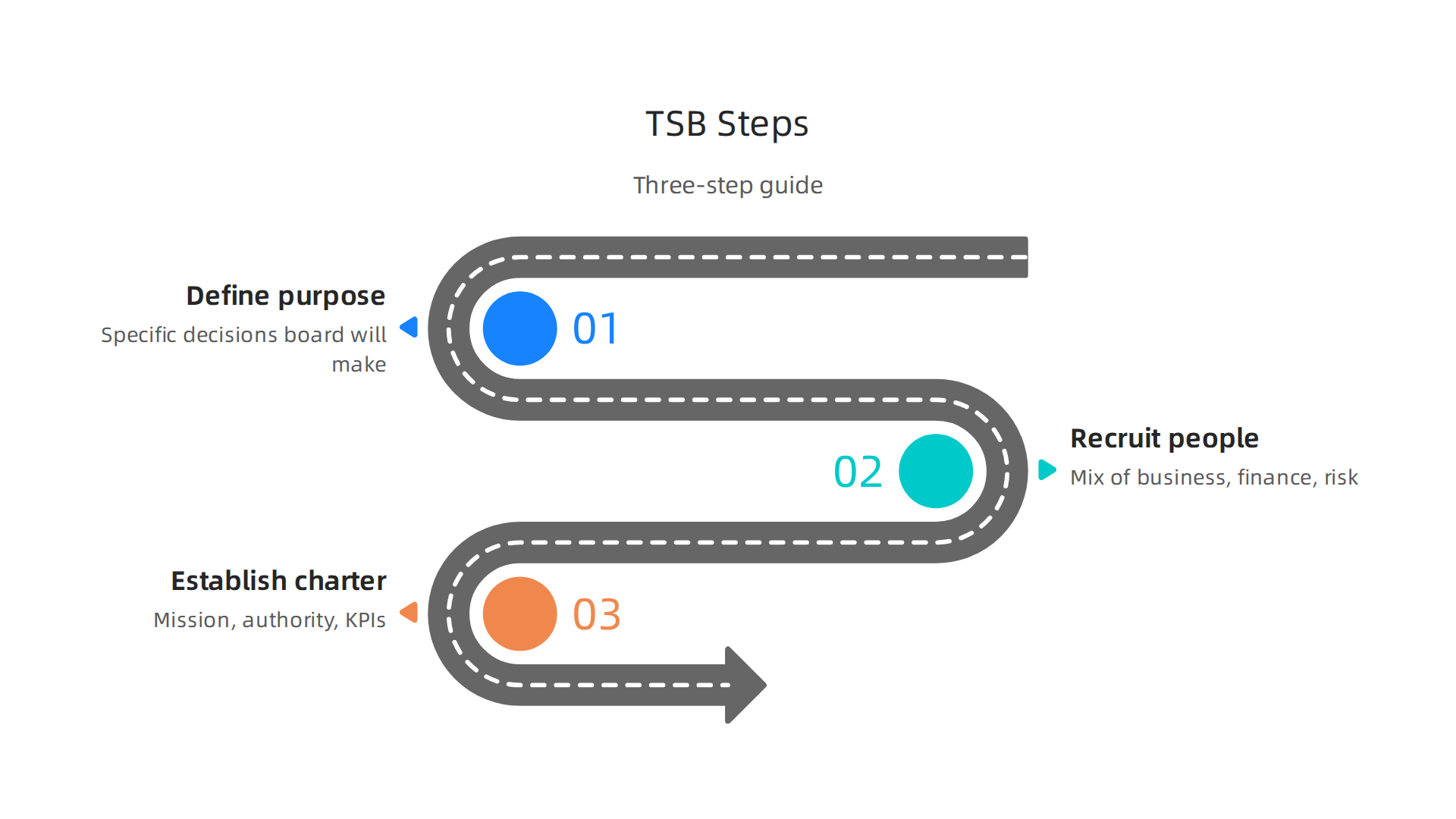
Building a technology strategy board that works starts with three simple steps.
Get these right, and your TSB will drive real value for years instead of becoming another meeting that nobody wants to attend.
Step 1: Define the purpose and scope. Before you invite anyone to join, get crystal clear on why the board exists. Is it to oversee big technology investments? To guide AI adoption? To approve cybersecurity policies? Write down the specific decisions this board will make. Define what is inside its scope and what is outside. When you do this early, you avoid confusion and conflict later. Start by understanding what technology truly means for your business so you can set the right boundaries. The 2026 CIO playbook from the IT Executives Council emphasizes that aligning technology governance with long-term goals is essential before any major initiative begins. Take the time to map out the exact territory your board will cover.
Step 2: Recruit the right mix of people. A strong TSB needs more than just tech experts. You need people who understand business strategy, finance, risk management, and governance. Aim for diversity in background, experience, and thinking style. Include at least one person who has deep technical knowledge. Include someone who has run a P&L. Include someone who understands compliance and regulation. A practical approach to IT strategic planning for 2026 from EZO recommends keeping steering groups small and focused, with five to ten members who can make decisions quickly. Do not let the board get too large. Every person should earn their seat by bringing a unique perspective.
Step 3: Establish a clear charter, meeting cadence, and KPIs. Write a formal charter that states the board’s mission, authority, and decision-making power. Specify how often the board meets. Monthly or quarterly works well for most organizations. Define the metrics you will use to measure success. These should connect directly to business outcomes like cost savings, revenue growth, or risk reduction. An AI strategy guide for 2026 from EverWorker suggests using a balanced portfolio approach with quick wins, platform enablers, and long-term bets. Apply this same thinking to your TSB’s project pipeline.
Once your board is built, commit to continuous learning. Technology changes fast, and your board members need to stay current on what is happening. Getting a daily stream of clear updates on AI and technology trends helps everyone make better decisions. Start with The AI Newsletter Worth Reading to keep your whole team informed and ready for what comes next.
Summary
A Technology Strategy Board (TSB) is a focused governance group that helps organizations translate deep tech research into business value by aligning long-term technology bets with corporate goals. This article explains what a TSB is, how it evolved from older R&D committees, and why deep tech fields like quantum, synthetic biology, and advanced materials need specialized oversight. It breaks down the board’s three core roles—oversight, advisory, and networking—then illustrates impact through case studies in quantum computing, synthetic biology, and clean energy. The piece also describes the right metrics to prove value, common failure modes (groupthink, misalignment, unclear authority), and a practical three-step blueprint to build an effective TSB: define scope, recruit diverse members, and set a charter with KPIs. Readers will finish knowing how to structure a TSB, what to measure, and how to avoid typical governance traps so innovation actually reaches market impact.