
Introduction
You have probably seen it happen. A friend uploads a photo and asks an AI tool what is in the image. Seconds later, the tool describes every detail perfectly. It sounds like magic, but it is actually a fast growing market. In 2026, the generative AI in computer vision market is valued at $14.84 billion and experts expect it to grow to $53.15 billion by 2030, according to a market report from Research and Markets. That is a massive leap.
The thing is, the speed of change creates a problem. Every week, someone announces a new tool. GPT Vision, Open Brain AI, Originality AI, GenSpark AI, and other new AI tools all claim to be the best. How do you know which one actually fits your workflow? The global computer vision market has already crossed $20 billion, and nearly 75% of manufacturers now use AI powered inspection, according to the Enterprise Vision AI Adoption Report 2026 from Datature. That is a lot of activity.
Here is the real challenge. You are busy. You might be a marketer, a healthcare professional, or a business owner. You do not have time to test every single tool.

You need clear answers. The Stanford HAI Artificial Intelligence Index Report 2026 found that generative AI hit nearly 53% population level adoption within three years. That is faster than the internet or the personal computer. So the pressure to keep up is real.
This article is built to cut through that noise. We compare GPT Vision with other leading vision tools, including Open Brain AI, Originality AI, and GenSpark AI. We look at real strengths, real limits, and real use cases. If you want to understand the landscape, you have come to the right place.
And if you want to stay ahead of the curve every single day, I strongly recommend checking out The Deep View Newsletter. It delivers clear daily AI updates straight to your inbox, so you never miss a trend that matters. Subscribe today.
Let us jump in and start with the tool that kicked off the modern vision AI wave: GPT Vision itself.
The Landscape of AI Vision Technologies in 2026
So, what does the AI vision landscape actually look like in 2026? It is a big shift from just a few years ago. Back then, most tools could only label objects in a photo. A cat. A car. A tree. That was it.
Now, things are different. Modern AI vision tools work across text, images, and even video. They read charts, spot defects, and answer questions about what they see. This is called multimodal understanding. It is a huge step forward.
The numbers tell the story. The global AI vision market is expected to reach USD 43.02 billion by 2029, growing at a steady pace of 23.7% per year, according to a recent report from MarketsandMarkets. That growth rate shows how fast industries are adopting this technology. In fact, the larger computer vision market could hit $674.23 billion by 2035, per another analysis from Market Research Future.
So who are the main players in this space? Four names keep coming up.
First up is GPT Vision. This is the tool from OpenAI that kicked off a lot of the excitement.
It can describe images, understand handwriting, and even reason about complex scenes. It is built directly into ChatGPT, which makes it easy to access.
Then there is Open Brain AI. This tool focuses on real time processing for things like surveillance and manufacturing. It is built for speed and accuracy in industrial settings.
Originality AI takes a different angle. It is designed to detect AI generated text and images. Many publishers and marketers use it to check content authenticity.
Finally, GenSpark AI offers a broader platform. It combines vision with other AI capabilities, making it useful for businesses that want one tool for many jobs.
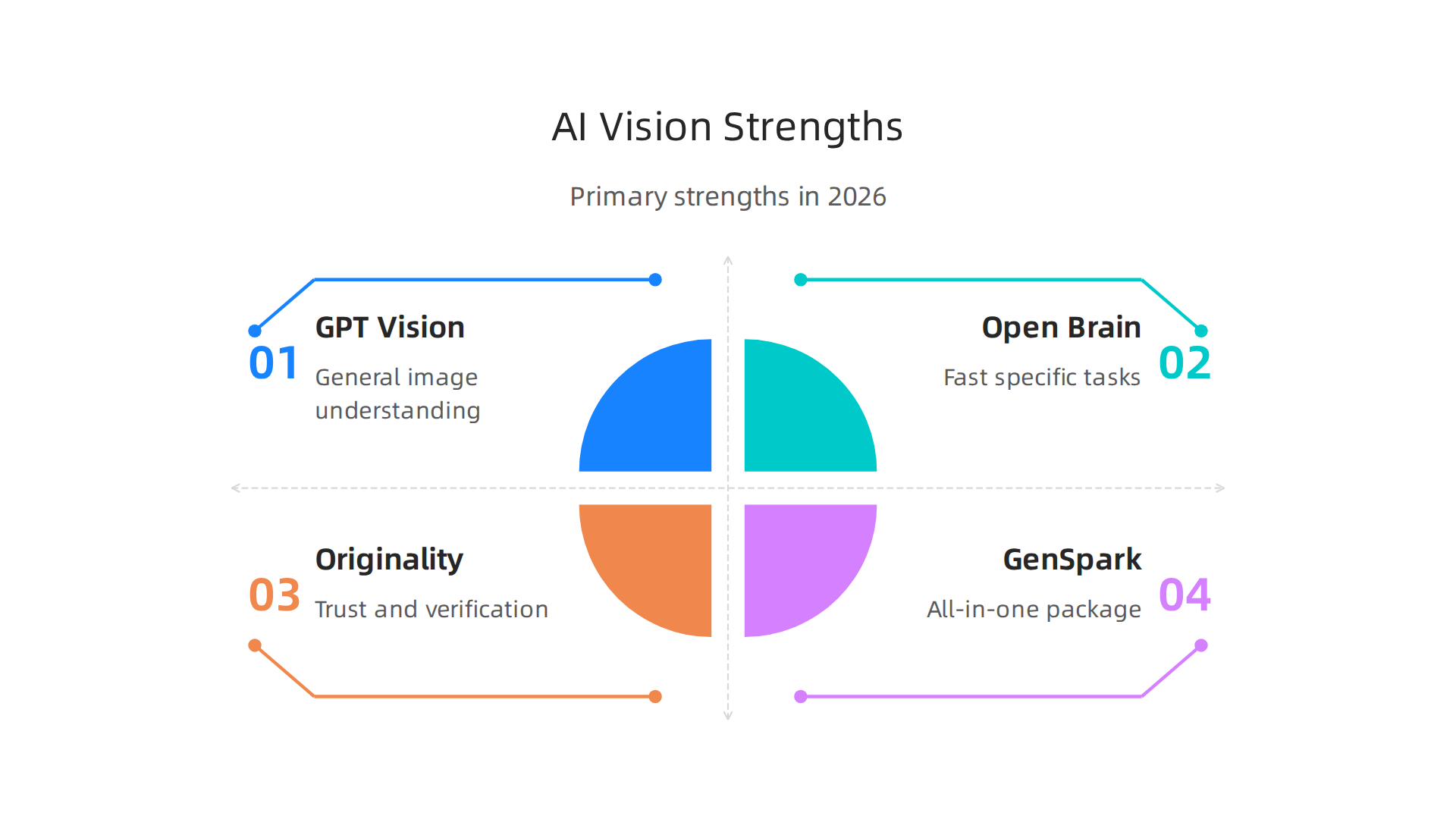
Each tool has a clear strength. GPT Vision handles general purpose image understanding very well. Open Brain AI is great for fast, specific tasks. Originality AI helps with trust and verification. GenSpark AI gives you an all in one package.
Here is the thing. Understanding this landscape helps you make smarter choices. You do not need to test every single tool. You just need to match the right one to your actual work.
If you want to keep up with how players like GPT Vision and other tools are evolving, it helps to have a steady source of updates. The pace of change is fast. One newsletter that covers this daily is The Deep View Newsletter. It delivers clear, practical AI news straight to your inbox. Subscribe today and stay ahead.
For a deeper look at how AI vision tools are changing business workflows, check out our article on how artificial intelligence with images is transforming business in 2026.
GPT Vision: Multimodal Capabilities and Real-World Applications
Now let’s zoom in on the tool that started a lot of the buzz: GPT Vision. This is the multimodal powerhouse from OpenAI. It does not just label objects like older AI tools. It connects what it sees with what it reads and reasons about it all at once.
Think of it like this. You show it a handwritten note with a sketch of a chart. It can read the handwriting, describe the chart, and even analyze the data trend. That is multimodal understanding in action. It works across text, images, and video.
Real world uses you should know about
One of the most exciting places GPT Vision is making a difference is in medical imaging.

Doctors are testing it to help interpret scans and clinical photos. A recent study benchmarked several large language models with vision for oral and maxillofacial radiology. The results showed these models are getting close to specialist level performance. If you are in healthcare, this is a trend to watch. For more on this, check out our look at how 81 percent of radiology departments already use AI in medical imaging in 2026.
Another big area is autonomous driving. Cars need to understand 3D space from 2D camera feeds. Researchers have tested GPT Vision on 3D visual question answering benchmarks. It showed a strong ability to reason about spatial relationships. This helps a self driving car know if an object is near or far.
Then there is visual search. This is where you search using an image instead of typing words. E-commerce sites use it so you can snap a photo of a chair and find the exact one to buy. GPT Vision makes this kind of search much more accurate. See how artificial intelligence with images is transforming business in 2026 for a deeper dive.
How well does it really perform?
Benchmarks in 2026 show that GPT Vision competes at the very top. According to model benchmarks from Epoch AI and Scale AI, GPT based models score very high on reasoning and vision tests. The MMMU Pro benchmark, which tests vision models on college level knowledge, places GPT Vision among the leaders.
But no model is perfect. The Stanford HAI 2026 AI Index Report found that hallucination rates across top models vary a lot. This means GPT Vision is powerful, but you still need to verify its outputs in critical tasks.
So, is GPT Vision the right tool for you? If you need a general purpose vision model that can handle text, images, and video with strong reasoning, it is a top choice. To understand how it got here, read about the journey from GPT-3 to GPT-5 and how these language models transformed AI.
OpenBrain: Open-Source AI and Collaborative Innovation
So, what if you could use a vision AI that you can fully control and even change to fit your needs? That is exactly what OpenBrain offers. It is an open-source AI platform built on transparency and community input. Instead of a black box that only its maker can adjust, OpenBrain lets developers, researchers, and businesses look under the hood. They can customize it, train it on their own data, and use it without being locked into one vendor.
This matters a lot for specialized vision tasks. Say you work in agriculture and need an AI that spots plant diseases. With OpenBrain, you can fine-tune the model on your own images. You do not have to wait for a big company to update their product. You take control. The architecture is designed so that even small teams can adapt it for things like medical imaging, factory quality checks, or visual search.
How does it stack up against the big players?
A few years ago, open-source models lagged behind proprietary ones like GPT Vision. But that gap has shrunk fast in 2026. Recent releases show that open models now compete at the top. For example, the MMLU leaderboard from 2026 shows open-source models like GLM 5 and R1 0528 scoring above 90 percent. They are right up there with the best. This trend matches what you see across the AI world: open innovation is catching up.
OpenBrain also brings something proprietary models cannot easily match: collaborative innovation. Thousands of developers can contribute improvements.

If someone finds a way to reduce bias or cut hallucination rates, the whole community benefits. The Stanford HAI 2026 AI Index Report points out that hallucination rates still vary a lot across models. OpenBrain’s open nature means these problems get spotted and fixed faster.
If you are tired of paying per API call or worrying about vendor lock-in, OpenBrain gives you a fresh option. It is part of a wave of new AI tools that put power back in your hands. To see how open-source AI fits into the bigger picture, check out our article on the AGI 2026 landscape and the rivalry between open and closed models.
The best way to stay on top of all these fast changes is to get daily updates from people who track them closely. That is why we recommend The Deep View Newsletter. It delivers clear, daily AI insights straight to your inbox. Subscribe here to never miss a trend.
Originality: AI Detection and Content Authenticity
As we just saw, open-source tools like OpenBrain are making AI more accessible. That is great for innovation, but it also creates a big challenge. When anyone can generate realistic text and images with tools like GPT Vision, how do you know what is real? That is where Originality comes in. It focuses on detecting AI generated content to maintain trust and compliance.
Originality.ai uses advanced watermarking and forensic analysis to spot synthetic media.
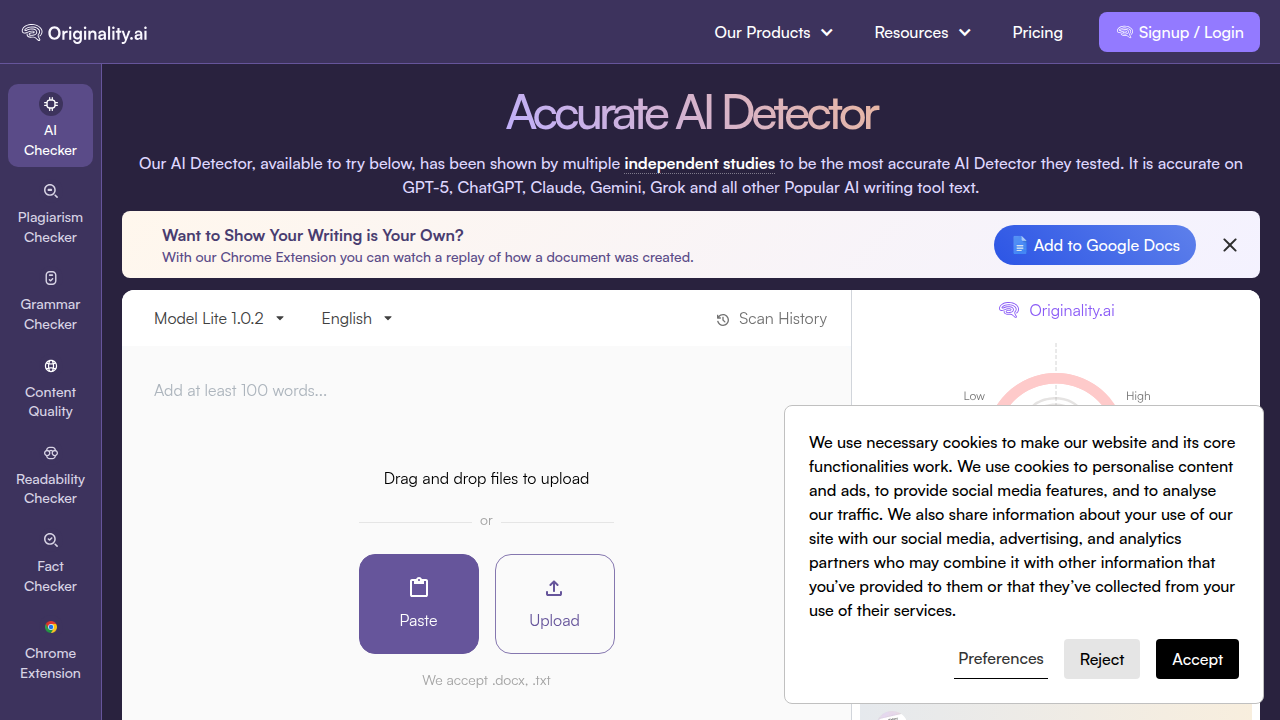
It is not just about catching students who use ChatGPT. In 2026, publishers, educators, and compliance teams face growing regulatory scrutiny. They need reliable tools to verify content authenticity. A meta-analysis of 14 studies found that Originality.ai achieved near perfect 98-100% average accuracy, ranking it as one of the most precise detectors on the market source. Other tools like GPTZero and Turnitin also claim high accuracy, but independent tests show mixed results source.
Why does this matter for you? If you publish content online, use AI in your workflow, or manage a team that does, you need to know what is human and what is machine made.
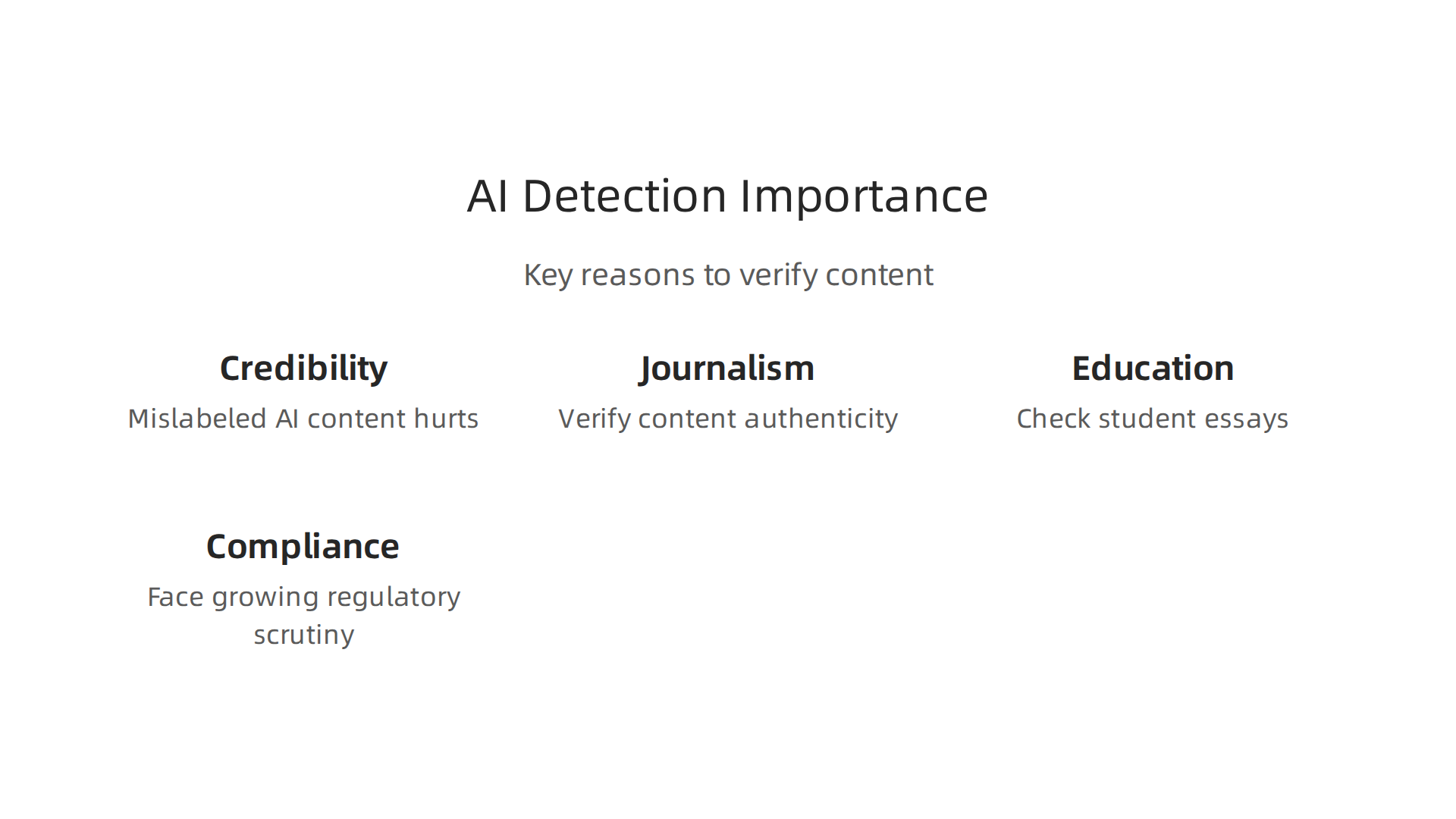
Mislabeled AI content can hurt your credibility, especially in industries like journalism, education, or legal compliance. Even a single false positive can damage trust.
GPT Vision makes this even more urgent. It can generate images, read text from photos, and create detailed descriptions on the fly. That is powerful, but it also means fake content can look very real. Detection tools are your first line of defense.
There are new AI tools appearing all the time, like Genspark AI, but few match Originality in accuracy and purpose built design. Whether you are a teacher checking student essays or a marketer auditing a freelancer’s work, using a dedicated detector is smart practice.
To dive deeper into how AI generation is evolving, check out our article on AI image generation in 2026. It shows how fast the landscape is changing on both sides.
The best way to keep up with these shifts? Get daily, clear updates from experts. The Deep View Newsletter delivers exactly that. Subscribe here to never miss a trend.
GenSpark: Generative AI Platform for Enterprise
So while catching AI content is one challenge, using AI to actually create content at scale is another. That is where GenSpark steps in. GenSpark is an enterprise grade generative AI platform built for large organizations that need speed, security, and customization. Unlike free public tools like GPT Vision, GenSpark gives companies control over their data and outputs.
What makes GenSpark stand out in 2026? It offers integrated vision capabilities. That means your marketing team can generate product images from a text description, or your design team can upload a sketch and get polished visuals in seconds. The platform uses advanced computer vision models, similar to what you get with GPT Vision, but wrapped in enterprise features like role based access, audit logs, and data privacy compliance.
Here is why that matters for you. If you lead a marketing department, you probably juggle dozens of content requests. With GenSpark, you can automate entire content pipelines. Write a blog post, generate matching images, and localize everything for different markets all inside one secure environment. No worrying about data leaking to public servers.
The platform also focuses on scalability. Whether you need to produce 100 product descriptions or 10,000, GenSpark scales without slowing down. It handles high volume workloads that would crash cheaper tools. Plus, you can fine tune the models on your own brand guidelines. That means every output matches your voice and style.
Security is a huge plus too. Enterprises in regulated industries like healthcare or finance can use GenSpark because it meets standards like SOC 2 and GDPR. You can even deploy it on your own infrastructure if needed.
Want to see how vision capabilities are reshaping business? Check out our article on AI image generation in 2026. It covers how tools like GenSpark and GPT Vision are changing marketing and product design.
GenSpark is just one example of the new AI tools appearing in 2026. But for companies that need reliability at scale, it is a strong choice. The landscape shifts fast though. To keep your finger on the pulse of generative AI platforms and other breakthroughs, get daily updates from experts. Subscribe to The Deep View Newsletter and never miss what comes next.
Now we have a clear picture of the major players. But which one fits your specific needs? That depends on what you are trying to accomplish. Each tool has its own strengths and tradeoffs. Let’s compare them side by side.
Comparative Analysis: GPT Vision vs. OpenBrain vs. Originality vs. GenSpark
The AI vision market is growing fast. MarketsandMarkets projects it will reach USD 43.02 billion by 2029. With so many options appearing, you need to pick the right tool for the job. Here is how the four main choices stack up.
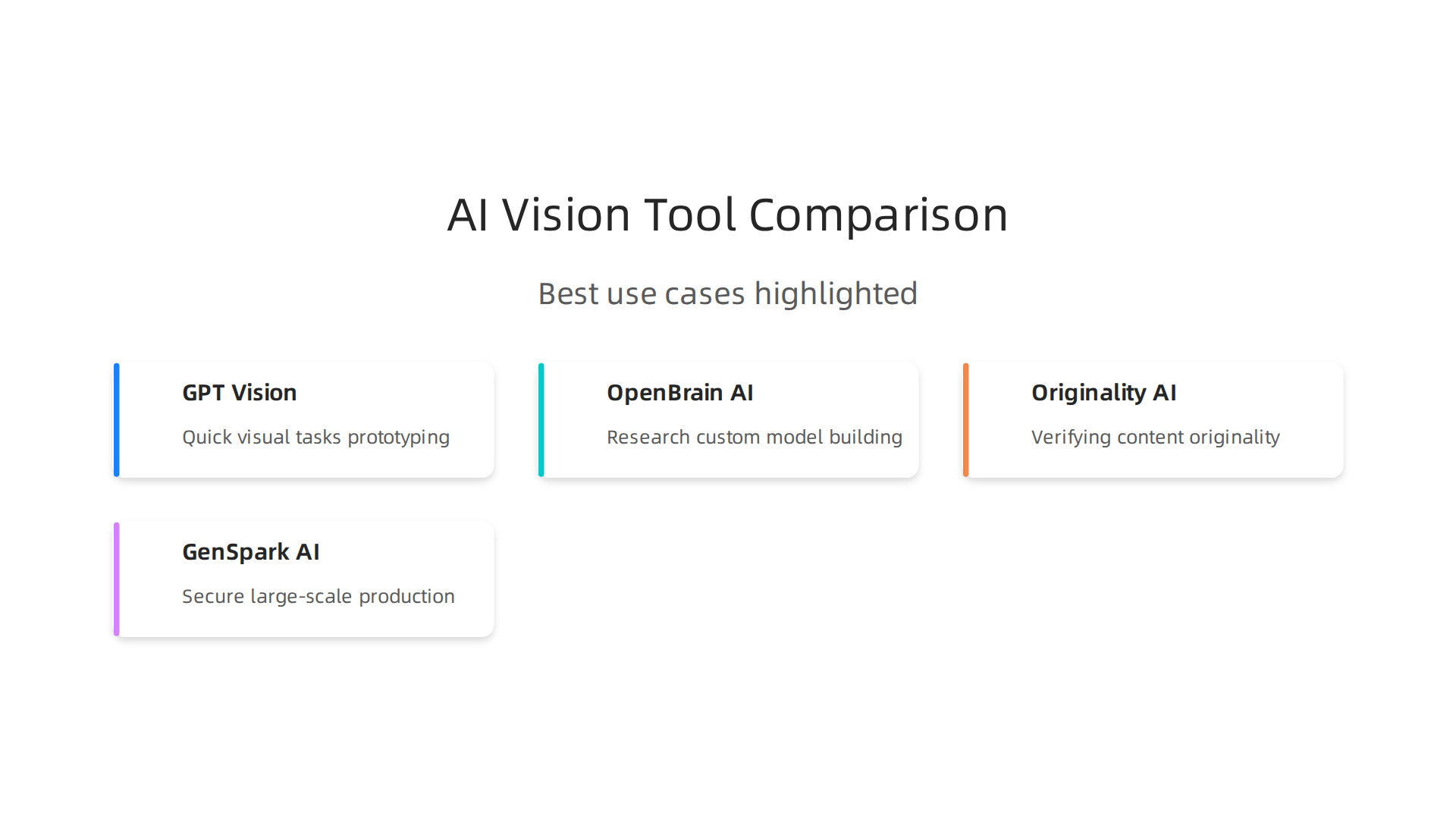
| Feature | GPT Vision | OpenBrain AI | Originality AI | GenSpark AI |
|---|---|---|---|---|
| What it does | Analyzes and generates images via ChatGPT | Open source computer vision models | AI content detection with visual analysis | Enterprise generative AI with vision |
| Accuracy | High for general tasks | Varies by model | High for AI text detection | Very high with fine tuning |
| Speed | Fast on OpenAI servers | Depends on your hardware | Fast for text checks | Fast at scale |
| Cost | Subscription or per token | Free to low (self hosted) | Per scan pricing | Enterprise pricing |
| Openness | Closed source | Fully open source | Closed source | Closed source with customization |
| Best for | Quick visual tasks and prototyping | Research and custom model building | Verifying content originality | Secure, large scale content production |
How to choose
Think about your main goal. If you need to quickly identify objects in a photo or generate an image for a social post, GPT Vision is the easiest option. It handles everyday tasks without setup.
For researchers or developers who want full control, OpenBrain AI gives you access to open source models. You can modify the code and run it on your own machines. No vendor lock in.
If your priority is catching AI generated content, Originality AI leads the pack. It specializes in detecting both text and visual content produced by AI. This is crucial for publishers and educators.
When you need enterprise grade security and scale, GenSpark AI stands out. It combines vision capabilities with role based access, audit trails, and compliance standards. Grand View Research notes the whole AI market hit $390.91 billion in 2025 and is growing fast in 2026. GenSpark is built for organizations that need to handle sensitive data at high volume.
The bottom line
No single tool wins in every category. You might even use two or three together. For example, use GPT Vision for quick prototypes and GenSpark for your final production pipeline. The key is matching the tool to the task.
All these new AI tools are changing how we work with images. To stay current on which one works best for your industry, keep learning and testing.
Still unsure which tool fits your workflow? Get clear daily updates on the latest AI advances so you never fall behind. Subscribe to The Deep View Newsletter and get expert breakdowns every day.
How to Choose the Right AI Vision Technology for Your Needs
You have seen the comparison table. Now it is time to make a choice. Picking the right tool can feel overwhelming with so many options out there.

But the decision gets easier when you break it down by the factors that matter most to your situation.
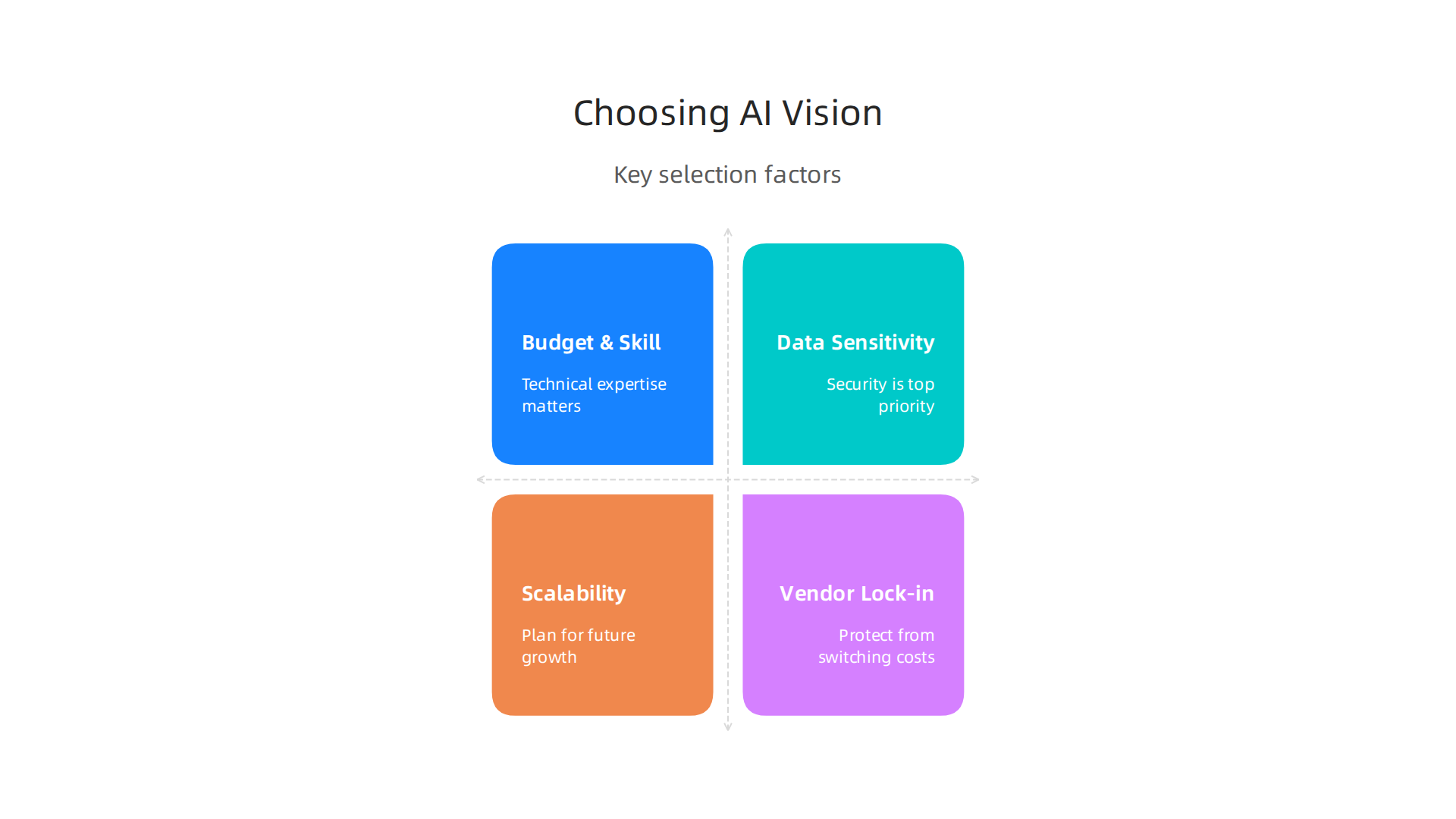
Start with your budget and skill level
Your technical expertise matters a lot. If you have a team of developers who can customize code, OpenBrain AI gives you the most freedom. It is open source and free to self host. You pay nothing for licensing and you control everything.
But if you need something that works right out of the box, paid tools like GPT Vision or Originality AI save you time. They handle setup, updates, and support for you. Brev.io’s strategic guide explains how to align AI planning with your actual business resources, which helps avoid overspending.
Think about data sensitivity
What kind of images are you working with? If you handle medical scans, financial documents, or customer data, security becomes your top priority. GenSpark AI offers enterprise grade security with role based access and audit trails.
A study from Georgia Tech shows that vision AI models improve decision making in manufacturing, energy, and finance, where data privacy rules are strict. For these industries, closed source tools with compliance certs are often the safest bet.
Plan for scalability
How fast do you expect to grow? If you process a thousand images today but might hit a million tomorrow, you need a tool that scales without breaking your budget.
GenSpark AI handles high volume with enterprise infrastructure. GPT Vision also scales well through OpenAI’s servers. Techment’s enterprise AI strategy report shows how CIOs are planning for scalability in 2026, and the same logic applies to vision tools.
Watch out for vendor lock in
Here is a hidden trap. Once you build your entire workflow around one tool, switching later gets expensive. Open source tools like OpenBrain AI protect you from this risk. You own your code and your data.
If you prefer a paid tool, check how often they release updates and how big their community is. Active development means the tool will stay useful. To see how these tools apply to real business cases, read this deep dive on how artificial intelligence with images is transforming business.
Your next step
Still unsure? That is perfectly normal. The best move is to pick one tool and run a small test project. See how it feels in your actual workflow.
To stay informed as new AI vision tools appear every month, you need a reliable source. Stay ahead by subscribing to The Deep View Newsletter for daily expert insights on the latest technology trends.
Future Trends and Challenges in AI Vision
You have picked your tool. But the AI vision space moves fast. What works today might look very different in a year or two. Let’s talk about what is coming next.
Open source and paid models are converging
Right now you have two camps. Tools like OpenBrain AI give you full control with no licensing fees. Tools like GPT Vision offer polished, ready to use power. But experts expect these worlds to merge by 2027 or 2028.
Microsoft and others are already blending open source flexibility with enterprise reliability. This shift means you will have more choices and better pricing. The Stanford HAI AI Index shows that the gap between what AI can do and how prepared we are to manage it is growing. That gap will drive more hybrid models.
Regulation will reshape detection tools
Synthetic media is everywhere now. Deepfakes, AI generated product images, and manipulated video are hard to spot. This is why tools like Originality AI are becoming essential.
The White House released a National Policy Framework for AI in March 2026 that calls for consistent rules around synthetic content. As regulations tighten, detection tools will need to update constantly. If you work with images or video, staying ahead of compliance requirements matters.
Edge deployment and real time processing take center stage
Cloud based vision AI is powerful. But many industries need answers in milliseconds, not seconds. Think about a factory inspecting products on a fast moving conveyor belt. Or a self driving car reading a traffic sign.
These use cases demand processing directly on the device, not in a remote server. Georgia Tech researchers found that vision AI models improve decision making in manufacturing, energy, and finance, but only when latencies are low. Edge deployment solves this.
GenSpark AI and other new AI tools are already optimizing for local processing. Expect every major vision platform to offer edge capable versions soon.
What this means for you
The AI vision landscape will keep evolving. New regulations, hardware improvements, and model convergence will create both opportunities and headaches. The best way to handle this is to stay informed.
For daily, clear updates on AI vision and other tech trends, subscribe to The Deep View Newsletter. It helps you spot changes early and adjust your strategy before your competitors do.
Also, check out our broader look at the world of AI in 2026 to see how vision fits into the bigger picture.
Summary
This article maps the 2026 AI vision landscape and helps you choose the right tool for your work by comparing GPT Vision, OpenBrain, Originality, and GenSpark. It explains what each platform does best—GPT Vision for multimodal reasoning and prototyping, OpenBrain for open‑source customization, Originality for detection and authenticity, and GenSpark for enterprise security and scale—and illustrates real-world uses in medical imaging, autonomous driving, and visual search. The piece reviews accuracy, speed, cost, openness, and typical applications, then gives practical selection criteria (budget, data sensitivity, scalability, and vendor lock‑in) and an implementation roadmap. It also covers near‑term trends like edge deployment, tighter detection regulations, and the narrowing gap between open and closed models. After reading, you’ll be able to match a vision tool to your team’s needs, run a focused pilot, and plan for compliance and scaling as models evolve.