Introduction
If you have scrolled through social media or visited a website lately, you have seen it: images and videos that look completely real but were actually created by artificial intelligence. This is not a niche trend anymore. In 2026, the market for AI image generation alone is valued at around $12.4 billion, and it keeps growing fast (source: AI Image Generation Statistics 2026). The same explosion is happening with videos on artificial intelligence and even 3D content.
For business leaders, marketers, and investors, this creates a big problem. There is simply too much information coming at you every day.

New tools, new models, new use cases appear almost weekly. It is hard to know which trends actually matter for your strategy and which ones are just hype. You need a trusted source that cuts through the noise and gives you the facts.
That is exactly what this article is for. We have gathered the latest data and expert perspectives to give you a clear, practical overview of what is happening with pictures on artificial intelligence right now. From market size and growth rates to real world applications and ethical questions, we cover everything you need to make smarter decisions in 2026 and beyond.
And if you want to stay ahead of these fast moving changes, you can Subscribe Free to The Deep View Newsletter. It delivers simple daily AI insights straight to your inbox, so you never miss the next big shift.
The State of AI Imagery and Multimedia Content in 2026
If you think AI is just about generating a few cool pictures on artificial intelligence, think again. The landscape in 2026 is way bigger than that. It covers everything from text-to-image tools to videos on artificial intelligence, and even 3D models that look like they came straight out of a Hollywood studio.
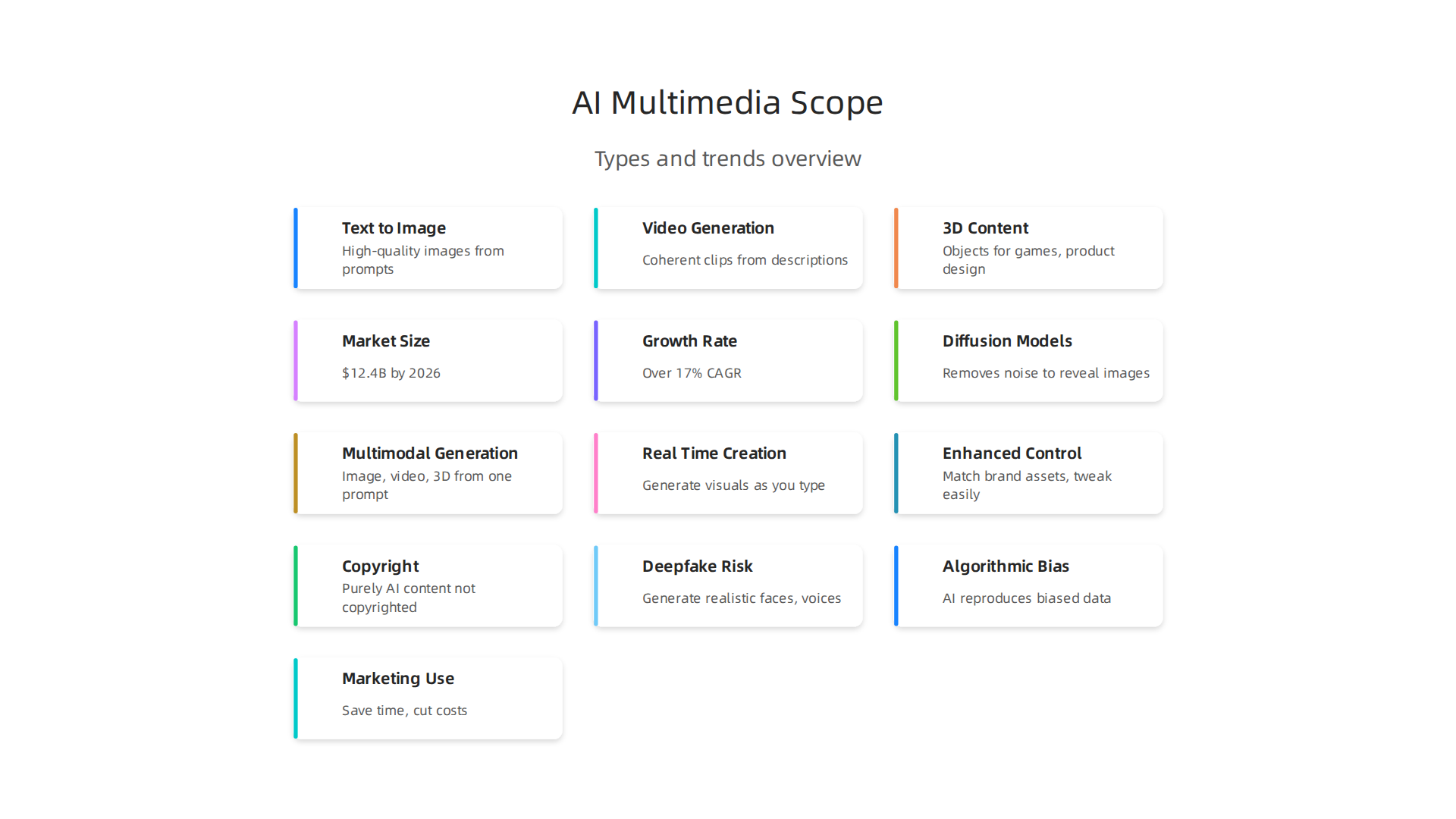
You can now describe a scene in plain English, and within seconds, you get a high-quality image, a short video clip, or a full three-dimensional object ready for use in games or product design.
How big is this market? Estimates vary, but one recent report puts the AI image generation market at around $12.4 billion in 2026, growing at a compound annual rate of over 17% (source).
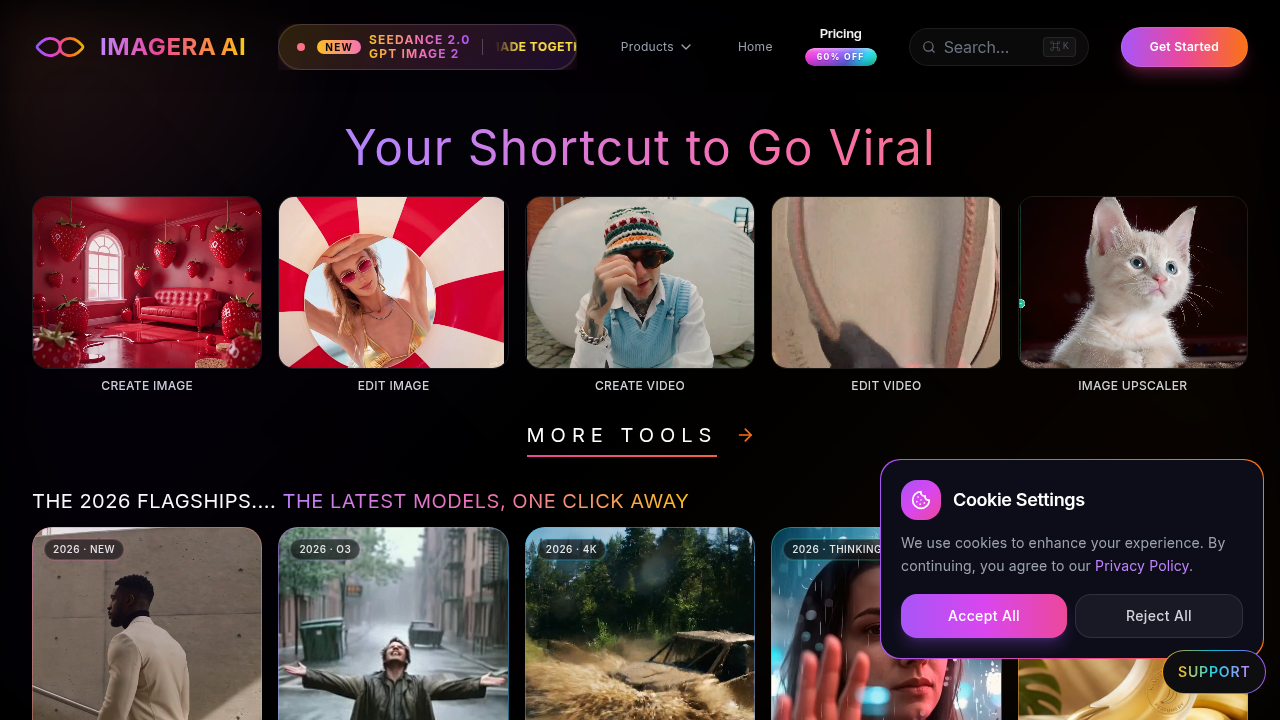
Another analysis from Knowledge Sourcing predicts the AI image generator segment will reach $1.68 billion by 2031, with a 24.6% CAGR from 2026 onward (source). Whatever number you look at, the direction is clear: adoption is accelerating fast.
Businesses aren’t just playing around with these tools for fun. They are integrating them into real workflows. Marketing teams create product mockups and ad visuals in minutes instead of weeks. Product designers iterate on packaging and prototypes without needing a full CGI studio. Training departments build custom illustrations and explainer videos on artificial intelligence without hiring expensive animators. In many cases, generative AI is blending right into existing photography and CGI pipelines, speeding up tasks that used to take days.
The big picture is simple. Artificial intelligence images are no longer a novelty. They are becoming a standard part of how companies create content. As the technology improves, the line between AI-generated and traditionally produced visuals will keep blurring.
If you want to stay on top of how these changes affect your industry, you do not have to do it alone. Subscribe Free to The Deep View Newsletter and get clear daily updates on AI trends that matter.
Core Technologies Powering AI Imagery and Multimedia
So what makes these tools tick? The magic behind pictures on artificial intelligence and videos on artificial intelligence comes down to a few core technologies.
Understanding them helps you see why the quality is getting so good so fast.
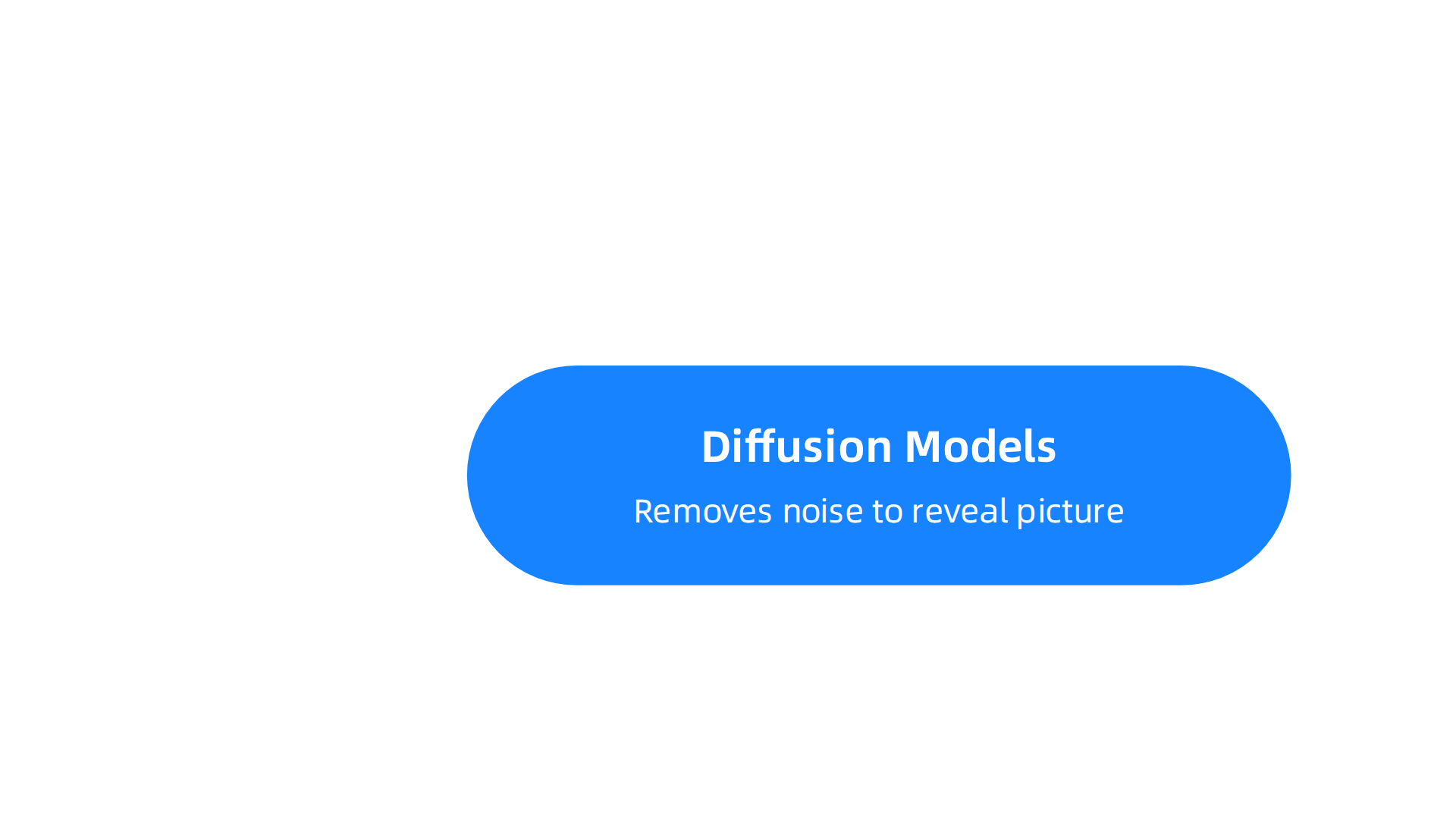
Diffusion models are the engine for most high-quality images. These models work by starting with pure noise, a random pattern of pixels. Then, step by step, they remove that noise to reveal a clear picture based on your text prompt. It sounds backward, but it works incredibly well. In 2026, diffusion models have gotten much faster and more detailed. For example, Stability AI’s research showed that Stable Diffusion 3 matches or beats other top models in many tests (source).
The key improvement is speed. What used to take 30 seconds now takes just a few seconds on standard hardware. And the images look more natural, with better lighting, texture, and composition. If you are curious about the technical details, a great resource is the Stanford CS25 lecture on transformers in diffusion models, which explains how these systems learn to generate realistic visuals from scratch (source). Open-source models also keep getting better, giving you more options for custom work (source).
Video generation is moving from short clips to full scenes. Early AI videos were clunky, jerky, and only lasted a few seconds. Now, in 2026, models can produce coherent multi-minute productions. How? Two main techniques drive this. The first is next-frame prediction. The model watches a sequence of frames and learns to predict what comes next, building motion that feels natural. The second is transformer-based architecture, the same technology behind language models like GPT. These transformers let the AI handle long sequences of video data, keeping characters and backgrounds consistent over time. A 2026 comparison of the best video generation tools shows models like Google Veo 3.1, Runway Gen-4.5, and Kling 2.6 leading the pack (source). The GitHub repo "Awesome Video Diffusion" also lists dozens of research papers and models that track this rapid progress (source). For marketers and creators, this means you can create product demos, social media clips, and even short narratives without a full video production team.
3D content creation is becoming production-ready. This is the frontier that excites game designers, AR/VR developers, and e-commerce teams. New models can take a single image or a text description and generate a full 3D object. The object has proper geometry, texture, and lighting. You can rotate it, place it in a scene, or use it in a game engine. This technology has practical uses. A furniture store can create 3D models from product photos. A game studio can generate characters from concept art. The quality is not quite Hollywood level yet, but it is good enough for many commercial applications. And it keeps improving month by month.
The combination of these three technologies means you can now create artificial intelligence images, videos, and 3D assets from the same general tools. The line between different media types is blurring. And that changes how businesses approach content creation entirely.
If you want to stay ahead of these fast-moving changes, you do not have to do it alone. Subscribe Free to The Deep View Newsletter and get clear daily updates on the AI technologies that matter for your work.
Advances in Image Generation: Beyond Diffusion
Diffusion models are powerful, but they are not the whole story anymore. In 2026, the best pictures on artificial intelligence come from hybrid models that blend diffusion with other techniques. These new systems combine the strengths of diffusion, autoregressive models, and even GANs (generative adversarial networks) to create images with better consistency and fewer weird artifacts. Stability AI’s research shows this hybrid approach is already outperforming pure diffusion in many tests (source). What does this mean for you? You get images that hold together better, especially for complex scenes with multiple characters or objects.
Prompt adherence has taken a big leap forward. Earlier models often ignored parts of your description or added random things you did not ask for. Now, region-based editing lets you specify exactly what goes where in the frame. You can say "a red car on the left and a blue house on the right" and the model actually follows those instructions. Multi-modal conditioning also helps. You can use a reference image plus text to guide the output, giving you fine-grained control over the final result.
On-device generation is finally here. You no longer need a powerful cloud server to create artificial intelligence images. Inference optimization has made it possible to run these models directly on your laptop, tablet, or phone. This matters for latency-sensitive tasks. A designer can generate variations of a logo in seconds without waiting for an internet connection. Open-source models have led this push, giving developers the building blocks to optimize for mobile hardware (source).
These advances mean artificial intelligence images are becoming more reliable, more controllable, and more accessible for everyday work.
Staying current with these rapid changes is tough. That is why Subscribe Free to The Deep View Newsletter is a smart move. You get clear daily updates on the tools and techniques that actually matter for your projects.
Video Generation: From Clips to Short Films
The same progress you saw in pictures on artificial intelligence is now happening with moving images. In 2026, videos on artificial intelligence have jumped from short, glitchy clips to coherent scenes that last several minutes. Models like Google Veo 3.1 and Runway Gen-4.5 now maintain consistent characters and backgrounds across longer sequences (source). That means a marketer can generate a 30-second product demo in one go, or a trainer can create synthetic footage for safety drills without a camera crew.
The applications go beyond creative work. Companies use these tools for synthetic data generation, training computer vision models on realistic but artificial videos. Advertising teams produce multiple variations of a spot in hours instead of weeks. The open-source community has also built extensive libraries of video diffusion models for anyone to experiment with (source).
Still, challenges remain. Longer videos often suffer from flickering or weird motion when objects move fast. Complex scenes with many moving parts can confuse the model. Consistency across very long durations is the next big hurdle.
Want to keep up with how artificial general intelligence images and video models evolve? Get Free Updates from The Deep View Newsletter. It delivers clear daily insights so you never miss a breakthrough.
3D Content Generation: Text to Assets
The leap from pictures on artificial intelligence to 3D assets is happening faster than many expected. In 2026, text-to-3D and image-to-3D pipelines have become genuinely useful for real work. E-commerce teams now generate product visualizations from a single photo or text prompt. Game developers create placeholder assets in minutes instead of days.
The technology behind this relies on two key innovations: neural radiance fields (NeRF) and 3D Gaussian splatting. These methods let AI understand depth and geometry from flat images. The results are getting better with each model release, and open-source communities are pushing the boundaries further (source).
Here is what is working well right now:
- Product shots for online stores without expensive photoshoots
- Background objects for game environments that look consistent
- Prototype visualizations for industrial design reviews
But there is a catch. Most generated 3D assets come out as a single mesh or point cloud. You cannot easily edit them like a Blender or Maya file. That means an artist cannot tweak the arm of a character or adjust the curve of a chair. The output is great for final renders, but not so great for iterative design work.
Still, the quality has reached production standards for many use cases. If you work in gaming, retail, or product design, these tools can save weeks of manual work.
Want to stay ahead of these rapid changes in videos on artificial intelligence and 3D generation? Get Free Updates from The Deep View Newsletter for simple daily insights.
Industry Applications: Where AI Multimedia Is Making an Impact
The 3D generation tools we just explored are part of a bigger shift. In 2026, pictures on artificial intelligence and videos created by AI are not just experiments. They are becoming standard tools across entire industries. Companies are using these technologies to save time, cut costs, and reach customers in new ways.
Let’s look at three areas where AI multimedia is already delivering real results.
Marketing and advertising are leading the charge. Brands now generate personalized ad creatives in seconds instead of weeks. They can test dozens of variations with AI and see which ones perform best. A study of 119 real-world examples shows how companies like Coca-Cola and Sephora use AI for everything from social media posts to product visuals (source).
The ability to create videos on artificial intelligence that target specific audiences has become a game changer. Instead of one generic ad, you can have a hundred custom clips. And this is not just for big brands. Small businesses can now use the same tools to compete.
Healthcare is another field where AI imagery is making a huge difference. Doctors and researchers use AI to create synthetic medical images like X-rays or MRIs. This helps train diagnostic models without needing as many real patient scans. It also helps in patient education. A clear artificial intelligence images showing how a procedure works can be much easier to understand than a written explanation. The healthcare industry is also using AI-powered visuals in marketing to build trust with patients (source). Philips notes that AI trends in 2026 are driving faster adoption of these tools (source).
Entertainment and gaming have been early adopters. Game studios now use AI to generate concept art, storyboards, and even in-game assets like props and backgrounds. This speeds up pre-production and lets artists focus on the creative parts that need a human touch. In film, AI helps create artificial general intelligence images for early visualizations, though true AGI remains a goal. The practical use today is about saving time. Instead of waiting for a concept artist to sketch 20 ideas, you can generate them in minutes and then refine.
Across all these industries, the pattern is the same. AI multimedia tools lower the barrier to creating professional visuals. You do not need a huge budget or a big team. You just need the right tools and a clear idea.
Want to stay informed about how artificial intelligence images and videos are changing your industry? Subscribe Free to The Deep View Newsletter for daily updates that keep you ahead of the curve.
Navigating the Ethical and Legal Landscape
As powerful as AI multimedia tools are, they raise serious questions.
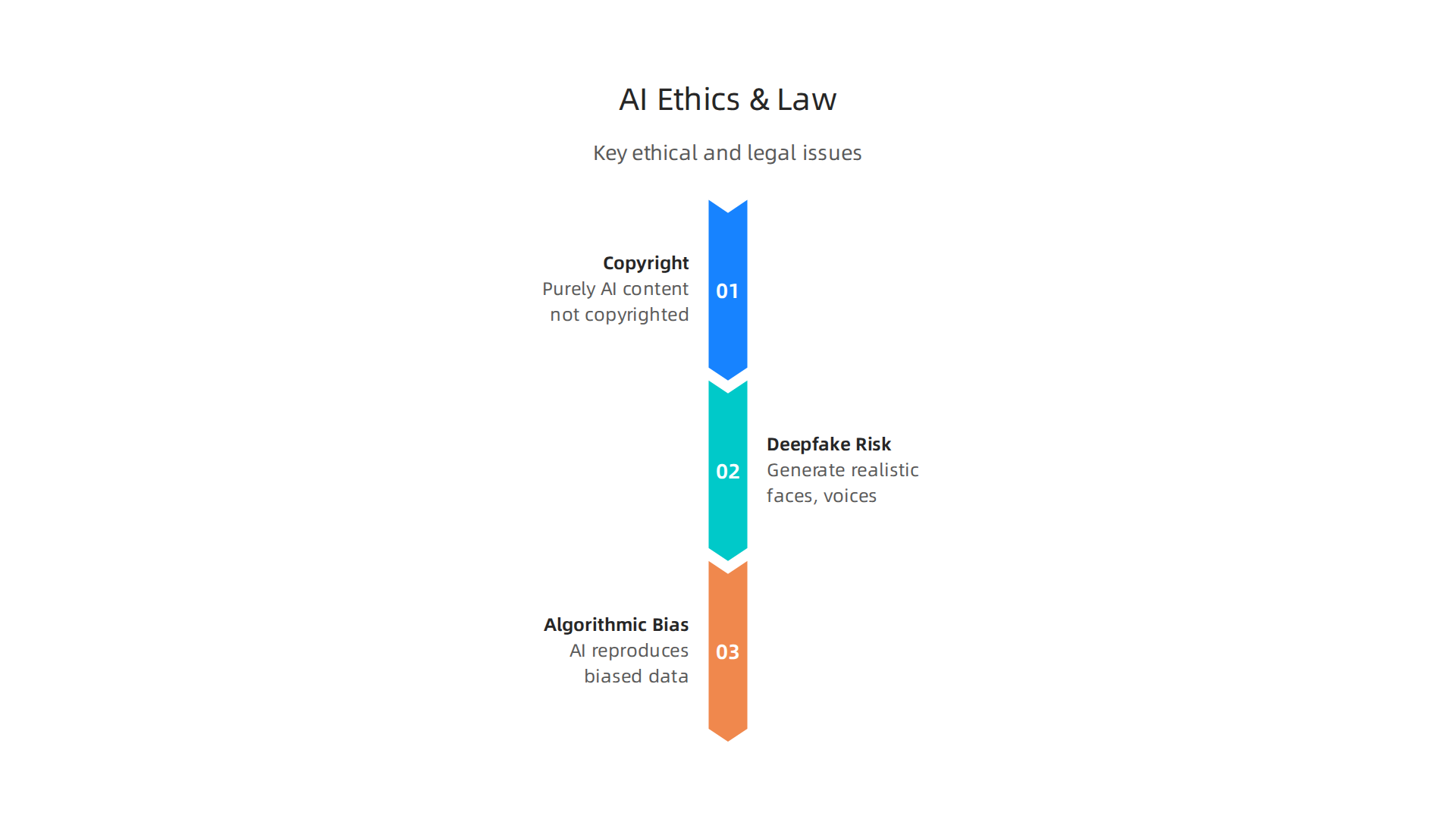
When you can create pictures on artificial intelligence that look completely real, who owns them? And how do we know what is real anymore? These are not small problems. They affect artists, businesses, and everyday users.
The biggest issue right now is copyright. In the United States, the Copyright Office has made it clear that purely AI-generated content cannot be copyrighted (source).

The law says copyright needs human authorship. So if you type a prompt and an AI makes an image, you do not own that image in the traditional sense. Courts are now working through dozens of lawsuits about this (source). Some argue the person writing the prompt should have rights. Others say the AI company owns the output. And some think no one owns it at all. You can see a full breakdown of where things stand in 2026 (source).
This is not just a legal gray area. It is a real problem for anyone creating videos on artificial intelligence for their business. If you make a video ad with AI, can you stop someone else from copying it? Right now, the answer is not always clear. That is why checking licensing terms on every tool you use is so important (source).
Then there is the deepfake problem. AI can now generate realistic faces, voices, and movements. That is amazing for creativity. But it is also dangerous for trust. Companies and regulators are pushing for better watermarking standards. The idea is to tag AI-generated content so viewers know what they are looking at. Some tools already do this automatically. Others do not. As a user, you should look for platforms that include transparent labels on their artificial intelligence images.
Bias is another issue that does not go away. AI models learn from data. If that data has bias, the AI will reproduce it. That means some artificial general intelligence images might represent certain groups poorly or leave others out entirely. Active work is needed to fix this. You have to review what the AI produces and make sure it matches your values.
These challenges are real, but they are not reasons to avoid AI. They are reasons to stay informed. The rules are changing fast. What is allowed today might not be tomorrow.
Want to keep up with the latest on AI law, ethics, and trends? Get Free Updates from The Deep View Newsletter and get daily insights delivered to your inbox.
Strategic Business Impact: Turning AI Imagery into Competitive Advantage
Even with all the legal and ethical questions we just covered, one thing is clear in 2026. Businesses are not waiting around. The smartest ones are finding huge advantages with pictures on artificial intelligence.

The numbers tell the story. The market for artificial intelligence images is on fire. Reports show the AI image generator market is expected to hit around $12.4 billion in 2026, with hundreds of millions of images created daily (source). This growth is happening for a simple reason. It saves serious money and time.
Slashing Costs and Production Time
Think about how much a traditional photoshoot costs. The location, the model, the photographer, the editing. It can take weeks. Now imagine generating that same high-quality product shot or marketing banner in minutes. Companies are reporting cost reductions of 50% to 90% for specific visual tasks. A marketer who needed a week to get a campaign asset now has it in an hour. That speed is a massive competitive edge. It lets teams test more ideas and react to trends instantly.
Hyper-Personalization at Scale
Here is another win. AI lets you personalize videos on artificial intelligence and images for every single customer segment. A travel site can show the same hotel room with sunny weather to one user and snowy mountains to another, all generated by AI in real time. This level of personalization was impossible before. It changes boring stock photos into targeted visuals that speak directly to the viewer. The result is higher engagement and better return on investment for every campaign.
New Business Models
The opportunity goes beyond just saving time. Entirely new businesses are being built on this tech. We are seeing "AI-as-a-service" creative agencies pop up. They use generative tools to produce custom content for clients at a fraction of the traditional cost.
There are also growing marketplaces for synthetic data. Instead of collecting real photos of people or products, companies buy AI-generated datasets to train their own computer vision models. This is faster and often solves some of the bias and privacy issues we talked about earlier.
The businesses that figure out how to use these tools effectively, while staying on the right side of the law, will have a huge advantage in the coming years.
Want to stay ahead of the curve? Subscribe Free to The Deep View Newsletter and get daily AI insights delivered to your inbox.
Future Trends: What’s Next for AI-Generated Multimedia?
The business advantages are clear today, but the real excitement is what comes next.
By 2026, the tools are already getting smarter fast. Experts predict that the impact of superhuman AI will be enormous, possibly exceeding the Industrial Revolution (source). That speed of change is about to reshape how we create pictures on artificial intelligence and everything around them.
End-to-End Multimodal Generation
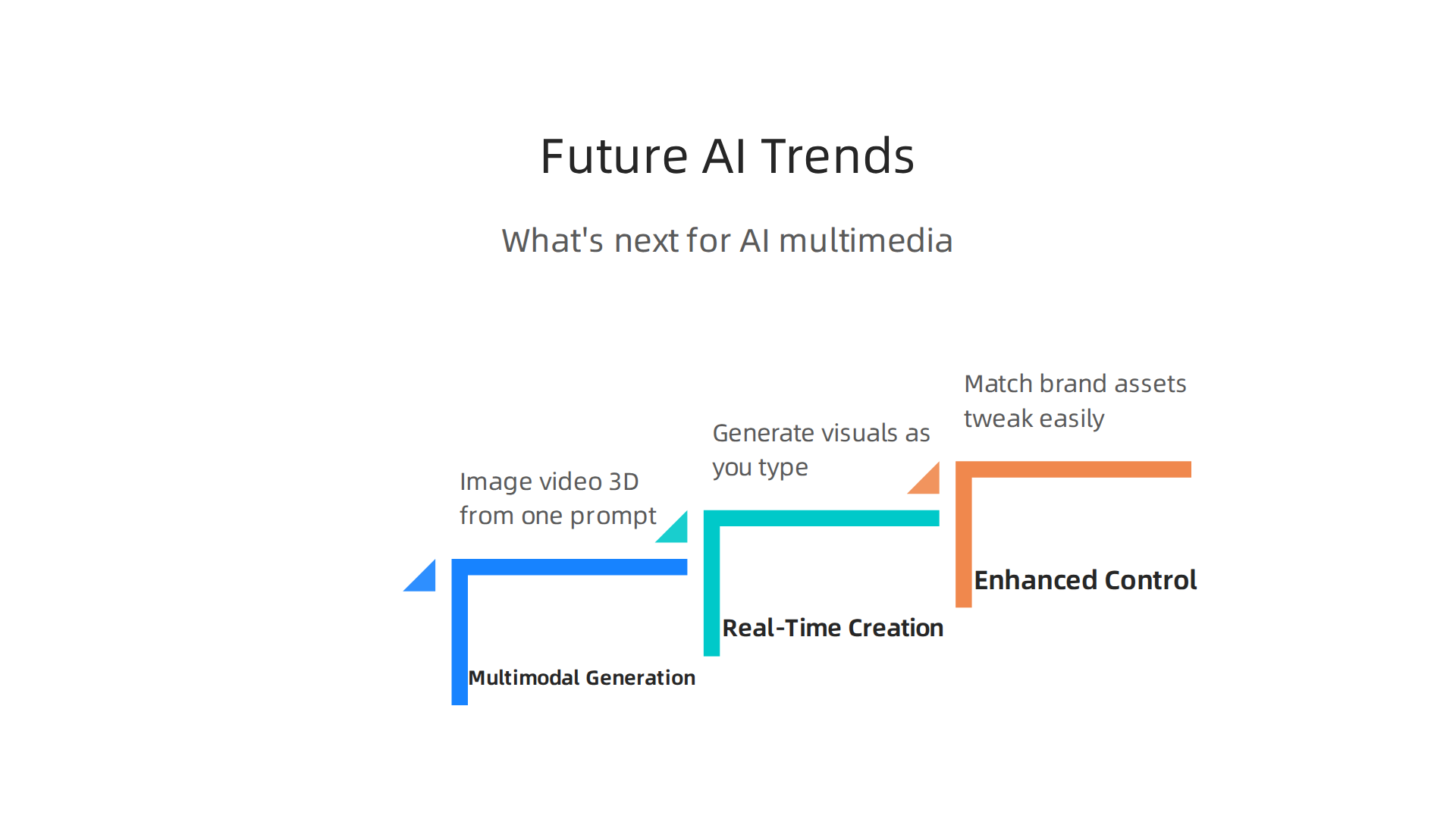
Right now, you might use one tool for an image and another for video. That is changing. The next wave is one single pipeline that takes a text prompt and produces an image, a video, 3D models, audio, and even voiceover all at once. Imagine typing "a rainy street in Tokyo at night" and getting a full video clip with sound and a 3D version you can rotate. This is already in development. It will make creating artificial intelligence images and videos on artificial intelligence feel seamless and fast.
Real-Time Interactive Generation
Another huge shift is real-time generation. Instead of waiting minutes for an image, you will see it appear as you type. For virtual worlds and live events, this means AI can build scenes on the fly. Think of a concert where the visuals change based on the music, or a video game where the landscape creates itself around you. This kind of interactive generation will change how we experience entertainment and training.
Better Control for Brands
Finally, the biggest focus in 2026 is making these tools more predictable. Companies want artificial general intelligence images that match their exact brand colors, logos, and style guides. The new tools will let you edit and tweak an AI image as easily as you edit text. You will be able to say "change the background to blue" or "make the product 20% bigger" and get instant results. This means much more controllability and editability, so brands can keep their look consistent across every piece of content.
The future of AI-generated multimedia is about making everything faster, more interactive, and more usable for real business needs.
Want to stay ahead of these fast-moving trends? Get Free Updates from The Deep View Newsletter and get simple daily AI insights that help you prepare for what is next.
Summary
This article gives a practical, business-focused overview of AI-generated images, videos, and 3D content in 2026, explaining how rapid advances are changing creative workflows and industries. It summarizes market size and growth estimates, then breaks down the core technologies—diffusion models, transformer architectures, NeRF and 3D splatting—and how they power modern image, video, and text-to-3D tools. The piece reviews real-world applications in marketing, healthcare, gaming, and e-commerce, shows where the technology already saves time and cost, and points out current limits like editability and long-duration video consistency. It also covers legal and ethical risks such as copyright, deepfakes, and bias, and offers practical advice for businesses seeking competitive advantage. Finally, the article outlines near-term trends—end-to-end multimodal pipelines, real-time generation, and better brand control—that will shape how teams create and deploy AI multimedia.