
Why comparing AI and human capabilities matters for business leaders in 2026
In 2026, artificial intelligence, or AI, is changing how businesses work every day. From helping with simple tasks to handling huge amounts of data, AI tools are everywhere. But here’s the thing: even with all the amazing progress in AI, it’s really important for business leaders to understand where AI shines and where humans still have the upper hand. It’s not always an "ai or human" choice. Sometimes, it’s about how they work best together.
We need a realistic view of AI’s skills. AI is super good at things like processing lots of information very quickly and finding patterns that humans might miss. For example, AI models have shown strong performance in many technical tasks, like understanding images and text, as highlighted in the Technical Performance report from Stanford University. It can sort data, answer specific questions, and even give feedback on learning materials. However, when it comes to deeper understanding, especially in complex areas like high-level math or social situations, humans still outperform AI by a lot. AI currently struggles with social cognitive tasks, meaning how we understand feelings and social cues Performance Gaps in AI Social Cognition.
This difference matters a great deal for executives, investors, and business operators. If you’re a business leader, you need to make smart, practical decisions about where to use AI and how to plan for the future.

Understanding the strengths and weaknesses of each helps you invest wisely and avoid problems. For instance, putting AI in charge of everything might not always lead to the best results, especially in areas needing human judgment or ethical thinking. In fact, some issues in science and technology show that human-AI teams can sometimes do worse than humans or AI working alone, especially for decisions. This is why a nuanced view is key for your business strategy in 2026. Knowing where human skills are irreplaceable can also help you develop your team and make sure your company uses technology responsibly. You can learn more about how AI is reshaping the world in our World of AI in 2026 guide.
To keep up with these fast-changing insights and make the best decisions for your business, you need reliable information.
Get clear daily AI updates from The AI Newsletter Worth Reading.
Core capability differences: What AI does better (and why)
To make smart decisions, it’s key to have a realistic view of what AI can truly do. While the previous section touched on AI’s ability to process lots of information, let’s dive deeper into where AI really shines when we compare it to human skills. It’s not always an "ai or human" competition, but rather understanding specific tasks where AI has a clear advantage.
AI is incredibly good at certain tasks because of how it processes information. Think about these main strengths:
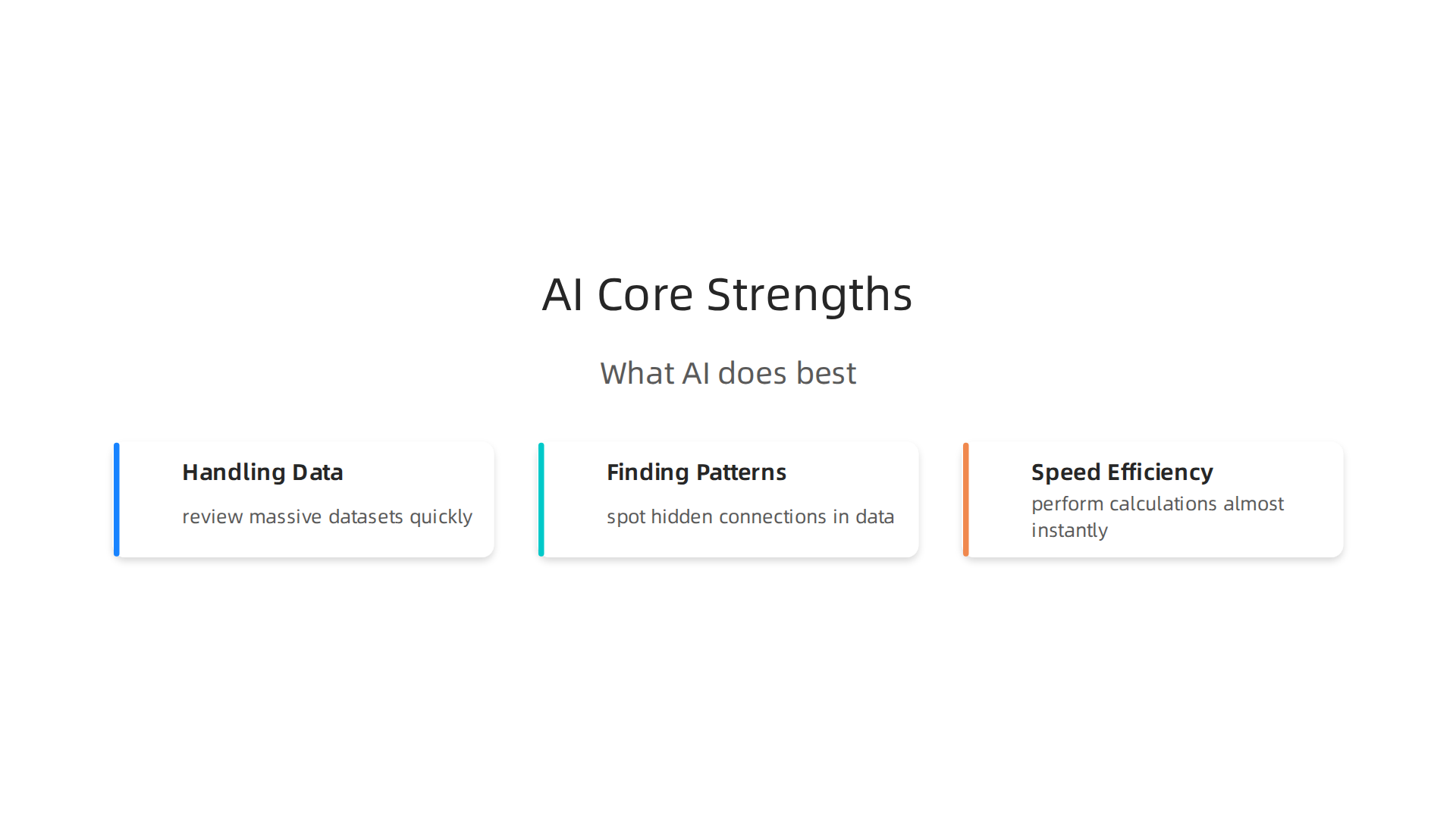
- Handling huge amounts of data: AI systems can quickly go through and make sense of massive datasets that would take humans ages to review. For example, in fields like medicine, AI can analyze countless medical images or patient records much faster than a team of doctors, helping to find important details. This ability to process data at scale is a huge benefit.
- Finding patterns: AI is designed to spot hidden patterns and connections in data. This is true even if the patterns are too complex or tiny for a human to notice. This skill is vital in everything from spotting fraud in financial transactions to predicting market trends. For instance, AI benchmarks help measure how well AI models find these patterns, especially in vision tasks Benchmark your model on out-of-distribution datasets with carefully collected human comparison data.
- Speed and efficiency: AI works at lightning speed. It can perform calculations and make decisions almost instantly, without getting tired or needing breaks. This makes it perfect for tasks that need constant monitoring or quick responses, like managing traffic flow or optimizing logistics. AI tools are increasingly being evaluated for their performance in real-world applications, showing impressive accuracy in areas like evaluating AI performance in systematic literature reviews.
These advantages come from the way AI works internally. AI uses powerful algorithms that allow it to do many things at once, a process called parallelization. It can also continually learn and improve, which is known as optimization. This means that with more data and practice, AI tools can get even better at their tasks, often outperforming humans in areas that require high precision and tireless effort. This constant learning and improvement is a core part of modern artificial intelligence basics.
When we talk about what AI does better, it’s often about these core capabilities. Humans, on the other hand, excel in areas that require empathy, creativity, and common sense, which we will explore next. Understanding these differences helps business leaders deploy AI in the most effective ways, creating stronger teams and better outcomes.
Human strengths that matter: judgment, context, creativity, and moral reasoning
While AI truly shines in crunching numbers and finding patterns super fast, it’s also important to remember what humans do best. When we look at the question of "ai or human," it’s clear that people have unique strengths that machines just can’t copy, at least not in 2026. These human skills are about understanding the world in a deeper, more thoughtful way.
Common Sense and Context
One big difference is common sense. This is our ability to understand things that aren’t spelled out for us. For example, if you say "I’m going to the bank," a human knows if you mean a river bank or a money bank based on other clues. AI struggles with this kind of everyday understanding. It doesn’t have the same "world knowledge" or hidden rules that humans use all the time.
Humans are great at looking at a situation and figuring out what’s really going on, even when things are complicated. This is called complex contextual inference. We can pick up on small details, body language, or the tone of a voice to understand the full picture. AI, even with all its advances in understanding tech culture, often misses these subtle clues.
Moral Judgment and Ethics
Another area where humans clearly lead is moral judgment. This is our ability to decide what is right and wrong. AI can follow rules that we give it, but it doesn’t truly understand why something is good or bad. Making moral choices involves feelings, values, and seeing how our actions affect other people Moral Thinking.
These kinds of decisions are vital for society and business, especially when facing new issues in science and technology. For example, deciding how self-driving cars should react in an accident or how data should be used responsibly requires human ethical reasoning, not just fast computing. It’s about more than just processing data; it’s about wisdom. Research also shows how different ways of thinking affect our moral judgments The Effect of Cognitive-Processing Manipulations on Moral Judgment.
Creativity and Original Ideas
When we think about creativity, humans bring something truly special.

While AI can create art or music based on what it’s learned, true human creativity comes from imagination, personal experiences, and a deep desire to make something new and meaningful. It’s about pushing boundaries and inventing things that have emotional depth. Creativity is also linked to critical reasoning, which helps us come up with original ideas Creativity as Central to Critical Reasoning and the Facilitative Role of Moral Education.
For example, a human artist feels something and then creates. An AI can combine existing styles, but it doesn’t have feelings or a life story that drives its art. This is why when we think about breakthrough innovations or truly moving works, it’s a human touch that often makes the biggest difference.
How These Strengths Help Businesses
These human strengths are not just for everyday life; they are key in the business world.
- Negotiation and Leadership: Imagine a tough business negotiation. This needs empathy, the ability to read people, make fair judgments, and build trust. AI can help with data, but it cannot truly lead a team, inspire people, or build deep relationships. Human social skills are essential here Part Iv: Social Capacities.
- Creative Strategy: Developing a new product, planning a big marketing campaign, or setting a company’s long-term vision requires human insight. You need to understand what people want, how culture is changing, and predict future trends that aren’t just based on past data. This is where human creativity really shines. Even with many advancements in AI research, a truly realistic AI can’t replace this human flair for creative strategy.
The question isn’t really "ai or human," but how AI and humans can work together. By understanding what each does best, businesses can create stronger teams and achieve better results in 2026.
Want to keep up with the latest in artificial intelligence and how it affects business?
Stay informed and get smarter about AI.
The AI Newsletter Worth Reading
We just talked about how humans are great at things like common sense, making moral choices, and coming up with new ideas. But it’s also true that AI is not perfect. While it’s super powerful, AI can make mistakes or fail in ways that humans usually don’t. Knowing these weak spots helps us understand why the question isn’t always "ai or human," but how they can best work together. Let’s look at some ways AI can stumble.
When AI Makes Big Mistakes: Hallucinations
One common problem for AI, especially the smart language programs, is something called "hallucinations." This is when an AI makes up facts or information that sounds real but is completely false. It’s like it’s dreaming up answers. For example, an AI might tell you about a book that doesn’t exist or give wrong medical advice. This isn’t just a small error; it can cause real harm or big problems if businesses rely on this false information. The International AI Safety Report 2026 highlights that failures like producing fabricated information can indeed lead to harm.
The Problem of Distribution Shift
Imagine you train an AI to recognize cats in perfect, sunny pictures. What happens if you then show it pictures of cats taken at night, in the rain, or with filters? The AI might get confused and not recognize them. This is called "distribution shift." It means the new information it sees is very different from the information it learned from. Because of this, even a very powerful AI can become unreliable in new situations it wasn’t trained for. This is a common issue that makes AI models less robust to changes in the real world, as noted in a survey on embodied AI.
Tricking AI: Adversarial Inputs
Another tricky problem is called "adversarial inputs." This is when someone purposely changes data in a small way to fool an AI. These changes might be so tiny that a human wouldn’t even notice them. But for an AI, these small tweaks can make it give totally wrong answers. For example, a tiny sticker on a stop sign could make a self-driving car think it’s a speed limit sign. This kind of attack is a big concern for the safety and security of AI systems, and it’s something experts are always studying in AI research. Learning how AI systems are built and what makes them tick can help us understand these challenges better, for instance, by exploring the types of artificial intelligence explained.
Real-World Problems and Business Impact
These failure modes are not just theoretical problems; they have real consequences for businesses and people in 2026.
- Reliability: If an AI used in customer service starts "hallucinating" or giving wrong answers, customers will lose trust.
- Safety: In critical areas like healthcare or transportation, an AI failing due to adversarial inputs or distribution shift can lead to dangerous situations.
- Business Costs: When AI systems make mistakes, companies can face extra costs, lost time, and damage to their reputation. A study found that AI incidents have risen a lot, now making up 1 in 10 technology incidents and causing big problems like data loss or system shutdowns. Some companies even face losses of over $1 million per hour during IT incidents. The first half of 2026 saw many such incidents, including hallucinations that reached customers and prompt injections that exposed data, showing these are serious AI Incidents that need close attention.
Because of these issues, it’s very important for companies to be transparent about how their AI systems work and what their limits are. Rules about this are becoming more common, like the Guidelines on transparency obligations for providers that began to apply from August 2, 2026, under the AI Act. This highlights the ongoing issues in science and technology that require careful thought.
Understanding these limitations is key to using AI wisely. It helps us remember that while AI is a great tool, it still needs human oversight and smart design to be truly effective and safe.
Understanding these limitations is key to using AI wisely. It helps us remember that while AI is a great tool, it still needs human oversight and smart design to be truly effective and safe. Now, let’s talk about the important ethical decisions we face when using AI.
Ethical Trade-offs: Bias, Accountability, Transparency, and Fairness
When we compare AI or human abilities, especially in tough situations, ethical questions often come up.

These questions are about making sure AI systems are fair, open, and that someone is responsible when things go wrong.
The Problem of Bias in AI
One big ethical challenge with AI is bias. AI learns from data, which is information fed into it. If this data has hidden biases, the AI will learn them too. For example, if an AI is trained mostly on pictures of people from one group, it might not recognize people from other groups as well. This means the AI might treat different people differently, which is not fair.
Humans, on the other hand, can usually think about fairness and adjust their decisions based on moral understanding, even if they have their own biases. AI doesn’t have common sense or a moral compass in the same way. It just follows the patterns it learned. This is a crucial difference when we think about how to build a realistic AI that serves everyone fairly.
Why Transparency Matters: The "Black Box" Problem
Another ethical concern is transparency. Many advanced AI models are like a "black box." It means we can give them input and get an output, but it’s hard to see how they reached that answer. Imagine an AI denies someone a loan or medical treatment. If a human made that decision, they could explain their reasons. But with AI, it can be very difficult to understand the exact steps or logic it used.
This lack of explainability makes it hard to trust AI, especially in important areas. Companies need to be able to show how their AI systems make choices. New guidelines, like the European Commission’s guidelines on transparency, which started to apply in August 2026, aim to help businesses meet these requirements for certain AI systems, including generative AI and deepfakes. These rules require providers to be clear about how their AI works and its limits, as highlighted in the Commission’s guidelines on transparency obligations.
Accountability: Who’s Responsible?
When an AI makes a harmful mistake, who should be held responsible? Is it the person who designed the AI, the company that used it, or the AI itself? Since AI doesn’t have feelings or legal standing, this becomes a complex question. Humans are accountable for their actions and can be judged based on their intentions. For AI, we need clear rules and frameworks to decide who is accountable when things go wrong. This is one of the big issues in science and technology that experts are working on.
Building Ethical AI: Decision Frameworks
To tackle these ethical trade-offs, companies and governments are creating rules and plans. These plans are called AI governance frameworks. They help decide what is fair, transparent, and how to assign responsibility when using AI. Key principles for these frameworks often include sustainability, safety, accountability, fairness, and explainability, as noted in various AI Governance Frameworks.
These frameworks help guide:
- Design: Making sure AI is built with fairness in mind from the start.
- Testing: Checking AI for biases before it’s used in the real world.
- Monitoring: Watching AI as it works to catch any unfair or wrong actions.
- Oversight: Having humans in charge to review and approve important AI decisions.
Groups like NIST have also expanded their AI Risk Management Framework in 2026, especially for important sectors like critical infrastructure. This shows how seriously everyone is taking the need for responsible AI use.
Staying informed about these ethical considerations and the latest developments in AI governance is vital for anyone working with technology today. If you want to keep up with these important conversations, consider subscribing.
Get clear daily AI updates from The AI Newsletter Worth Reading.
When we think about making AI and humans work together, we need to design smart systems. It’s about figuring out the best ways for people and computers to team up. This is where we talk about different ways to build these hybrid systems and how to manage them well.
Designing Human+AI Systems: Complementary Workflows and Governance
Working with AI means finding the right balance between what the AI does and what humans do. It’s not always about letting AI do everything. Often, the best results come from a partnership. There are a few main ways we can set up this teamwork.
How Humans and AI Can Work Together
Imagine AI as a helpful assistant. Sometimes the assistant needs your approval for every step, sometimes it works on its own and you just check in, and sometimes you just give it general directions. This is like the different "loops" of human involvement.
-
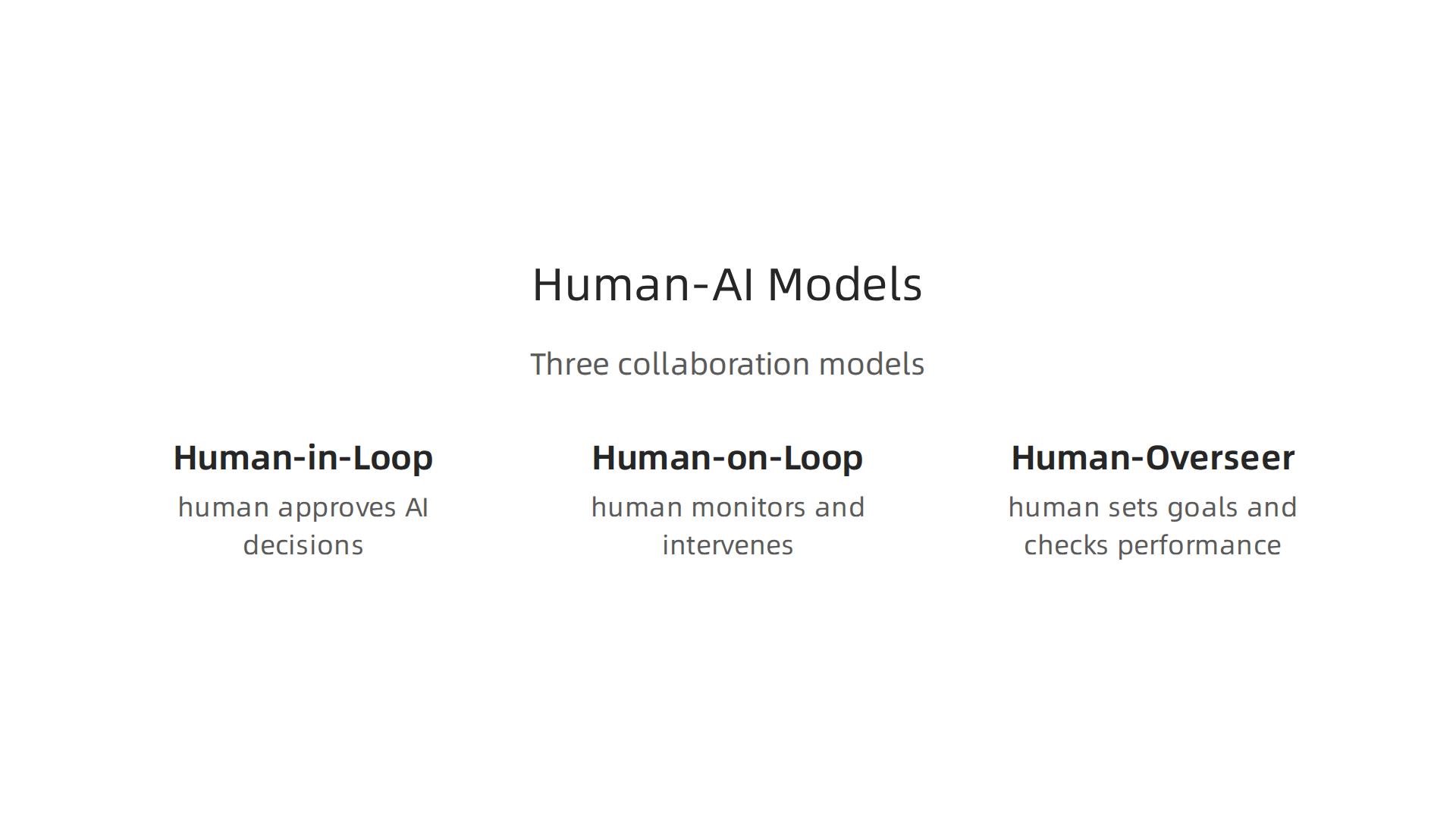
Human-in-the-Loop (HITL): This means a human is directly involved in many or all of the AI’s decisions. The AI might suggest something, but a human must approve it before it happens. This is very important for big or risky decisions, like in healthcare or law. For example, an AI might help a doctor suggest a treatment, but the doctor always makes the final call. This approach brings human judgment into the AI process, especially for high-impact choices, as highlighted by experts discussing Human-in-the-Loop AI and Governance Frameworks. Companies need to make sure humans have real power to step in, fix, or change what the AI suggests. Integrating human judgment into AI applications in a systematic way is key, giving humans clear roles and decision power throughout the process to guide the AI’s behavior, as explained in research on Human-in-the-Loop Themes in AI Application Development. For businesses using AI, having strong human controls is essential, like setting up clear paths for problems to reach a human and keeping records of any changes made, as discussed in the Enterprise Case for Human in the Loop AI Controls.
-
Human-on-the-Loop (HOTL): Here, the AI can make decisions and take actions on its own. But a human is always watching what the AI does, ready to step in if there’s a problem after the AI has acted. This works well for situations where speed is important, and mistakes can be easily fixed. Think of an AI sorting emails; it does the job, and you can correct any errors later. This approach lets AI work by itself while a human checks the outcomes and can fix things if needed, especially in situations that aren’t too risky and where mistakes can be undone, according to a 2026 Guide to AI Oversight.
-
Human-Overseer: In this setup, the AI mostly runs things on its own. The human sets the overall goals and rules, then regularly checks the AI’s general performance to make sure it’s doing what it should. This is good for tasks that are low-risk and happen often, like an AI managing a factory’s temperature.
Choosing the right design, whether it’s more "ai or human" focused, depends on how critical the task is, how fast decisions need to be made, and how much a mistake would cost. To truly understand these differences, it helps to learn about the Artificial Intelligence Basics Our Clear Guide To How AI Works In Everyday Life.
Keeping Humans in Charge: Governance Mechanisms
Even with AI doing more, humans must stay accountable. This is where governance comes in. It’s about setting up rules and checks to make sure AI systems are used safely and fairly.
- Auditing AI: This means regularly looking at how the AI makes decisions and whether its actions match our rules. It’s like checking a company’s books to make sure everything is correct.
- Monitoring Performance: We need to keep an eye on AI systems as they work. This involves tracking how well they perform, if they are making errors, or if they are showing any unfair biases. We can measure things like how many tasks the AI finishes on its own or how often a human has to step in, as explained in guides on Measuring AI Automation Success and KPIs Beyond Hours Saved. Good monitoring helps us see if the AI is meeting its goals and avoiding problems.
- Escalation Protocols: What happens when an AI encounters something it doesn’t know how to handle, or if it makes a serious error? We need clear steps for the AI to "hand over" the problem to a human expert. This ensures that no critical issue falls through the cracks.
- Preserving Human Accountability: No matter how smart an AI is, humans are ultimately responsible for its actions. This means that someone must always be the named owner who can act on problems and make sure corrections happen. Simply having a "human in the loop" isn’t enough; strong governance means having clear accountability, as an IBM insight explains on why Human in the Loop Alone Is Not a Governance Strategy.
By carefully designing these systems and putting good governance in place, we can make sure that AI helps us in powerful ways without losing human control or responsibility. This helps us to develop a truly realistic ai for the future. Learning more about the World of AI in 2026 Technologies Trends and What Comes Next can help you stay current with these important trends.
Now that we know how to set up AI systems and keep them well-managed, the next big question is: when should we use AI? And how much "ai or human" involvement is best for a task? It’s not always about fully automating everything. Sometimes, AI can help humans do their jobs better, and sometimes, a task needs to be done only by a person.
Practical Decision Framework: When to Automate, Augment, or Retain Human Control
Deciding the best way to use AI means thinking about a few key things.

This simple checklist can help you figure out if a task is better for full AI automation, for AI helping humans (augmentation), or if it should stay purely human-controlled.
Decision Checklist for AI Use:
- How important is speed?
- If a task needs to be done very, very fast, like sorting thousands of emails in minutes, AI can often automate it.
- If speed is helpful but not critical, AI can augment human work to make it quicker.
- If speed isn’t the main goal, and careful thought is more important, a human might be best.
- What if a mistake happens? (Risk and Ethics)
- If a small mistake doesn’t cause a big problem, AI can often handle the task alone. Think about an AI suggesting products to buy online.
- If mistakes could be somewhat bad but easily fixed, AI augmentation with a human checking might work.
- If a mistake could be very dangerous, unfair, or illegal (like in healthcare or legal advice), then a human must be fully in charge. This touches on serious issues in science and technology regarding AI.
- How much does it cost?
- Setting up AI can be costly at first. If the task is simple and happens often, AI automation can save money over time.
- If the task is complex and needs human brains, humans might still be cheaper or more effective.
- Does the task need human judgment or creativity?
- Tasks that are very routine and have clear rules are good for AI to automate.
- Tasks that need new ideas, deep understanding of feelings, or tricky decisions are usually best for humans, perhaps with AI tools to help them.
- Is there a lot of good data for the AI to learn from?
- AI learns from data. If there isn’t much data, or the data isn’t good, AI might struggle. This is a common challenge in ai research.
Understanding the Trade-offs
Every choice about using AI comes with trade-offs.
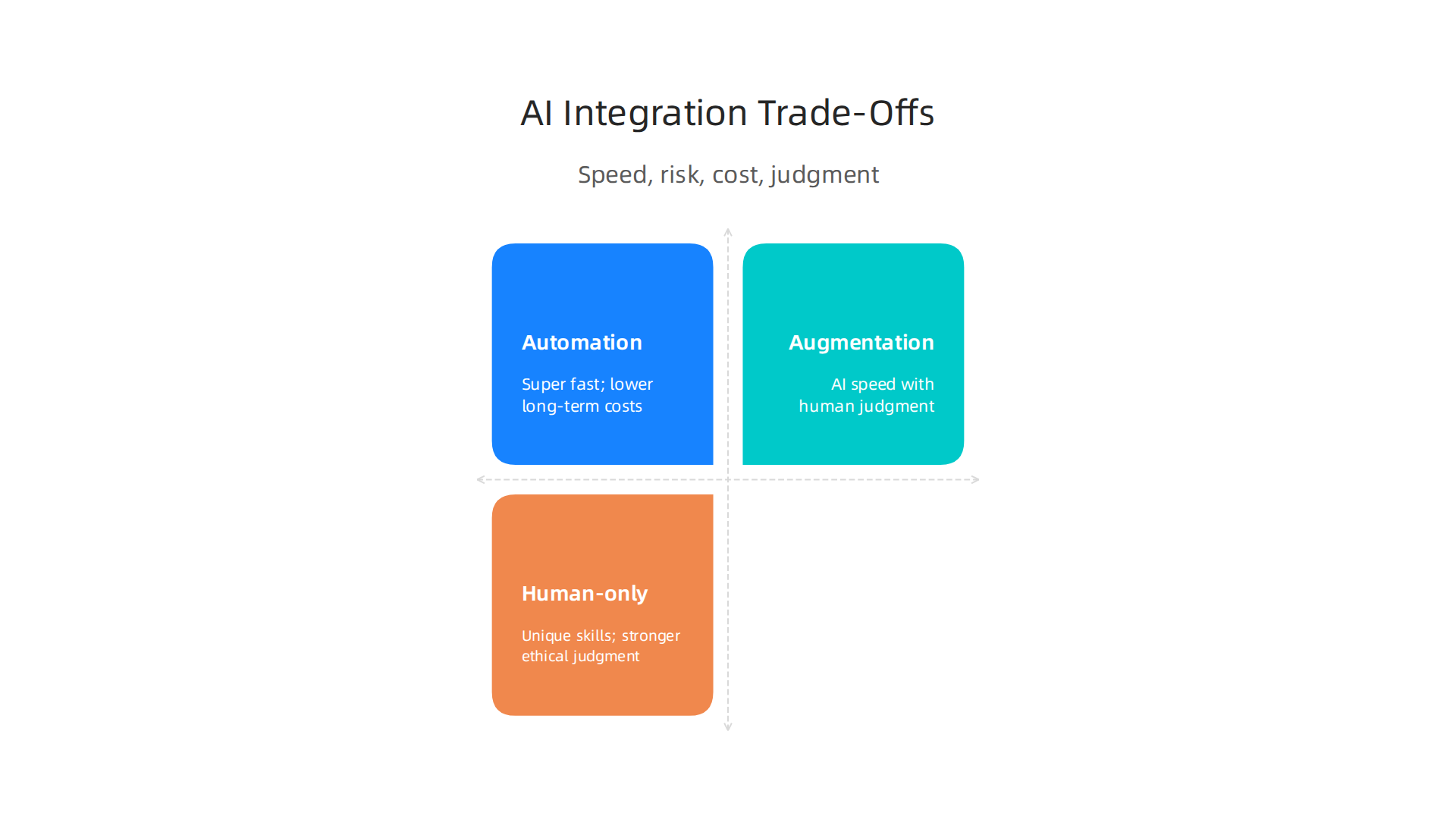
- Automation: Can be super fast and lower long-term costs. But it carries higher risk if the AI makes a mistake, and it may lack human understanding.
- Augmentation: Combines AI’s speed with human judgment. This often leads to better quality and keeps ethical concerns lower, but might not be as fast or cheap as full automation.
- Human-only: Best for tasks needing unique human skills, strong ethics, or very low risk. It can be slower and more expensive, but offers the highest level of control and responsibility.
Who is Affected? (Stakeholder Considerations)
When making these decisions, think about everyone involved. How will it affect your team? Your customers? Society as a whole? Making sure decisions are fair and transparent helps build trust, which is important for creating truly realistic ai solutions.
Staying informed about the latest developments in AI and how other businesses are finding the right "ai or human" balance is key.
Get clear daily AI updates to help you navigate these choices.
The AI Newsletter Worth Reading
Summary
This article explains why business leaders in 2026 need a realistic comparison of AI and human capabilities to make better operational, strategic, and ethical decisions. It outlines the core strengths of AI—speed, large-scale data processing, and pattern detection—alongside the human advantages of common sense, moral judgment, creativity, and leadership. The piece reviews common AI failure modes (hallucinations, distribution shift, adversarial inputs), the real-world business risks those failures create, and new transparency and accountability requirements. It then describes how to design human+AI systems (human-in/on-the-loop and overseer models), governance practices like monitoring and audits, and a practical checklist to decide when to automate, augment, or keep tasks human-led. Readers will finish with a clear framework for where to invest in AI, how to preserve human control, and how to reduce ethical and operational risk.