Why AI detection and verification matter now
It seems like artificial intelligence (AI) is everywhere in 2026, creating all sorts of content. From articles and reports to marketing messages, AI tools are making writing faster and easier. But this also brings up a big question: How do we know if the words we read were truly written by a person, or if they came from a computer?

This is why AI detection and verification have become so important today.
Knowing if content is AI-made is a crucial step for many reasons. For businesses, it is about keeping trust with customers and making sure the quality of information is high. Imagine a company publishing important reports; readers need to know those words come from human experts, not just a program. For schools, AI detection helps ensure that students are doing their own work and learning properly. For legal or medical fields, confirming human creation can be a matter of compliance and safety. Simply put, it helps us all know what information we can truly believe and rely on.
This challenge has made finding the most accurate AI detector a top priority for many organizations. It’s not always easy, because AI models like those from OtherHalf AI, DeepBrain AI, and Augment AI keep getting smarter, making their generated content harder to spot. Even companies like AI Foundry are working on ways to create and identify AI text. Research in 2026 shows that while deep learning models are getting better at spotting AI-generated text, their accuracy can still vary, sometimes dropping to 60-75% when facing tricky AI inputs A Systematic Review of AI-Generated Text Detection.
In this article, we will help you understand the world of AI content and how to tell the difference between human and machine writing. You will find an easy-to-understand comparison of the top AI detection tools and learn how they actually work. We will also show you real-world steps for checking content, especially for businesses, so you can make smart choices about using these new technologies.
To keep up with all the fast changes in AI, you might find The AI Newsletter Worth Reading very helpful. If you want to learn more about the big picture of how AI is changing things, check out our guide on the world of AI in 2026.
Why organizations need AI detection and verification
Beyond the general need for trust, organizations face specific and serious challenges if they don’t use AI detection properly. For businesses, getting it wrong can lead to costly mistakes.

For example, a "false positive" happens when a human-written document is wrongly flagged as AI-generated. This can cause legal issues or hurt a company’s good name, especially if it means wrongly accusing an employee of not doing their own work or rejecting important client projects.
On the other hand, a "false negative" means AI-generated content slips through, appearing as if a person wrote it. This can be very risky. Imagine a company using content from AI models like OtherHalf AI or DeepBrain AI that contains incorrect information or shows bias. If this content is published without human review and verification, it could damage the company’s reputation and trust with its customers. It can also lead to operational problems if decisions are made based on unverified AI text. A report from 2026 highlights that the real-world accuracy of AI content detectors can vary, often falling in the 66-92% range, depending on the tool and the type of text checked
AI Content Detector Report 2026: 70+ Sourced Stats. This means there’s always a chance of these false results.
Many industries, especially those dealing with sensitive information like legal, medical, or finance, now have strict rules. These rules or "regulatory expectations" demand that content is verified to be human-created. Also, clients often expect to know that the information they receive comes from human experts, not just a program. This push for clear verification means organizations must find the most accurate AI detector to meet these standards. Even as companies like Augment AI and AI Foundry push the boundaries of AI content creation, the need for reliable detection only grows. This ensures that organizations can safely use new technologies while keeping trust and meeting important rules. To understand more about how businesses can best use AI tools, you might want to learn how to maximize business impact with enterprise AI platforms.
When we talk about how good an AI detector is, we look at special numbers called accuracy metrics. These numbers help us understand how well a tool like the most accurate AI detector can tell the difference between human-written and AI-generated text.
Here are some important metrics and what they mean:
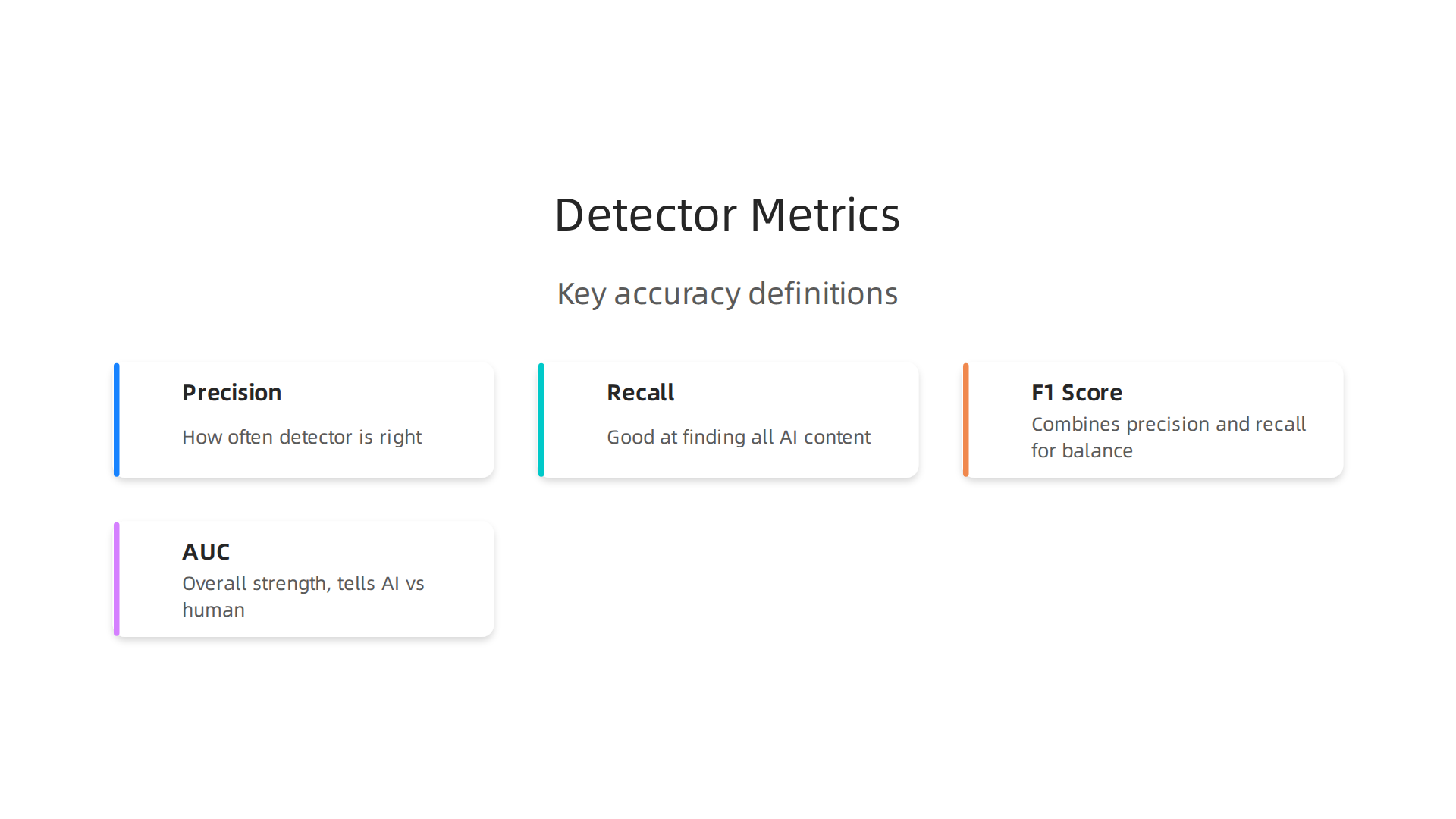
- Precision: This tells us how often the detector is right when it says something is AI-generated. If a detector has high precision, it means that most of the time it flags content as AI, it truly is AI. This helps avoid wrongly accusing a human of using AI, which is known as a false positive.
- Recall: This metric shows how good the detector is at finding all the AI content out there. If a detector has high recall, it means it catches most of the AI text. This helps stop AI-generated content from slipping through, which is called a false negative.
- F1 Score: This number combines both precision and recall. It gives us a single score that shows a good balance between catching AI content and not making mistakes about human content. A high F1 score means the detector is strong in both areas.
- AUC (Area Under the Curve): This is another way to see the overall strength of a detector. It shows how well the detector can tell the difference between AI and human text across all possible outcomes. The closer the AUC is to 1, the better the detector is.
While these numbers are helpful, real-world accuracy can be tricky. For example, some tests show that deep learning models are good at detecting AI text, with one study showing about 82.87% accuracy with a simpler method, but deep learning does better AI Generated Text Detection. However, what a detector does in a lab might not be the same as in daily use.
Why Real-World Accuracy Can Change
Several things can make a detector less accurate in the real world:
- Dataset Composition: Detectors learn from examples. If the examples they learn from are very simple or do not match the real kinds of text people want to check, the detector might not work as well. Researchers often use large sets of text, like HC3 or DAIGT v2, to train and test these tools AI Text Detection Methods. But real-life content from tools like OtherHalf AI or DeepBrain AI can be different.
- Adversarial Examples: These are special texts made by AI that are designed to trick detectors. They are like puzzles meant to fool the system. Studies show that detection accuracy can drop a lot when faced with these tricky examples A Systematic Review of AI-Generated Text Detection.
- Prompt Engineering: This means changing the way people ask AI tools like Augment AI or AI Foundry to write. By giving very specific instructions, the AI can create text that looks more human and is harder for detectors to spot.
It’s clear that finding the most accurate AI detector means looking beyond simple numbers. It requires understanding how these tools perform against smart AI text and real-world challenges.
Want to stay on top of all the latest AI developments?
Get clear daily AI updates from The AI Newsletter Worth Reading.
Finding the most accurate AI detector is not just about looking at simple numbers. It also means understanding the many tools available today, in 2026, and how they try to solve the challenge of spotting AI-generated content. The market for these tools is growing fast, with many companies offering different ways to check text.
How AI Detection Tools Are Grouped
AI detection tools can be put into different groups based on how they work and where they are used:
- Cloud APIs: These are like online services you can connect to from your own computer programs. They are easy to use and good for smaller businesses or for adding AI detection into other software.
- On-Premise Solutions: These tools are installed directly onto a company’s own computers or servers. Big companies often choose these when they need full control over their data or have very strict privacy rules.
- Open-Source Detectors: These are tools where the code is freely available for anyone to use and change. They offer a lot of flexibility and grow with help from a community of users, but they might not always be as polished as paid options.
- Hybrid Verification Platforms: These platforms combine several different ways to detect AI. They might use a mix of checks to get a more reliable result, offering a more complete picture than a single method. The market for these different types of tools is expected to grow significantly by 2032, showing how important they are becoming for businesses and institutions alike

AI Detector Market – Global Forecast 2026-2032.
What Makes One AI Detector Different from Another?
Vendors, or the companies that make these tools, try to stand out in a few key ways:
- Detection Technique:
- Statistical Analysis: Some tools look for patterns in writing, like how often certain words are used or how long sentences are, to guess if a text is AI-generated.
- Machine Learning (ML) Classifiers: Many tools use smart computer programs that have been taught on huge amounts of text. These programs learn to tell the difference between human writing and AI writing, even from tools like OtherHalf AI or DeepBrain AI. This is a common way for the most accurate AI detector to work. To learn more about how AI systems are built, you can check out resources on types of artificial intelligence explained.
- Provenance: This method tries to track the origin of the text, sometimes through digital watermarks or by checking specific details about how the content was made. This can be very useful for content created by advanced AI Foundry or Augment AI models.
- Performance Claims: Every tool claims to be good, but real-world tests give us a clearer picture. For example, some reports show that tools like GPTZero and Originality.ai are often ranked among the top for accuracy in 2026, with others like Winston AI also performing well Best AI Detector: We Tested All the Top Tools for Accuracy.
- Integration Options: How easily a detector can connect with other tools or systems is also very important for businesses. Many offer APIs (Application Programming Interfaces) that let developers weave AI detection right into their existing workflows. This helps maximize business impact with enterprise AI platforms.
Tool deep dive: Detector A — strengths and limitations
Now, let’s look closely at one of the top tools. When people talk about the most accurate AI detector in 2026, GPTZero often comes up. It’s a popular choice for many, especially in schools.
How GPTZero Works and How Accurate It Is
GPTZero uses smart computer programs to look at your text. It tries to tell if a human wrote it or if an AI tool like OtherHalf AI or DeepBrain AI made it. Many tests in 2026 show that GPTZero is very good at this, with some reports saying it has an accuracy rate of 99% or even 99.6% 7 Best AI Detectors in 2026 (Tested With Real Data). It does well at finding AI-generated content and also at correctly saying when human writing is actually human 8 Best AI Detectors 2026: Free & Paid Tools Compared …. This makes it a strong choice if you want to be sure about where your text comes from.
Who Uses It and What It’s Best For
GPTZero is often seen as the best tool for educators and professionals. It’s helpful for teachers checking student papers or for anyone who needs to make sure content is truly original. It can work across different writing styles, too 10 Best AI Detectors with Highest Accuracy (Updated June ….
But like all tools, it has its limits. While it’s great for most text, some tests show it might not be perfect with very short sentences or when checking a wide mix of languages. It mainly focuses on written text and might not be the best choice for checking things like images made by AI Foundry or Augment AI models. For businesses, knowing how AI works is key. If you want to dive deeper into how different AI types function, you can explore resources on artificial intelligence basics.
To get a clearer picture of AI’s daily impact and keep up with these fast changes, consider subscribing to a dedicated newsletter.
Get clear daily AI updates from The AI Newsletter Worth Reading.
When looking at AI detectors for big companies, things get a bit different. While tools like GPTZero are great for individual use or schools, businesses often need solutions that can plug into their existing systems. This is where a detector built for "enterprise integration" shines.
Integration Capabilities
For larger organizations, a top AI detector isn’t just about spotting AI content from tools like OtherHalf AI or DeepBrain AI. It’s about how well it fits into their daily work.
- API (Application Programming Interface): Think of an API as a special code that lets different computer programs talk to each other. A good enterprise AI detector will have an API. This means it can automatically check documents as they’re made or stored, without someone having to copy and paste text.
- SIEM/PLATFORM Connectors: Many companies use big security systems (called SIEM) or other platforms to manage their technology. An AI detector with connectors can send its findings directly to these systems. This helps the company quickly see if any AI-generated content might be a risk, like from AI Foundry or Augment AI models.
- On-Prem Options: Some businesses, especially those dealing with very private or secret information, don’t want their data to leave their own computers. An "on-prem" (on-premises) option means the AI detector software and all its data live on the company’s own servers. This offers maximum control and security.
Operational Considerations
Beyond just fitting in, big companies also think about how these detectors actually run.
- Throughput: This means how much text the detector can check in a short amount of time. For a large company with many documents, high throughput is very important to keep things moving.
- Privacy: Protecting sensitive company information is a top priority. Enterprise AI detectors must have strong privacy features to make sure company secrets stay safe during scanning.
- Data Residency: Where data is stored matters a lot. Some countries have strict rules about where data can be kept. An enterprise detector should offer options for "data residency," allowing companies to choose where their data is processed and stored to meet legal requirements.
Choosing the right AI detector for a business is a big decision. It’s not just about finding the most accurate AI detector, but also about finding one that works seamlessly with how a company already operates. Understanding these integration and operational points helps businesses make smart choices to maximize business impact with enterprise AI platforms and keep up with market trends in 2026 AI Detector Market – Global Forecast 2026-2032.
While large businesses look for AI detectors that fit perfectly into their existing systems, there’s another kind of tool out there: open-source detectors. Let’s look at Detector C as an example of an open-source option that focuses on research first.
Tool Deep Dive: Detector C & Open-Source Approach
Open-source means that the code for the AI detector is freely available for anyone to see, use, and change. This is very different from private tools like those made by OtherHalf AI or DeepBrain AI.
Here’s why open-source AI detectors like Detector C can be a good choice:
- Transparency: You can see exactly how the detector works. This makes it easier to trust its findings. It also helps you understand why it might flag something as AI-generated, whether it’s from AI Foundry or Augment AI models.
- Auditability: Because the code is open, experts can check it for fairness and accuracy. This can help improve how reliable the tool is.
- Customization: If you have special needs, you or a skilled developer can change the code to make the detector work better for your specific tasks.
However, open-source tools also have some things to consider:
- Maintenance Burden: Unlike paid tools, there’s often no dedicated company to fix bugs or add new features. You might need your own team to keep it updated.
- Coverage Gaps: Open-source detectors might not be the most accurate AI detector for every type of AI-generated content, especially very new or private language styles. They might not cover all specific formats or languages as well as commercial tools do.
Independent tests in 2026 show that while AI detectors can be very accurate on raw AI text, their reliability can drop when the text is paraphrased or edited by humans AI Detector Reliability in 2026: Are They Trustworthy?. Understanding the different types of artificial intelligence can help you choose the right detector for your needs.
No matter which type of AI detector you consider, staying informed about the fast-changing world of AI is key.
Get clear daily AI updates from The AI Newsletter Worth Reading.
Next, let’s look at Detector D, which takes a very different path to figuring out if content is made by AI. Instead of just looking at the writing style, Detector D uses special methods like cryptographic signing and provenance.
Tool deep dive: Detector D — provenance and cryptographic verification
Detector D works by giving content a kind of digital fingerprint when it’s made. This is called cryptographic signing. It’s like a seal that proves where and when the content came from. This system also uses provenance metadata, which means it keeps a full history, or "chain of custody," of the content. Imagine a diary that notes every step a piece of writing takes, from its first draft to being published. This makes it a very trusted way to track content from any source, including models from AI Foundry or Augment AI.
Why is this type of tool helpful?
- Verified pipelines: Businesses can prove that content made in-house or by trusted partners is truly original and hasn’t been changed by an unknown AI, like those from OtherHalf AI or DeepBrain AI.
- High-trust publishing: For news sites or important reports, this method helps show readers that the information is real and has a clear origin. This builds more trust than traditional detection alone.
- Legal evidence: If there’s ever a question about who made a piece of content, this digital history can serve as strong proof. It helps confirm the true source.
While some tools aim to be the most accurate AI detector by analyzing text patterns, Detector D focuses on proving the origin itself. This approach adds a strong layer of trust that other detectors can’t always offer. This kind of technology, often linked to how we track things in a secure, step-by-step way, is also used in master block tech for enterprise transformation. It’s a newer way to ensure content is trustworthy, especially as we see more and more AI-generated text. Independent tests often look at how well detectors find AI text, but methods like Detector D add another layer of verification to consider What Each Tool Is Actually….
While Detector D looks at a piece’s digital history, Detector E takes a different path to find if content is made by AI. It uses a hybrid approach, which means it mixes many ways of looking at text. This can help it be a very strong contender for the title of most accurate AI detector.
Detector E doesn’t just check for robotic writing styles. It also looks at other clues:
- Statistical Detection: This is like checking for common patterns or ways of speaking that AI models often use, such as those from Augment AI or AI Foundry.
- Metadata: This is information hidden in the file itself. It can show who made the file, when, and with what tools.
- Behavioral Signals: This looks at how the content was created. Did someone write it, then suddenly paste in a lot of text? Did they make many small changes over time, or was a large chunk made all at once? This can give clues if models like OtherHalf AI or DeepBrain AI were used.
These combined methods make Detector E especially good for forensic analysis. This means it can dig deep to explain why it thinks something is AI-generated.
Here are some of its strong points:
- Explainability: It helps show you the specific reasons behind its findings. This is super helpful when you need to understand the ‘how’ and ‘why’ of a detection.
- Evidence Export: If you need to keep a record, Detector E can often save its findings in a way that can be used as proof.
- Human-in-the-Loop Workflows: This means people can work closely with the tool. It doesn’t just make a decision; it gives insights that humans can then check and use to make final judgments. This combined human and machine effort can really boost how well you understand the source of content and is often a good way to master behavioral tech to unlock strategic business advantage.
This hybrid method helps organizations feel more sure about the content they use and share in 2026.
Staying updated on the latest in AI is key to understanding these tools.
Get clear daily AI updates from The AI Newsletter Worth Reading.
Following up on staying updated with AI tools, it’s helpful to know that not all AI detectors are made for the same thing. Just like you wouldn’t use a screwdriver to hammer a nail, you might need a special tool for certain types of AI content. That’s where Detector F comes in.
Tool deep dive: Detector F — specialized detectors (code, images, multimodal)
Detector F is a good example of specialized AI detection. Instead of looking at general text, it focuses on specific kinds of content. This includes:
- Code: It checks if computer code was written by a human or generated by an AI.
- Images: It can tell if a picture is real or made by AI. This is a big deal in 2026, as AI image generation has become very lifelike. You can learn more about how this works in how artificial intelligence with images is transforming business in 2026.
- Audio: This means checking if sounds or voices were created by AI.
- Multimodal Verification: This is a fancy way of saying it can check different kinds of content together, like a video with both images and sound, to see if AI was involved.
So, when should you pick a specialized detector like Detector F over a general one? General AI tools, even those that use the power of Augment AI or AI Foundry, are great for most written text. But if your main concern is detecting AI-made images from models like OtherHalf AI or sound clips from DeepBrain AI, a specialized tool will often be the most accurate AI detector. These tools are built to understand the unique patterns and traces AI leaves in non-text forms, giving you more reliable results for those specific needs.
Now that you know about specialized AI detectors like Detector F, it’s time to put things side-by-side. Choosing the right AI detector can feel tricky because there are so many options out there. This table will help you quickly see the main features and strengths of different types of tools. It’s like comparing different cars to see which one fits your needs best.
Comparative table: side-by-side tool features and strengths
Before diving into the table, let’s look at what each column means:
- Detector Type: This tells you what kind of AI detector it is, like if it’s for general writing or something very specific.
- Main Method: How does the tool work? Does it check writing patterns or look for special signs in images?
- Claimed Accuracy: This is what the company that made the tool says about how well it works.
- Independent Test Accuracy (2026): This is often a more real-world number, based on tests done by groups not connected to the company. You might find that claimed accuracy is often higher than what independent tests show, with some tests finding false positive rates between 43% and 83% for human work flagged as AI content in 2026. This shows it’s hard to get the most accurate AI detector every time.
- Best Use Cases: This explains when you should use each type of tool for the best results.
Here is a simple look at different AI detection tools:
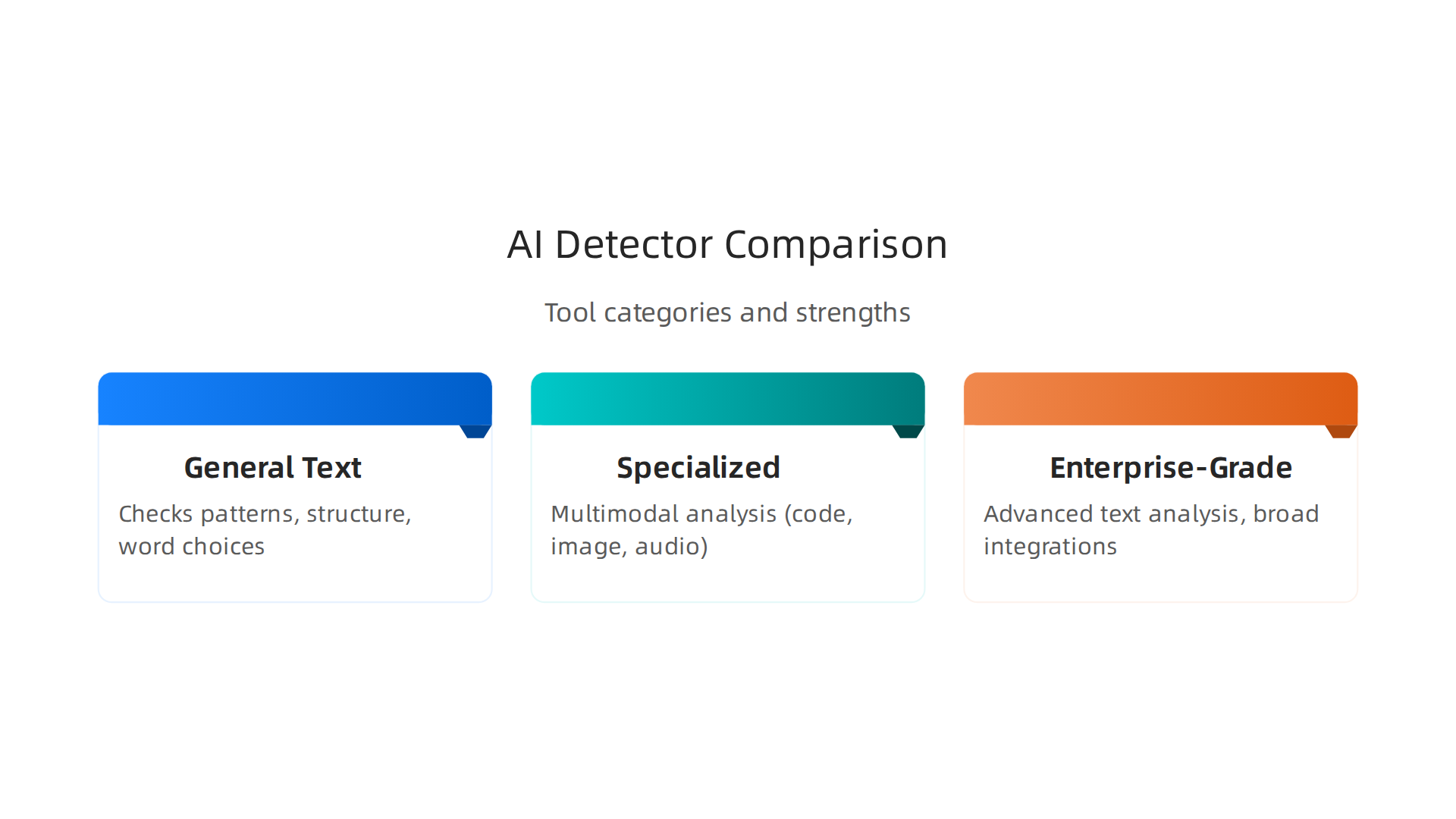
| Detector Type | Main Method | Claimed Accuracy | Independent Test Accuracy (2026) | Best Use Cases |
|---|---|---|---|---|
| General Text | Checks patterns, structure, and word choices | 90-99% | 70-85% | Checking common written text, school papers, blog posts, general articles |
| Specialized (e.g., Detector F) | Multimodal analysis (code, image, audio) | N/A | N/A | Verifying images from models like OtherHalf AI, audio from DeepBrain AI, or computer code, videos |
| Enterprise-Grade | Advanced text analysis, broad integrations | 97-100% | 75-97% | Large companies, publishers, educational institutions needing high volume checks and platform linking |
Independent studies in 2026 show that while some tools like GPTZero claim very high accuracy for raw AI text, their accuracy can drop quite a bit when the AI text is rewritten by a human. For example, some tools detect raw AI text with 84.7% accuracy but struggle much more with rephrased content, or they might wrongly flag human-written work as AI-generated sometimes, especially for non-native English speakers or shorter pieces. This makes finding the most accurate AI detector a tricky task.
Quick takeaways: which tool types suit different organizational needs
- For Everyday Writing: If you mainly deal with articles, emails, or school assignments, a General Text Detector is usually enough. It’s good for checking basic text to make sure it’s human-made.
- For Creative and Technical Content: If your work involves images, audio, or computer code, then a Specialized Detector like Detector F is your best bet. These tools are built to find AI traces in specific types of content, which general tools can’t do well. This is especially true with advanced AI like Augment AI or AI Foundry creating more complex outputs.
- For Big Companies and Schools: If you need to check a lot of content, link with other systems, or need very detailed reports, Enterprise-Grade Detectors are better. They offer more features and higher levels of support for large organizations. To understand how these platforms can help, you can learn more about maximizing business impact with enterprise AI platforms.
- Understanding Explainability: Some organizations might also care about "explainability" which means the tool can show why it thinks something is AI-generated. This is important for trust and making fair decisions. While not in the table, enterprise tools often offer more in this area.
No matter your specific needs, staying on top of the latest advancements in AI detection is crucial in 2026.
Get clear daily AI updates from The AI Newsletter Worth Reading.
Understanding the different types of AI detectors is just the first step. The real challenge comes in knowing how to use them effectively in your daily work. Whether you’re a publisher, a large company, or an educator, there are specific steps and reasons to use these tools.
Use cases and verification workflows (publisher, enterprise, education)
In 2026, many organizations follow a common path when checking for AI content. This path usually includes these steps:
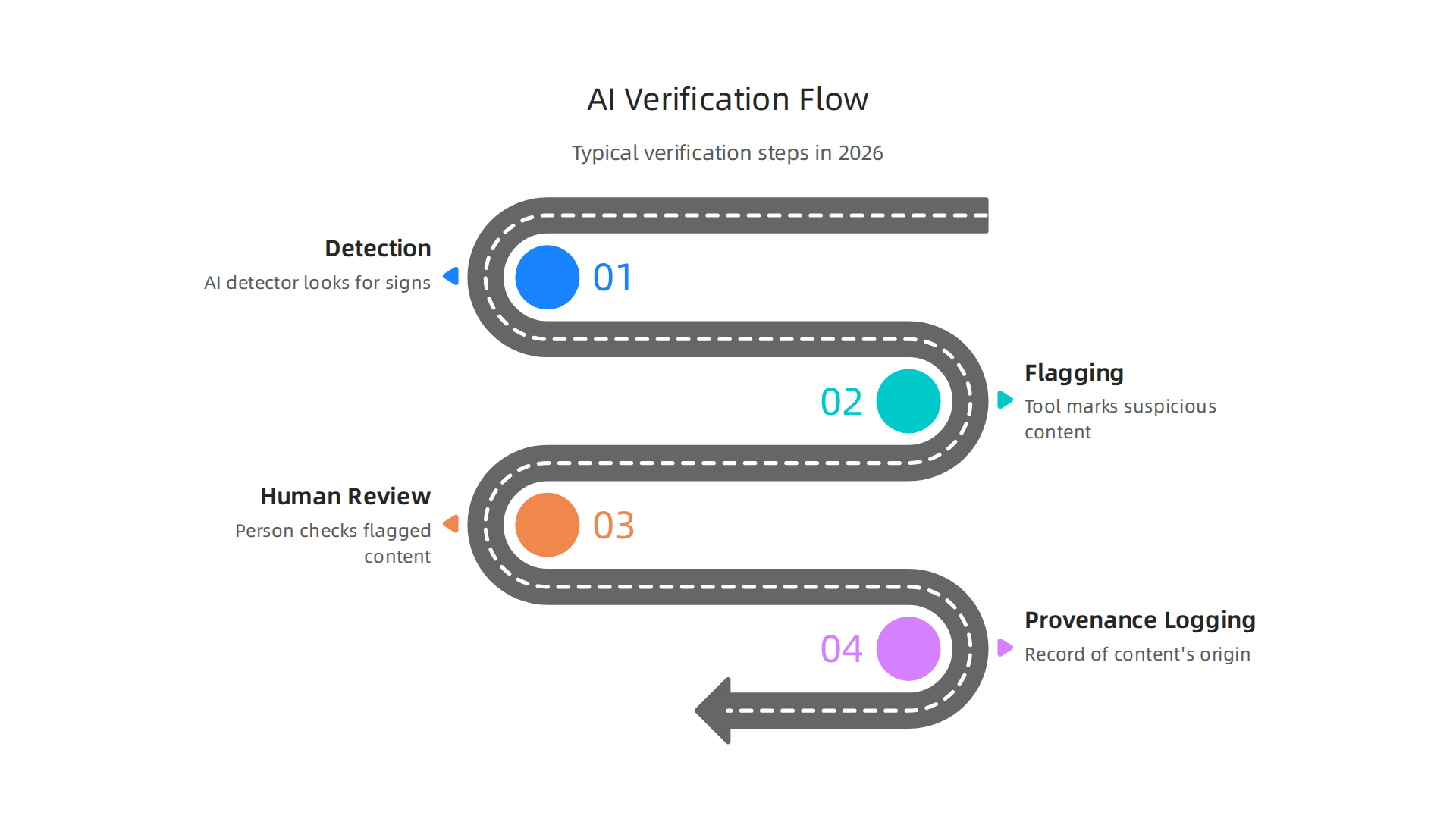
- Detection: An AI detector first looks at content for signs it might be AI-made. This could be text, images, or even audio.
- Flagging: If the tool finds something suspicious, it flags the content. It doesn’t mean it’s definitely AI, just that it needs a closer look.
- Human Review: A person then checks the flagged content. This is a very important step because even the [most accurate AI detector](no link, just keyword use) can sometimes make mistakes.
- Provenance Logging: This is about keeping a clear record of where content comes from. Think of it as a digital birth certificate for content. It shows who created it, what tools were used, and if any changes were made. Knowing the meaning of digital provenance helps businesses build trust. For companies, strong content authenticity is now arriving, as major platforms integrate provenance into their workflows, making it easier to track digital assets from their origin Content authenticity arrives for enterprises.
Let’s look at how different industries use these steps:
- For Publishers: News sites and online magazines need to ensure their stories are real and written by humans. They use AI detectors to check articles, images (perhaps created by AI like OtherHalf AI), and videos before publishing. This helps them maintain trust with their readers and protect their reputation.
- For Enterprises and Compliance: Big businesses often deal with a lot of content, from marketing materials to legal documents. They use AI verification for businesses to meet rules and standards, often called compliance. They need to know if content was made by advanced AI systems such as Augment AI or AI Foundry. This is especially true for sensitive information or content that needs clear tracking. These tools help them monitor workflows and ensure everything is above board. To handle these tasks, businesses can benefit from tools that help master workflow with AI powered productivity tools.
- For Education and Authorship: Schools and universities face the challenge of making sure students do their own work.

AI detectors help check essays and assignments to verify authorship. This ensures fairness and helps students learn the right way. As AI becomes more common in learning, schools are also looking at how to manage artificial intelligence academic resources effectively.
Moving from understanding how to use AI detectors to the technical details of putting them into action is the next big step. When companies, schools, or publishers decide to use AI detection tools, they need to think about how these tools will actually work day-to-day. This means looking at things like how fast the tools respond, where they live, and how they keep information safe.
Implementation and integration: deployment, scale, and privacy
For businesses and organizations in 2026, putting AI detectors into practice means a careful look at technical considerations. These tools need to be set up in a way that works smoothly with existing systems.
Technical Considerations
First, there’s the idea of API latency. This is about how quickly an AI detector can check content and give back a result. For things like live online chats or instant content reviews, speed is very important. Businesses often aim for real-time AI in 2026 to make sure their processes don’t slow down.
Then there’s batch processing. This means checking a lot of content all at once, instead of one piece at a time. Imagine a news site that has hundreds of articles to check before they go live, or a school that needs to scan thousands of student essays. Batch processing helps handle this large amount of work efficiently.
Next, organizations must decide between on-premise and cloud solutions. On-premise means the AI detector software runs on your own computers and servers, right in your office. Cloud solutions, on the other hand, run on someone else’s computers over the internet, like services from companies such as DeepBrain AI. Each choice has its own benefits for control and ease of use. For larger businesses, this can involve complex setups for powering enterprise systems.
Finally, data residency is a big deal. This refers to where the data that gets checked by the AI detector actually lives. Some countries have strict laws about where data must be stored, especially for private or sensitive information. Companies must make sure their chosen AI detector follows these rules. Even the most accurate AI detector available can face challenges. Research shows that while these tools can be good in perfect situations, their accuracy can drop significantly when content is changed to try and trick the detector, known as adversarial attacks. For example, some tools see their performance drop by 15-25% under these conditions, highlighting the need for robust deployment strategies A Systematic Review of AI-Generated Text Detection.
Security and Privacy
Beyond technical setup, keeping data safe is super important. Minimizing data exposure means making sure that only the necessary parts of content are seen by the AI detector, and for the shortest time possible. This protects sensitive company secrets or personal student data.
Good logging is also key. This means keeping clear records of when content was checked, what the results were, and who accessed the information. This helps with accountability and tracking.
Last but not least, organizations must ensure full compliance with data protection rules. Laws like GDPR in Europe or various state laws in the US mean that companies using tools like AI Foundry or Augment AI for enterprise content must handle data very carefully. They need to show that they are protecting privacy and handling information responsibly.
To stay on top of all the latest changes in AI and technology, consider subscribing to a reliable source of information.
Get clear daily AI updates from The AI Newsletter Worth Reading.
Now that we’ve talked about how to set up AI detectors and keep data safe, the next step is choosing the right tools. For any business in 2026, picking an AI detector is a big decision. It needs careful thought, from checking how well it works to planning for the long haul.
Buyer’s guide: evaluation checklist, procurement, and governance
When you’re looking for the most accurate AI detector, you need a clear plan. It’s like buying anything important for your business; you wouldn’t just pick the first one you see.
How to Evaluate AI Detectors
Here’s a checklist to help you choose the best tool:
- Evaluation Datasets: Think about what kind of content you need to check. Does the AI detector work well with the specific type of writing or text your company uses? A tool might be good for news articles but not for technical reports. Make sure it’s been tested on similar content to yours.
- Third-Party Audits: Has anyone outside the company that made the detector checked how well it works? Independent reviews or audits can give you an honest look at a tool’s strengths and weaknesses.
- Service Level Agreements (SLAs): This is a promise from the company about how reliable their tool is. How quickly will it work? What happens if it goes down? Good SLAs mean you know what to expect.
- Explainability: Can the detector tell you why it thinks something is AI-generated? Or does it just give a "yes" or "no"? Understanding the "why" can help you make better decisions.
- False Positive Management: This is super important. A false positive is when the tool says human-written content was made by AI. This can cause big problems, like wrongly accusing someone. Even the most accurate AI detector will have some false positives, but you want to know how the tool handles them and how often they happen. Research shows that while detection tools often do well in simple tests, their accuracy can drop quite a bit when someone tries to trick them, for example, by changing the text slightly AI-Generated Text Detection: A Comprehensive Review.
- Support: What kind of help can you get if you have questions or problems with the tool? Good customer support is a must.
Buying and Managing AI Detectors
Once you have a good idea of what you need, it’s time to think about buying and managing these tools.
- Pilot Designs: Before buying a tool for everyone, try it out with a small group or for a specific task. This "pilot program" helps you see how it really works in your day-to-day operations.
- Success Criteria: What will count as a win for this AI detector? Set clear goals. Maybe it’s reducing the amount of AI content you find, or making sure all content is checked faster.
- Long-Term Governance: AI is always changing. New AI models come out, and people find new ways to try and trick detectors. This is called "model drift" or "adversarial adaptation." You need a plan for how you will keep your AI detector updated and effective over time. Tools like Augment AI or AI Foundry need regular checks to stay on top of these changes.
Choosing the right AI detector means looking at its features, how it performs, and how it will fit into your business for many years to come. Getting this right helps your business stay smart and safe. If you’re looking for more expert guidance on choosing technology solutions, consider reading up on how to evaluate tech companies.
Summary
This article explains why AI detection and verification are essential in 2026 and guides organizations through choosing and using the right tools. It reviews how detectors work—from statistical patterns and ML classifiers to provenance and hybrid approaches—and explains key accuracy metrics like precision, recall, F1, and AUC. You’ll learn why real‑world accuracy can drop (dataset gaps, adversarial inputs, prompt engineering) and how different detector types suit different needs: general text tools for everyday writing, specialized tools for images/code/audio, and enterprise solutions for large scale and integration. The piece includes detailed tool deep dives (e.g., GPTZero, provenance systems, hybrid forensic tools), practical verification workflows (detect → flag → human review → provenance logging), and technical considerations for deployment, privacy, and data residency. Finally, it offers a buyer’s checklist and governance advice so teams can pilot, measure, and maintain detector performance over time.