
Introduction: Why the Confusion Between IT and IS Matters
Have you ever sat in a meeting where someone used “IT” and “IS” like they were the same thing? It happens more than you think. Even experienced executives and tech professionals toss these terms around interchangeably. And that mix-up can cost real money.

When leaders confuse information systems vs information technology, they make poor decisions about hiring, budgets, and digital strategy. You might hire a network engineer when what you really need is someone who understands how people and processes use that network to make decisions. Or you might invest in expensive hardware while ignoring the workflows that turn raw data into useful insights.
Getting the distinction right is essential for smart resource allocation, career planning, and successful digital transformation. In 2026, with technology changing faster than ever, you cannot afford to get it wrong.
Here is what this article will give you: clear, authoritative definitions grounded in current research, practical comparisons you can use right away, and actionable insights to help you decide which path fits your goals. We will also explore the technology definition from both a science perspective and a business perspective, so you see the full picture.
Think of information technology as the tools and infrastructure: computers, networks, software, and databases. That is the classic technology definition science often uses. Now think of information systems as the bigger picture: the people, processes, data, and technology all working together to achieve business outcomes. The distinction first became really clear in the world wide web 1990s, when companies realized that having the internet alone was not enough. You needed a system to make it useful.
But let’s look at what the experts say. According to a helpful guide on understanding information systems and information technology, IT refers to the use of computers, software, and networks to manage data. Meanwhile, IS is a socio-technical system that integrates people, processes, and technology to support organizational goals.
If you want a broader look at what “technology” really means today, check out this clear definition of technology article that breaks down the history and dimensions of tech.
Staying on top of these fast-moving trends is tough. To get daily, clear updates on AI and broader tech shifts, consider subscribing to The AI Newsletter Worth Reading. It is a simple way to stay informed.
Now let’s dive into the full information systems vs information technology comparison so you can stop guessing and start making smarter choices.
What Is Information Technology? Scope, Components, and Standards
Information technology is the hands-on stuff. It is the computers on your desk, the cables in the walls, the software that runs payroll, and the servers that store your email. When most people picture "tech," they are really picturing IT.
The formal definition from the US government is pretty clear. The National Institute of Standards and Technology (NIST) defines IT as any equipment or system used for the automatic acquisition, storage, manipulation, management, movement, control, display, switching, interchange, transmission, or reception of data. If you want the exact wording, check out the official NIST glossary definition of information technology. That covers a lot. Hardware, software, firmware, and all the services that support them.
The Core Components of IT
IT breaks down into a few main buckets. Hardware includes the physical devices: computers, servers, routers, switches, storage drives, and printers. Software is the code that tells hardware what to do. That includes operating systems like Windows or Linux, business applications like Salesforce, and security tools. Networking is the glue that connects everything together. And telecommunications covers phone systems, video conferencing, and other communication tools.
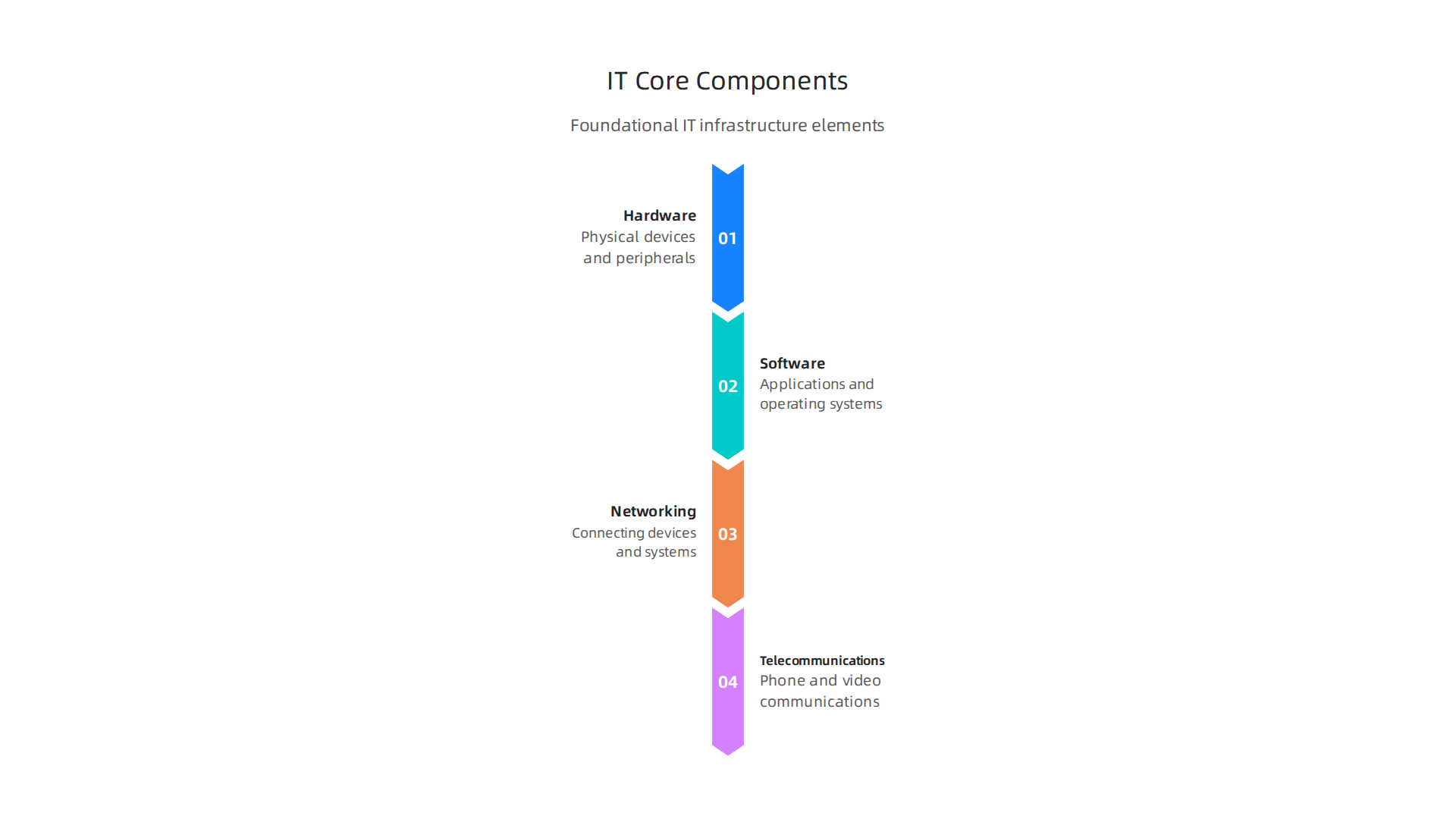
According to a thorough breakdown from Purdue Global’s guide to information technology, these components work together to form the IT infrastructure that organizations depend on every single day.
Standards That Keep IT Running
IT does not run on guesswork. It runs on standards. Two big ones you hear about all the time are ITIL and COBIT. ITIL (Information Technology Infrastructure Library) is all about IT service management. It gives you a playbook for handling incidents, managing changes, and delivering support. COBIT focuses on governance. It helps leaders make sure that IT investments line up with business goals and that risks stay under control.
The IEEE and ISO also publish hundreds of standards that define everything from network protocols to security requirements. These standards make sure your email talks to my email and your cloud app talks to my cloud app.
Who Works in IT?
IT roles are very hands-on and technical. You have network administrators who keep data flowing. Help desk technicians who solve everyday user problems. Cybersecurity analysts who protect systems from threats. Infrastructure architects who design the whole setup. The CompTIA blog on what information technology is covers many of these roles and the trends shaping them in 2026.
These jobs are about building, maintaining, and protecting the technology layer. If it plugs in, boots up, or connects to a network, an IT professional is probably involved.
Where IT Fits in the Bigger Picture
Think of IT as the engine. It is powerful and essential. But an engine by itself does not drive a car. You need a driver, a map, and a destination. That is where information systems come in. Understanding the information systems vs information technology distinction means knowing that IT is the tool, and IS is how you use that tool to achieve something meaningful.
If you want to see how different technologies are coming together in 2026 to reshape business, read this piece on convergence AI and network intelligence reshaping business. It shows how IT infrastructure is evolving to support smarter systems.
Now let us look at the other side of the coin: information systems and how they turn raw technology into real business value.
What Is Information Systems? The Sociotechnical Perspective
If information technology is the engine, then information systems is the whole driving experience. You have the car. But you also have the driver behind the wheel, the map showing the route, the rules of the road, and the destination itself. That is the difference between IT and IS in a nutshell.
Information systems combine IT with people, processes, and data. The goal is not just to run technology. The goal is to support decisions, improve operations, and help an organization actually do something useful with all that computing power.
The Wikipedia definition of information systems describes IS as a formal, sociotechnical system designed to collect, process, store, and distribute information. That word "sociotechnical" is the key. It means that technology alone is not enough. You have to think about the people using the system, the tasks they need to complete, and the structures they work within.
The Four Pieces of the Puzzle
From a sociotechnical perspective, information systems have four core components. Task is the work that needs to get done. People are the users, managers, and everyone who interacts with the system. Structure covers the roles, rules, and relationships that guide how work happens. And technology is the IT hardware and software that makes it all possible.
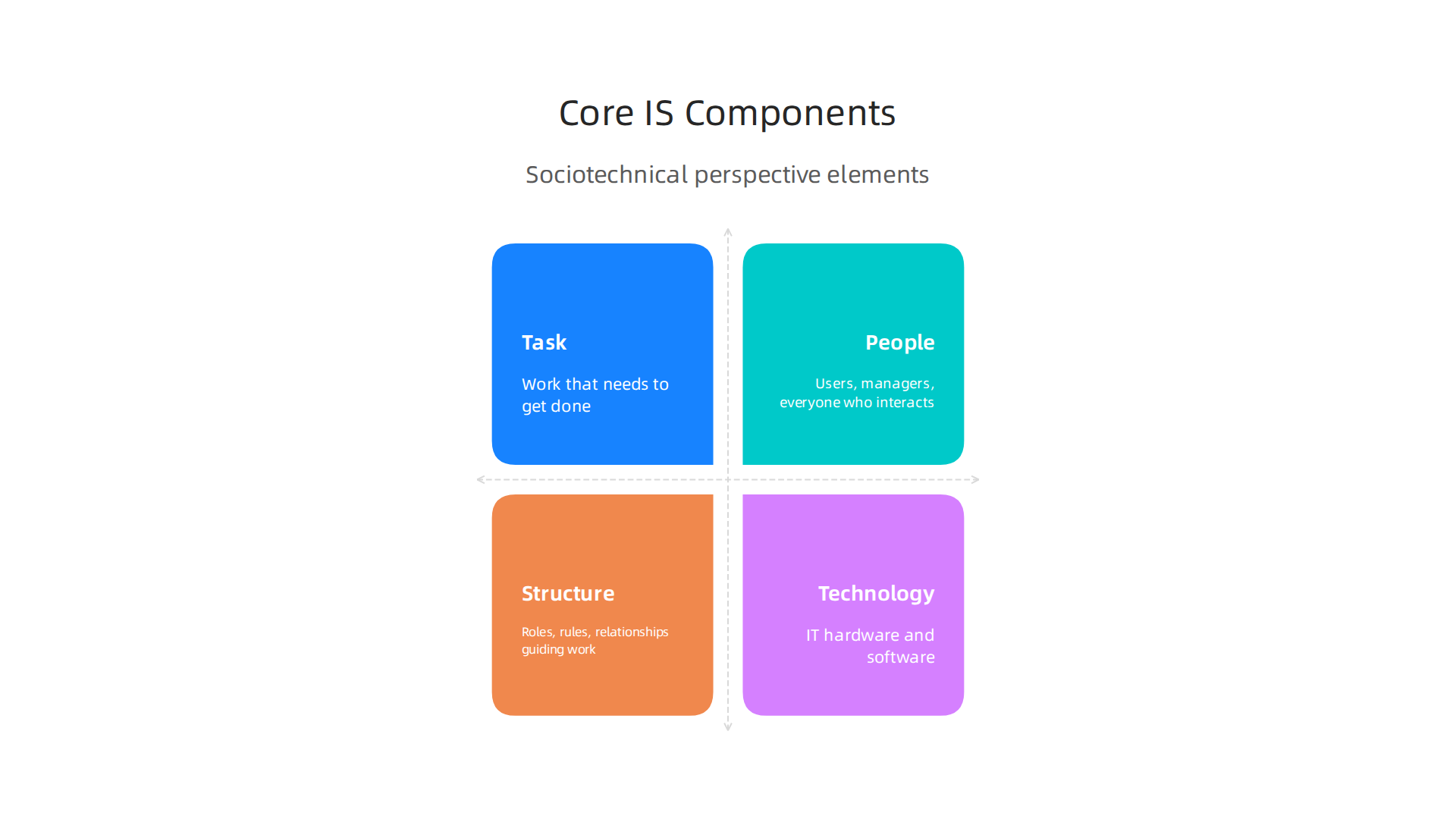
When all four pieces fit together, you get a system that actually delivers value. When one piece is missing or broken, the whole thing falls apart. That is why the information systems vs information technology debate matters. You can buy the best servers and software in the world. But if your team does not know how to use them or your processes are a mess, you have wasted your money.
Real-World Examples You Know
You have probably used an information system today without even realizing it. Enterprise resource planning (ERP) systems like SAP or Oracle help companies manage everything from inventory to payroll in one place. Customer relationship management (CRM) systems like Salesforce track every interaction a business has with its customers. Decision support systems help managers analyze data and choose the best course of action.
Automated information systems, or AIS, are another common example. The Giva guide on automated information systems explains how these systems use hardware and software together to automate communication, reporting, and data storage. They speed up operations and give leaders better visibility into what is happening inside their business.
Why This Matters for the Big Picture
When people ask about the difference between information systems and information technology, they are really asking about how technology becomes useful. IT gives you the tools. IS gives you the strategy, the people, and the process to make those tools work. If you want to see how modern systems are using data to drive better decisions, take a look at some AI use cases that deliver real results. It shows how the IS approach turns raw tech into tangible outcomes.
Now that you understand both sides of the coin, let us talk about how to tell them apart in practice and why that distinction matters for your career and your business.
So how do they actually differ in day-to-day practice? Let’s put them side by side. The clearest way to see the information systems vs information technology split is to look at what each field cares about most.
IT vs. IS: The Core Differences Side by Side
Information technology is first and foremost about the technology itself. The National Institute of Standards and Technology defines information technology as any equipment or system used to automatically acquire, store, manipulate, and transmit data. That definition from the NIST glossary for information technology covers everything from servers and laptops to software and cloud services. IT professionals focus on making sure the hardware works, the network stays up, and the software runs without crashing.
Information systems, on the other hand, start with a business problem. An IS specialist looks at a company and asks: "What do we need to accomplish, and how can people and technology together make that happen?" The technology is just one piece. You also have to think about whether employees know how to use the tools, whether the workflow actually makes sense, and whether the data coming out of the system helps leaders make better choices.
Here is a quick breakdown of the major differences.
| Dimension | Information Technology | Information Systems |
|---|---|---|
| Focus | Technology hardware, software, networks | People, processes, and technology combined |
| Main goal | Keep systems running, secure, and efficient | Solve business problems and support decisions |
| Typical questions | "Is the server down?" "Is the firewall updated?" | "Does this system help our team work faster?" "Are we getting the right data?" |
| Who leads it | Often a Chief Technology Officer (CTO) or IT Director | Often a Chief Information Officer (CIO) who reports to the CEO |
| End product | Working infrastructure | Actionable insights and improved operations |
Think of IT as the plumbing and wiring of a building. You need it to be solid, safe, and well maintained. But IS is the architect who figures out how to arrange the rooms, where the windows go, and how people will actually move through the space. Both are essential. But they require totally different mindsets.
This distinction shows up in how companies organize their leadership. IT departments usually report to a CTO who worries about technical performance, uptime, and security. IS functions often report to a CIO or directly to the CEO because they deal with strategy, competitive advantage, and how technology changes the way the business operates. Understanding this difference can help you decide which career path fits you better. If you love tinkering with hardware and solving technical puzzles, IT might be your lane. If you enjoy understanding people, designing workflows, and linking technology to business goals, IS could be a better fit.
It also explains why companies that invest heavily in IT sometimes still struggle. They bought the best tools, but they never trained the team or changed the processes to use them well. That is a classic IS failure disguised as an IT problem. To avoid that trap, many businesses now focus on the convergence of AI and network intelligence to bridge the gap between raw infrastructure and real business value.
In the next section, we will look at how these roles play out in real jobs and which one pays off more in today’s market.
How IT and IS Work Together in Modern Organizations
So far we have looked at IT and IS as separate worlds. One handles the pipes and wires. The other handles the people and processes. But here is the truth that matters most: in any successful organization, these two sides must work together constantly. The information systems vs information technology debate is useful for understanding career paths, but in real business operations, the line gets blurry fast.

Think of IT as the engine of a car. It provides the power, the cooling, the fuel delivery. Now think of IS as the driver and the navigation system. The engine does nothing useful without someone steering it toward a destination. And the driver cannot move anywhere without a working engine. That is the relationship between IT and IS in modern organizations.
Why Cross-Functional Collaboration Matters
Most digital transformation efforts fail not because the technology was bad, but because the people and processes were not ready. According to PwC’s 2026 digital trends in operations survey, more than four-fifths of business leaders say AI and automation will break down traditional silos between departments. Yet only about a quarter have fully embedded an AI strategy across their business units.
This gap between owning the technology and actually using it well is exactly where IS skills come in. IT teams install the cloud platform and make sure it stays secure. IS teams figure out which data the company actually needs, how employees should access it, and what questions the business should ask of that data. One cannot succeed without the other.
Agile and DevOps practices have also helped blur the old lines. In companies that use these approaches, developers and operations staff sit in the same meetings as business analysts and product managers. They talk about deadlines, customer needs, and system performance all at once. An IT person who only understands servers without understanding business goals will struggle. An IS person who only understands strategy without understanding technical limits will struggle too.
The New Reality in 2026
Most organizations now realize they need people who can speak both languages. That is why job postings for roles like product manager, technical project lead, and business systems analyst have grown so fast. These roles sit right in the middle of IT and IS.
If you are trying to decide between these two paths, do not think of it as a permanent choice. Many professionals start in IT support or network administration and later move into systems analysis or IT management. Others start in business analysis and pick up technical skills along the way. For a deeper look at how professionals make sense of all this data, check out this guide on how to turn data overload into strategic insight in the information society.
The key takeaway is simple. IT builds the bridge. IS decides where the bridge should go and who should cross it. Companies that value both equally are the ones that actually succeed with their technology investments.
Career Paths: IT vs. IS Roles, Skills, and Salaries
Picking between information systems vs information technology for your career is a lot like deciding whether you want to build the bridge or decide where it goes. Both paths are rewarding, stable, and growing fast. But the day-to-day work looks very different. Understanding these differences helps you choose the right fit for your natural strengths.
The Roles
IT careers lean heavily into technical depth. You might work as a network administrator, cloud engineer, or security analyst. Your days involve configuring firewalls, managing servers, patching systems, and keeping the infrastructure running. The work is hands on with the hardware and software layers. If you love solving technical puzzles, this is your space.
IS careers lean into business analysis, project management, and data interpretation. You might work as a business systems analyst, IT project manager, or data analyst. Your days involve talking to stakeholders, mapping business processes, writing requirements, and figuring out which technology investments actually move the needle for the company. If you enjoy translating between technical teams and business leaders, this path fits well.
A simple way to see it: IT pros ask "how do we make this technology work?" IS pros ask "what technology do we actually need to succeed?"
The Skills and Education Path
The skills you build also differ.
For IT, you will want deep certifications like CompTIA Security+, AWS Solutions Architect, or Cisco CCNA. Degrees are usually in computer science or computer engineering. You focus on the pure technology definition science layer.
For IS, certifications like PMP (Project Management Professional) or CBAP (Certified Business Analysis Professional) matter a lot. Degrees are often in Management Information Systems (MIS) or a business degree with a tech minor. You learn how to connect teams and make smart technology investments. If you want a deeper look at how technology itself is understood in a business context, check out this guide on the true technology meaning for business advantage.
Salaries and Demand
The Bureau of Labor Statistics offers great news for both paths. Employment is growing fast across the board. Information security analysts are listed among the fastest growing occupations in 2026. Computer and Information Systems Managers also show excellent growth and high median pay.
IS roles like Data Scientist are among the fastest growing too, with salaries often exceeding six figures. The key difference is that IS salaries require strong communication and strategy skills on top of technical knowledge. IT salaries reward deep, specialized technical expertise.
The Real Takeaway
Do not stress too much about picking the perfect side right away. Many people start in IT support and shift into IS management later. Others start in business analysis and pick up coding to move into technical architecture. What matters is understanding your own style. Do you love fixing technical problems? Go IT. Do you love solving business puzzles with technology? Go IS. The information systems vs information technology decision is really a choice between depth and breadth. And both are absolutely needed for the digital world to function well.
Future Trends That Are Redefining IT and IS (2026 and Beyond)
But the world of technology does not stand still. The trends reshaping 2026 are blurring the lines between IT and IS even further. If you thought the information systems vs information technology choice was clear cut, the next few years will test that. Here is what is coming.
AI Is No Longer Optional
Artificial intelligence has moved from a nice-to-have project to a core business requirement. According to Gartner’s Technology Trend Playbook For 2026, disruption is accelerating and AI is now essential. This changes everything for both IT and IS roles.
For IT professionals, AI means managing new infrastructure. Think AI supercomputing platforms that combine CPUs, GPUs, and specialized chips. You will need to know how to deploy and secure these systems. For IS professionals, AI means deciding which tools actually solve business problems. Domain specific language models, multi-agent systems, and AI-native development platforms are shifting from experiments to production. The lines between who builds and who selects technology are fading. If you want to understand how AI and network intelligence are already reshaping business, check out this piece on AI and network intelligence reshaping business in 2026.
Low-Code and No-Code Empower Business Users
Another trend pulling IT and IS closer together is the rise of low-code and no-code platforms. These tools let business analysts and project managers build applications without writing traditional code. This is a game changer for the IS side. Instead of waiting for IT to deliver a solution, you can drag and drop your way to a working prototype.
Gartner calls these AI-native development platforms. They integrate generative AI into the development process, so even non-technical people can create software. For IT, the role shifts from building everything to governing and securing what others build. The technology definition itself is expanding. It is no longer just about hardware and software. It is about who can create value using the tools available.
Cybersecurity and Data Privacy Force Convergence
Here is where IT operations and IS strategy must become best friends. Cybersecurity threats are getting smarter. Preemptive cybersecurity, confidential computing, and digital provenance are top trends for 2026. IT teams handle the firewalls, encryption, and monitoring. But IS teams must decide which data to protect, how to manage compliance, and what risks the business can accept.
These two sides can no longer work in silos. A security breach is not just an IT problem. It is a business problem that affects brand trust and revenue. The best organizations are creating hybrid roles where IT depth meets IS strategic thinking. This convergence means that whether you lean toward the technical or the business side, you will need to understand the other half intimately.
Staying Ahead in a Fast-Changing Landscape
The trends of 2026 demand that you keep learning. AI, low-code platforms, and cybersecurity are evolving faster than ever. To stay ahead of these changes, daily insights can make a big difference. The AI Newsletter Worth Reading delivers clear, daily AI updates that help you understand what matters and what is hype. Whether you are in IT or IS, keeping your knowledge current is the best way to future-proof your career.
Summary
This article clarifies the often-confused terms information technology (IT) and information systems (IS) by giving clear, practical definitions and real-world context. IT is presented as the hardware, software, networks, and standards that keep systems running, while IS is framed as a sociotechnical system that combines people, processes, data, and technology to solve business problems. The piece compares the two side-by-side, explains how they cooperate in organizations, and outlines typical roles, skills, and salary trends for each path. It also highlights why confusing them leads to poor hiring and budgeting decisions and shows how modern trends — AI, low-code platforms, and cybersecurity — are blurring the lines. After reading, you will be able to distinguish IT work from IS work, choose an appropriate career or hire, and apply a checklist to align technology investments with business outcomes.