
You have probably heard the term "artificial intelligence" so many times that it has started to lose its meaning. News headlines shout about robots taking jobs, smart assistants answering questions, and self-driving cars navigating city streets. It is easy to feel overwhelmed. You are not alone. The truth is that AI has quietly become one of the most transformative technologies of our time, reshaping industries and daily life faster than almost any innovation before it.
In 2026, artificial intelligence is no longer a futuristic idea. It is here, and it is everywhere. According to AI adoption statistics, 88% of organizations now use AI in at least one business function.

From the recommendation engine that suggests your next show to the voice assistant that sets your morning alarm, AI is already woven into the fabric of everyday existence. But for most of us, the technology behind these tools remains a black box. Terms like machine learning, neural networks, and deep learning get thrown around without any real explanation of what they mean.
That is where this guide comes in. We are here to clear up the confusion and give you a solid foundation in artificial intelligence basics — without the jargon, without the hype, and without making you feel like you need a computer science degree. Our goal is simple: help you understand how AI works, translate complex ideas into AI to human language, and show you the many ways everyday AI already touches your life. By the end, you will be able to spot AI in everyday life with confidence and even start thinking about how these tools can work for you.
We will walk through the big picture first, then zoom in on the core building blocks: machine learning, neural networks, and the different types of AI that exist today. We will also explore real-world applications that illustrate these concepts in action. Whether you are a business professional trying to make smarter decisions, a curious learner wanting to keep up with the times, or someone who simply wants to understand the technology shaping our world, this article is for you.
If you want to stay ahead of the curve and get clear, daily insights on the latest AI developments, consider signing up for The AI Newsletter Worth Reading. It delivers simple, actionable updates straight to your inbox so you never get lost in the noise.
Ready to dive in? Let us start by exploring why understanding artificial intelligence basics matters more than ever in 2026.
A Brief History of Artificial Intelligence: From Theory to Mainstream
Let’s trace where AI came from. It might surprise you to learn that the dream of creating thinking machines is not new. It started way back in the 1950s.
The Birth of AI: The Dartmouth Workshop
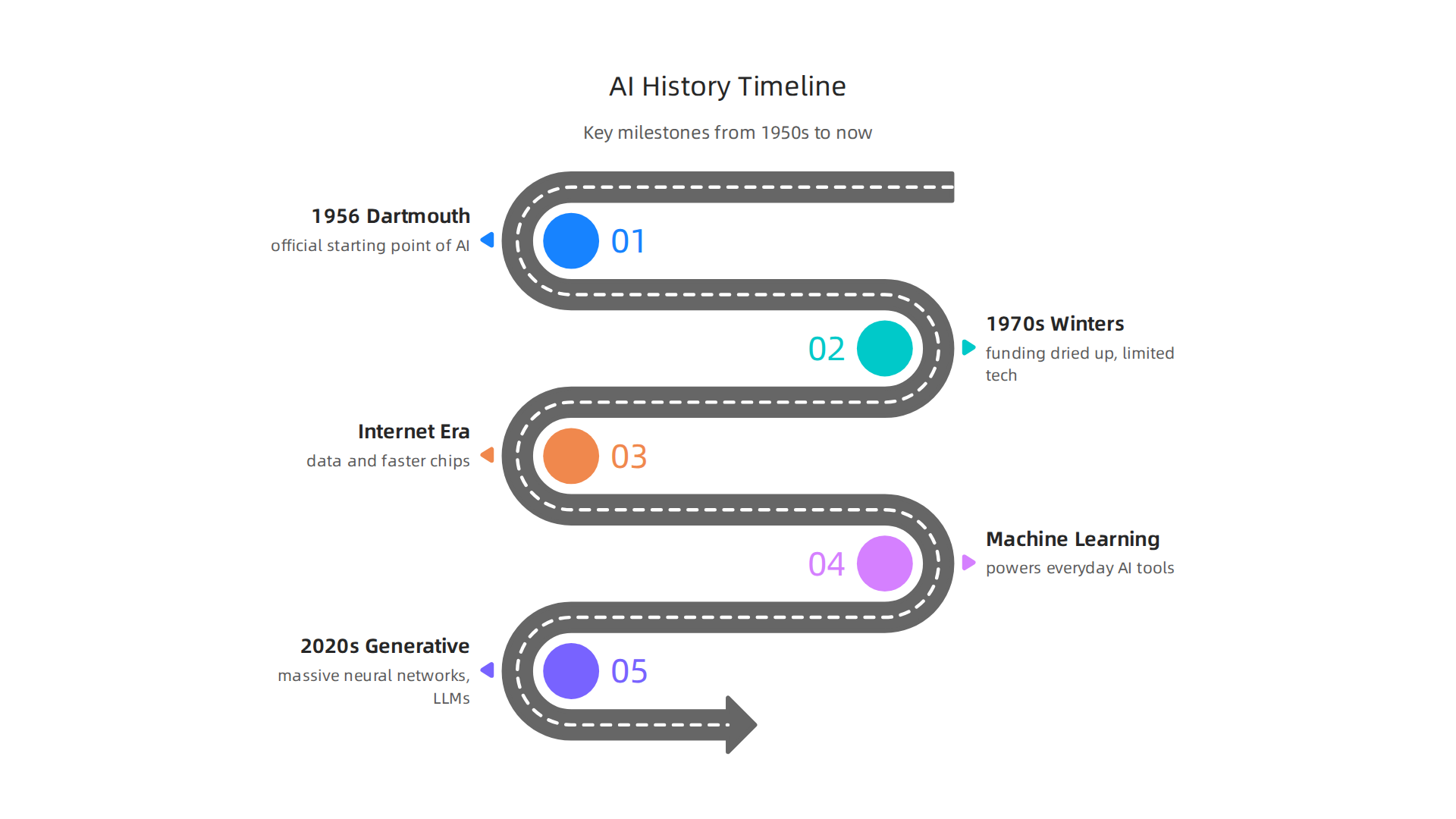
In the summer of 1956, a small group of scientists gathered at Dartmouth College. They called their project "artificial intelligence." They believed that machines could be built to think, reason, and learn. This workshop is widely seen as the official starting point of AI as a field. Early work focused on symbolic AI. Programmers wrote explicit rules to help computers solve math problems, play chess, or prove theorems. It was impressive, but fragile. These systems could not handle messy, real world information.
The AI Winters: Hype Meets Reality
The initial excitement led to bold predictions. Soon, machines would be able to do everything humans could do. But the technology of the time was too limited. Computers were slow and had almost no memory. By the 1970s, funding dried up. This period of disappointment is called an "AI winter." Researchers learned a hard lesson. It is not enough to give a machine rules. You need data and computing power.
The Revival: Data and Computing Power Arrive
The internet changed everything. For the first time, computers had access to massive amounts of data. At the same time, computer chips became much faster and cheaper. This perfect storm allowed a new approach to flourish. It is called machine learning. Instead of following explicit rules, machines could learn patterns directly from data. This was a massive shift in how AI works.
From Theory to Your Pocket
Machine learning led to deep learning. Deep learning uses artificial neural networks, which are loosely inspired by the human brain. These networks are incredibly good at finding patterns in images, sound, and text. You can see a clear explanation of the relationship between these fields in the deep learning vs machine learning hierarchy defined by Google Cloud.
This breakthrough is what powers the everyday AI tools we use today. The voice assistant on your phone uses deep learning. So does the facial recognition that unlocks your device. This is the reality of AI in everyday life in 2026.
The Generative AI Explosion
In the 2020s, these techniques scaled up enormously. Companies built massive neural networks called large language models (LLMs). These models were trained on huge parts of the internet. They learned not just to understand language, but to generate it. It is a stunning leap from the simple rule based systems of the 1950s. To understand how this latest revolution happened, check out this guide on the transformation of AI from GPT-3 to GPT-5. The history of AI shows one clear pattern: every time we get more data and more computing power, AI takes a big step forward. And we are just getting started.
Core Concepts: AI vs. Machine Learning vs. Deep Learning
You hear the term "AI" everywhere. But here’s the thing: that word gets used for many different things. A simple voice assistant and a tool that writes poetry are both called AI, but they work very differently. To really understand artificial intelligence basics, you need to know the layers inside the term.
Think of a set of Russian nesting dolls. The biggest doll is artificial intelligence. That is the entire field of building machines that can think, reason, and make decisions.
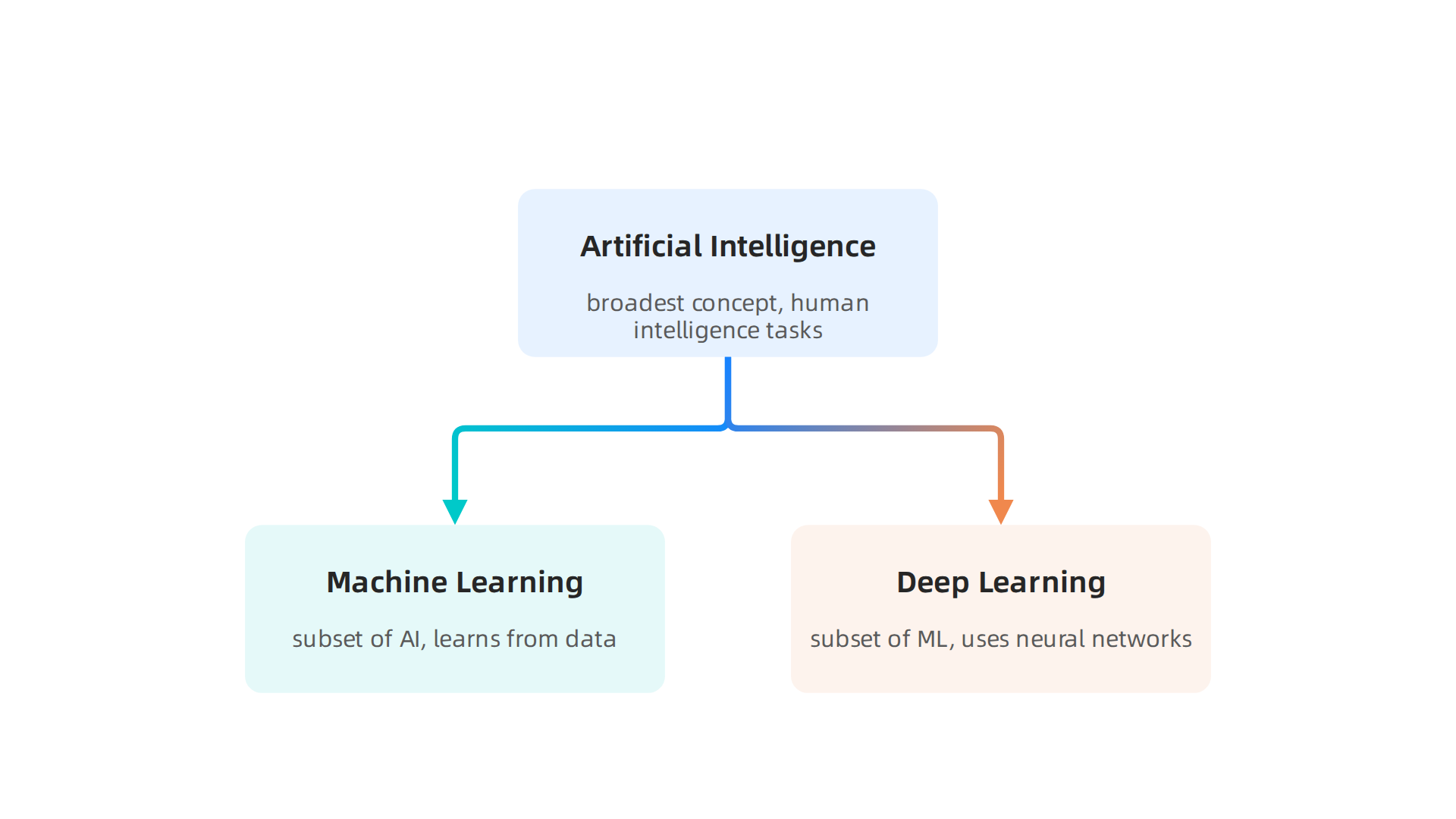
Inside that big doll sits machine learning. And inside machine learning sits deep learning. Each layer is more specialized than the one before. This visual helps explain how AI works at a glance.
Artificial intelligence (AI) is the broadest concept. It covers any system that performs tasks we normally associate with human intelligence. This includes things like playing chess, understanding language, recognizing faces, or recommending a movie. As one helpful guide explains, AI is the field of creating systems that can perform tasks requiring human intelligence, such as reasoning and problem solving. The comprehensive definitions of AI and its subfields show just how wide this umbrella really is.
Machine learning (ML) is a subset of AI. Instead of giving a computer explicit rules for every situation, ML allows the machine to learn from data. You show it thousands of examples, and it finds patterns on its own. It gets better over time without a human rewriting the code. This is a big shift from the old way of programming. For a deeper look at how these fields connect, check out this overview of deep learning vs machine learning key differences. ML is what powers spam filters, product recommendations, and fraud detection.
Deep learning (DL) is a subset of machine learning. It uses artificial neural networks with many layers (that is where "deep" comes from). These networks are inspired by the way our brains work. Deep learning handles huge amounts of messy data like images, audio, and text. It is the engine behind voice assistants, facial recognition, and generative AI tools. As the 2026 guide to deep learning vs machine learning from Zendesk points out, deep learning models can learn on their own without humans telling them what features to look for.

Why does this matter for you? When you hear a company say they use AI, ask which type. Is it simple rules based AI, a machine learning model, or a deep learning system? Each has different strengths and needs different amounts of data and computing power. Knowing these differences helps you make smarter decisions for your business or personal projects. If you want to go deeper into the different levels of AI capability, read this guide on the types of artificial intelligence. Understanding these core concepts is the foundation of everything else in AI in everyday life.
How Machine Learning Works: The Engine Behind Modern AI
You have probably used a streaming service that suggests movies you actually like. Or a shopping site that recommends products you end up buying. That is machine learning at work. It powers a huge chunk of everyday AI. But how does it actually learn?
Machine learning follows some basic rules. Think of it like teaching a child. You show examples, correct mistakes, and over time the child gets better. The machine does the same thing, but with data instead of life experience.
Three Main Ways Machines Learn
There are three big categories of machine learning. Each works a little differently.
Supervised learning is the most common. You give the machine a bunch of labeled examples. For instance, you show it thousands of pictures of cats and dogs, each one labeled. The machine learns to spot the difference. Later, it can look at a new picture and say "that is a cat." This is how spam filters learn to block junk email.
Unsupervised learning does not use labels. You just give the machine a pile of data and let it find patterns on its own. It might group customers by buying habits without anyone telling it which groups exist. This is useful for market research and spotting weird data points.
Reinforcement learning works like training a pet. The machine tries different actions and gets rewards for good ones. It learns by trial and error. This is how robots learn to walk and how AI beats humans at complex games like chess and Go.
The Machine Learning Pipeline
Getting a machine learning model to work takes several clear steps. The process is often called the ML pipeline.
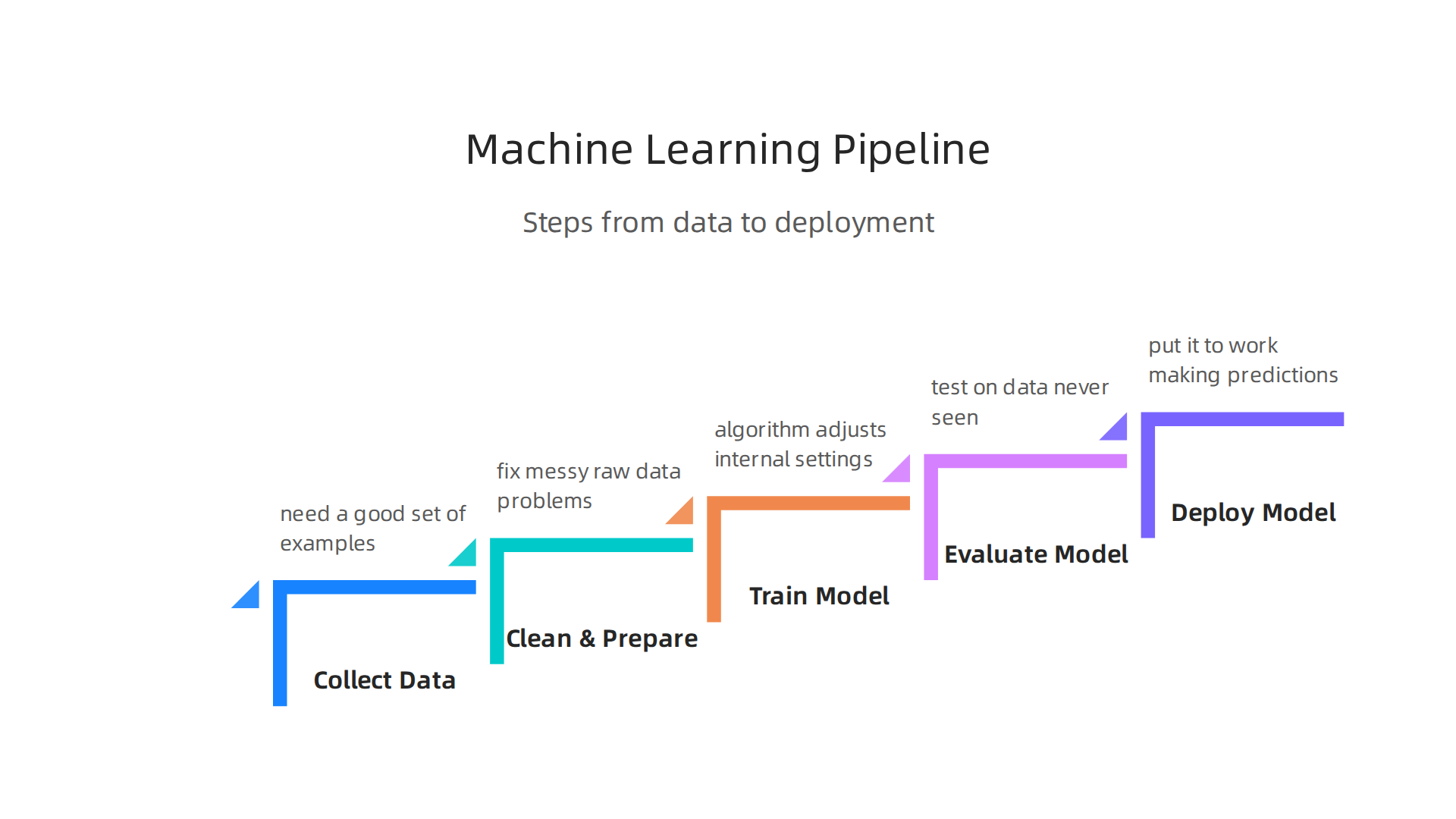
As one detailed breakdown explains, the main stages of machine learning workflow include data collection, data cleaning, data labeling, feature engineering, model training, evaluation, tuning, and deployment. Here is the simple version.
Step 1: Collect the data. You need a good set of examples. If you are building a tool to detect diseases in X-rays, you need thousands of X-ray images. The more data you have, the better the model can learn.
Step 2: Clean and prepare the data. Raw data is messy. Some images might be blurry. Some records might have missing info. You have to fix these problems before the machine can learn. This step takes the most time.
Step 3: Train the model. You feed the clean data into an algorithm. The algorithm adjusts its internal settings to make better predictions. This is where the actual learning happens.
Step 4: Evaluate the model. You test the model on data it has never seen. If it performs well, great. If not, you go back and adjust settings or get better data.
Step 5: Deploy the model. Once the model is good enough, you put it to work in the real world. It starts making predictions on new data.
Why Data Quality Matters So Much
There is a famous saying in machine learning: garbage in, garbage out. If your data is full of errors, your model will be useless no matter how smart the algorithm is.

As research from Lumenalta shows, organizations see model accuracy improve by 15 to 30 percent and training time drop by half when they pay attention to data quality. The 7 stages of ML model development highlight that systematic data preparation is the foundation for accurate models.
So when you think about how AI works, remember it all starts with clean, relevant data. Without that, even the most advanced machine cannot do its job.
Understanding these basics helps you see through the hype. Next time someone says their product uses AI, ask yourself: is it supervised, unsupervised, or reinforcement learning? And what kind of data is powering it? Those answers tell you how artificial intelligence basics really work under the hood. For a closer look at how invisible AI is already running behind the scenes in business, check out this piece on invisible AI quietly transforming business operations.
Neural Networks and Deep Learning Demystified
You snap a photo of your dog at the park. Later, your phone tags that photo as "dog" without you typing a word. How does it know? That is a neural network at work. And when you stack many layers of them together, you get deep learning. These ideas power some of the most impressive everyday AI you use today.
The Building Blocks: Layers and Neurons
Think of a neural network like an assembly line. It has three main parts.
Input layer. This is where data enters. If your phone sees a photo, the input layer receives every pixel’s color and brightness.
Hidden layers. These are the middle workers. Each layer looks for patterns. The first hidden layer might find edges and simple shapes. The next layer might find textures like fur or grass. Deeper layers combine those into bigger ideas, like a face or a tail.
Output layer. This gives the final answer. In our example, it says "dog" with a confidence score.
Each connection between layers has something called a weight. You can think of weights like volume knobs on a radio. Some connections turn up the signal. Others turn it down. The network learns the right settings over time.
How the Machine Learns: The Learning Dance
Training a neural network involves two key steps that work together. According to IBM’s explanation, backpropagation is the process of calculating how changes to each weight affect the model’s error. Then gradient descent uses that information to adjust the weights. The understanding of backpropagation shows it is like hiking down a foggy hill. You take small steps in the steepest downhill direction to reach the bottom, which means the lowest error.
Here is the simple version. First, the network makes a guess (forward pass). It compares its guess to the right answer. If it guessed wrong, it measures the error. Then it goes backward through the layers (backpropagation) to figure out which knobs to adjust. Finally, it nudges those knobs a tiny bit (gradient descent). Repeat this thousands of times, and the network gets better and better.
Real Ways Deep Learning Shows Up
You interact with deep learning almost every day without thinking about it. Image recognition on your phone uses it. Voice assistants like Siri and Alexa use it to understand your words. Streaming services use it to recommend your next show.
Large language models like GPT are also deep learning. They process words the same way the phone processes pixels. The many hidden layers learn grammar, context, and meaning.
For a closer look at how these models evolved from early versions to today’s powerful tools, check out this article on the GPT-3 AI to GPT-5 transformation.
Why This Matters for You
Understanding these basics helps you see through the hype. When a company says their product uses AI, you can ask: is it a simple decision tree or a deep neural network with many hidden layers? That difference tells you how sophisticated the technology really is.
Deep learning is powerful, but it needs lots of data and computing power. The more data it sees, the better it learns. That is why big tech companies have an edge. They have the data and the machines to run these networks at scale.
Types of AI: Narrow, General, and Superintelligence
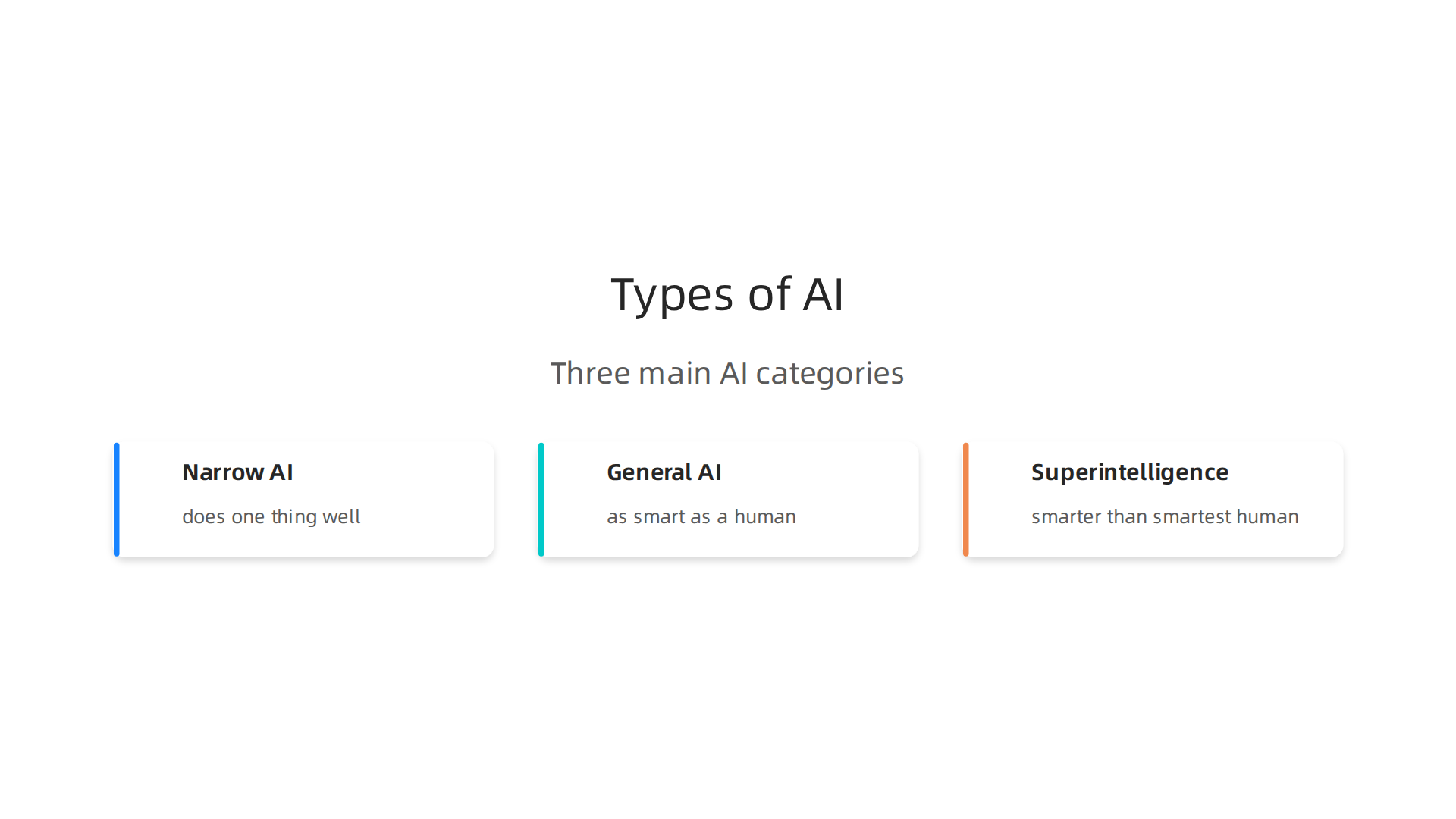
Now that you understand how neural networks learn, you might wonder: is every AI system as smart as the ones that recommend your next movie? Not even close. The truth is, artificial intelligence basics start with a simple but important fact. Almost every AI you interact with today is what experts call Narrow AI.
Narrow AI: The Kind That Actually Exists
Narrow AI is the only type of AI we have right now. It is designed to do one thing well. Your email spam filter is narrow AI. The facial recognition that unlocks your phone is narrow AI. The chatbot that helps you book a hotel room is narrow AI.
These systems are powerful, but they have zero understanding of anything outside their specific task. Your spam filter does not know what a cat is. It only knows what spam looks like. That is the key limit of narrow AI. It is brilliant at its job and useless at everything else.
When people talk about everyday AI, they almost always mean narrow AI. According to the breakdown from Google Cloud, artificial intelligence is the broadest field, while machine learning is a subset, and deep learning is a subset within that. Most practical applications live in the narrow AI category. They do not think or feel. They just predict and classify really well.
General AI: The Big Goal
Artificial General Intelligence, or AGI, is the dream. An AGI system would be as smart as a human. It could learn any new skill, solve any unfamiliar problem, and understand context the way you do. It would not need to be retrained for each new task. It would just figure things out.
We do not have AGI yet. Not even close. Some experts think we might reach it in ten years. Others say fifty or more. The hype makes it sound like AGI is right around the corner, but the reality is humbler. Today’s best AI models are still narrow. They are incredibly fast and accurate within their lane, but they cannot step outside it.
Superintelligence: The Sci-Fi Idea
Superintelligence takes AGI one step further. It would be smarter than the smartest human in every way. It could solve problems we cannot even understand. This is where the scary movies come from.
Is superintelligence possible? Maybe. Is it coming soon? Almost certainly not. For now, it remains a fascinating thought experiment, not a practical concern for your business.
What This Means for Your Business
Here is the practical takeaway. Stop worrying about AGI and superintelligence. They are not here yet. Instead, focus on narrow AI solutions that solve real problems today. That is where the return on investment lives.
A narrow AI tool that automates customer support, predicts inventory needs, or flags fraud can save you time and money right now. That is a much smarter bet than waiting for a general intelligence that may not arrive for decades.
For a deeper look at where the race for AGI stands in 2026, check out this overview of the AGI 2026 landscape. It covers the major players, current benchmarks, and safety considerations that are actually relevant today.
Understanding these three categories helps you cut through the hype. When a company claims their product is intelligent, ask yourself: is it narrow AI doing one job well, or are they selling a future that does not exist yet? That question alone will save you confusion and bad decisions.
Ethical AI and Responsible Development: Building Trust
Knowing the difference between narrow AI and AGI is a great start. But even the smartest narrow AI tool can cause real harm if it is not built responsibly. In fact, invisible AI is quietly transforming business operations, and with that transformation comes new ethical responsibilities.
The biggest ethical concerns are bias, fairness, transparency, privacy, and accountability.

Bias is especially tricky because it often hides inside training data. If your data mostly represents one group, the AI will perform worse for everyone else. As a detailed guide on algorithmic bias in artificial intelligence explains, bias can come from the data, the algorithm, or even the people labeling the data.
These problems directly hurt adoption. When people see a hiring tool that favors certain backgrounds or a loan model that denies whole neighborhoods, trust disappears. Without trust, no amount of technical power will save your AI project. That is why governments are creating rules. The EU AI Act, for example, demands transparency and human oversight for high-risk systems.
So what can you do? Adopt responsible AI principles from day one. Use diverse training data, audit your models for bias regularly, and always keep a human in the loop for big decisions. Document everything so your AI decisions can be explained.
Staying on top of these fast-changing rules and best practices is tough. That is why a clear, daily update helps. Check out the AI newsletter worth reading to get concise insights on AI ethics, regulation, and trends delivered to your inbox each day.
Practical Steps to Build Your AI Literacy
By now you have seen how fast AI is moving. Over 75% of organizations now use AI in at least one business function, according to updated AI adoption statistics from 2026. That means understanding the basics is no longer optional. It is a skill that helps you stay relevant, make smarter decisions, and spot opportunities before others do.
So how do you go from curious beginner to confident user? Here are three practical steps.
**1. Learn the fundamentals through trusted resources.

** You do not need a computer science degree. Free and low-cost courses on platforms like Coursera and fast.ai can teach you the core ideas in just a few weeks. For self-paced reading, books like "Artificial Intelligence: A Guide for Thinking Humans" lay out the concepts in plain language. Podcasts such as "Practical AI" and "The Robot Brains" make learning feel like a conversation with experts.
2. Get your hands dirty with beginner-friendly tools. Reading about AI is helpful, but actually using it is where the real learning happens. Start with Google Colab, a free tool that runs Python code right in your browser. Hugging Face offers thousands of pre-built models you can test with a few clicks. Try generating text, classifying images, or building a simple chatbot. The goal is not to become an engineer. It is to understand how AI works from the inside. This hands-on practice turns abstract ideas into real understanding.
3. Follow reliable news sources and newsletters. The AI landscape changes weekly. Make it a habit to skim a digest from sources you trust. You can find a curated list of sites that professionals rely on by checking out our guide on top AI websites professionals trust. A daily five-minute read can keep you aware of breakthroughs, regulation updates, and ethical debates.
Building your AI literacy does not have to be overwhelming. Start small. Pick one course, run one notebook, and bookmark one source. Over time, those small steps add up to real confidence. And as you learn, you will see how AI connects to the world around you, from the recommendations on your phone to the automation in your workplace. That is the power of understanding artificial intelligence basics.
Summary
This article explains artificial intelligence fundamentals in clear, nontechnical language so anyone can see how AI shapes daily life and business in 2026. It traces AI’s history from the Dartmouth workshop through AI winters to the data- and compute-driven revival that produced machine learning, deep learning, and large language models. The guide breaks down the differences between AI, machine learning, and deep learning, details how supervised, unsupervised, and reinforcement learning work, and demystifies neural networks with simple metaphors. It also distinguishes narrow AI from the aspirational ideas of AGI and superintelligence, and highlights real-world applications you likely already use. The article addresses ethical risks—bias, transparency, privacy—and gives practical steps to build AI literacy, including hands-on tools and reliable news sources. Readers will finish able to spot AI in everyday products, ask smarter questions about claims, and take first steps toward using AI responsibly in work or projects.