
Introduction
Artificial intelligence is everywhere in 2026. You hear about it in the news, at work, and probably in your email inbox. But here’s the thing: most people still get confused about the different types of AI.
That confusion matters. When you don’t understand the categories, it becomes hard to pick the right tool for your business.

You might end up using a narrow AI chatbot when what you really need is a system that can analyze large data sets. Or you might miss out on a new technology like edge AI because you didn’t know it existed.
So let’s clear that up.
The Big Picture: Three Main Types
Researchers generally group AI into three types based on how smart they are. The most common classification is Narrow AI, General AI, and Super AI.
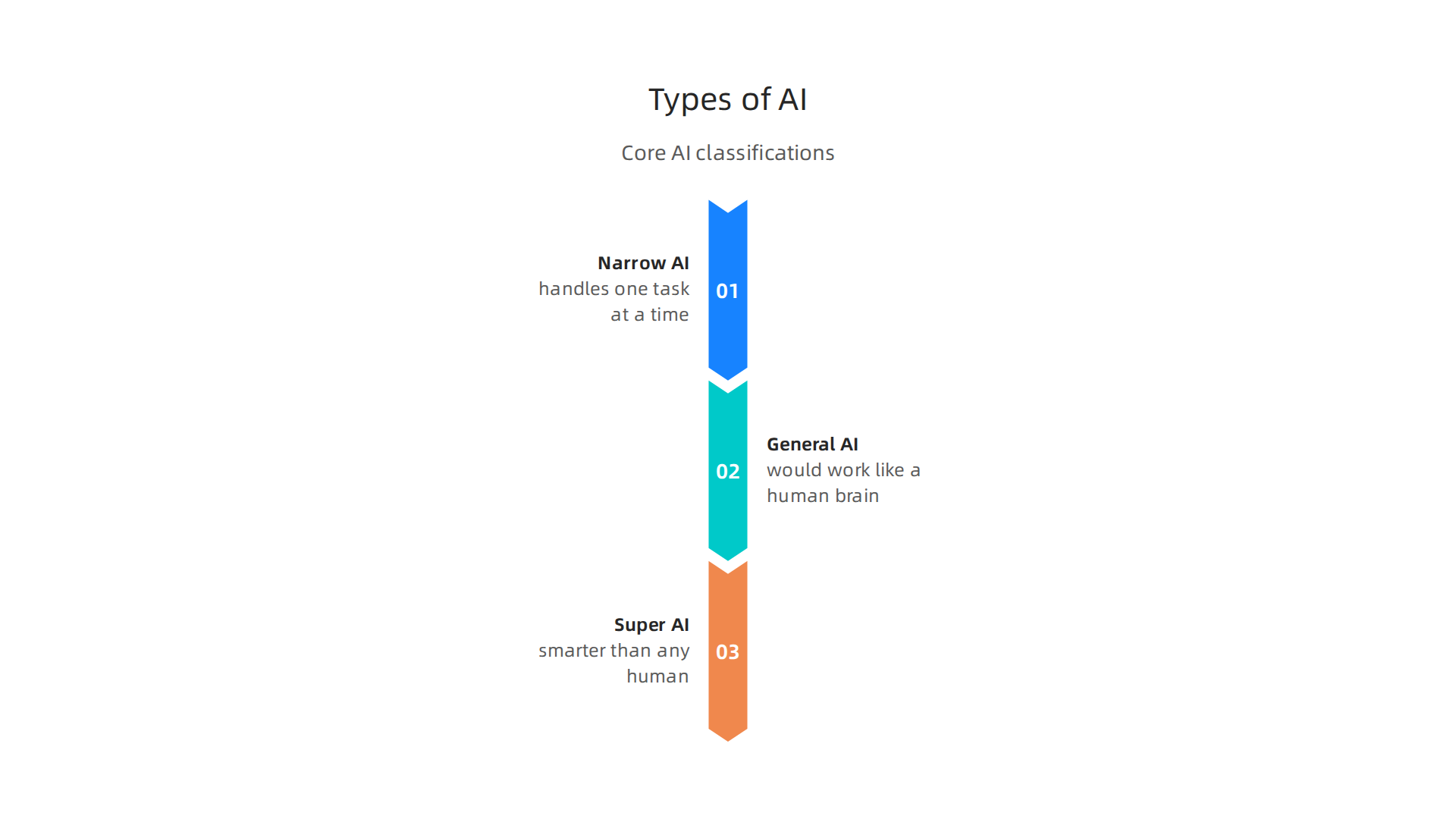
Narrow AI handles one task at a time. It powers your voice assistant, your recommendation engine, and your spam filter. General AI would work like a human brain, able to learn almost anything. But it’s still theoretical. Super AI would be smarter than any human. That one is also just a concept for now.
As one guide from IBM explains, these three categories help you understand what AI can and cannot do. You can read more about the different types of artificial intelligence in their detailed breakdown.
Why This Matters in 2026
In 2026, new terms keep popping up. You hear about LLM AI (large language models like GPT-5), edge AI (running models on phones and devices), lightning AI (fast inference tools), and deepsearch AI (advanced search and analysis systems). These are all examples of narrow AI doing specific jobs very well.
Understanding the categories helps you match the technology to your goals. Want to automate customer service? You probably need a narrow AI chatbot. Want to predict market trends? You might need a system that uses edge AI to process data in real time.
This guide will give you a simple framework to sort through all the noise. We will cover the main types, the latest 2026 developments, and how to choose the right one for your needs.
If you want to stay ahead of these trends, check out our deep dive into the world of AI in 2026. And for daily updates that cut through the noise, consider getting clear daily AI updates from The Deep View Newsletter.
Now let’s start with the most common type: Narrow AI.
What Are the Main Types of AI? A Clear Categorization
Before we dive into Narrow AI specifically, it helps to see the full picture. Researchers generally group artificial intelligence into three main levels. You can explore the types of AI: explore key categories and uses in a detailed guide from the Syracuse University School of Information Studies.
Narrow AI is the only type that actually exists today. Also called Weak AI, these systems handle one specific job. Your email spam filter, voice assistant, and Netflix recommendations are all examples. Each one performs its task very well but cannot do anything outside that task.
General AI would work like a human brain. It could learn new things, adapt to new situations, and apply knowledge across different areas without retraining. Researchers call this AGI or strong AI. As of 2026, this is still theoretical. No machine has reached this level yet.
Superintelligent AI or ASI is a step beyond. This kind of AI would be smarter than any human in every way. It could solve complex problems, create original art, and make decisions far beyond human ability. This is also still just a concept.
Now here is something interesting. Philosopher John Searle created the Chinese Room argument to point out a key limit of narrow AI. He showed that a system can process symbols and give correct answers without truly understanding what those symbols mean. This means today’s AI systems do not "think" the way humans do. They just follow patterns very well.
Understanding these three types of AI helps you see what is real and what is just marketing hype. When you hear a company claim their tool has human-like intelligence, you can recognize it is almost certainly still narrow AI. That is fine. Narrow AI is incredibly powerful for specific tasks like running an LLM AI chatbot, processing data with edge AI, or using deepsearch AI tools for advanced analysis.
For a closer look at where the field is heading, read this overview of the AGI 2026 landscape to understand the current state of general AI research.
Now let us unpack Narrow AI in more detail. That is the technology behind almost every AI product you use today.
Narrow AI (Weak AI) – The Power Behind Today’s Technology
Now let us look closer at Narrow AI, the engine behind nearly every AI tool you interact with. This type of AI handles one specific job and does it extremely well. It cannot learn a new skill on its own or switch tasks the way a human can. But within its narrow domain, it often outperforms people.
Think about image recognition. A narrow AI system can scan millions of photos and identify objects, faces, or even diseases faster than any human. Language translation tools like Google Translate use Narrow AI to convert text between dozens of languages in seconds. Every time you get a recommendation on Netflix, Amazon, or Spotify, a narrow AI algorithm is analyzing your past behavior to predict what you will like next. Chatbots, including the LLM AI models you may use for customer support or content creation, all fall under this category.
These systems are not conscious. They do not understand what they are doing. They simply process patterns in data and produce outputs based on statistical rules. The Chinese Room argument from John Searle, which the previous section explained, captures this limit perfectly. A narrow AI can give you a correct answer without having any real understanding of the question.
Despite that limitation, Narrow AI is extremely valuable. It drives the vast majority of commercial AI applications today. According to the 2026 AI Index Report from Stanford HAI, organizational AI adoption reached 88% in 2025, and 4 in 5 university students now use generative AI tools.

Almost all of that usage relies on Narrow AI systems. They power everything from email spam filters and voice assistants to fraud detection in banking and predictive maintenance in manufacturing.
Because Narrow AI is task-specific, it is also easier to build, deploy, and measure than general AI. Companies can train a model on a focused dataset and get reliable results quickly. This is why we see so many specialized AI products on the market today. For a broader look at how these technologies are evolving, check out our guide to the world of AI in 2026 technologies trends.
As Narrow AI continues to improve, staying informed about new developments becomes more important. If you want clear, daily updates on AI and technology trends, consider signing up for The AI Newsletter Worth Reading. It delivers concise insights straight to your inbox so you never miss what matters.
General AI (AGI) – The Quest for Human-Level Intelligence
While Narrow AI handles specific tasks today, researchers have long dreamed of something bigger: machines that can think, learn, and adapt across any task, just like a human. This is General AI, also called Artificial General Intelligence (AGI) or Strong AI. According to IBM’s overview of artificial intelligence types, AGI is a theoretical concept where machines can perform any intellectual task that a human being can. Unlike Narrow AI, which is stuck in one lane, AGI would be able to switch between completely different problems without needing new training.
But here is the hard truth: AGI does not exist yet. And nobody agrees on when it will arrive. Current prediction markets estimate only a 10% chance of achieving full AGI in 2026, with a 50% chance by 2041 and a 90% chance stretching out to 2164. That is a huge range. Some leaders like Demis Hassabis at DeepMind and Sam Altman at OpenAI believe scaling up current models will eventually lead to AGI. Others argue that fundamental breakthroughs in architecture are still needed.
Leading research labs including OpenAI, DeepMind, and Anthropic are actively pursuing AGI. They are exploring new approaches like neural symbolic systems, long-horizon agents, and novel training methods. In 2026, the focus has shifted from pure scaling to rigorous evaluation. Google DeepMind recently introduced a framework for measuring progress toward AGI based on ten cognitive abilities such as reasoning, learning, and metacognition.
The challenges remain enormous. AGI requires transfer learning – the ability to take knowledge from one area and apply it to a completely different one. Humans do this naturally. For example, learning to ride a bike helps you balance on a scooter. AI models today still struggle with this. Common sense reasoning is another big hurdle. A system might ace a medical exam but fail to understand that you cannot pour coffee into a laptop. Embodiment, or having a physical body to interact with the world, may also be necessary for true general intelligence.
Despite the uncertainty, progress is accelerating. Some experts argue that functional AGI in the form of long-horizon coding agents is already here in 2026. Whether you agree with that or not, one thing is clear: the race toward human-level intelligence is moving faster than ever. For a detailed breakdown of the key players, benchmarks, and safety discussions, check out our AGI 2026 landscape and benchmarks guide.
As AGI research continues to evolve, staying informed about the latest developments helps you separate hype from reality. Understanding the different types of AI and where each one stands gives you a clearer picture of what is truly coming next.
Superintelligence – Theoretical Possibilities and Ethical Safeguards
Now we come to the most mind-bending category of all: Superintelligence. Also called Artificial Superintelligence (ASI), this is a theoretical form of AI that would surpass human intelligence in every way. Creativity, problem-solving, emotional understanding, strategy – an ASI would beat us at all of them. It would not just match a human mind. It would leave it behind. As explained in the overview of the three main types of AI, ASI represents the ultimate expression of what artificial intelligence could become.
So how might we get there? Philosopher Nick Bostrom explored this in his famous book "Superintelligence". He outlined possible paths like brain emulation, AI self-improvement, and whole-brain scanning. He also warned about the risks. If an ASI had goals that did not perfectly match human values, the results could be catastrophic. Even a small misalignment could cause unintended harm at a global scale.
That is where alignment research comes in. Alignment research is the field focused on making sure superintelligent systems do what we actually want them to do. It is not about making AI smarter. It is about making sure it is safe. In 2026, alignment is one of the hottest areas of study. Labs like Anthropic and DeepMind are pouring resources into understanding how to train models that remain helpful and honest, even as they become more capable.
The big question is: should we even build ASI at all? Some argue it could solve climate change, disease, and poverty. Others say the risks of creating something smarter than us are too high. The debate is far from settled, and it involves everyone – researchers, policymakers, and everyday people like you.

To stay informed about these rapid developments, consider subscribing to The AI Newsletter Worth Reading. It delivers clear daily updates so you never miss an important breakthrough or safety discussion. And if you want a broader look at the tech landscape, check out the world of AI in 2026 to see where narrow AI, AGI, and superintelligence all fit together.
Key AI Methodologies and Development Approaches
To understand how the different types of AI actually work, you need to look at how engineers train them. Most modern AI relies on three main approaches. Each one is a different way of teaching a computer to learn.
Machine Learning: The Foundation
Machine learning is the core of almost every AI system today. It comes in three flavors.
Supervised learning is like studying with an answer key. You give the computer lots of labeled data. For example, you show it pictures of cats that are already labeled "cat." The computer learns to spot patterns and then can identify new cat pictures on its own. It is great for tasks like sorting emails into spam or not spam. IBM’s breakdown of supervised and unsupervised learning goes into more detail on how this works in practice.
Unsupervised learning is different. You give the computer data without any labels. The machine has to find patterns by itself. Think of customer shopping habits. The computer can group customers into clusters without being told what to look for. This is useful for spotting unusual behavior or finding hidden trends.
Reinforcement learning is like training a dog with treats. The computer tries different actions in an environment. When it does something good, it gets a reward. When it makes a mistake, it gets a penalty. Over time, it learns the best way to reach a goal. This is how robots learn to walk and how game AIs master chess or Go.
Deep Learning and Neural Networks
Deep learning is a more powerful version of machine learning. It uses layers of artificial neurons, inspired by the human brain. These neural networks can handle huge amounts of data. They are the reason computers can now recognize faces, understand speech, and translate languages. In 2026, deep learning powers everything from your phone’s camera to self-driving cars. Engineers are even optimizing these models to run on small devices, a field called edge AI. The approach is behind many of the latest breakthroughs in computer vision and natural language processing.
Generative AI: Creating New Content
The biggest recent change in AI is generative AI. This includes tools like ChatGPT, image generators, and music creators. They use special architectures called transformers and diffusion models.
Transformers are the engine behind large language models (LLMs). They process words in context, which lets them write essays, answer questions, and even write code. Diffusion models work by slowly turning random noise into a clear image. They are the secret behind tools like Midjourney and DALL-E.
Generative AI has changed what we expect from machines. Instead of just analyzing data, AI can now create original content. To see how this plays out in one creative field, check out the latest AI image generation 2026 market trends.
These three methodologies – machine learning, deep learning, and generative AI – are the building blocks of every AI system you use today. Understanding them helps you make sense of the different types of AI and where the technology is headed next.
2026 AI Trends – What’s Shaping the Future
AI is moving fast. In 2026, the market is expected to reach roughly $404 billion, according to the Artificial Intelligence Market Size report. But the numbers only tell part of the story. What really matters is how the technology itself is changing.
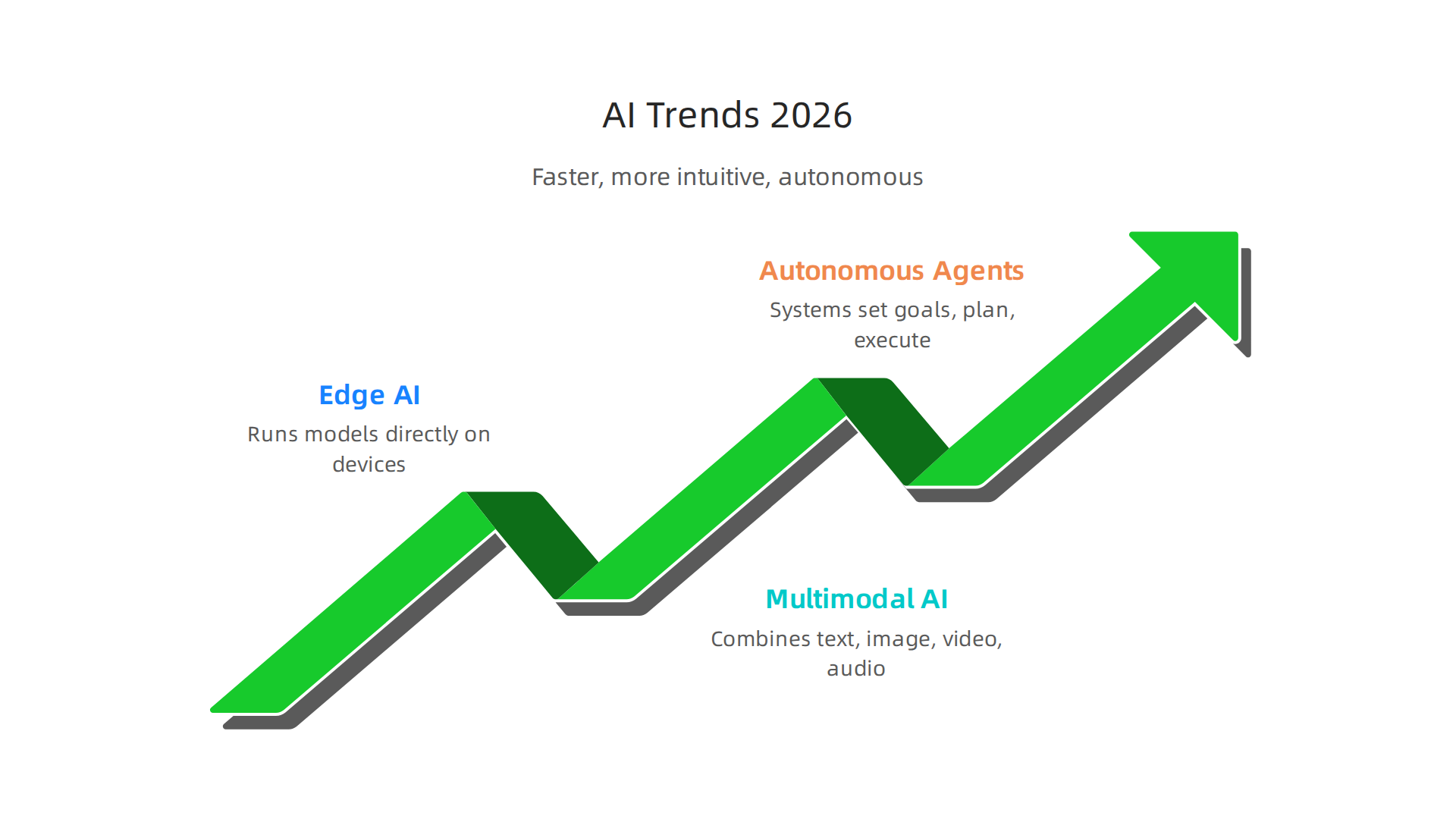
Three big trends are defining this year. They show us a future where AI works faster, understands more, and acts on its own.

Edge AI and Small Language Models Go Mainstream
For years, most AI ran in the cloud. You sent data to a server and waited for a response. That works for some things, but it is slow, expensive, and raises privacy concerns.
Enter edge AI. This approach runs AI models directly on your device. Your phone, your laptop, or even a smart sensor can process data locally. No internet needed. The result? Faster responses and better privacy.
At the same time, small language models are gaining ground. Unlike giant LLMs that need huge computing power, these compact models can do impressive work on smaller devices. They are perfect for real time tasks. For example, a smart thermostat can adjust your home’s temperature using a tiny AI model that runs right on the chip. This type of edge AI is already appearing in consumer gadgets and industrial sensors.
If you want a deeper look at how quickly decisions happen with edge processing, check out how real-time AI in 2026 delivers millisecond decisions across industries.
Multimodal AI: Seeing, Hearing, and Reading at Once
Another major shift is multimodal AI. Older AI systems could only handle one type of input. Text in, text out. Image in, label out. But in 2026, AI models can combine text, images, video, and audio all together.
Think about a customer service bot that can read your message, look at a screenshot you attached, and hear the tone of your voice in a voice note. That is multimodal AI in action. It creates a much richer understanding of your request.
This trend is changing how we interact with machines. Instead of typing keywords, you can show a picture and ask a question. The AI understands both. It feels more natural and human.
Autonomous Agents and Smarter Robotics
The third trend is the rise of autonomous agents. These are AI systems that can set goals, plan steps, and execute tasks without constant human guidance. They go beyond simple chatbots.
Imagine an AI agent that manages your calendar, books meetings, sends follow up emails, and even orders supplies when inventory runs low. That is the direction we are heading. Foundation models provide the brain, and the agent uses tools to get things done.
Robotics is also benefiting. New humanoid robots guided by AI foundation models can learn tasks by watching humans. They are entering warehouses, factories, and even hospitals.
As these trends unfold, staying informed is key. The landscape shifts every week. To keep up with daily updates, you might want to get the AI Newsletter Worth Reading. It delivers clear insights straight to your inbox.
These three trends – edge AI, multimodal systems, and autonomous agents – are reshaping what AI can do. They bring intelligence closer to you, make interactions richer, and give machines the ability to act independently. Understanding these types of AI trends helps you prepare for what comes next.
How to Choose the Right AI Approach for Your Business
So you understand the big trends. Now comes the real question. How do you pick the right type of AI for your specific business needs?

The answer depends on three main factors.
Start With Your Problem Type
Not all problems are the same. AI systems handle tasks in different ways. The first step is to figure out what you need the AI to do.
Are you trying to classify something? Think spam detection. You have emails that are either spam or not spam. The AI learns from labeled examples and predicts which category new emails fall into. That is supervised learning in action.
Maybe you want to generate new content. Writing a blog post, creating an image, or drafting code. That falls under generative AI, which uses different techniques like large language models.
Or perhaps you need to predict future outcomes. Sales forecasts, inventory needs, or customer churn. Prediction problems often use supervised learning with historical data.
Here is a simple framework. If you have labeled data and know the answer you are looking for, supervised learning works best. If you want to discover hidden patterns without predefined labels, unsupervised learning is your friend. If you need an AI that learns by trial and error in a changing environment, that is reinforcement learning territory.
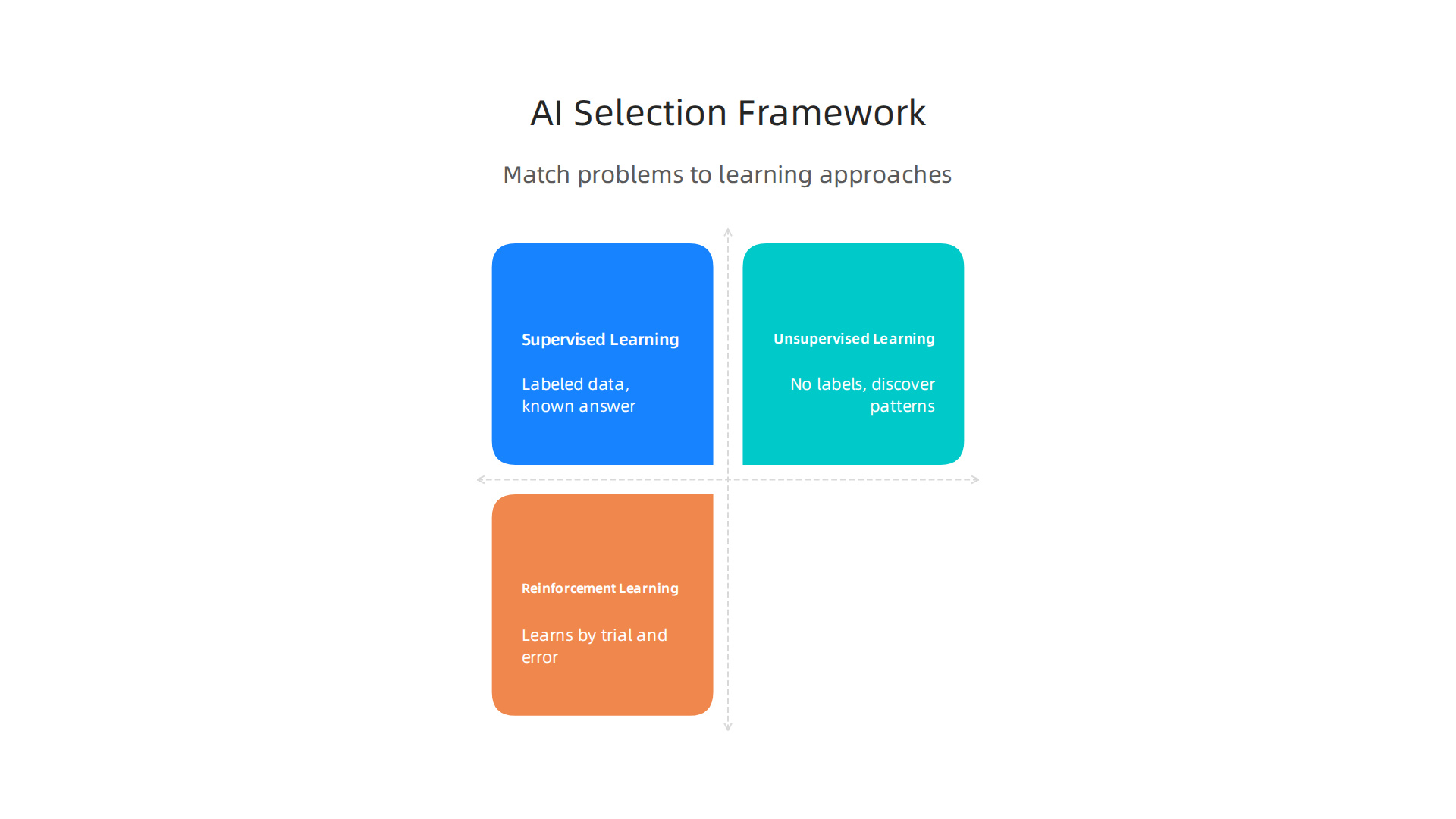
The IBM guide on supervised vs unsupervised learning offers a clear breakdown of these categories.
Check Your Data and Resources
Data is the fuel for any AI system. But not all businesses have the same amount or quality of data.
Ask yourself a few questions. Do you have thousands of labeled examples? Or just a handful? Does your data live in spreadsheets, databases, or messy PDFs? Do you have a team of data scientists or just a curious developer?
If you have tons of clean, labeled data, you can train custom models from scratch. If you have limited data, pre-trained models are a smarter choice. Many AI companies now offer APIs that work well with just a little fine-tuning.
Compute power matters too. Training a giant LLM requires serious hardware. Running a small edge AI model can happen on a cheap chip. Match your infrastructure to the scale of your AI needs.
Build vs Buy: A Critical Decision
Here is where many businesses get stuck. Should you build your own AI system or buy an existing solution?
Building gives you full control. You can tailor the model to your exact needs and own the intellectual property. But it is expensive. You need talent, time, and ongoing maintenance.
Buying gives you speed. You plug into an API, and you are live in days. The tradeoff is less flexibility and ongoing subscription costs.
For most small and medium businesses, buying is the better path. Pre-trained APIs from major providers handle common tasks like text generation, image recognition, and sentiment analysis very well. You only need to build custom models if your problem is unique and your data is special.
If you want to explore practical examples of how companies are implementing these decisions today, check out this guide on how to use AI to drive business growth with practical applications.
Choosing the right approach is not about following trends. It is about matching the technology to your actual business problem. Start with the problem, check your resources, and decide whether to build or buy. That is how smart businesses get real value from AI in 2026.
Summary
This article explains the practical landscape of AI in 2026 by breaking down the three widely used categories—Narrow AI, General AI (AGI), and Superintelligence—and showing what exists now versus what remains theoretical. It dives into how narrow AI powers everyday systems like chatbots, recommendation engines, and image recognition, and contrasts those present capabilities with the open questions and benchmarks around AGI and ASI. The guide also outlines the main engineering approaches—supervised, unsupervised, and reinforcement learning—plus deep learning and generative models such as transformers and diffusion. You’ll get a clear read on three defining 2026 trends (edge AI, multimodal systems, autonomous agents), why they matter for speed, privacy, and richer interactions, and a practical framework to choose between building or buying AI. The article finishes with actionable criteria—problem type, data and compute needs, and resource tradeoffs—so readers can pick the right AI approach for their business goals.