

Introduction: Why Real‑time AI Matters in 2026
If you follow tech news at all, you have probably heard a lot about artificial intelligence. But here is the thing. Not all AI is the same. The biggest shift happening right now is the move toward real time AI. This is AI that processes data and makes decisions as events happen, not hours or minutes later.
Think about self driving cars. They need to react to a pedestrian in under a second. That is real time AI at work. The same goes for fraud detection in banking, live language translation, and even smart home devices that adjust your thermostat before you walk in the door.
The market numbers show just how fast this is growing. According to the Artificial Intelligence Market Size & Share Report, 2026-2033, the global AI market was valued at $390.9 billion in 2025 and is expected to reach $539.45 billion in 2026. By 2033, it could hit $3.5 trillion. A big part of that growth comes from applications of AI that demand instant responses.
But here is the challenge. Decision makers like you are drowning in hype. Everyone claims their tool is the next big thing.

Terms like GPT-4 Vision and real magic AI get thrown around without much clarity. It is hard to know what actually works and what is just marketing.
That is why we wrote this article. We want to give you a structured, evidence-based overview of real time AI technologies and use cases in 2026. No fluff. Just practical insights you can use to make better decisions.
To get a broader view of where AI is heading this year, check out our guide on the world of AI in 2026 technologies trends and what comes next. And to stay on top of all these developments without the noise, consider subscribing to The Deep View Newsletter for clear daily AI updates straight to your inbox.
Defining Real‑time AI: What Makes It ‘Real‑time’?
So let’s get clear on what real time AI actually means. Because the term gets thrown around a lot, but not everyone uses it the same way.
At its core, real time AI is about speed. We are talking about systems that process data and return an answer almost instantly. For most real world applications, that means end to end latency under 100 milliseconds. Think about a voice assistant that translates your speech while you are still talking. Or a security camera that spots a person and locks a door before they can take another step. That is the difference between reacting and just reporting.
The secret sauce is a constant loop. First, the system ingests data continuously, not in chunks. Then it runs inference on that data right where it is collected. Finally, it triggers an action automatically. No human waiting in the middle. This loop runs over and over, every second of every day.
To see how industries are putting this loop to work today, read about how to use AI to drive business growth with practical applications in 2026.
Now contrast that with traditional batch AI. Batch AI is like your monthly bank statement. It processes a pile of data, crunches numbers overnight, and gives you a report the next morning.
That works fine for trend analysis and budgeting. But it cannot stop a fraudulent credit card charge while the thief is still online. Batch AI is schedule driven. Real time AI is event driven. Something happens, and the system must respond now.
This event driven nature is why so many applications of AI are moving to the edge. Edge devices like smartphones, cameras, and industrial sensors can run inference locally, cutting out the lag of sending data to the cloud and waiting for a response. That is where the real magic AI happens. You get instant decisions without needing a constant internet connection.
According to the State of AI 2026 report, enterprise adoption of AI has reached 78% globally, and a growing share of that adoption is for real time use cases that simply cannot afford delay. The shift from batch to real time is not just a technical upgrade. It is a fundamental change in what AI can do for your business.
As you evaluate tools for your own work, ask yourself this. Does the system need to act in the moment, or can it wait until tomorrow? The answer will tell you whether real time AI is the right fit or just marketing hype.
Core Technologies Powering Real‑time AI
So how does real time AI actually work under the hood? It takes a few key technologies working together to make decisions in milliseconds. Let’s look at the three main pieces.
Model optimization makes models smaller and faster
Big AI models are powerful, but they are also slow and hungry for memory. To run them in real time, we need to shrink them without losing too much accuracy. That is where optimization techniques come in.
- Quantization reduces the precision of numbers the model uses. Instead of 32‑bit numbers, you use 8‑bit or even 4‑bit. This makes the model smaller and faster. According to the Edge AI Opportunity Will Come to Life in 2026 report, model quantization and distillation are creating small models that are as capable as early cloud‑based models.
- Pruning removes unnecessary parts of the model. Think of it like trimming dead branches from a tree. The model still works well but runs much quicker.
- Knowledge distillation lets a smaller "student" model learn from a large "teacher" model. The student picks up the most important patterns and can run on devices that the teacher could never fit on.
The result is a tiny model that can run on a phone or a camera and still give smart answers almost instantly.
Edge hardware brings AI to the device
You also need the right hardware to run that optimized model. In 2026, three types of chips are leading the way: GPUs, NPUs, and TPUs. These chips are designed specifically for AI tasks and can process data much faster than a regular CPU.
The Edge AI Hardware Market report shows that the market for these chips is worth over $30 billion in 2026. Chips like NVIDIA’s Jetson, Qualcomm’s Snapdragon, and Intel’s Core Ultra with built‑in NPUs can handle real‑time AI without needing the cloud.

These are the brains that make real magic AI happen at the edge.
Streaming data platforms feed the models continuously
Even the fastest model is useless if it has to wait for old data. Real‑time AI needs a constant flow of fresh information. That is where streaming data platforms like Apache Kafka and Apache Flink come in. They collect data from thousands of sources in real time and feed it into the AI model as it arrives.
System designers today are building products that combine embedded processing, specialized accelerators, and efficient data pipelines to support local AI inference, as the Edge AI Technology Report 2026 explains.
Putting it all together
When you combine optimized models, powerful edge chips, and streaming data, you get a system that can sense, think, and act in less than a blink of an eye. That is the technology behind everything from self‑driving cars to smart factory robots.
If you want to keep up with how these technologies are reshaping business, check out the world of AI in 2026 for a broader look at what is coming next. And to stay updated on the latest breakthroughs in AI every day, consider subscribing to The AI Newsletter Worth Reading for clear, daily updates delivered straight to your inbox.
Real‑time Computer Vision: Seeing and Acting in Milliseconds
You have probably seen a self‑driving car spot a pedestrian or a factory camera catch a tiny defect in a product. That is real‑time computer vision in action.

It lets machines see and react almost instantly. In 2026, this technology is faster and cheaper than ever before.
So how do these systems work? They use lightweight object detection models like YOLO (You Only Look Once) and EfficientDet. These models can spot objects at 30 frames per second or more on edge devices. That means a camera on a robot or a car can process each image in under 33 milliseconds. The latest version, YOLOv26, released in January 2026, is built for real‑time deployment. It achieves sub‑2ms latency for its smallest model on a standard GPU, making it perfect for power‑sensitive systems. According to a detailed breakdown of YOLOv26, this model is up to 43% faster on CPUs compared to earlier versions while keeping strong accuracy.
These fast models power three major real‑world applications:
Autonomous vehicles: Cars, trucks, and drones use real‑time vision to detect lanes, traffic signs, pedestrians, and other vehicles. The system must process every frame without delay. One mistake could be dangerous. That is why car makers use models that can run at 60+ FPS on specialized edge hardware like NVIDIA’s DRIVE Thor.
Industrial quality inspection: Factories deploy cameras on assembly lines to scan products for scratches, dents, or missing parts. A model like EfficientDet or YOLOv9 can catch defects in milliseconds. The Edge AI Hardware Market report (already used) noted that NPUs achieve up to 960 frames per second for vision tasks, meaning a single camera can inspect hundreds of items per minute.
Surveillance and security: Security cameras now use real‑time AI to detect unusual behavior, track people across multiple feeds, and read license plates. A single pipeline might combine a detection model, a tracking model, and an optical character recognition (OCR) model. All three run in sequence within the same video stream without slowing down.
When you put these pieces together, you get a system that sees the world in real time and acts on what it sees. That is the kind of real magic AI that is already changing industries. If you want to learn more about how vision AI is reshaping business, check out our article on how artificial intelligence with images is transforming business for practical examples.
Real‑time Generative AI and NLP: From Chatbots to Instant Content
You have probably chatted with a customer service bot that answered instantly. Or used a voice assistant that translated your words into another language in real time. That is real‑time generative AI and NLP at work. In 2026, these systems are fast enough to feel like a real human conversation.
The key breakthrough? Small language models (SLMs) and a technique called speculative decoding. SLMs are tiny models that run on phones or edge devices. They can generate text in milliseconds. Speculative decoding makes them even faster. A small "draft" model guesses the next few words, and a larger model checks those guesses all at once. This can nearly double the speed. According to a 2026 guide to lowest latency AI inference explained by GMI Cloud, speculative decoding breaks the serial bottleneck of standard model generation.
So how fast is fast enough? The best models today deliver a first token in under a second. Mistral Large 2512, for example, has a first token latency of just 0.30 seconds. That is ideal for live chat or voice systems where every millisecond counts. The 2026 LLM latency benchmark from AIMultiple shows that models like GPT-5.2 and Mistral Large 3 can produce sub‑second responses, making real‑time conversational AI a reality in production.
Conversational AI in customer service now relies on real‑time intent detection. A support bot must understand your question and reply within a second or two. If it takes longer, users get frustrated. These systems use lightweight SLMs for simple FAQs and escalate complex issues to larger models. The whole loop—detect intent, generate a response, and check for safety—happens in under a second. The latest conversational AI models in 2026 show how companies build multi‑model pipelines to balance speed and quality.
Emerging use cases push this even further. Real‑time voice‑to‑voice translation can now process speech in about 90 milliseconds. AI agents can hold multi‑turn conversations, write emails, and update databases while you wait. These are not lab experiments. They are live in customer support, sales, and healthcare today.
If you want to stay on top of these fast‑moving changes, consider subscribing to The AI Newsletter Worth Reading from The Deep View for daily updates on the latest real‑time AI tools and trends. And for a broader view of how all these pieces fit together, check out our full coverage of the world of AI in 2026 for more insights on the technologies shaping tomorrow.
Industry Case Studies: Real‑world Impact of Real‑time AI
You have probably heard about real time AI changing industries. But what does that look like on the ground? The real magic AI brings to life is happening right now in hospitals, factories, and banks.

Let us look at a few places where the speed we talked about is saving money and even saving lives.
Healthcare: Seeing Problems in Milliseconds
Imagine a radiologist looking at a CT scan to find a tiny tumor. In 2026, AI tools help with that job in under a second. Object detection models like YOLOv26 can spot anomalies in medical images fast enough to keep up with live video streams. According to the AI experts at LearnOpenCV, YOLOv26 is an object detector built for real time deployment with sub-2ms latency on standard GPUs. That speed lets a hospital system flag a suspicious spot while the patient is still in the scanner.
Real time AI also watches patient vitals in the ICU to predict sepsis hours before symptoms show. And in surgical robotics, AI processes camera feed in real time to help the surgeon see better and cut more precisely. One of the most exciting applications of AI in medicine is predictive analytics that alerts doctors the moment something goes wrong. If you want a deeper look at how widely hospitals have adopted these tools, check out the radiology AI adoption rates in 2026.
Manufacturing: Fewer Downtime, Fewer Defects
On a factory floor, every second of pause costs money. Real time AI now watches assembly lines for defects using cameras running object detection. These systems can catch a missing screw or a cracked part as it moves by at high speed. The best models compare accuracy and speed side by side. A detailed YOLOv9 vs EfficientDet comparison shows how modern detectors achieve high frames per second while maintaining accuracy. That means quality control happens instantly without slowing production.
Predictive maintenance is another win. Sensors on motors and pumps feed data into a real time AI model that flags unusual vibrations or heat spikes. Maintenance teams get an alert before a machine breaks. This reduces unplanned downtime by big margins. AI tools for manufacturing now run on edge devices right on the factory floor, so there is no delay sending data to the cloud.
Finance: Decisions in Microseconds
Banks and trading firms live and die by speed. Fraud detection systems powered by real time AI scan every credit card transaction as it happens. If something looks suspicious, the system blocks the purchase or sends a fraud alert in a fraction of a second. No human review needed for simple cases. High frequency trading firms use even faster models. They look for price patterns and execute trades before a human can blink. For these applications, latency is everything. A 2026 LLM latency benchmark from AIMultiple shows Mistral Large 2512 can deliver a first token in just 0.30 seconds. That kind of speed makes real time fraud detection and automated trading possible at scale.
Also, banks use the applications of AI to monitor millions of transactions per second. The model spots patterns that signal money laundering or account takeover. These systems learn from new fraud attempts constantly, so they get better over time without slowing down.
Bringing It All Together
Real time AI is not a future concept. It is in radiology suites, factory control rooms, and trading floors right now in 2026. The real magic AI delivers is the ability to process and act on data as it arrives, not hours later. Whether it is catching a tumor, a defective part, or a fraudulent charge, the speed of these systems makes the difference between a good outcome and a bad one.
If you want to keep up with the latest real world uses of real time AI and see what comes next, the The AI Newsletter Worth Reading has daily updates that break down complex tech into clear, useful insights. For a broader view of how these case studies fit into the bigger picture, read our full guide to the world of AI in 2026.
Overcoming the Hurdles: Latency, Accuracy, and Trust
So real time AI is doing amazing things in hospitals and factories. But getting it to work well is not easy. Three big problems pop up again and again: speed versus correctness, data privacy rules, and making sure the AI actually does what it should.
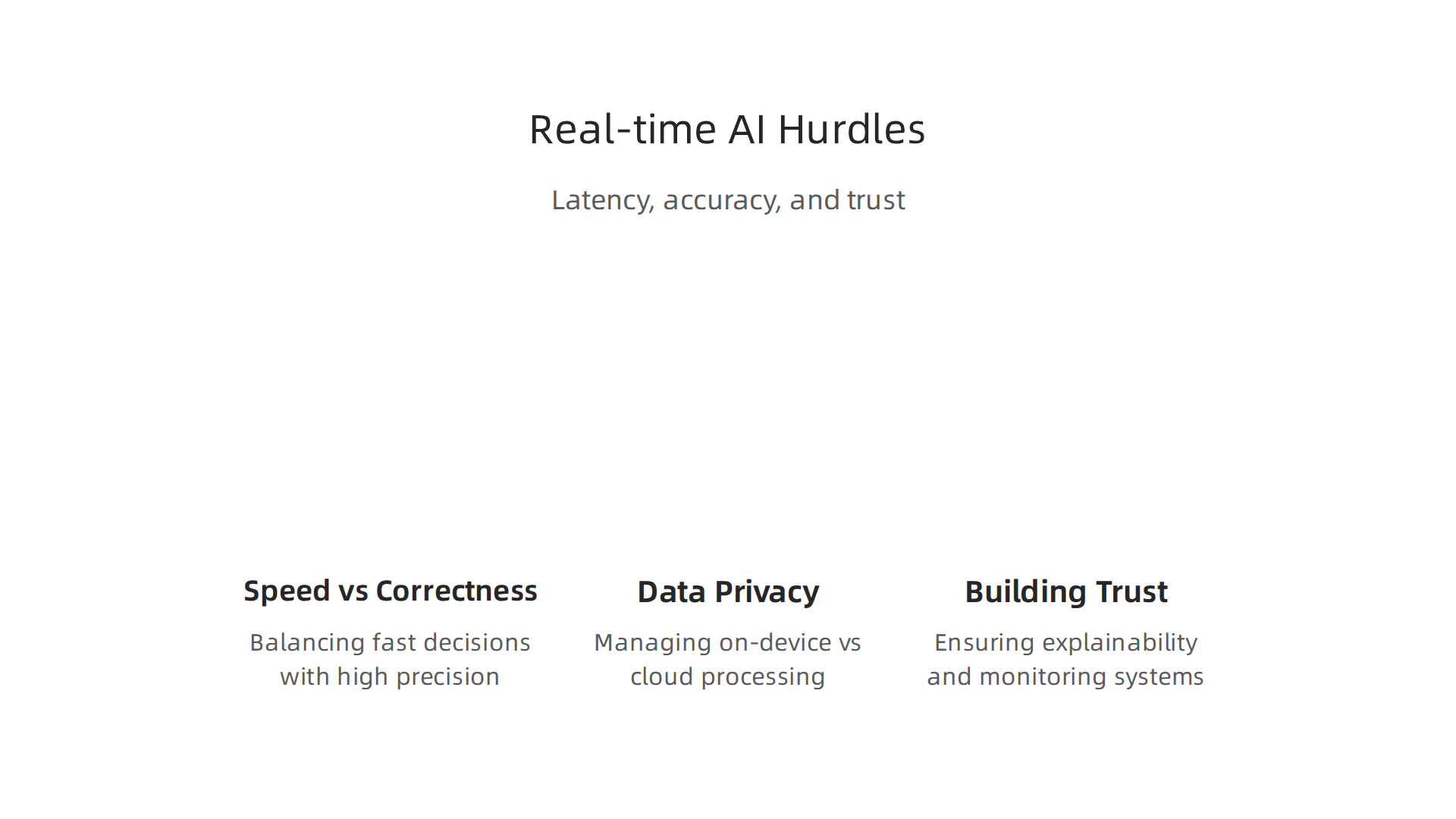
Let us break each one down.
The Speed versus Correctness Balance
Here is the hard truth about real time AI. The fastest model is not always the most accurate. To make a decision in milliseconds, you sometimes have to sacrifice a little precision. This trade off is the central challenge of real time AI. If a model takes too long to think, it is useless for live video or fraud detection. But if it cuts corners to be fast, it might miss something important.
Take object detection in a self driving car. The model needs to spot a pedestrian now, not in two seconds. But if it misidentifies a trash can as a person and hits the brakes, that is also a problem. The best real time AI systems find a middle ground. They use lightweight models that run fast on edge devices while still hitting high accuracy scores. A detailed guide on AI deployment from Mirantis explains that ensuring reliable model performance in production requires monitoring for drift and latency issues constantly. Without that balance, the system either stalls or makes dangerous mistakes.
Data Privacy Rules and Where the AI Lives
Where you run your real time AI matters a lot for privacy. If you process data on a local device, you keep it off the cloud. That helps with laws like GDPR in Europe and CCPA in California. Edge AI is a natural fit here because patient health records or financial transactions never leave the hospital or bank.
But running models on the edge brings its own headaches. Edge devices have limited power and memory. You cannot just drop a giant neural network onto a small camera or sensor. The data processing challenges of edge AI, as outlined by Flolive, include managing limited compute and storage while still getting real time results. Companies have to choose: send data to the cloud for stronger models and risk privacy violations, or run smaller models locally and accept lower accuracy. Regulations are pushing more firms toward the edge.
Building Trust Through Explainability and Monitoring
Even if your real time AI is fast and accurate, nobody will use it if they do not trust it. A doctor needs to know why the AI flagged a tumor. A bank needs to explain why it blocked a transaction. This is where explainability comes in. AI models that act like a black box are hard to put into production.
In a 2026 survey by IBM, 59% of companies cited lack of trust as a top challenge in AI adoption. To fix that, teams must monitor everything. They track latency, accuracy, and data drift day after day. If a model starts acting weird, they roll it back or retrain it. Monitoring also catches bias. If an AI starts making unfair decisions about certain groups, the team can step in. The AI21 Labs guide on AI deployment emphasizes that continuous monitoring of key metrics like prediction accuracy and response time is essential for keeping systems reliable and trustworthy. Trust is not built overnight; it comes from watching the system work correctly over time.
The Bigger Picture
Getting real time AI to work in the real world means solving all three hurdles together. Fast enough. Accurate enough. Private enough. Explainable enough. Miss one, and the whole thing falls apart. But when you get the balance right, the results speak for themselves, like the case studies we saw earlier.
For more on how these challenges play out in specific industries, read our guide on how to use AI to drive business growth with practical applications in 2026. It covers real world solutions companies are using right now.
Summary
This article explains what real‑time AI means in 2026, why it matters, and how organizations are using instant decisioning to transform industries. It defines real time as event‑driven systems with end‑to‑end latency often under 100 milliseconds, contrasts that with batch AI, and describes the core stack: optimized models (quantization, pruning, distillation), edge‑grade hardware (GPUs, NPUs, TPUs), and streaming data pipelines. You’ll read how real‑time computer vision and small language models power live safety, quality control, and conversational services, and see concrete industry examples in healthcare, manufacturing, and finance. The article also covers key tradeoffs — speed versus accuracy, privacy and edge deployment, and the need for explainability and monitoring — so you can evaluate, deploy, and trust real‑time AI systems responsibly.